
Florida LMFT Requirements: Hours, Exams & Step-by-Step Guide
Stop guessing if your categories match Florida requirements. License Trail checks your direct, indirect, and supervision hours against LMFT requirements continuously and flags mismatches before you submit.
No credit card required · Free plan available
Quick Requirements Overview
- Master’s degree meeting FL LMFT education standards (COAMFTE MFT, CACREP w/ MFT emphasis + required courses, or “teach‑out” non‑CACREP/COAMFTE degree conferred before 9/1/2027)
- Graduate coursework in 11 required content areas (e.g., MFT systems/techniques, ethics, assessment/diagnosis, sexuality, substance abuse, research)
- Graduate practicum/internship in MFT setting: ≥400 hours over ≥12 months, incl. ≥300 direct client hours and ≥200 relational (couple/family/system) hours; cannot count toward post‑master’s hours
- Must register as a Florida Registered MFT Intern and have a Board‑approved Qualified Supervisor before accruing post‑master’s hours (pre‑registration hours don’t count)
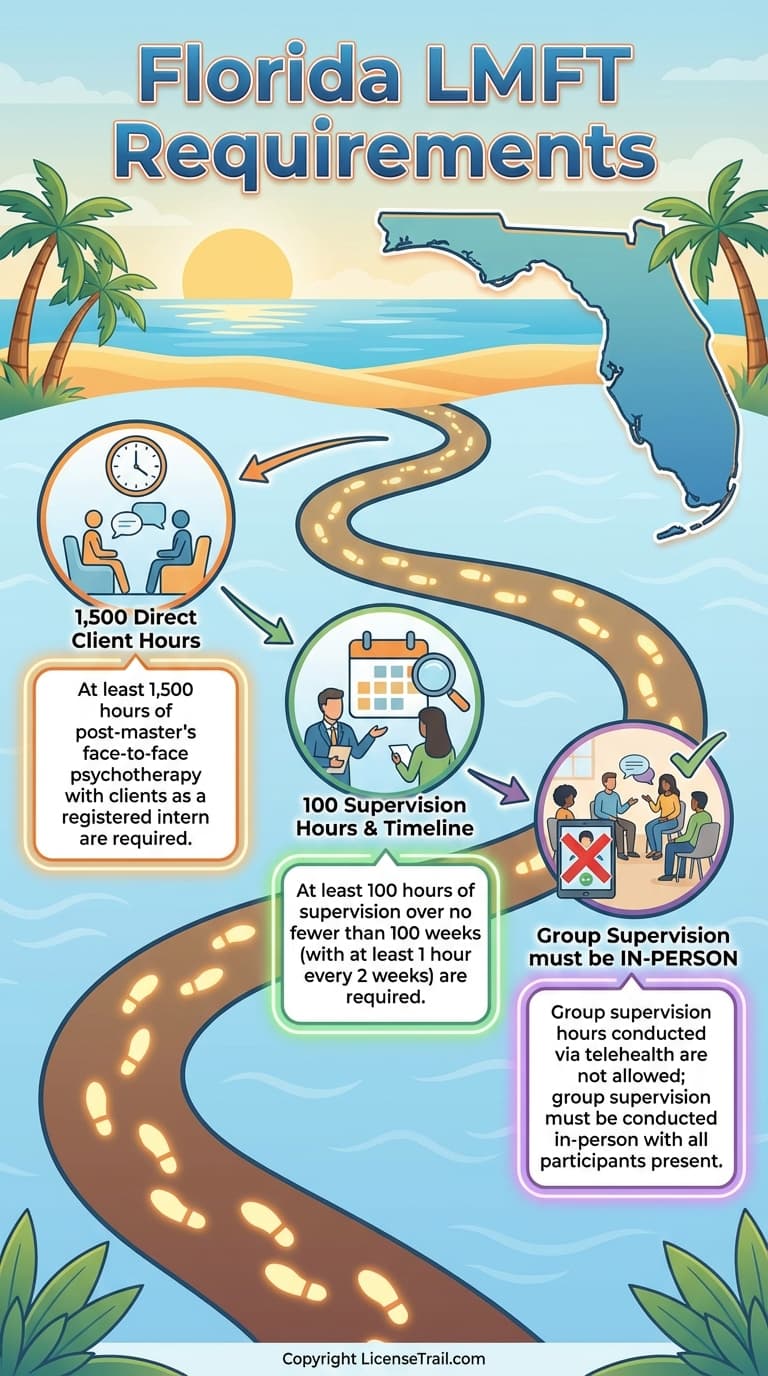
- Post‑master’s clinical experience: 1,500 hours face‑to‑face psychotherapy accrued over ≥100 weeks; ≥50% of clients must be MFT services; must include varied couple/family case types
- Supervision during post‑master’s experience: ≥100 hours over ≥100 weeks, with ≥1 hour every 2 weeks; supervision uses “raw data”; ≥50% in‑person (rest may be electronic)
- Pass the AMFTRB national MFT exam (Board‑approved theory/practice exam)
- Complete required add‑on training (e.g., FL laws & rules, 3‑hr HIV/AIDS, 2‑hr domestic violence) and submit application materials, fees, and background screening/fingerprints
License Details
Procedures
Licensure as a Licensed Marriage and Family Therapist (LMFT) in Florida is governed primarily by Chapter 491, Florida Statutes, and Chapter 64B4, Florida Administrative Code, and administered by the Florida Board of Clinical Social Work, Marriage & Family Therapy, and Mental Health Counseling. What follows focuses on licensure by examination (the standard route), with an emphasis on hours and how the Board defines “experience” and “supervision,” as of late 2025.
1. Educational foundation: the qualifying graduate degree
Acceptable degrees
To qualify, you must hold at least a master’s degree that meets one of these tracks: (floridasmentalhealthprofessions.gov)
- A master’s in Marriage and Family Therapy from a program accredited by COAMFTE, or
- A master’s with a major emphasis in MFT or closely related field from a CACREP‑accredited counseling program, plus required MFT coursework, or
- A master’s with an emphasis in MFT or a closely related field from an institutionally accredited college or university, with a degree conferred before September 1, 2027, plus required coursework (this is a “teach‑out” path for non‑CACREP/COAMFTE programs).
The Board reviews your official transcript for: degree, accrediting body, total graduate hours, and specific MFT‑content courses. (floridasmentalhealthprofessions.gov)
Required graduate coursework (content areas)
Florida requires graduate‑level coursework (usually 3 semester or 4 quarter credits each) in 11 content areas, including: dynamics of marriage and family systems; marriage therapy theory/techniques; family therapy theory/techniques; individual human development; psychopathology; human sexuality; psychosocial theory; substance abuse theory and counseling; legal/ethical/professional issues in MFT; diagnosis/appraisal/assessment/testing; and behavioral research as applied to clinical practice. (floridasmentalhealthprofessions.gov)
The Board will not allow research, testing, or thesis credits alone to substitute for most of these clinical content requirements; they must be distinct graduate courses. (tla1.thelegalassistant.com)
Required master’s practicum / internship (“student practicum”)
In addition to coursework, you must complete a graduate practicum/internship/field experience in an MFT setting that meets all of the following: (floridasmentalhealthprofessions.gov)
- Minimum 400 hours of supervised clinical practicum, internship, or field experience.
- Conducted over at least 12 months.
- Includes at least 300 hours of direct client services,
- Of which at least 200 hours must be “relational” (work with couples, families, or other relational systems).
- Supervised by a licensed MFT or equivalent (as defined by Rule 64B4‑21.007, F.A.C.) and certified complete by an authorized university official.
Crucially, these 400+ practicum hours may not be used to satisfy the post‑master’s clinical experience requirement for licensure. (floridasmentalhealthprofessions.gov)
2. Registration as a Florida Marriage & Family Therapy Intern
Before counting any post‑master’s clinical hours toward licensure, you must become a Registered Marriage and Family Therapy Intern. (floridasmentalhealthprofessions.gov)
Key points:
- You apply to the Board for MFT Intern registration after finishing your degree and required practicum.
- The Board must approve your Qualified Supervisor.
- The statute explicitly states that to meet the clinical experience requirement in Florida, you must register under s. 491.0045 before beginning that experience. (law.justia.com)
- The intern registration and supervisor approval must be in place; hours worked before that do not count toward licensure. (floridasmentalhealthprofessions.gov)
3. Post‑master’s clinical experience and supervision
Florida law and Board rule distinguish between:
- “Clinical experience” – your actual psychotherapy work with clients, and
- “Supervision” – structured oversight of that work by a Qualified Supervisor.
You must satisfy both.
3.1 Statutory clinical experience requirement (the 2‑year standard)
Chapter 491.005(3), F.S. requires that an LMFT applicant: (law.justia.com)
- Complete at least 2 years of clinical experience at the post‑master’s level, and
- During this period, at least 50% of your clients must be receiving marriage and family therapy services, and
- Experience must be under a licensed marriage and family therapist with at least 5 years of experience (or equivalent) who is a Board‑recognized Qualified Supervisor.
Within those 2 years, you must provide direct individual, group, or family therapy and counseling with a range of cases including:
- unmarried dyads,
- married couples,
- separating or divorcing couples, and
- family groups including children. (law.justia.com)
A doctoral internship may be credited toward this clinical experience requirement if it meets the statutory and rule criteria. (law.justia.com)
3.2 How the Board defines “clinical experience”: hours and timeframe
Rule 64B4‑2.001, F.A.C. defines what “two years of clinical experience” means for MFT licensure: (regulations.justia.com)
- It “consists of at least 1,500 hours of providing psychotherapy face‑to‑face with clients” as a registered intern, and
- Those hours “shall be accrued in no less than 100 weeks.”
In practical terms:
- 1,500 hours of direct client psychotherapy is your clinical experience requirement.
- These 1,500 hours must be accrued over at least 100 weeks (about two years), not in a shorter time frame.
3.3 How the Board defines “supervision”: hours and structure
Rule 64B4‑2.002, F.A.C. defines the required supervision for that clinical experience. To receive credit, an intern must: (regulations.justia.com)
- Receive at least 100 hours of supervision in no less than 100 weeks,
- Provide at least 1,500 hours of face‑to‑face psychotherapy with clients, and
- Receive at least 1 hour of supervision every two weeks.
The rule also clarifies that:
- Supervision must focus on “raw data” from the intern’s client sessions (e.g., written case notes, direct observation, audio/video recordings).
- Supervision may use electronic methods, but at least half of all supervisory interactions must still be in‑person, face‑to‑face. (regulations.justia.com)
The Board’s own LMFT and Registered MFT Intern pages restate this in practical language: your two years of post‑master’s supervised experience must consist of: (floridasmentalhealthprofessions.gov)
- At least 100 hours of supervision over at least 100 weeks,
- 1,500 hours of face‑to‑face psychotherapy with clients, and
- One hour of supervision every two weeks.
3.4 Relationship between “experience” hours and “supervision” hours
To answer your specific type‑of‑hours question:
- Florida does not require 1,500 hours of “direct experience” plus a separate 1,500 hours of “supervised experience.”
- Instead, Florida defines the required clinical experience as:
- 1,500 hours of face‑to‑face psychotherapy with clients, accrued over at least 100 weeks. (regulations.justia.com)
- In addition, Florida separately requires supervision of that experience amounting to:
- At least 100 hours of supervision,
- Delivered at a minimum rate of 1 hour every 2 weeks,
- Over no fewer than 100 weeks,
- By a Board‑approved Qualified Supervisor. (regulations.justia.com)
So, in shorthand:
Post‑master’s requirement = 1,500 hours of face‑to‑face psychotherapy + 100 hours of supervision, spread over at least 100 weeks (≈ 2 years).
4. Qualified Supervisor requirements (high level)
Your supervisor must meet the Board’s criteria for a Qualified Supervisor for MFT interns. In most cases this means: (floridasmentalhealthprofessions.gov)
- Being a licensed MFT (or other allowed licensed mental health professional) with at least 5 years of clinical experience, and
- Having completed Board‑approved supervision training (graduate course or CE meeting Rule 64B4‑6.0025 requirements, or designation as an AAMFT Approved Supervisor).
If the supervisor is not an LMFT, they also must show specific graduate coursework in marriage and family systemic theories and techniques. (floridasmentalhealthprofessions.gov)
5. Examinations and additional coursework
5.1 National MFT examination
You must pass the national examination approved by the Board, currently the AMFTRB MFT exam. Statute 491.005(3)(d) requires passage of a “theory and practice examination” designated by Board rule. (law.justia.com)
5.2 Florida laws and rules, HIV/AIDS, and domestic violence
The Board and AAMFT summarize additional requirements: (aamft.org)
- Completion of a Board‑approved Florida laws and rules course (commonly 8 hours) covering Chapter 491, F.S., and relevant rules in Chapter 64B4, F.A.C.
- Completion, around the time of initial licensure, of:
- A 3‑hour HIV/AIDS course, and
- A 2‑hour domestic violence course,
from Board‑approved providers.
These are continuing‑education‑style requirements associated with initial licensure and the first renewal cycles.
6. Application for full LMFT licensure
Once you have:
- The qualifying master’s degree and coursework,
- The 400‑hour practicum/internship (not counted toward post‑master’s hours),
- Registration and completion of two years of supervised post‑master’s clinical experience (1,500 client hours + 100 supervision hours), and
- A passing score on the national MFT exam, plus required laws/rules and related courses,
you apply to the Florida Board for licensure by examination as a Marriage and Family Therapist. The Board’s LMFT licensure page specifies that the standard license‑by‑exam applicant is someone who has completed “two years and 1,500 hours of supervised clinical experience, the national examination, [and] all education requirements.” (floridasmentalhealthprofessions.gov)
The application package typically includes: (floridasmentalhealthprofessions.gov)
- Completed application and fees (application + initial license).
- Official graduate transcript sent directly from the institution.
- A practicum/internship verification letter on university letterhead confirming your 400+ practicum hours and relational hours.
- The Board’s Verification of Clinical Experience Form(s) documenting:
- At least 2 years,
- 1,500 hours of face‑to‑face psychotherapy,
- 100 hours of supervision in ≥100 weeks.
- Exam score verification for the AMFTRB exam.
- Background screening / electronic fingerprints, now required under recent legislation (House Bill 975).
The Department of Health cannot approve your license until both background screening and all other licensure criteria are met. (floridasmentalhealthprofessions.gov)
7. Summary of key hour and experience requirements
Pre‑licensure (during master’s program) (floridasmentalhealthprofessions.gov)
- 400+ hours supervised practicum/internship/field experience in an MFT setting, over at least 12 months.
- ≥ 300 hours direct client services.
- ≥ 200 hours must be relational (couples/families/relational systems).
- Supervised by a licensed MFT (or equivalent) and certified by your university.
- Does not count toward the post‑master’s 1,500 hours.
Post‑master’s clinical experience and supervision (as Registered MFT Intern) (regulations.justia.com)
- Time frame: At least 2 years, and by rule at least 100 weeks.
- Clinical experience (direct client work)
- 1,500 hours of face‑to‑face psychotherapy with clients as a registered MFT intern.
- At least 50% of clients must be receiving marriage and family therapy services.
- Must include a mix of individual, couple, and family cases: unmarried dyads, married couples, separating/divorcing couples, and family groups including children.
- Supervision (separate from the 1,500 client hours):
- At least 100 hours of supervision over no fewer than 100 weeks.
- Minimum 1 hour of supervision every 2 weeks.
- Supervision must be by a Board‑approved Qualified Supervisor (LMFT or other eligible licensee meeting supervisor criteria).
- At least 50% of supervisory contact must be in‑person, even if some sessions occur by electronic means.
Taken together, Florida’s LMFT pathway requires a clearly defined combination of education, practicum hours, 1,500 hours of post‑master’s face‑to‑face psychotherapy, 100 hours of supervision, and passage of the national exam plus required laws/rules and related training, all under the direction of a Qualified Supervisor and consistent with Chapter 491, F.S., and Chapter 64B4, F.A.C.
Track your LMFT hours with confidence
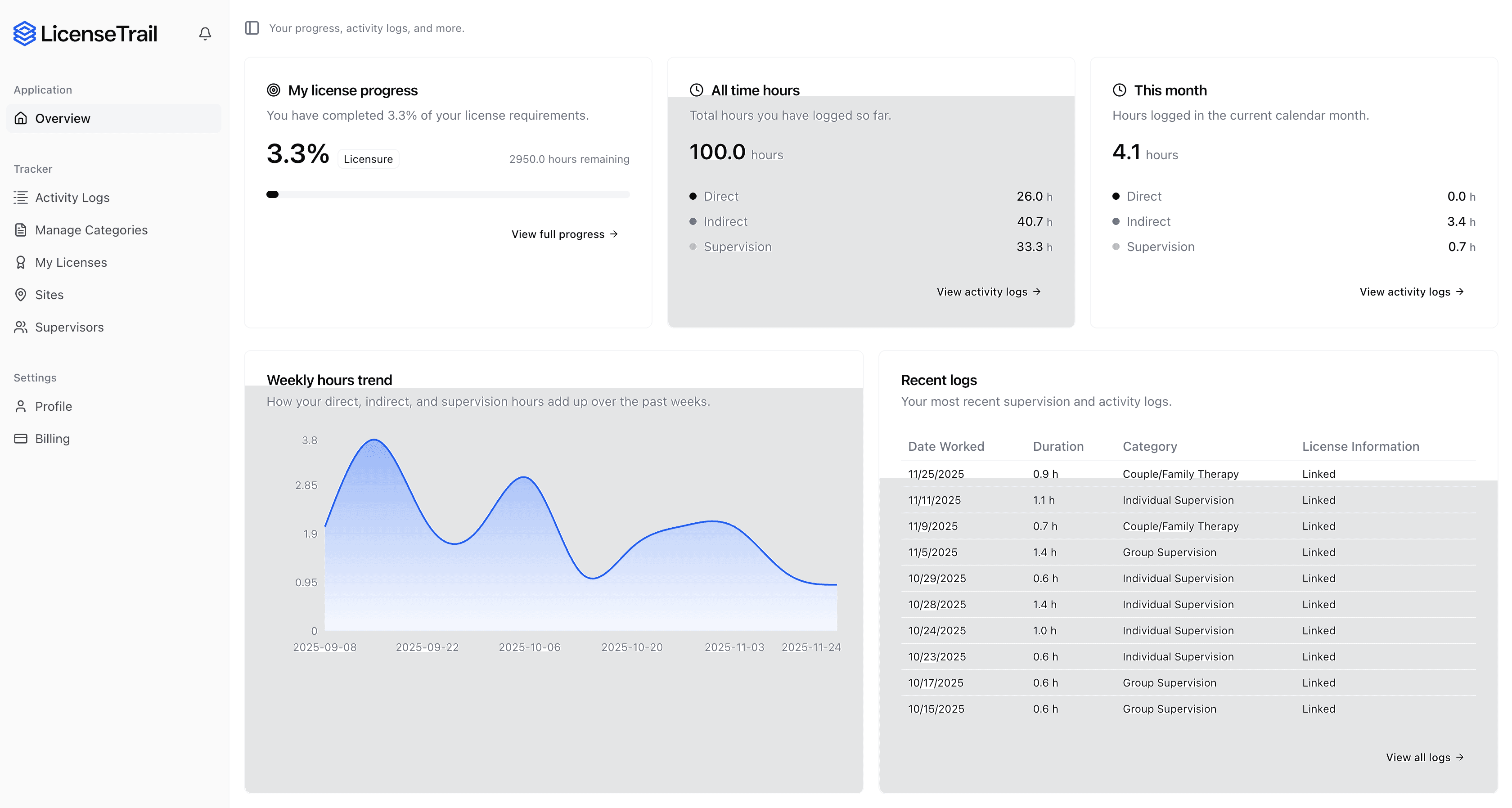
License Trail checks your direct, indirect, and supervision hours against Florida LMFT requirements continuously and flags mismatches before you submit.
 Start Tracking for Free
No credit card required · Free plan available
Is your spreadsheet hiding Florida LMFT risks?
Stop guessing if your categories match Florida Board of Clinical Social Work, Marriage & Family Therapy and Mental Health Counseling requirements. License Trail checks your direct, indirect, and supervision hours continuously and flags mismatches before you submit.
Import or log
Bring your spreadsheet or start fresh
Upload your existing tracking spreadsheet and we'll map every hour into the right Florida Board of Clinical Social Work, Marriage & Family Therapy and Mental Health Counseling categories automatically.
Verify against Florida
Catch mismatches before the board does
License Trail checks your direct, indirect, and supervision hours against Florida LMFT requirements continuously.
Export board-ready
One-click clean reports
Generate professional, board-ready reports for supervision meetings and Florida Board of Clinical Social Work, Marriage & Family Therapy and Mental Health Counseling submissions in seconds.
No credit card required · Free plan available