
Georgia LMFT Requirements: Hours, Exams & Step-by-Step Guide
Stop guessing if your categories match Georgia requirements. License Trail checks your direct, indirect, and supervision hours against LMFT requirements continuously and flags mismatches before you submit.
No credit card required · Free plan available
Quick Requirements Overview
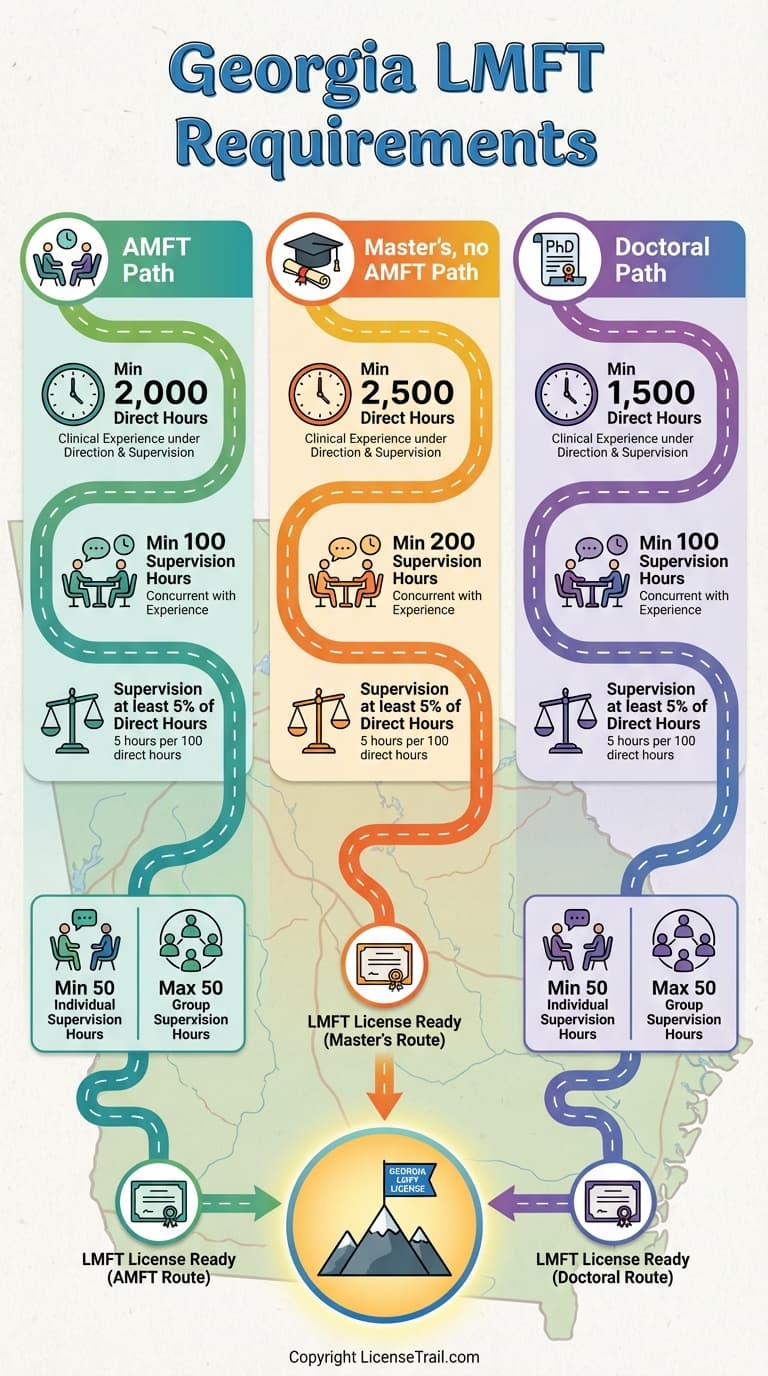
- Governing authority: GA Composite Board (Rule 135‑5‑.06); requirements vary by pathway (AMFT holder vs master’s/no AMFT vs doctoral).
- Education (non‑AMFT routes): Qualifying master’s/doctoral degree from CHEA‑recognized accredited institution (or COAMFTE program) + required MFT coursework (MFT, MFT studies, MFT ethics, psychopathology/diagnosis).
- Pathway: AMFT → LMFT: 2 years post‑master (equiv allowed); 2,000 direct clinical MFT hours; part‑time window 2–5 years.
- Pathway: Master’s, no AMFT: 3 years post‑master (equiv); 2,500 direct clinical hours total, incl 2,000 in MFT; up to 1 year/500 hours may be approved practicum; part‑time window 3–5 years.
- Pathway: Doctoral: 2 years post‑master or post‑doc in MFT; 1,500 direct clinical hours (≥ 1,000 in one full‑time post‑degree year); up to 1 year/500 hours may be approved internship.
- Supervision (core rules): Must be concurrent; at least 50 hours individual (max 50 group); ≥5 supervision hours per 100 direct clinical hours; supervisor must meet GA rule qualifications (incl approved MFT supervisor options).
- Supervision totals by pathway: AMFT route 100 hours; Master’s/no AMFT 200 hours (≥100 by AAMFT/GA Board‑Approved MFT Supervisor or supervision‑of‑supervision; up to 100 may be during practicum); Doctoral 100 hours (qualified approved MFT supervisor; up to 50 during doctoral/internship).
- Exam: AMFT holders do not re‑take the MFT exam; Master’s/no AMFT and Doctoral applicants must pass the Examination in Marital & Family Therapy after Board approval to test.
License Details
Procedures
Becoming a Licensed Marriage and Family Therapist (LMFT) in Georgia is governed by the Georgia Composite Board of Professional Counselors, Social Workers, and Marriage & Family Therapists under Rule 135‑5‑.06, “Marriage and Family Therapists.” The Board distinguishes requirements based on (1) whether you already hold an Associate MFT license, (2) whether you have a qualifying master’s degree but no Associate license, or (3) whether you have a qualifying doctoral degree. (rules.sos.georgia.gov)
Below is a step‑by‑step guide organized by pathway, with the Board’s own key phrases for hours and supervision.
1. Core Definitions and Concepts
Before the pathways, it helps to understand how Georgia’s rules describe experience and supervision:
- “Approved Practicum or Internship Program” – supervised experience obtained while enrolled in graduate courses designated practicum or internship at a CHEA‑recognized accredited educational institution. (rules.sos.georgia.gov)
- “Direct clinical experience” – the rules consistently require that a portion of your experience be “direct clinical experience” in the practice of professional counseling, clinical social work, or marriage and family therapy, and, for full licensure, specifically “in the practice of marriage and family therapy” for part of those hours. (law.cornell.edu)
- “Under direction and supervision” – post‑degree experience must be documented as full‑time (or its equivalent) under direction and supervision, with specific required hours of supervision concurrent with documented experience. (law.cornell.edu)
- “Board Approved Marriage and Family Therapy Supervisor” – a licensed MFT approved by the Board who meets specified post‑licensure and supervision‑of‑supervision criteria (relevant mainly to who can supervise you). (rules.sos.georgia.gov)
2. Pathway A: You Hold a Current Associate MFT (AMFT) License in Georgia
If you already hold an Associate Marriage and Family Therapist license, the Board’s Rule 135‑5‑.06(2)(a) applies. (rules.sos.georgia.gov)
2.1 Post‑Master’s Experience Requirement
You must document:
- “two years of full-time post-master’s experience or its equivalent, under direction and supervision.” (law.cornell.edu)
This experience:
- “shall have been in the practice of marriage and family therapy, and shall include a minimum of 2,000 hours of direct clinical experience.” (law.cornell.edu)
- If you worked less than full‑time, equivalent experience may be accrued over “a total of not less than two years and not more than five years.” (law.cornell.edu)
In other words, for the AMFT‑to‑LMFT route, Georgia requires:
- 2 years post‑master’s practice (2–5 calendar years if part‑time), including
- 2,000 hours of direct clinical experience in marriage and family therapy.
2.2 Supervision Requirement
Concurrent with that experience, you must have:
- “100 hours of supervision, concurrent with his/her documented experience.” (law.cornell.edu)
That supervision must meet all of the following:
-
Who can supervise
Supervision must have been provided by:- “a licensed marriage and family therapist, professional counselor, clinical social worker, psychiatrist, or psychologist who shall have been licensed and in good standing for a minimum of three years; or
- an American Association for Marriage and Family Therapy (AAMFT) Approved Supervisor, a Georgia Board Approved Marriage and Family Therapy Supervisor, or a person who was receiving supervision‑of‑supervision in order to qualify for either designation.” (law.cornell.edu)
-
Individual vs. group supervision
- “A minimum of 50 of these 100 hours must have been in individual supervision, and a maximum of 50 of these 100 hours may have been in group supervision.” (law.cornell.edu)
-
Linkage to direct clinical experience
- “A minimum of 5 hours of such supervision must have been obtained concurrent with each 100 hours of direct clinical experience.” (law.cornell.edu)
2.3 Examination
For current AMFTs:
- “The applicant is not required to re‑take the Examination in Marital and Family Therapy” after Board approval of the application for LMFT licensure. (law.cornell.edu)
3. Pathway B: Master’s Degree, No Associate MFT License
If you have a qualifying master’s degree but you do not hold an active AMFT license, Rule 135‑5‑.06(2)(b) governs your route. (law.cornell.edu)
3.1 Educational Requirements
You must:
-
Hold a master’s degree in:
- “marriage and family therapy, counseling, social work, medicine, applied psychology, psychiatric nursing, pastoral counseling, applied child and family development, applied sociology, or from any program accredited by the Commission on Accreditation for Marriage and Family Therapy Education (COAMFTE).”
- The degree must be from a CHEA‑recognized regionally accredited institution. (law.cornell.edu)
-
Meet specified coursework requirements, including:
- “at least two courses in Marriage and Family Therapy, two courses in Marriage and Family Studies, one course in Marriage and Family Therapy Ethics, and one course in either psychopathology or the diagnosis of mental problems and conditions,” with these courses from CHEA‑recognized institutions (or, before January 1, 2020, from a Board‑approved training institute). (law.cornell.edu)
There are additional detailed options for those with degrees in psychology, child and family development, sociology, or divinity/theology (clinical content courses plus practicum/internship), but the bottom line is that your degree and coursework must align with the Board’s definitions. (law.cornell.edu)
3.2 Post‑Master’s Experience Requirement
You must document:
- “three years of full-time post-master experience, or its equivalent, under direction and supervision, which shall include a minimum of 2,500 hours of direct clinical experience.” (law.cornell.edu)
Within that:
-
Up to one year may be practicum:
- “One year of such experience may have been in an approved practicum before or after the granting of the master’s degree, which shall include a minimum of 500 hours of direct clinical experience in the practice of professional counseling, clinical social work or marriage and family therapy.” (law.cornell.edu)
-
At least two years must be marriage and family therapy‑specific:
- “At least two years of such experience shall have been in the practice of marriage and family therapy, which shall include a minimum of 2,000 hours of direct clinical experience.” (law.cornell.edu)
-
Part‑time equivalency window:
- If less than full‑time, the experience may be accrued over “a total of not less than three years and not more than five years.” (law.cornell.edu)
In practical terms for the master’s‑only route:
- Total direct clinical experience required:
- At least 2,500 hours of direct clinical experience,
- Of which at least 2,000 hours must be direct clinical experience in the practice of marriage and family therapy.
- Up to 500 of the 2,500 hours may come from an approved practicum.
3.3 Supervision Requirement
You must obtain:
- “200 hours of supervision, concurrent with his/her documented experience.” (law.cornell.edu)
Supervision details:
-
Who can supervise
Supervision must have been provided by:- “a licensed marriage and family therapist, professional counselor, clinical social worker, psychiatrist, or psychologist who shall have been licensed and in good standing for a minimum of three years; or,
- an American Association for Marriage and Family Therapy (AAMFT) Approved Supervisor, a Georgia Board Approved Marriage and Family Therapy Supervisor, or a person who was receiving supervision‑of‑supervision in order to qualify for either designation.” (law.cornell.edu)
-
Requirement for supervisor type and format
- “At least 100 hours of such supervision shall have been provided by an American Association for Marriage and Family Therapy Approved Supervisor, a Georgia Board Approved Marriage and Family Therapy Supervisor, or a person who was receiving supervision‑of‑supervision in order to qualify for either designation.”
- “A minimum of 50 of these 100 hours must have been in individual supervision, and a maximum of 50 of these 100 hours may have been in group supervision.” (law.cornell.edu)
-
Linkage to direct clinical experience
- “A minimum of 5 hours of such supervision must have been obtained concurrent with each 100 hours of direct clinical experience.” (law.cornell.edu)
-
Practicum supervision credit
- “Up to 100 hours of such supervision may have been obtained during an approved practicum before or after the granting of the master’s degree.” (law.cornell.edu)
3.4 Examination Requirement
For master’s‑only applicants without an AMFT license:
- You must “register and sit for the Examination in Marital and Family Therapy following Board review of [your] application… and approval to take the examination. Passage of the exam is a requirement to issue a license.” (law.cornell.edu)
4. Pathway C: Doctoral Degree Route
If you hold a qualifying doctoral degree, your requirements are under Rule 135‑5‑.06(2)(c). (law.cornell.edu)
4.1 Educational Requirements
You must have a doctoral degree in:
- “marriage and family therapy, counseling, social work, medicine, applied psychology, psychiatric nursing, pastoral counseling, applied child and family development, applied sociology, or from any program accredited by the Commission on Accreditation for Marriage and Family Therapy Education (COAMFTE),” from a CHEA‑recognized accredited institution. (law.cornell.edu)
As with the master’s route, there are specific expectations for clinical content courses and for courses in:
- Marriage and Family Therapy (2 courses)
- Marriage and Family Studies (2 courses)
- Marriage and Family Therapy Ethics (1 course)
- Psychopathology or diagnosis of mental problems and conditions (1 course) (law.cornell.edu)
4.2 Experience Requirement
You must document:
- “two years of full-time post-master or post-doctorate experience, in the practice of marriage and family therapy, under direction and supervision, which shall include a minimum of 1,500 hours of direct clinical experience.” (law.cornell.edu)
Within that:
-
Internship credit:
- “One year of such experience may have been in an approved internship program before or after the granting of the doctoral degree, which shall include a minimum of 500 hours of direct clinical experience.” (law.cornell.edu)
-
Minimum truly post‑degree year:
- “At least one year of such experience shall have been full-time post-master or post-doctorate experience, which shall include a minimum of 1,000 hours of direct clinical experience.” (law.cornell.edu)
So, for doctoral applicants, Georgia requires at least:
- 1,500 hours of direct clinical experience in marriage and family therapy across at least two years (with at least 1,000 hours in a full‑time post‑master or post‑doctorate year).
4.3 Supervision Requirement
You must have:
- “100 hours of supervision, concurrent with their documented experience.” (law.cornell.edu)
The supervision must:
-
Be provided by:
- “a licensed marriage and family therapist, professional counselor, clinical social worker, psychiatrist, or psychologist, who was also an American Association for Marriage and Family Therapy Approved Supervisor, a Georgia Board Approved Marriage and Family Therapy Supervisor, or a person who was receiving supervision-of-supervision in order to qualify for either designation.” (law.cornell.edu)
-
Meet format and concurrency rules:
- “A minimum of 50 of these 100 hours must have been in individual supervision, and a maximum of 50 of these 100 hours may have been in group supervision;
- A minimum of 5 hours of such supervision must have been obtained concurrent with each 100 hours of direct clinical experience; and
- A maximum of 50 of these 100 hours may have been obtained during the applicant’s doctoral degree or internship program.” (law.cornell.edu)
4.4 Examination Requirement
Doctoral applicants must:
- “register and sit for the Examination in Marital and Family Therapy… Passing the examination is a requirement for licensure.” (law.cornell.edu)
5. Practicum and the Associate MFT Stage (Context)
Although your question focuses on LMFT licensure, Georgia’s structure assumes many applicants first hold an Associate Marriage and Family Therapist license under Rule 135‑5‑.05. That rule requires, among other things, a one‑year practicum that: (rules.sos.georgia.gov)
- “shall include a minimum of 500 hours of direct clinical experience,” and
- “shall include 100 hours of supervision” provided by a suitably qualified supervisor (who is also an AAMFT Approved Supervisor, a Georgia Board Approved MFT Supervisor, or under supervision‑of‑supervision).
Those practicum hours can then feed into the LMFT requirements within the limits specified under each pathway.
6. Summary of Key Hour Requirements by Pathway
All phrased using the Board’s language:
-
AMFT → LMFT (Master’s + Associate license)
- Experience: “two years of full-time post-master’s experience or its equivalent, under direction and supervision,” including “a minimum of 2,000 hours of direct clinical experience” in marriage and family therapy.
- Supervision: “100 hours of supervision, concurrent with… documented experience,” with at least 50 individual, max 50 group, and at least 5 supervision hours per 100 hours of direct clinical experience. (law.cornell.edu)
-
Master’s degree, no AMFT
- Experience: “three years of full-time post-master experience, or its equivalent, under direction and supervision, which shall include a minimum of 2,500 hours of direct clinical experience,” of which at least two years must be “in the practice of marriage and family therapy, which shall include a minimum of 2,000 hours of direct clinical experience.”
- Supervision: “200 hours of supervision, concurrent with… documented experience,” at least 100 by an AAMFT Approved or Georgia Board Approved MFT Supervisor (or supervision‑of‑supervision), with at least 50 of those 100 individual, max 50 group, and at least 5 supervision hours per 100 hours of direct clinical experience. Up to 100 hours of supervision may be obtained during an approved practicum. (law.cornell.edu)
-
Doctoral degree route
- Experience: “two years of full-time post-master or post-doctorate experience, in the practice of marriage and family therapy, under direction and supervision, which shall include a minimum of 1,500 hours of direct clinical experience,” with at least 1,000 hours in one full‑time post‑master/post‑doctorate year.
- Supervision: “100 hours of supervision, concurrent with… documented experience,” at least 50 individual, max 50 group, at least 5 supervision hours per 100 hours of direct clinical experience, and up to 50 supervision hours may be during the doctoral degree/internship. (law.cornell.edu)
For the most precise and current language, applicants should always compare their situation directly to Georgia Rules and Regulations, Chapter 135‑5, especially Rules 135‑5‑.05 and 135‑5‑.06, as maintained by the Georgia Secretary of State and the Composite Board. (rules.sos.georgia.gov)
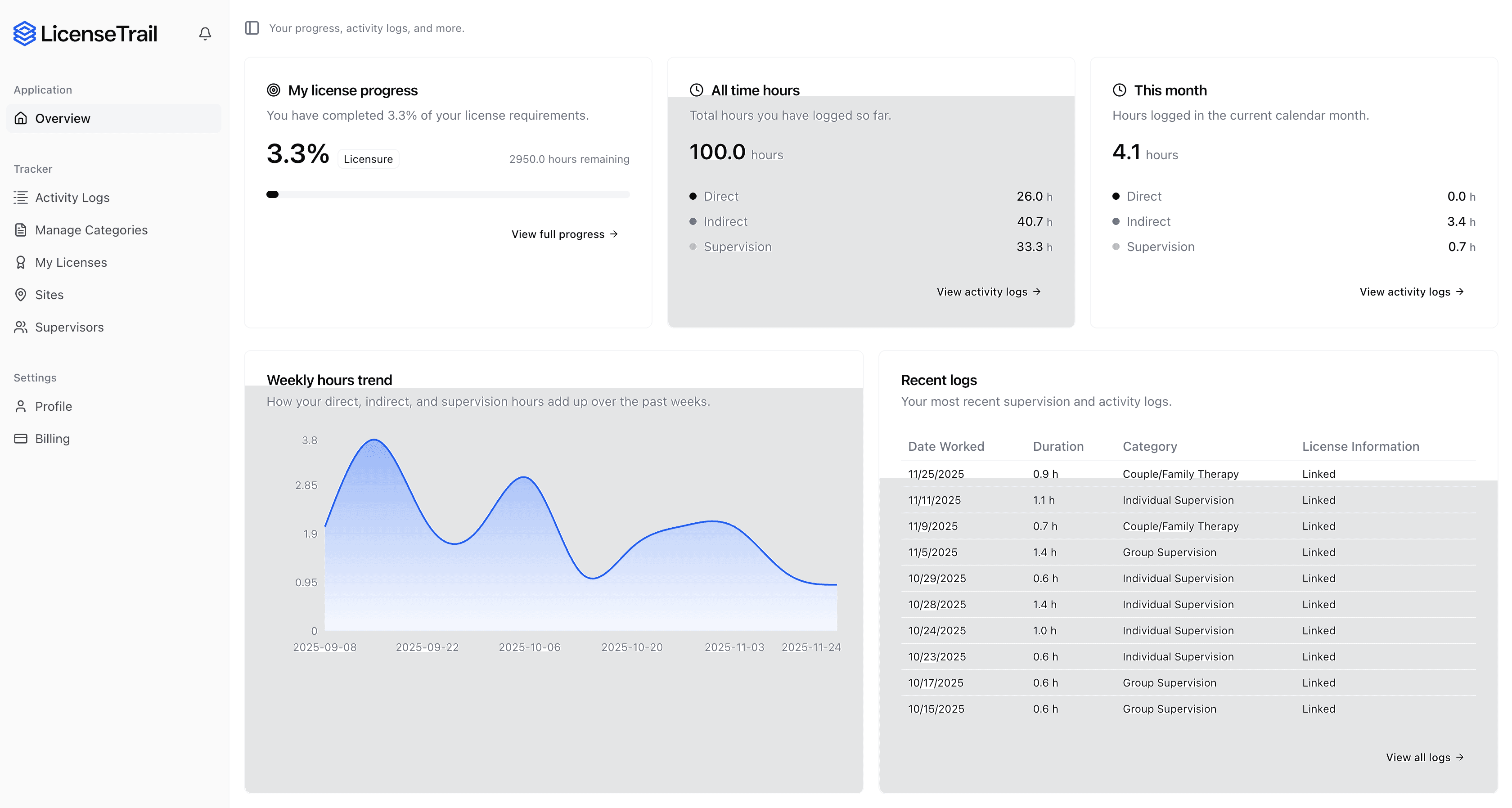
Track your LMFT hours with confidence
License Trail checks your direct, indirect, and supervision hours against Georgia LMFT requirements continuously and flags mismatches before you submit.
 Start Tracking for Free
No credit card required · Free plan available
Is your spreadsheet hiding Georgia LMFT risks?
Stop guessing if your categories match Georgia Board of Professional Counselors, Social Workers, and Marriage & Family Therapists requirements. License Trail checks your direct, indirect, and supervision hours continuously and flags mismatches before you submit.
Import or log
Bring your spreadsheet or start fresh
Upload your existing tracking spreadsheet and we'll map every hour into the right Georgia Board of Professional Counselors, Social Workers, and Marriage & Family Therapists categories automatically.
Verify against Georgia
Catch mismatches before the board does
License Trail checks your direct, indirect, and supervision hours against Georgia LMFT requirements continuously.
Export board-ready
One-click clean reports
Generate professional, board-ready reports for supervision meetings and Georgia Board of Professional Counselors, Social Workers, and Marriage & Family Therapists submissions in seconds.
No credit card required · Free plan available