
Georgia LPC Requirements: Hours, Exams & Step-by-Step Guide
Stop guessing if your categories match Georgia requirements. License Trail checks your direct, indirect, and supervision hours against LPC requirements continuously and flags mismatches before you submit.
No credit card required · Free plan available
Quick Requirements Overview
- Two-step pathway: Qualify/hold APC first, then apply for LPC after completing Board-defined directed experience + supervision
- Education: Master’s+ in counseling-content or applied psychology (or Specialist/Doctorate/CRC route); required counseling core coursework; practicum/internship 300 hrs (600 hrs if degree awarded after 9/30/2018)
- APC requirements: Submit Directed Experience Under Supervision Contract (update within 14 days of changes); pass Board-approved exam; practice only under supervision; APC valid up to 5 years while accruing experience
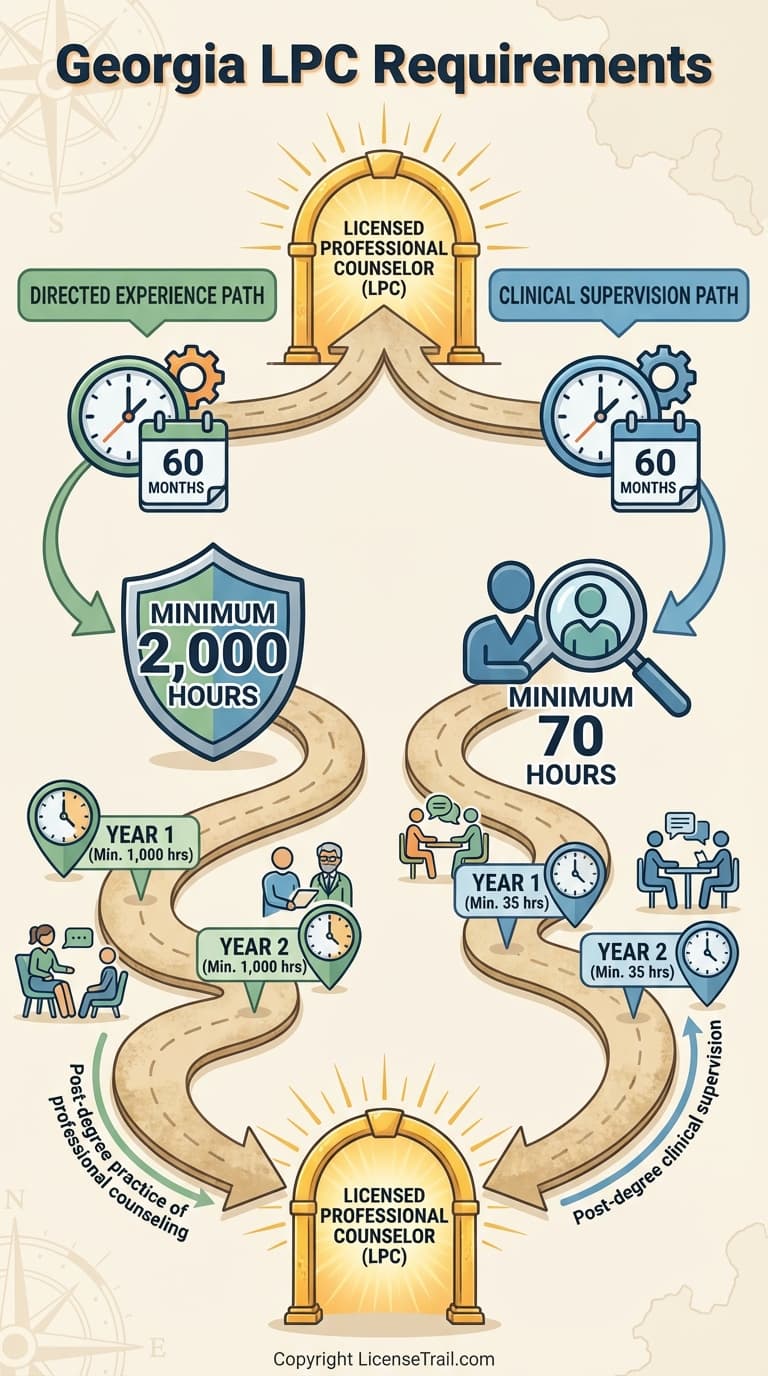
- Directed experience (post‑9/30/2018 standard): 1 “year” = 1,000 hours over ≥12 months; must be in a structured setting; all hours must be within 60 months of LPC application
- Supervision (post‑9/30/2018 standard): 1 “year” = 35 supervision hours over the same 12-month period; all supervision within 60 months of application
- Typical LPC experience totals (post‑2018): Master’s counseling/applied psych 4,000 hrs + 120 sup hrs (or 3,000 hrs + 105 sup hrs if qualifying 600‑hr practicum); Specialist 2,000–3,000 hrs + 70–105 sup hrs; Doctoral 1,000 hrs + 35 sup hrs (or 750‑hr doctoral internship)
- Supervisor qualifications: LPC/LCSW/LMFT/Psychologist/Psychiatrist with required post-licensure experience; LPC supervisors need ACS or CPCS for post‑9/30/2018 supervision; minimum supervision must be by an LPC (amount varies by degree route)
- Final licensure: Apply for GA LPC after meeting route-specific education + directed experience + supervision and passing the Board-prescribed LPC exam
License Details
Procedures
Licensure as a Licensed Professional Counselor (LPC) in Georgia is tightly defined in the Georgia Composite Board’s rules, especially Chapter 135‑5 (“Requirements for Licensure”). The Board talks in terms of “directed experience” and “years of supervision,” not in a simple split like “1,500 direct hours and 1,500 supervised hours.”
Below is a step‑by‑step guide that tracks the Board’s own terminology and structure.
1. How Georgia’s LPC pathway is structured
Georgia uses a two‑step model:
- Associate Professional Counselor (APC) – an entry‑level license you hold while you accumulate supervised post‑master experience. (rules.sos.ga.gov)
- Licensed Professional Counselor (LPC) – the independent license you obtain after meeting specific experience and supervision requirements under Rule 135‑5‑.02 (“Professional Counselors”). (rules.sos.ga.gov)
You must first qualify educationally, become an APC, complete Board‑defined “directed experience under supervision,” and then apply for LPC.
2. Step One: Educational foundation
2.1 For APC (the usual first license)
To become an APC, you must hold at least a master’s degree in a:
- “Program primarily counseling in content” or
- “Program of applied psychology”
from a regionally accredited institution. The degree must include a supervised practicum or internship of at least 300 hours, and for degrees awarded after September 30, 2018, that practicum/internship must be at least 600 hours and the program must be CACREP/CORE or a substantially similar regionally accredited program. (rules.sos.ga.gov)
The rules spell out required graduate content areas (human growth and development, multicultural counseling, counseling techniques, group, career, assessment, research, professional ethics, and psychopathology), which is the Board’s definition of a “program primarily counseling in content.” (rules.sos.ga.gov)
2.2 Educational pathways the Board accepts for LPC
For full LPC status, Rule 135‑5‑.02 recognizes several degree routes, each with its own years‑of‑experience requirement: (rules.sos.ga.gov)
- Master’s degree in a program primarily counseling in content.
- Specialist degree in a program primarily counseling in content.
- Doctoral degree in a program primarily counseling in content.
- Certified Rehabilitation Counselor route.
- Master’s degree in applied psychology.
All of these degrees must meet very similar accreditation and coursework standards to what is required for APC.
3. Step Two: Obtain the APC license
Under Rule 135‑5‑.01 (“Associate Professional Counselors”), you must: (rules.sos.ga.gov)
-
Meet the educational requirements described above (master’s in a qualifying counseling/applied psychology program with required practicum hours).
-
Register a “Directed Experience Under Supervision Contract.”
The Board defines this as a Board‑supplied document that “defines the working relationship for the purposes of obtaining the required post‑masters directed experience under supervision.” The contract must identify the work setting and supervisor and must be updated within 14 days if anything changes. (rules.sos.ga.gov)
-
Pass a Board‑approved exam for APC (the specific exam is referenced in Rule 135‑3‑.03 – typically the NCE or other approved counseling examination). (rules.sos.ga.gov)
-
Practice only under direction and supervision. An APC “may engage in the practice of Professional Counseling, but only under direction and supervision, and only for a period not to exceed five years” while completing the post‑master experience needed for LPC. (rules.sos.ga.gov)
4. Step Three: Accumulate post‑master experience and supervision for LPC
4.1 Key Board definitions of hours
For LPC, Georgia uses three key concepts in Rule 135‑5‑.02(a): (rules.sos.ga.gov)
-
Directed Experience
- Defined as time “spent under direction engaging in the practice of Professional Counseling” as that term is defined in the statute.
- The work site must have a formal structure (job description, office hours, performance review, dismissal policies, etc.). Non‑paid positions are allowed only if they function like employment and are approved case‑by‑case. (rules.sos.ga.gov)
-
Years of Directed Experience
- Before 9/30/2018, one year could be as low as 600 hours, but for current applicants the post‑2018 standard applies.
- After September 30, 2018, “one year of Directed Experience” means a minimum of 1,000 hours of directed experience acquired in not less than a 12‑month period. (rules.sos.ga.gov)
- All directed experience must be obtained within the 60 months (5 years) before the date of application. (rules.sos.ga.gov)
-
Years of Supervision
- Each “year of Supervision” was historically 30 hours, but for current applicants the Board states that after September 30, 2018, one year of supervision means at least 35 hours of supervision obtained during one 12‑month period of directed experience. (rules.sos.ga.gov)
- All supervision hours also must fall within the 60 months prior to the application date. (rules.sos.ga.gov)
-
Who qualifies as a supervisor
- Must be a licensed Professional Counselor, Clinical Social Worker, Marriage and Family Therapist, Psychologist, or Psychiatrist, with specific minimum post‑licensure experience (3 years for master’s‑level supervisors, 2 years for specialist, 1 year for doctoral). (rules.sos.ga.gov)
- For supervision entered into after September 30, 2018, if the supervisor is an LPC, the Board requires either an NBCC Approved Clinical Supervisor (ACS) credential or the Georgia LPC Association’s Certified Professional Counselor Supervisor (CPCS) credential. (rules.sos.ga.gov)
4.2 How many hours are required? (By degree route)
Because Georgia defines experience in “years,” you translate that into hours using the 1,000‑hours‑per‑year rule that applies after 9/30/2018. (rules.sos.ga.gov)
Below are the main routes and their hour equivalents for applicants today.
4.2.1 Master’s degree in a program primarily counseling in content (most common route)
Rule 135‑5‑.02(b) requires: (rules.sos.ga.gov)
-
Option 1 – 4‑year route (no qualifying practicum beyond minimum):
- 4 years of post‑master directed experience under supervision in professional counseling.
- Using the Board’s post‑2018 definition, this is 4,000 hours of directed experience (4 × 1,000 hours).
- “Four years of Supervision” means at least 120 total hours of supervision (4 × 35 hours).
-
Option 2 – 3‑year route (with qualifying practicum/internship):
- 3 years of post‑master directed experience under supervision in professional counseling.
- At post‑2018 standards, that is 3,000 hours of directed experience (3 × 1,000 hours).
- Must also have a supervised counseling practicum/internship of at least 300 hours as part of the degree, but for degrees after 9/30/2018 the Board raises this to 600 hours. (rules.sos.ga.gov)
- “Three years of Supervision” means at least 105 hours of supervision (3 × 35 hours).
In both master’s‑route options:
- At least two years of the supervision must be provided by a supervisor who is a licensed Professional Counselor meeting the Board’s supervisor standards. (rules.sos.ga.gov)
4.2.2 Specialist degree in counseling
For applicants with a specialist degree in a program primarily counseling in content, Rule 135‑5‑.02(c) provides: (rules.sos.ga.gov)
-
Option 1 – 2‑year route (with qualifying practicum):
- 2 years of post‑master directed experience under supervision in professional counseling in a work setting acceptable to the Board.
- At the post‑2018 standard this is 2,000 hours of directed experience (2 × 1,000).
- Requires a 300‑hour (600‑hour after 9/30/2018) practicum/internship in the degree program.
- “Two years of Supervision” = at least 70 hours of supervision (2 × 35 hours).
-
Option 2 – 3‑year route (no qualifying practicum beyond minimum):
- 3 years of post‑master directed experience under supervision (3,000 hours) in acceptable settings.
- “Three years of Supervision” = at least 105 hours of supervision.
In both options, at least one year of the supervision must be from a licensed Professional Counselor meeting the Board’s supervisor criteria. (rules.sos.ga.gov)
4.2.3 Doctoral degree in counseling
Applicants with a doctoral degree from a program primarily counseling in content must, under Rule 135‑5‑.02(d): (rules.sos.ga.gov)
- Hold a qualifying doctoral degree (CACREP/CORE or substantially similar program, for post‑2018 degrees).
- Complete either:
- 1 year of supervised counseling internship of at least 750 hours during the doctoral program in a work setting acceptable to the Board, or
- 1 year of post‑master directed experience under supervision in professional counseling in an acceptable work setting.
At current standards:
- 1 year of Directed Experience = 1,000 hours.
- One year of Supervision = at least 35 hours of supervision, and at least half of that year’s supervision must be provided by a licensed Professional Counselor meeting Board standards. (rules.sos.ga.gov)
4.2.4 Certified Rehabilitation Counselor route
For an applicant who is a Certified Rehabilitation Counselor (CRC), Rule 135‑5‑.02(e) requires: (rules.sos.ga.gov)
- A qualifying rehabilitation counseling master’s degree (with required accreditation/content).
- Three years of post‑master directed experience providing rehabilitation services in an acceptable rehab setting under supervision of a CRC or other qualified supervisor; or
- Two years of post‑master directed experience in rehab plus a 300‑hour (600‑hour post‑2018) supervised counseling practicum/internship in the degree.
Translating this:
- 3‑year option = 3,000 hours of directed experience, with at least one year (1,000 hours) of supervision provided by a Certified Rehabilitation Counselor or LPC meeting Board supervisor requirements.
- 2‑year + practicum option = 2,000 hours of directed experience plus the practicum/internship hours.
Supervision hours track the same “35 hours per year” standard (70–105 hours total, depending on the route).
4.2.5 Master’s degree in applied psychology
An applicant with a master’s degree in applied psychology must meet similar but slightly different experience requirements in Rule 135‑5‑.02(f): (rules.sos.ga.gov)
- Qualifying applied psychology master’s program (with CACREP/CORE‑equivalent content post‑2018).
- Option 1 – 4‑year route:
- 4 years of post‑master directed experience under supervision in professional counseling (4,000 hours).
- “Four years of Supervision” = at least 120 hours of supervision.
- Option 2 – 3‑year route (with practicum):
- 3 years of post‑master directed experience under supervision (3,000 hours) plus a supervised counseling or applied psychology practicum/internship of at least 300 hours (600 hours for post‑2018 degrees).
- “Three years of Supervision” = at least 105 hours of supervision.
In both options, at least two years of supervision must be provided by a licensed Professional Counselor who meets the Board’s supervisor criteria or a licensed Psychologist (with certain grandfathering provisions for earlier supervision). (rules.sos.ga.gov)
5. Step Four: Apply for LPC
Once you have:
- Maintained an APC in good standing,
- Completed the required post‑master directed experience hours within the last 60 months,
- Accrued the corresponding supervision hours (35 per year of directed experience under today’s rules), and
- Met the degree‑specific requirements (LPC supervisor years, practicum hours, CRC credential if using that path),
you may apply to the Board for LPC licensure under Rule 135‑5‑.02. (rules.sos.ga.gov)
You must also pass the Board‑prescribed LPC examination (the same or equivalent to what you passed as an APC, depending on timing and Board policy under Rule 135‑3‑.03). (rules.sos.ga.gov)
6. Quick reference: common pathways and hour counts (post‑2018 applicants)
All numbers below assume you fall under the post‑September 30, 2018 standards:
| Route | Directed experience required | Approx. hours of directed experience | Supervision required | Approx. hours of supervision |
|---|---|---|---|---|
| Master’s – counseling (no qualifying practicum beyond minimum) | 4 years | 4,000 hours | 4 years | 120 hours |
| Master’s – counseling + 600‑hr practicum | 3 years | 3,000 hours | 3 years | 105 hours |
| Specialist – counseling + 600‑hr practicum | 2 years | 2,000 hours | 2 years | 70 hours |
| Specialist – counseling (no qualifying practicum beyond minimum) | 3 years | 3,000 hours | 3 years | 105 hours |
| Doctoral – counseling | 1 year (or 750‑hr doc internship) | 1,000 hours (if post‑master route) | 1 year | 35 hours |
| CRC route | 2–3 years in rehab settings | 2,000–3,000 hours | 2–3 years | 70–105 hours |
| Master’s – applied psychology (no qualifying practicum beyond minimum) | 4 years | 4,000 hours | 4 years | 120 hours |
| Master’s – applied psychology + 300/600‑hr practicum | 3 years | 3,000 hours | 3 years | 105 hours |
The Georgia Board, in its rules, does not phrase the requirements as “X hours of direct experience and Y hours of supervised experience.” Instead, it defines:
- Directed experience as time spent under direction practicing professional counseling, and
- Supervision as the clinical review and teaching provided by a qualified supervisor,
- Then assigns years of each, which, for current applicants, convert to 1,000 hours of directed experience and 35 hours of supervision per year. (rules.sos.ga.gov)
Those are the controlling definitions and hour requirements for becoming an LPC through the Georgia Composite Board.
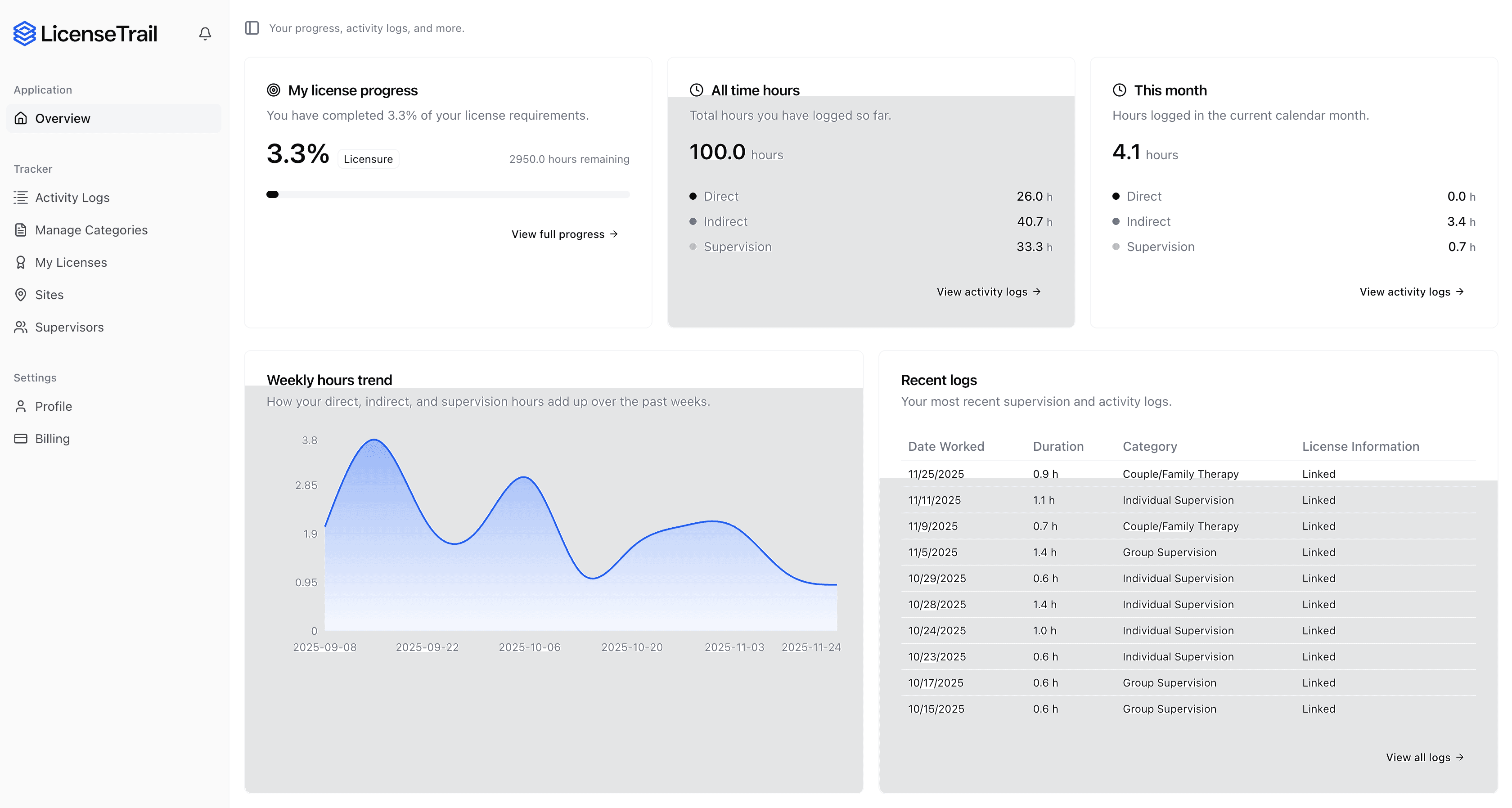
Track your LPC hours with confidence
License Trail checks your direct, indirect, and supervision hours against Georgia LPC requirements continuously and flags mismatches before you submit.
 Start Tracking for Free
No credit card required · Free plan available
Is your spreadsheet hiding Georgia LPC risks?
Stop guessing if your categories match Georgia Board of Professional Counselors, Social Workers, and Marriage & Family Therapists requirements. License Trail checks your direct, indirect, and supervision hours continuously and flags mismatches before you submit.
Import or log
Bring your spreadsheet or start fresh
Upload your existing tracking spreadsheet and we'll map every hour into the right Georgia Board of Professional Counselors, Social Workers, and Marriage & Family Therapists categories automatically.
Verify against Georgia
Catch mismatches before the board does
License Trail checks your direct, indirect, and supervision hours against Georgia LPC requirements continuously.
Export board-ready
One-click clean reports
Generate professional, board-ready reports for supervision meetings and Georgia Board of Professional Counselors, Social Workers, and Marriage & Family Therapists submissions in seconds.
No credit card required · Free plan available