
Hawaii LBSW Requirements: Hours, Exams & Step-by-Step Guide
Stop guessing if your categories match Hawaii requirements. License Trail checks your direct, indirect, and supervision hours against LBSW requirements continuously and flags mismatches before you submit.
No credit card required · Free plan available
Quick Requirements Overview
- Governing authority: HI DCCA/PVL Social Worker Program; HRS Chapter 467E
- Education: Bachelor’s degree in Social Work from a CSWE-accredited (or deemed equivalent) program
- Exam: Pass the ASWB Bachelors (basic level) exam
- Supervised hours for initial LBSW: None required (degree + exam model)
- Practice limitation: LBSW practice is in an agency setting under supervision (scope restriction, not hours)
- Application: Apply to HI PVL; submit application, official transcripts, fees; board authorizes exam
- Renewal cycle: Triennial, due June 30 every 3 years
- Continuing education (active status): 45 CE hours per renewal period, including 3 ethics (NASW/ASWB-approved)
License Details
Procedures
Licensure as a Licensed Bachelor Social Worker (LBSW) in Hawaii is designed as an entry‑level professional credential, and the State does not impose a supervised‑hours requirement for this license. The structure is degree + exam, rather than degree + practicum + post‑degree hours.
Below is an article‑style guide based directly on Hawaii statutes and the DCCA/Professional & Vocational Licensing (PVL) program.
Overview of the Hawaii LBSW license
Hawaii regulates social work under Hawaii Revised Statutes (HRS) Chapter 467E and administers licenses through the Department of Commerce and Consumer Affairs (DCCA), Professional & Vocational Licensing Division (PVL), Social Worker Program. (cca.hawaii.gov)
The state recognizes three levels:
- Licensed Bachelor Social Worker (LBSW)
- Licensed Social Worker (LSW)
- Licensed Clinical Social Worker (LCSW) (cca.hawaii.gov)
For LBSW, the law focuses on:
- A specific educational credential in social work, and
- Passing a national exam.
Unlike the LCSW license, there is no statutory requirement for a set number of supervised practice hours (such as “1,500 hours of direct experience and 1,500 hours of supervised experience”) for the LBSW in Hawaii. All numerical hour requirements in Chapter 467E apply to post‑master’s clinical hours for LCSW, not to bachelor‑level licensure. (law.justia.com)
Step 1: Understand the legal definition and scope of an LBSW
Hawaii law restricts who may call themselves a “licensed bachelor social worker” or use the initials L.B.S.W.. (law.justia.com)
“No person shall purport to be a ‘licensed bachelor social worker’ ... or use the letters ‘L.B.S.W.’ in connection with the person’s name, or use any words or symbols indicating or tending to indicate that the person is a ... licensed bachelor social worker ... without meeting the applicable requirements and holding a license as set forth in this chapter.” (law.justia.com)
Hawaii also distinguishes the scope of bachelor‑level practice from clinical social work. Statutory amendments describe that the “licensed bachelor social worker” performs the duties in the social work definition under supervision and in an agency setting, as contrasted with the broader and more independent scope for LCSWs. (data.capitol.hawaii.gov)
This distinction explains why Hawaii attaches hour requirements only to the clinical (LCSW) level, not to LBSW.
Step 2: Meet the education requirement
The education requirement for LBSW is set directly in HRS § 467E‑7(1):
“For the licensed bachelor social worker, the applicant:
(A) Holds a bachelor’s degree from a college or university in a social work program accredited by or deemed to be equivalent to a program accredited by the Council on Social Work Education; and
(B) Has passed the basic level national examination given by the Association of Social Work Boards.” (law.justia.com)
In practice, that means:
- Your degree must be a BSW (or equivalent) in social work.
- The program must be CSWE‑accredited or determined equivalent to a CSWE‑accredited program by Hawaii. (law.justia.com)
No additional coursework beyond that CSWE‑accredited bachelor’s social work degree is specified for LBSW.
Step 3: Pass the required national examination
Hawaii requires LBSW applicants to pass the ASWB Bachelors (basic level) exam:
- HRS § 467E‑7(1)(B) requires passing “the basic level national examination given by the Association of Social Work Boards.” (law.justia.com)
- State and national clearinghouses confirm that Hawaii uses the ASWB Bachelors exam for LBSW licensure. (publichealthonline.org)
The typical sequence is:
- Apply to the Hawaii DCCA/PVL Social Worker Program for LBSW.
- Once the board approves and authorizes you, register for the ASWB Bachelors exam.
- Pass the exam; the PVL is then notified and can issue your license. (cca.hawaii.gov)
Step 4: Understand experience and supervision requirements at the LBSW level
This is where Hawaii differs from some other jurisdictions.
No post‑degree supervised‑hours requirement for LBSW
The governing statute lists specific quantitative hours only for LCSW and only in the context of post‑master’s clinical social work experience:
- “At least three thousand hours of post masters clinical social work experience under supervision completed within no fewer than two years, but within no more than five years.”
- Within those 3,000 hours:
- A minimum of two thousand hours in assessment, clinical diagnosis, and psychotherapy;
- No more than nine hundred hours of client‑centered advocacy, consultation, and evaluation;
- At least one hundred hours of supervision, of which at least sixty are “direct face‑to‑face” individualized supervision and no more than forty can be in small group supervision. (law.justia.com)
This entire hours‑based framework is tied explicitly to LCSW, not to LBSW.
For the LBSW, by contrast, HRS § 467E‑7 lists only:
- The CSWE‑accredited bachelor’s degree, and
- The ASWB basic level (Bachelors) exam.
There is no additional statutory requirement such as “1,500 hours of direct experience and 1,500 hours of supervised experience” for the LBSW license in Hawaii law or in current DCCA/PVL guidance. (law.justia.com)
Supervision is about scope, not about a specific count of hours
Hawaii limits the bachelor‑level license to practice under supervision, but it does not convert that into a quantified hour requirement for licensure the way it does for clinical practice:
- Amendments to Chapter 467E specify that a “licensed bachelor social worker” performs the social work duties listed in the statute “in an agency setting under supervision.” (data.capitol.hawaii.gov)
This is functional language about how an LBSW may practice (i.e., not independently), rather than a requirement that an applicant accumulate a set number of hours before the license is granted.
Step 5: Apply through Hawaii DCCA / PVL Social Worker Program
The application process is administered by the Professional & Vocational Licensing Division – Social Worker Program. (cca.hawaii.gov)
On the PVL Social Worker Program page you will find:
- Application Forms, Requirements, Fees and Instructions for LBSW, LSW, and LCSW
- Application Deadline and Examination Dates (important if the state is using specific test‑cycle approvals)
- Links to Licensing Laws and Rules (HRS/HAR) (cca.hawaii.gov)
While the exact form layout changes over time, in general you should expect to provide:
- Completed application form for LBSW.
- Official transcripts sent directly from your CSWE‑accredited (or equivalent) BSW program.
- Application fee as listed on the current fee schedule.
- Any additional documentation the board requests (name change, disciplinary history explanations, etc.).
Once your application is approved, the board will authorize you to sit for the ASWB Bachelors exam. After you pass, the PVL receives your scores and issues the license.
Step 6: Maintain and renew the LBSW license
Hawaii uses a triennial renewal cycle:
- Licenses must be renewed by June 30 every three years (e.g., 2025, 2028, 2031). (cca.hawaii.gov)
For renewal, LBSWs on active status must complete continuing education (CE):
- The DCCA Social Worker Program explains that all LBSW, LSW, and LCSW licensees on active status must complete at least 45 hours of CE approved by NASW or ASWB, including 3 hours in ethics, during each three‑year renewal period, subject to any timing phase‑in rules for new licensees. (cca.hawaii.gov)
The board may audit compliance and can take disciplinary action if a licensee fails to produce proof of CE upon request. (cca.hawaii.gov)
Summary of Hawaii LBSW licensing requirements in the state’s own terms
Using the verbiage and structure of HRS § 467E‑7 and DCCA guidance, the requirements to become an LBSW in Hawaii can be summarized as:
-
Degree requirement
- “Holds a bachelor’s degree from a college or university in a social work program accredited by or deemed to be equivalent to a program accredited by the Council on Social Work Education.” (law.justia.com)
-
Examination requirement
- “Has passed the basic level national examination given by the Association of Social Work Boards” (the ASWB Bachelors exam). (law.justia.com)
-
Practice context and supervision
- The “licensed bachelor social worker or ‘L.B.S.W.’ shall perform duties ... in an agency setting under supervision.” (data.capitol.hawaii.gov)
-
No quantified hour requirement for licensure
- Hawaii law specifies detailed hour requirements only for the licensed clinical social worker (LCSW)—3,000 hours of post‑master’s clinical social work experience with defined sub‑categories and supervision hours.
- There is no statutory requirement that an LBSW applicant complete a specific number of supervised hours (such as 1,500 or 3,000) as a condition of initial LBSW licensure. (law.justia.com)
Taken together, Hawaii’s LBSW is a degree‑and‑exam‑based license with a supervised practice setting requirement, but without a numerical supervised‑hours prerequisite like the one you mentioned in your example.
Track your LBSW hours with confidence
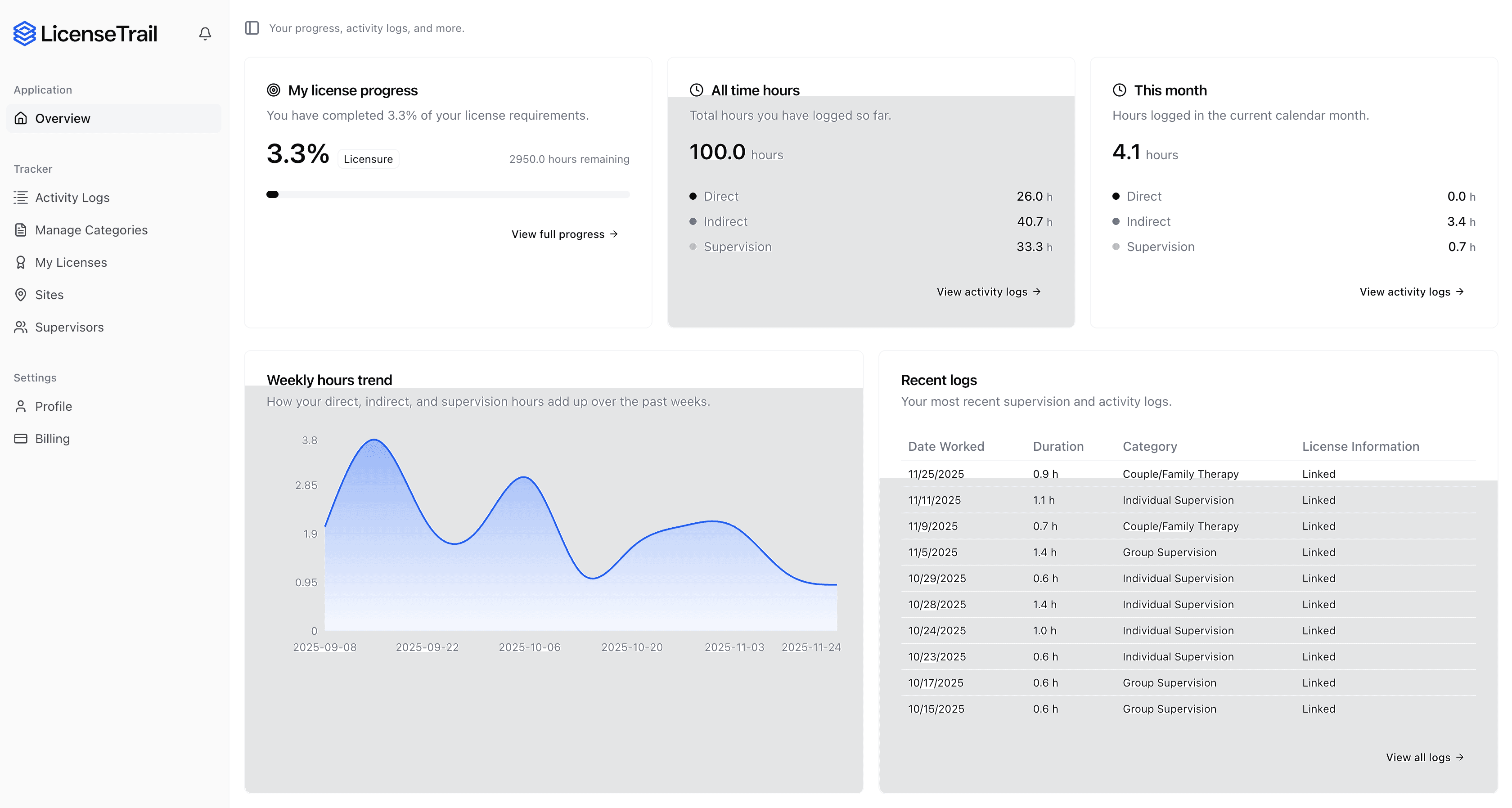
License Trail checks your direct, indirect, and supervision hours against Hawaii LBSW requirements continuously and flags mismatches before you submit.
 Start Tracking for Free
No credit card required · Free plan available
Related Licenses
Is your spreadsheet hiding Hawaii LBSW risks?
Stop guessing if your categories match Hawaii Department of Commerce and Consumer Affairs (Social Worker Licensing Program) requirements. License Trail checks your direct, indirect, and supervision hours continuously and flags mismatches before you submit.
Import or log
Bring your spreadsheet or start fresh
Upload your existing tracking spreadsheet and we'll map every hour into the right Hawaii Department of Commerce and Consumer Affairs (Social Worker Licensing Program) categories automatically.
Verify against Hawaii
Catch mismatches before the board does
License Trail checks your direct, indirect, and supervision hours against Hawaii LBSW requirements continuously.
Export board-ready
One-click clean reports
Generate professional, board-ready reports for supervision meetings and Hawaii Department of Commerce and Consumer Affairs (Social Worker Licensing Program) submissions in seconds.
No credit card required · Free plan available