
Hawaii LSW Requirements: Hours, Exams & Step-by-Step Guide
Stop guessing if your categories match Hawaii requirements. License Trail checks your direct, indirect, and supervision hours against LSW requirements continuously and flags mismatches before you submit.
No credit card required · Free plan available
Quick Requirements Overview
- Regulator: Hawaiʻi DCCA (Professional & Vocational Licensing Division), Social Worker Program
- Education: MSW (CSWE-accredited/equivalent) or doctoral degree in social work from regionally accredited university
- Exam: Pass ASWB Masters or higher (Masters/Advanced Generalist/Clinical; older Level B/C pre-1990 accepted)
- Pre-licensure hours/supervision: None required for initial LSW (hours apply to LCSW, not LSW)
- Minimum age: 18+
- ID/eligibility: Social Security Number required
- Disclosures: Criminal/disciplinary history must be disclosed with supporting documents as required
- Renewal/CE: 45 CE hours every 3 years, incl. 3 ethics hours (NASW/ASWB-approved providers); subject to audit
License Details
Procedures
Licensure as a Licensed Social Worker (LSW) in Hawaiʻi is governed by the Hawaii Department of Commerce and Consumer Affairs (DCCA), Professional & Vocational Licensing Division, Social Worker Program. The LSW is Hawaiʻi’s master’s‑level social work license and, importantly, it does not require any post‑degree practice hours for initial licensure. All hour‑based requirements relate either to (1) clinical licensure (LCSW) or (2) continuing education after you are licensed.
Below is a step‑by‑step guide built directly from the DCCA’s own application packet and the state statute.
1. Understand what the Hawaiʻi LSW license is
Hawaiʻi regulates three social work credentials: Licensed Bachelor Social Worker (LBSW), Licensed Social Worker (LSW), and Licensed Clinical Social Worker (LCSW). (cca.hawaii.gov)
By statute, the Licensed Social Worker (LSW) is a master’s or doctoral‑level social worker who has passed an appropriate national exam. The governing statute, HRS §467E‑7, states that for the LSW:
the applicant “[h]olds a master’s degree… or a doctoral degree… in social work” and “[h]as passed the intermediate or higher level national examination” of the ASWB. (law.justia.com)
No experiential or supervision hours are listed in the statute for the LSW category.
2. Core eligibility requirements for LSW
The official DCCA LSW Requirements & Instructions document (LSW‑App_0925r.pdf, updated 2025) spells out the licensing requirements in almost the same words as the statute:
“To be licensed, an applicant shall meet the necessary qualification requirements as identified below:
- Holds a master’s degree… [or] holds a doctoral degree…
AND- Pass the intermediate, advanced or clinical national examination administered by the Association of Social Work Boards (ASWB)….” (cca.hawaii.gov)
Translating that into a checklist:
-
Education
- Master’s degree in social work (MSW) from a program accredited by, or deemed equivalent to one accredited by, the Council on Social Work Education (CSWE); or (cca.hawaii.gov)
- Doctoral degree in social work from a university accredited by the Western Association of Schools and Colleges (WASC) or another comparable regional body. (cca.hawaii.gov)
-
Exam
- Pass an intermediate‑level or higher national exam given by the Association of Social Work Boards (ASWB). The DCCA form specifies that this may be the Masters, Advanced Generalist, or Clinical exam, or, for older applicants, the ASWB “level B or C” exam taken prior to 1990. (cca.hawaii.gov)
-
General licensing prerequisites
- Be at least 18 years of age. (cca.hawaii.gov)
- Provide a Social Security Number (required by federal and state law for professional licensure). (cca.hawaii.gov)
- Disclose any criminal convictions or disciplinary actions and provide the supporting documentation listed in the application instructions (court records, explanations, criminal history checks, etc.). (cca.hawaii.gov)
No pre‑licensure practice‑hour or supervision requirement appears in the statute or in the official LSW application packet. The only “hours” you will see for LSW relate to continuing education after licensure, discussed below.
3. What Hawaiʻi does not require for LSW (hours and supervision)
You asked specifically about “type of hours required” and the board’s verbiage—for example, whether Hawaiʻi requires something like “1,500 hours of direct experience and 1,500 hours of supervised experience.”
For Licensed Social Worker (LSW) in Hawaiʻi, the answer is:
- Required experience hours before LSW licensure:
None. There is no numeric requirement in HRS §467E‑7 or the DCCA LSW application for:- direct client‑contact hours,
- supervised practice hours, or
- a specified number of “post‑degree” hours. (law.justia.com)
All such hour‑based requirements in Hawaiʻi apply only to the Licensed Clinical Social Worker (LCSW) credential.
For context, the same statute, §467E‑7, spells out very detailed hour requirements for the LCSW:
- “at least three thousand hours of post masters clinical social work experience under supervision completed within no fewer than two years, but within no more than five years,” including:
- “a minimum of two thousand hours of assessment, clinical diagnosis, and psychotherapy;”
- “no more than a maximum of nine hundred hours of client‑centered advocacy, consultation, and evaluation;” and
- “at least one hundred hours of supervision,” with at least 60 hours as individual face‑to‑face supervision and no more than 40 in small group supervision. (law.justia.com)
That is the kind of detailed “1,500 hours of X / 1,500 hours of Y” language you see in some other states—but Hawaiʻi uses it only for LCSW, not for LSW.
4. Step‑by‑step process to obtain the LSW in Hawaiʻi
Step 1: Complete an eligible social work degree
- Finish an MSW or social work doctorate that meets the accreditation requirements above (CSWE‑accredited MSW or regionally accredited DSW/PhD in social work). (cca.hawaii.gov)
- Your program’s in‑program practicum/field hours are governed by CSWE standards, not by separate Hawaiʻi LSW hour rules.
Step 2: Arrange your official transcript
The LSW application instructions require that:
- Your program’s Registrar sends an official transcript directly to DCCA, indicating your degree, major, and date conferred. Applicant‑submitted copies are not accepted. (cca.hawaii.gov)
There is a temporary “degree completed” letter option for new UH Mānoa graduates to let them start the licensing process before the degree is formally posted, but this does not replace the need for an official transcript. (manoa.hawaii.edu)
Step 3: Complete the LSW application form
From the DCCA Social Worker Program “Application Forms & Publications” page, select “Licensed Social Worker – Requirements and License Application Form.” (cca.hawaii.gov)
In that packet you will:
- Fill out the Application for License – Licensed Social Worker (LSW‑01) form.
- Provide:
- Legal name and contact information.
- Social Security Number.
- Education history.
- Disclosure answers about discipline and criminal history, with supporting documents if you answer “Yes” to any of those questions. (cca.hawaii.gov)
Step 4: Pay application and licensing fees
The 2025 LSW packet lists fees as follows (amounts vary with what year of the 3‑year renewal cycle you enter):
- Non‑refundable application fee: $60.
- Original license fee, compliance resolution fund fee, and prorated renewal fee, totaling:
- First year of triennium: $374.
- Second year of triennium: $300.
- Third year of triennium: $226. (cca.hawaii.gov)
Checks must be in U.S. dollars from a U.S. financial institution and payable to “Commerce and Consumer Affairs.” (cca.hawaii.gov)
Step 5: Handle the ASWB exam requirement
Depending on your situation, you will do one of two things:
-
If you still need to take the exam (most new graduates):
- Submit the LSW application and application fee to DCCA.
- Once your application is approved, DCCA issues an eligibility letter valid for one year.
- You then register with ASWB for the Masters‑level exam (or higher) and schedule your test at Pearson VUE (as of 2025; DCCA/ASWB note a transition back to Pearson VUE with a brief pause in testing). (cca.hawaii.gov)
-
If you have already passed an acceptable ASWB exam:
- Arrange for ASWB to send an official score transfer directly to DCCA (original score transfer documents only; copies are not accepted). (cca.hawaii.gov)
The LSW instructions explicitly allow candidates who previously took certain levels (intermediate, advanced, clinical, or pre‑1990 level B or C) to use those passing scores. (cca.hawaii.gov)
Step 6: Monitor application status and issuance
- Under Hawaiʻi’s general licensing rules, your application is considered abandoned if you do not complete the process or pass the exam within one year after filing. You would then have to reapply and meet the requirements in effect at that time. (cca.hawaii.gov)
- Once all requirements are met (education, transcript, fees, exam scores, and any required background documentation), DCCA issues your Licensed Social Worker (LSW) license.
5. Post‑licensure hour requirements: Continuing education
The only ongoing hour‑based requirement tied to the LSW is continuing education (CE) for renewal.
The DCCA Social Worker Program states that:
- All LBSW, LSW, and LCSW licensees on active status must complete at least 45 hours of continuing education every 3 years, and
- At least 3 of those 45 hours must be in ethics courses. (cca.hawaii.gov)
Additional details:
- The renewal cycle is triennial, with renewal due by June 30 of each renewal year (2025, 2028, 2031, etc.). (cca.hawaii.gov)
- CE courses must be approved by NASW or ASWB (or by providers recognized through ASWB’s ACE program). (cca.hawaii.gov)
- You keep your own CE records; the department may audit licensees and request proof. (cca.hawaii.gov)
These CE hours do not function like supervised practice hours; they are education hours for maintaining your license.
6. Summary of hour‑type requirements for Hawaiʻi LSW
Bringing it all together in the format you requested:
-
Pre‑licensure direct practice hours required for LSW:
0 hours. There is no specified number of direct service, supervised practice, or post‑degree hours in the DCCA LSW requirements or in HRS §467E‑7 for the Licensed Social Worker category. (law.justia.com) -
Supervised experience hours required for LSW:
0 hours. Supervised hour requirements (3,000 post‑MSW hours, broken into 2,000 clinical diagnosis/psychotherapy, up to 900 advocacy/consultation/evaluation, and 100 supervision hours) apply only to the Licensed Clinical Social Worker (LCSW) license in Hawaiʻi. (law.justia.com) -
Continuing education hours after LSW licensure:
45 hours of continuing education every three years, of which 3 hours must be in ethics, from NASW‑ or ASWB‑approved providers. (cca.hawaii.gov)
So unlike some states that require something like “1,500 hours of direct experience and 1,500 hours of supervised experience” for a mid‑level license, Hawaiʻi’s Licensed Social Worker (LSW) category is strictly a degree‑plus‑exam license, with no experiential hour requirement beyond what is already built into your accredited social work program and the ongoing CE requirement for renewal.
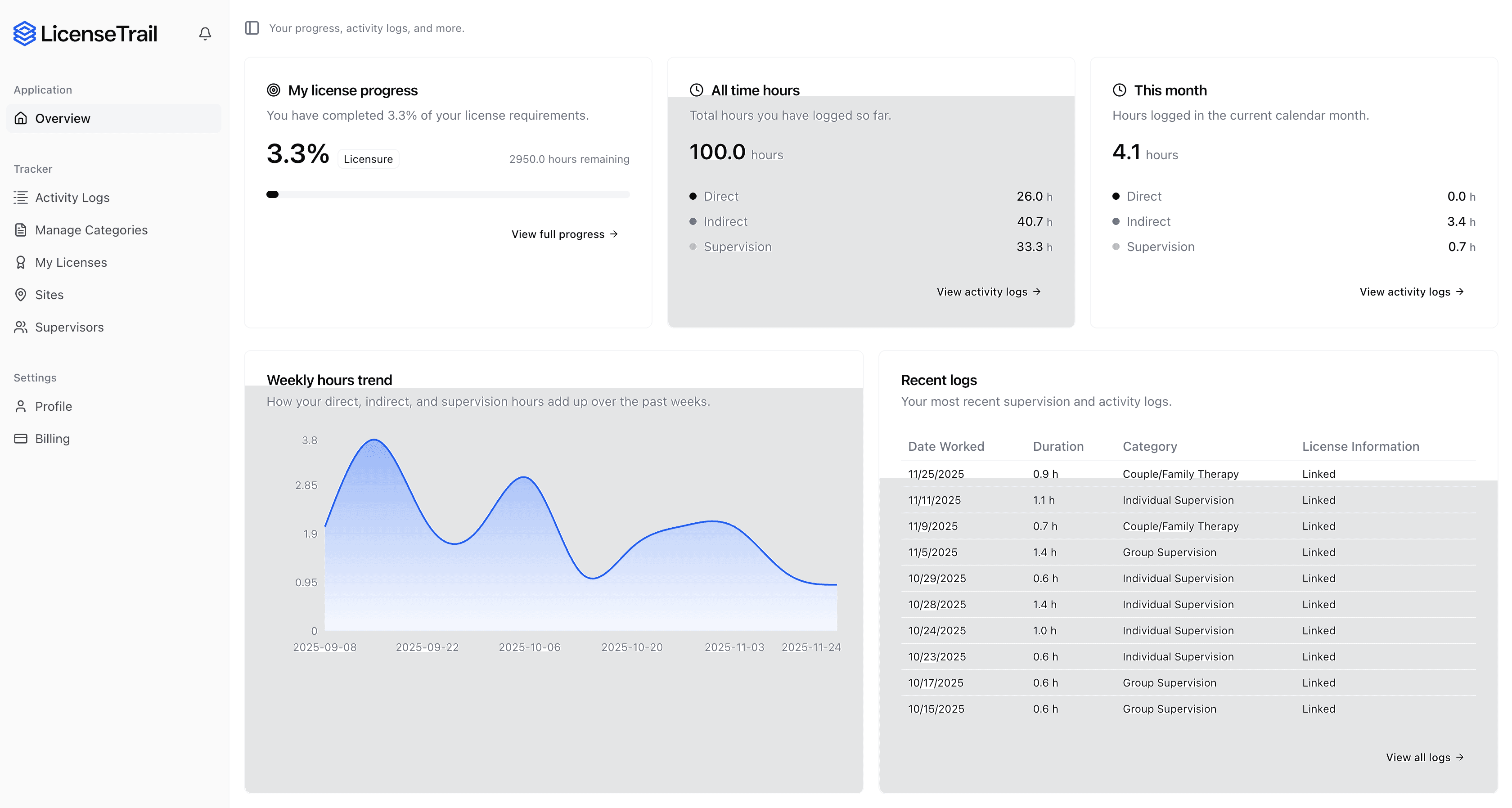
Track your LSW hours with confidence
License Trail checks your direct, indirect, and supervision hours against Hawaii LSW requirements continuously and flags mismatches before you submit.
 Start Tracking for Free
No credit card required · Free plan available
Related Licenses
Is your spreadsheet hiding Hawaii LSW risks?
Stop guessing if your categories match Hawaii Department of Commerce and Consumer Affairs (Social Worker Licensing Program) requirements. License Trail checks your direct, indirect, and supervision hours continuously and flags mismatches before you submit.
Import or log
Bring your spreadsheet or start fresh
Upload your existing tracking spreadsheet and we'll map every hour into the right Hawaii Department of Commerce and Consumer Affairs (Social Worker Licensing Program) categories automatically.
Verify against Hawaii
Catch mismatches before the board does
License Trail checks your direct, indirect, and supervision hours against Hawaii LSW requirements continuously.
Export board-ready
One-click clean reports
Generate professional, board-ready reports for supervision meetings and Hawaii Department of Commerce and Consumer Affairs (Social Worker Licensing Program) submissions in seconds.
No credit card required · Free plan available