
Idaho LMSW Requirements: Hours, Exams & Step-by-Step Guide
Stop guessing if your categories match Idaho requirements. License Trail checks your direct, indirect, and supervision hours against LMSW requirements continuously and flags mismatches before you submit.
No credit card required · Free plan available
Quick Requirements Overview
- Regulator: Idaho Board of Social Work Examiners (DOPL), not the PC/MFT board
- Education: MSW/DSW in social work from a Board‑approved school (typically CSWE‑accredited)
- Exam: Pass ASWB Master’s exam (must have been passed within the past 7 years)
- Experience (initial LMSW): No post‑degree supervised hours required
- Background/fitness: Must meet character standards; relevant criminal history can affect eligibility
- Application: Submit DOPL application + official transcript/verification + required fees
- Scope note: Psychotherapy allowed only under supervision (LCSW/psychologist/psychiatrist)
- Planning ahead (not required for LMSW): LMSW‑Independent = 3,000 hrs/2–5 yrs; LCSW = 3,000 clinical hrs/2–5 yrs + 100 supervision hrs (≥50% LCSW)
License Details
Procedures
Licensing as a Licensed Master Social Worker (LMSW) in Idaho
(under the Idaho Board of Social Work Examiners, not the counselor/MFT board)
Idaho regulates social workers through the Idaho Board of Social Work Examiners within the Division of Occupational and Professional Licenses (DOPL). This board issues the Licensed Master Social Worker (LMSW) credential, as well as LBSW, LMSW‑Independent, and LCSW licenses.(dopl.idaho.gov)
The Board of Professional Counselors and Marriage and Family Therapists (the “PC/MFT” board) regulates LPC, LCPC, and LMFT licenses and does not license social workers. Its supervised‑hour requirements (for LCPC/LMFT) are separate and do not apply to LMSWs.(dopl.idaho.gov)
Below is a step‑by‑step guide focused on Idaho’s LMSW, followed by the post‑LMSW hour requirements (independent practice and LCSW) that social workers often need to plan for.
1. How Idaho Law Defines a “Master Social Worker” and LMSW
Idaho’s Social Work Licensing Act (Title 54, Chapter 32) defines a “master social worker” as an individual licensed under the chapter who may be designated as a Licensed Master Social Worker (LMSW).(law.justia.com)
The Board’s rules describe “Master’s Social Work” as applying social work theory, knowledge, methods, and ethics at an advanced practice level—assessment, treatment planning, implementation and evaluation, case management, supportive counseling, supervision and consultation, advocacy, research, and program/policy work. Master‑level social workers who are not clinically licensed may only provide psychotherapy under supervision of an LCSW, psychologist, or psychiatrist.(adminrules.idaho.gov)
2. Initial LMSW License: Core Requirements
All licensing requirements flow from Idaho Code § 54‑3206 and the Board’s rules at IDAPA 24.14.01.
2.1 Education
To qualify for an LMSW, you must:
- Hold a master’s or doctorate in social work from a college or university approved by the Board. Idaho Code § 54‑3206 states that for a master social worker license, the applicant must “possess a master’s degree or doctorate in social work from a college or university approved by the board.”(codes.findlaw.com)
“Approved” programs are those accredited by the Council on Social Work Education (CSWE) or otherwise approved, housed in an institution accredited by a recognized higher‑education accreditor.(adminrules.idaho.gov)
2.2 Examination
Idaho requires passage of the ASWB Master’s exam:
- The Board’s rules define the “approved examination” as the applicable ASWB licensing exam for the license type, “passed within the previous seven (7) years.”(adminrules.idaho.gov)
- The Board’s FAQ explains that you must submit a complete application and fees before you will be authorized to register for the ASWB exam; once you pass and your official scores and transcript are received, the LMSW license is issued.(dopl.idaho.gov)
2.3 Character / Background
Section 54‑3206 requires that LMSW applicants:
- Have passed the examination conducted or approved by the Board; and
- “Have not been convicted, found guilty, or received a withheld judgment or a suspended sentence… of a crime that is deemed relevant” under Idaho Code § 67‑9411(1).(codes.findlaw.com)
The Board also generally requires disclosure of criminal history and may review background information to determine fitness for licensure.
2.4 Application and Fees
The Board’s fee schedule lists for LMSW:
- Application fee (all social work licenses): up to $70.
- LMSW license fee: up to $80 per renewal cycle (Board currently lists LMSW/LSW renewal as $160 biennial / $80 annual).(adminrules.idaho.gov)
You apply to the Board of Social Work Examiners via DOPL’s online portal, submitting:
- Completed LMSW application
- Proof of identity
- Verification of education (official transcript, or program verification if applying before graduation)
- Required fees
3. Experience Requirements for Initial LMSW Licensure
This is the critical point for your question about hours.
3.1 Experience Required for the LMSW License Itself
For LMSW initial licensure, Idaho does not require any post‑degree experience hours.
Idaho Code § 54‑3206 sets out different pathways for each license type. The section explicitly requires “two (2) years of postgraduate supervised clinical experience” only for the clinical social worker (LCSW) license. For the master social worker license, it requires only the master’s or doctoral degree in social work from an approved college or university; **no supervised practice hours are listed for this license level.(codes.findlaw.com)
Connecticut’s legislative summary of state licensure requirements reflects this: Idaho’s Licensed Master Social Worker (LMSW) is shown with “0” required experience hours for initial licensure, while LCSW and LMSW‑Independent show post‑graduate experience requirements.(cga.ct.gov)
So, to become an LMSW in Idaho, you do not need a specific number of practice hours beyond any fieldwork required to earn your CSWE‑accredited MSW.
4. Hours That Come After the LMSW
Although you can obtain the LMSW without post‑degree hours, Idaho law and rules do impose detailed hour requirements for:
- Independent non‑clinical practice at the BSW or MSW level (LBSW‑Independent or LMSW‑Independent); and
- Clinical licensure (LCSW) — which you pursue after you hold an LMSW.
Because your question emphasized the type of hours and the Board’s own language, this section outlines those hour requirements.
4.1 Independent Practice at the BSW or MSW Level (LMSW‑Independent)
Idaho allows Baccalaureate and Master Social Workers to earn a separate independent practice authorization (non‑clinical, non‑private practice). This applies to LMSWs who want to practice more autonomously within the non‑clinical LMSW scope.(mswguide.org)
Board‑focused summaries of Idaho’s rules describe the requirement this way:
- A Bachelor Social Worker or Master Social Worker who seeks authorization as an independent practitioner must complete at least 3,000 hours of practice over two (2) to five (5) years.
- The supervisor must be a social worker already authorized as an independent practitioner, and at a license level at least equal to the supervisee’s level (for example, an independent BSW may supervise an LBSW; an independent LMSW or LCSW may supervise an LMSW toward independent status).(mswguide.org)
Key points about these 3,000 hours for independent LMSW practice:
- They are general social work practice hours, not specifically clinical/psychotherapy hours.
- No official breakdown (e.g., direct vs. indirect) appears in statute for independent (non‑clinical) practice; instead, the focus is that the practice is within your LMSW scope (assessment, treatment planning, interventions, case management, etc., but not unsupervised psychotherapy).(adminrules.idaho.gov)
- The independent‑practice supervision plan must be approved by the Board before you start counting hours.(mswguide.org)
Once you complete these 3,000 hours and meet any additional Board requirements, your LMSW license can be upgraded to LMSW‑Independent, allowing independent but still non‑clinical practice.
4.2 Clinical Licensure (LCSW) — Hours Required After LMSW
For many LMSWs, the ultimate goal is to become a Licensed Clinical Social Worker (LCSW). The Idaho rules are very explicit about the type and number of hours required, and this is where the breakdown you asked about appears.
Under IDAPA 24.14.01.100.03, the Board defines “Approved Postgraduate Supervised Clinical Experience for Clinical Social Worker License” as:(adminrules.idaho.gov)
Total Clinical Experience Hours
- 3,000 hours of supervised clinical social work experience, completed over no fewer than 2 and no more than 5 years.
Breakdown of those 3,000 hours by type
Within the 3,000 hours, Idaho requires:
-
1,750 hours of direct client contact
- These hours must be direct, face‑to‑face work with clients providing treatment in clinical social work—for example, psychotherapy, clinical interventions, and related therapeutic services.(adminrules.idaho.gov)
-
1,250 hours of assessment, diagnosis, and other clinical social work
- These can include assessment, diagnosis, treatment planning, documentation, and other clinical social work activities, and may include indirect hours that occur outside the client’s presence (e.g., charting, consultation about clinical cases).(adminrules.idaho.gov)
Supervision Hours Within the 3,000 Clinical Hours
The rule also specifies minimum supervision contact:
- At least 100 hours of face‑to‑face supervision with your clinical supervisor(s).
- Supervision may be in‑person or via live electronic connection.
- No more than 50 of these 100 hours may be in group supervision format; the remainder must be individual face‑to‑face supervision.(adminrules.idaho.gov)
Who Can Provide the Supervision
- At least 50% of the total supervision must be provided by a Licensed Clinical Social Worker (LCSW).
- The remaining supervision can be provided by a licensed clinical psychologist, psychiatrist, clinical professional counselor, or marriage and family therapist, all of whom must be licensed and in good standing in the state where the experience occurs.(adminrules.idaho.gov)
The Board’s “Supervision and Supervisor Information” page reinforces this for LMSWs:
- An LMSW who wants to work toward clinical licensure must first obtain a supervisor who meets Rules 002.03 and 100.03, and
- “You must have an LCSW supervise at least 50% of your clinical hours” and file a Board‑approved supervision plan before you begin counting hours.(dopl.idaho.gov)
Other Conditions on the 3,000 Clinical Hours
- The hours must be completed in 2–5 years; going beyond 5 years triggers a competency review.(adminrules.idaho.gov)
- Hours spent on case management do not count toward the required 3,000 clinical hours; they are explicitly excluded in the rule.(adminrules.idaho.gov)
- Supervision must be “interactive and consultative teaching” aimed at improving your clinical knowledge and skills, not just administrative oversight.(adminrules.idaho.gov)
Once those hours and supervision are complete and documented on the Board’s Clinical Supervision Report forms, you can apply to sit for the ASWB Clinical exam and upgrade to LCSW.(adminrules.idaho.gov)
5. Scope of Practice and Practice Settings for Idaho LMSWs
Putting the above into practical terms for an LMSW in Idaho:
-
At initial licensure (LMSW)
- You may provide advanced social work services such as assessment, treatment planning, supportive counseling, case management, program administration, advocacy, and research, consistent with the Board’s definition of “Master’s Social Work.”(adminrules.idaho.gov)
- You may provide psychotherapy only under supervision by an LCSW, psychologist, or psychiatrist.
-
After 3,000 hours of general supervised practice (LMSW‑Independent)
- You may engage in independent non‑clinical practice within your LMSW scope (e.g., autonomous case management, supportive counseling, program administration) as defined by the Board’s standards and by Idaho’s definitions of “independent practice” versus “private practice.”(law.justia.com)
-
After 3,000 hours of supervised clinical experience (LCSW)
- You may independently practice clinical social work, including diagnosis and treatment of mental, emotional, and behavioral disorders, and may engage in private practice as defined in § 54‑3207.(adminrules.idaho.gov)
Summary of Key Hour Requirements Relevant to an Idaho LMSW
-
To obtain the LMSW license itself:
- 0 hours of post‑degree experience required.
- Requirements are education (MSW/DSW in social work from an approved program), passing the ASWB Master’s exam, and meeting character/fitness standards.(codes.findlaw.com)
-
To gain independent (non‑clinical) practice status as an LMSW (LMSW‑Independent):
- 3,000 hours of supervised practice over 2–5 years, supervised by an independent social worker at or above your license level, under a Board‑approved plan.(mswguide.org)
-
To progress from LMSW to LCSW (clinical license):
- 3,000 hours of supervised clinical social work over 2–5 years, of which:
- 1,750 hours must be direct client contact in clinical treatment.
- 1,250 hours must be assessment, diagnosis, and other clinical social work (including certain indirect hours).
- At least 100 hours of face‑to‑face supervision, no more than 50 hours in group supervision.
- At least 50% of supervision must be by an LCSW; remaining supervision may be by other specified licensed mental health professionals.(adminrules.idaho.gov)
- 3,000 hours of supervised clinical social work over 2–5 years, of which:
These structures—no hours for initial LMSW, 3,000 hours for independent non‑clinical practice, and 3,000 tightly defined clinical hours for LCSW—reflect the Idaho Board of Social Work Examiners’ current statutes and administrative rules.
Track your LMSW hours with confidence
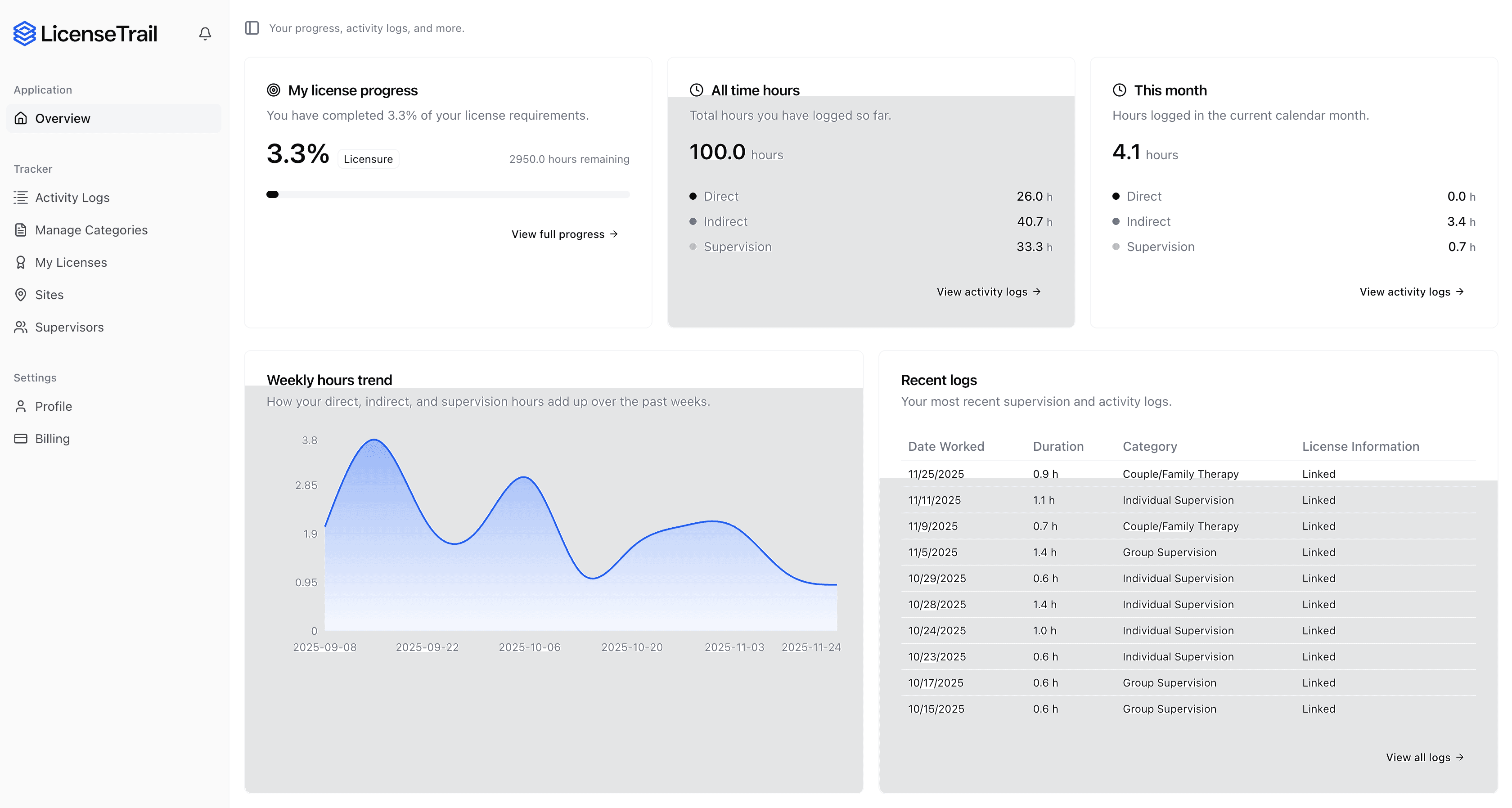
License Trail checks your direct, indirect, and supervision hours against Idaho LMSW requirements continuously and flags mismatches before you submit.
 Start Tracking for Free
No credit card required · Free plan available
Is your spreadsheet hiding Idaho LMSW risks?
Stop guessing if your categories match Idaho Board ofPC, MFT and Professional Counselors requirements. License Trail checks your direct, indirect, and supervision hours continuously and flags mismatches before you submit.
Import or log
Bring your spreadsheet or start fresh
Upload your existing tracking spreadsheet and we'll map every hour into the right Idaho Board ofPC, MFT and Professional Counselors categories automatically.
Verify against Idaho
Catch mismatches before the board does
License Trail checks your direct, indirect, and supervision hours against Idaho LMSW requirements continuously.
Export board-ready
One-click clean reports
Generate professional, board-ready reports for supervision meetings and Idaho Board ofPC, MFT and Professional Counselors submissions in seconds.
No credit card required · Free plan available