
Illinois ALMFT Requirements: Hours, Exams & Step-by-Step Guide
Stop guessing if your categories match Illinois requirements. License Trail checks your direct, indirect, and supervision hours against ALMFT requirements continuously and flags mismatches before you submit.
No credit card required · Free plan available
Quick Requirements Overview
- Qualifying graduate degree (Master’s/Doctoral) in MFT or related field meeting IL Rule 1283.30; minimum 48 semester hours MFT curriculum
- Degree must include practicum/internship: 300 face-to-face hours, including 100 conjoint (deficits must be completed before post-degree hours count)
- No exam required to obtain ALMFT; issuance authorizes you to sit for the AMFTRB National MFT Exam
- No post-degree experience required to be issued the ALMFT
- No independent practice: must practice under qualified clinical supervision (per IL rules)
- ALMFT is valid 5 years, one-time only, not renewable
- Application via IDFPR (CORE) with education verification (transcripts/ED form, AAMFT Clinical Membership, or course-by-course docs) + fee; out-of-state license certification if applicable
- Hours typically accrued under ALMFT toward LMFT: 3,000 professional work hours in 2–5 years, including 1,000 face-to-face clinical (≥350 individual + ≥350 conjoint) and 200 clinical supervision (≥100 individual; ≥100 post-degree)
License Details
Procedures
In Illinois, the Associate Licensed Marriage and Family Therapist (ALMFT) is the supervised, pre‑independent license issued by the Illinois Department of Financial and Professional Regulation (IDFPR), under the Marriage and Family Therapy Licensing and Disciplinary Board. It is designed for new graduates who are accumulating hours toward full Licensed Marriage and Family Therapist (LMFT) status.
Below is a step‑by‑step guide focused first on what you need to obtain the ALMFT itself, then on the specific types of hours the Board requires you to complete while practicing under that license.
1. What the ALMFT Is (and Is Not)
Purpose and status
- The ALMFT is a transitional license for those who have completed a qualifying graduate degree and are working toward the requirements for LMFT licensure. (iamft.org)
- By statute, an associate licensed marriage and family therapist “may not practice independently” and “must be clinically supervised by a licensed marriage and family therapist or equivalent as defined by rule.” (law.justia.com)
Duration
- The associate license is valid for 5 years and cannot be renewed; it is expressly described as a “one‑time only, not renewable license,” expiring 5 years from the issue date. (law.cornell.edu)
2. Core Requirements to Become an ALMFT
The Board has published a dedicated “Qualifications for Licensure: Associate Licensed Marriage and Family Therapist (208)” document, effective December 2024. (idfpr.illinois.gov) It organizes ALMFT requirements into three main categories: education, examination, and experience.
2.1 Education – Graduate Level Program with MFT Curriculum
The ALMFT qualifications state that you must have:
- “A graduate level education experience as described in Rules 68 IAC Section 1283.30.” (idfpr.illinois.gov)
Section 1283.30 of the Illinois Administrative Code then spells out what this “education experience” must look like. In summary:
-
Qualifying degree
You must hold a master’s or doctoral degree in:
- Marriage and family therapy from a program accredited by COAMFTE or CACREP, or (law.cornell.edu)
- Marriage and family therapy or a related behavioral/mental health field from a regionally accredited institution, with an equivalent course of study meeting the Board’s curriculum rules. (law.cornell.edu)
-
Minimum graduate coursework
- At least 48 semester hours (or equivalent) of graduate coursework. (law.cornell.edu)
- Coursework must cover specific content areas, including:
- Clinical interviewing / individual therapy
- Family therapy (foundations and advanced models)
- Couples therapy
- Psychopathology / diagnostic systems (DSM/ICD)
- Individual development and family relations
- Ethics / professional studies
- Research methods
- Assessment in marriage and family therapy (law.cornell.edu)
-
Practicum / Internship hours in the degree
The rules require a clinical practicum/internship that:
- Is at least 300 hours in length
- Includes 100 hours of conjoint therapy (sessions with two or more clients in significant relationships with each other)
- Consists entirely of face‑to‑face contact with individuals, couples, families, or groups for assessment, diagnosis, and treatment (law.cornell.edu)
The rules further specify that any deficit in these 300 face‑to‑face hours must be completed before you begin counting post‑degree “Clinical Experience” hours toward LMFT licensure. (law.cornell.edu)
2.2 Examination – Not Required for ALMFT Licensure
The current IDFPR ALMFT qualifications are explicit:
- “Illinois Associate Licensed Marriage and Family Therapist licensure does not require a licensing examination.” (idfpr.illinois.gov)
Instead, once the ALMFT license is issued, IDFPR notes that:
- “When an Associate Licensed Marriage and Family Therapist license is issued, IDFPR provides approval to sit for the National Marriage and Family Therapy Examination.” (idfpr.illinois.gov)
So the usual sequence is:
- Complete qualifying graduate education.
- Obtain ALMFT.
- Then sit for the national AMFTRB exam while accumulating your post‑degree hours.
2.3 Experience – None Required to Obtain the ALMFT
The same qualifications document states plainly:
- “No experience is required for Illinois Associate Licensed Marriage and Family Therapist licensure.” (idfpr.illinois.gov)
That means:
- There is no required number of post‑degree client‑contact hours, supervision hours, or professional work hours to receive the ALMFT itself.
- The only “hours” baked into the ALMFT requirement are those that were already part of your graduate practicum/internship (the 300 face‑to‑face hours described above).
3. Documentation Pathways for Demonstrating Education
To apply, IDFPR requires you to document that your education meets Rule 1283.30. You must submit one of the following options: (idfpr.illinois.gov)
Option A – COAMFTE/CACREP MFT degree
- Official transcript(s) or an Education (ED) form showing a graduate MFT degree accredited by:
- Commission on Accreditation for Marriage and Family Therapy Education (COAMFTE), or
- Commission on Accreditation of Counseling and Related Educational Programs (CACREP).
Option B – AAMFT Clinical Membership
- Evidence of Clinical Membership in the American Association for Marriage and Family Therapy (AAMFT).
Option C – Detailed course‑by‑course documentation
- Completed Certification of Education (ED) form documenting a graduate degree that fits Rule 1283.30.
- Official transcripts for each institution where you completed graduate‑level MFT coursework.
- Course descriptions (from the time you took them) for each graduate‑level MFT course, to show they match the required curriculum.
If you already hold a comparable license in another state or U.S. jurisdiction, you must also provide Certification of Licensure from that state. (idfpr.illinois.gov)
4. Application Mechanics for the ALMFT
From the statute and rules, the application for an ALMFT license must include: (law.cornell.edu)
-
Application Form
- Filed through IDFPR’s CORE online system.
-
Verification of Education
- Proof that you have completed the education requirements in Section 1283.30 (using the transcript/ED form and documentation options above).
-
Required Fee
- The associate license fee set out in Section 1283.95(a)(2) of the rules.
-
(If applicable) Out‑of‑state licensure certification
- If you were originally licensed elsewhere, certification from that state confirming:
- The period you were licensed.
- The examination used.
- Any disciplinary history.
- If you were originally licensed elsewhere, certification from that state confirming:
IDFPR’s ALMFT qualifications also emphasize that applications remain active for three years from receipt, and direct applicants to IDFPR’s FAQs and phone line for questions. (idfpr.illinois.gov)
5. Supervision and Scope While You Hold the ALMFT
Even though no post‑degree hours are required to get the ALMFT, the law places clear limits on how you may practice with that credential.
5.1 No independent practice
The Marriage and Family Therapy Licensing Act specifies that an associate licensed marriage and family therapist:
- May not practice independently; and
- Must be clinically supervised by a licensed marriage and family therapist or an equivalent supervisor as defined in rule. (law.justia.com)
5.2 How “clinical supervision” is defined
The Board defines supervision in detail in Section 1283.25. Key points include: (law.cornell.edu)
- Total requirement for LMFT: An applicant must complete 200 hours of clinical supervision of marriage and family therapy.
- At least 100 of those 200 hours must occur after receiving the first qualifying degree; up to 100 hours earned during graduate training may count.
- At least 100 of the 200 hours must be with a supervisor who meets specific criteria (e.g., AAMFT Approved Supervisor, LMFT with 5 years of clinical experience, or certain other licensed clinicians who meet MFT‑specific experience thresholds).
- At least 100 of the 200 supervision hours must be “individual supervision,” defined as a maximum of two supervisees meeting with one supervisor.
- “Supervision” itself is defined as direct clinical review by a supervisor of your interactions with clients, delivered through live, interactive, face‑to‑face (including approved video) conversations, using raw clinical data (live observation, co‑therapy, notes, recordings, etc.), with the purpose of developing your clinical skills.
While you are an ALMFT, the supervision you receive should be structured to meet these regulatory criteria so that it can later be counted toward LMFT requirements.
6. The Post‑Degree Hours You Will Accumulate Under an ALMFT (Toward LMFT)
Although not required to obtain the ALMFT, the Board lays out very specific hour requirements you must meet after your first qualifying degree to become a fully licensed LMFT. These hours are generally accumulated while you hold the ALMFT.
6.1 Overall professional work experience requirement
Section 1283.15 states that an applicant for LMFT licensure must: (law.cornell.edu)
- Complete at least 3,000 hours of professional work experience in marriage and family therapy.
- These 3,000 hours must be accrued:
- After receiving the first qualifying graduate degree, and
- In not less than 2 years and not more than 5 years.
The rule further explains:
- Professional work experience is defined as providing professional services that include:
- Clinical activities as defined in the “Clinical Experience” rule, and
- Non‑clinical activities related to the practice of marriage and family therapy. (law.cornell.edu)
Within those 3,000 hours, the Board explicitly requires:
- 1,000 hours of Clinical Experience (face‑to‑face client contact)
- 200 hours of Clinical Supervision
So, in Board language, the 3,000‑hour requirement is not split into “1,500 direct experience / 1,500 supervised experience,” but rather:
- 3,000 total professional work hours, including:
- 1,000 hours of clinical experience (face‑to‑face client contact)
- 200 hours of clinical supervision
The remaining 1,800 hours are additional professional work experience (a mix of clinical and related non‑clinical tasks, such as case notes, trainings, and other professional activities in MFT practice). (law.cornell.edu)
6.2 Breakdown of the 1,000 hours of “Clinical Experience”
Section 1283.20 describes “Clinical Experience” as follows: (law.cornell.edu)
- After your first qualifying degree, you must complete at least 1,000 hours of face‑to‑face client contact with individuals, couples, and families for the evaluation and treatment of mental, emotional, behavioral, and interpersonal disorders.
Within those 1,000 hours:
- At least 350 hours must involve working with only one client present in the session (individual therapy that is part of treatment of couples or families).
- At least 350 hours must be conjoint therapy, meaning sessions with two or more clients present who are in significant relationships with each other outside therapy.
The rule also specifies examples of clinical activities that count toward this category, including:
- Individual and conjoint therapy
- Psychotherapy and counseling
- Assessment and treatment of mental, emotional, behavioral and interpersonal disorders
- Crisis intervention, group therapy, multi‑family therapy, psychoeducation, and other direct treatment services in the MFT scope. (law.cornell.edu)
6.3 Detailed requirements for the 200 hours of “Clinical Supervision”
As noted earlier, Section 1283.25 requires: (law.cornell.edu)
- 200 total hours of clinical supervision in marriage and family therapy.
Within those 200 hours:
-
Timing
- At least 100 hours must be post‑degree (after your first qualifying degree).
- Up to 100 hours can come from graduate training (practicum/internship) if they meet all supervision criteria.
-
Supervisor qualifications
- At least 100 of the 200 hours must be with a supervisor who:
- Is an AAMFT Approved Supervisor or supervisor‑in‑training, or
- Is an LMFT with at least 5 years of clinical MFT experience, or
- Meets a set of equivalent licensure and experience conditions (e.g., licensed clinical psychologist, LCSW, LCPC, or psychiatrist with at least five years of MFT clinical experience and at least 1,000 hours of conjoint therapy, plus supervision training/experience).
- At least 100 of the 200 hours must be with a supervisor who:
-
Format
- 100 of the 200 hours must be individual supervision (no more than two supervisees with one supervisor).
- Group supervision can include up to six supervisees per supervisor.
All of these supervised hours must meet the Board’s definition of “supervision” (live, interactive, face‑to‑face—onsite or synchronous video—with review of your actual clinical work).
7. How the Pieces Fit Together in Practice
Putting the rules together, the typical Illinois MFT path looks like this:
-
Complete a qualifying graduate MFT degree
- Includes 300 practicum/internship hours (100 conjoint, all face‑to‑face). (law.cornell.edu)
-
Apply for and obtain the ALMFT
- Submit the online application via CORE.
- Document your education per Rule 1283.30 (transcripts, ED form, or AAMFT Clinical Membership).
- Pay the ALMFT fee.
- No post‑degree hours or exam are required at this stage. (idfpr.illinois.gov)
-
Practice as an ALMFT under clinical supervision
- You cannot practice independently.
- You must be clinically supervised by a qualified supervisor as defined in the rules and statute. (law.justia.com)
-
While licensed as an ALMFT, accumulate the hours for LMFT
- 3,000 hours of professional work experience over 2–5 years, including:
- 1,000 hours of face‑to‑face clinical experience (with at least 350 hours individual and 350 hours conjoint therapy).
- 200 hours of clinical supervision, structured per Section 1283.25.
- The remaining 1,800 hours are additional professional work related to MFT practice. (law.cornell.edu)
- 3,000 hours of professional work experience over 2–5 years, including:
-
Sit for and pass the National MFT Exam
- Once your ALMFT is issued, IDFPR authorizes you to take the AMFTRB National Marriage and Family Therapy Examination. (idfpr.illinois.gov)
-
Apply for LMFT licensure
- Submit verification of your 3,000 hours of professional work experience, including 1,000 clinical hours and 200 supervision hours, along with exam results and required fees, under Section 1283.46. (regulations.justia.com)
In summary: to become an ALMFT in Illinois, you must complete a qualifying graduate MFT education (including a 300‑hour practicum), document that education according to Rule 1283.30, submit the ALMFT application and fee, and you do not need any post‑degree experience hours or an exam at that stage. Once licensed as an ALMFT, you then earn the Board‑specified 3,000 total professional hours, including 1,000 hours of clinical experience and 200 hours of clinical supervision, under appropriate supervision, to qualify later for full LMFT licensure.
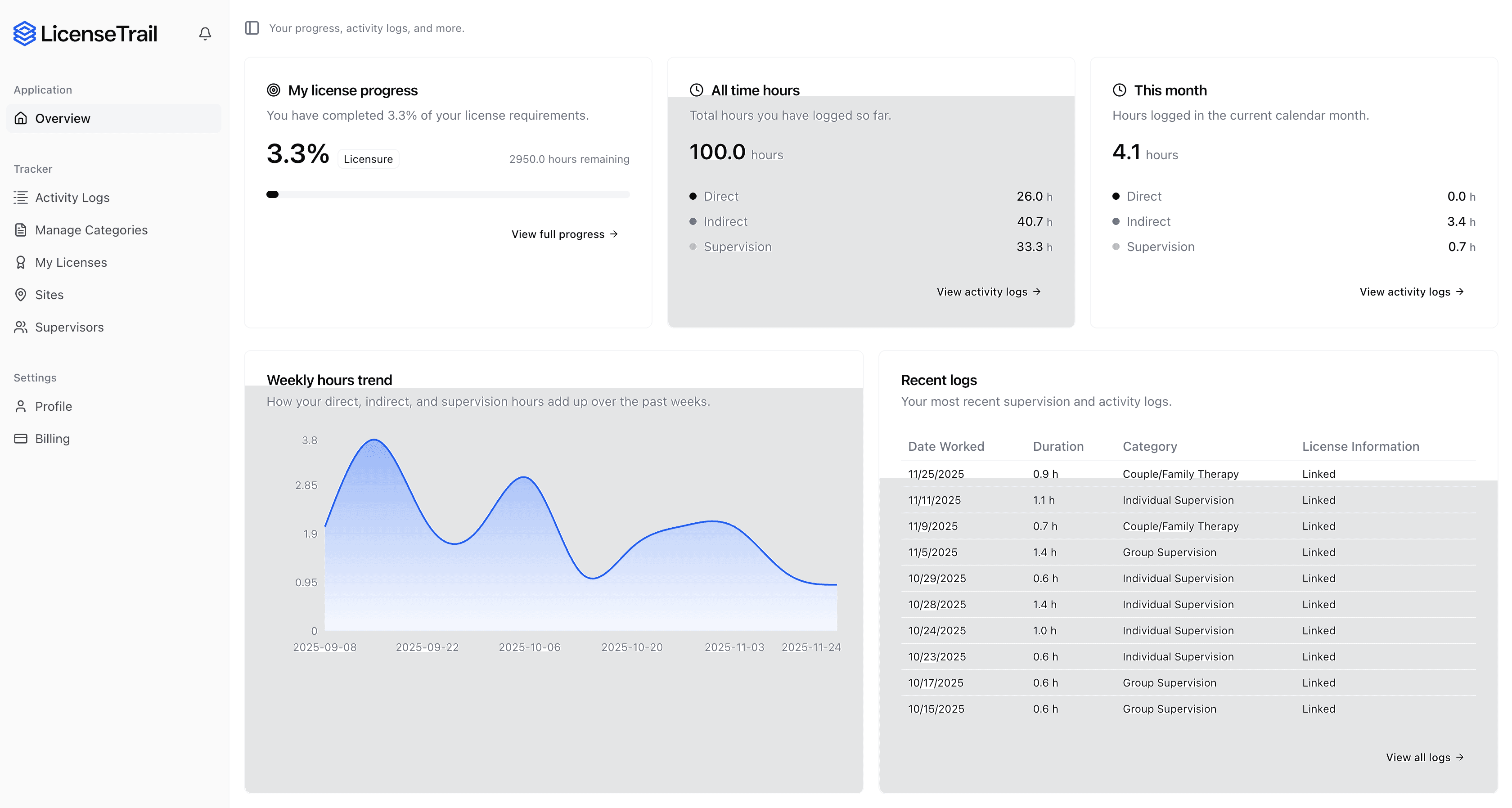
Track your ALMFT hours with confidence
License Trail checks your direct, indirect, and supervision hours against Illinois ALMFT requirements continuously and flags mismatches before you submit.
 Start Tracking for Free
No credit card required · Free plan available
Related Licenses
Is your spreadsheet hiding Illinois ALMFT risks?
Stop guessing if your categories match Illinois Department of Financial and Professional Regulation (Marriage and Family Therapy Licensing and Disciplinary Board) requirements. License Trail checks your direct, indirect, and supervision hours continuously and flags mismatches before you submit.
Import or log
Bring your spreadsheet or start fresh
Upload your existing tracking spreadsheet and we'll map every hour into the right Illinois Department of Financial and Professional Regulation (Marriage and Family Therapy Licensing and Disciplinary Board) categories automatically.
Verify against Illinois
Catch mismatches before the board does
License Trail checks your direct, indirect, and supervision hours against Illinois ALMFT requirements continuously.
Export board-ready
One-click clean reports
Generate professional, board-ready reports for supervision meetings and Illinois Department of Financial and Professional Regulation (Marriage and Family Therapy Licensing and Disciplinary Board) submissions in seconds.
No credit card required · Free plan available