
Illinois LCP Requirements: Hours, Exams & Step-by-Step Guide
Stop guessing if your categories match Illinois requirements. License Trail checks your direct, indirect, and supervision hours against LCP requirements continuously and flags mismatches before you submit.
No credit card required · Free plan available
Quick Requirements Overview
- Doctoral degree required (APA-accredited/National Register–approved clinical/school/counseling program or IDFPR-equivalent meeting core content areas)
- Practicum: ≥400 hours direct clinical services; ≥40 hours face-to-face supervision; does not count toward the 2 supervised years
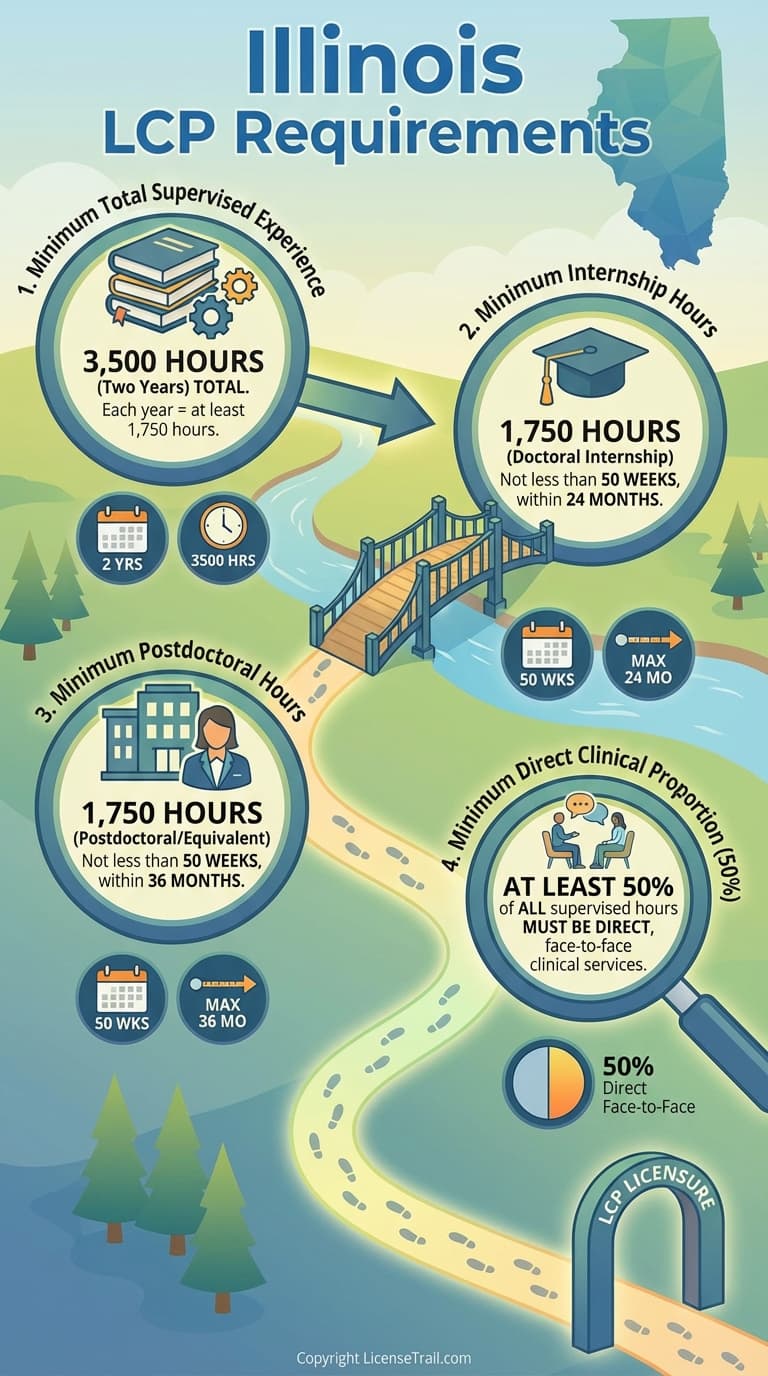
- Supervised experience: 2 years total = 3,500 hours (1,750 hrs/year), with one year = internship and one year postdoctoral
- Internship: ≥1,750 hours in ≥50 weeks and within 24 months; structured program; 1 hr/week face-to-face individual supervision + 2 hrs/week learning activities
- Additional/postdoc year: ≥1,750 hours in ≥50 weeks within 36 months; ≥1 hr/week face-to-face individual supervision
- Direct service threshold: across the 3,500 supervised hours, ≥50% must be ongoing, face-to-face client services
- Supervisor rules: supervised work under supervisor’s “order, control, and full professional responsibility”; supervisor must be licensed (active/good standing); paid supervision by supervisee not accepted
- Exam: pass EPPP (or ABPP clinical/counseling exam accepted)
License Details
Procedures
In Illinois, the Licensed Clinical Psychologist (LCP) credential is issued by the Illinois Department of Financial and Professional Regulation (IDFPR), under the Clinical Psychologist Licensing Act and its implementing rules in 68 Ill. Adm. Code Part 1400. The Clinical Psychologist Licensing and Disciplinary Board advises IDFPR on these standards.
Below is a structured description of the requirements, with a focus on the type and number of hours and the precise categories used by the Board.
1. Basic eligibility and degree requirements
Illinois requires a doctoral degree plus specific supervised experience and an exam.
Under Section 10 of the Clinical Psychologist Licensing Act and 68 Ill. Adm. Code §1400.100, an applicant must: (law.justia.com)
-
Hold a doctoral degree from:
- An APA‑accredited (or National Register–approved) clinical, school, or counseling psychology program; or
- A doctoral program the Department deems equivalent to a clinical/school/counseling program; or
- A doctoral psychology program or a program “psychological in nature” that meets detailed criteria and includes coursework in seven core content areas (ethics, biological, cognitive‑affective, social bases of behavior, individual differences, assessment, and treatment modalities). (law.cornell.edu)
-
Complete:
- A practicum,
- An internship or equivalent supervised clinical experience, and
- Two years of supervised clinical psychology experience, one of which must be an internship and one of which must be postdoctoral. (law.cornell.edu)
2. Categories of experience and required hours
Illinois law and rule do not use a simple “X direct hours + Y supervised hours” formula. Instead, they define several layers of experience:
- Practicum (externship/clerkship) – minimum 400 hours (does not count toward the two supervised years).
- Internship (or equivalent supervised clinical experience) – minimum 1,750 hours within 24 months (this is one full “year” of supervised experience).
- Additional supervised clinical experience (including required postdoctoral year) – at least one more “year” of 1,750 hours, with specific conditions (supervision, time frame, and proportion of direct services).
In total, to meet the two supervised years requirement, you need at least:
- 3,500 hours of supervised clinical experience (2 “years” × 1,750 hours),
- Plus a separate 400‑hour practicum that does not count toward those 3,500 hours. (law.cornell.edu)
Below, each category is broken out in the Board’s own terms.
2.1 Practicum (externship or clerkship)
The practicum is defined in 68 Ill. Adm. Code §1400.110(b) and must: (law.cornell.edu)
- Be part of doctoral coursework or an equivalent 400 hours of coursework or training with a “grade of satisfactory or better” in a new area of competence approved by the Board.
- “Involve the applicant in direct clinical psychology services to the client.”
- Provide personal supervision by:
- A licensed clinical psychologist,
- A licensed psychologist engaged in clinical psychology, or
- A person with the educational and experience qualifications necessary for licensure (but not someone who has failed the licensing exam).
- Be under the “order, control and full professional responsibility of the supervisor,” who must meet with the applicant face‑to‑face for at least 40 hours.
- Be “a minimum of 400 hours in duration” (not necessarily in one setting).
- Does not count toward the two years of supervised experience required for licensure.
Key idea: Practicum is a 400‑hour, supervised, direct‑service training experience embedded in your doctoral program, but it is separate from and in addition to the required two supervised years.
2.2 Internship (or equivalent supervised clinical experience)
The internship is governed by §1400.110(c). It is considered part of the required “two years of supervised experience” and must meet all of the following: (law.cornell.edu)
-
Organized training program
- Must be a pre‑planned, programmed sequence of training experiences with documented goals and objectives to ensure “breadth and quality of training.”
-
Supervision and learning activities
- At least 1 hour per week of regularly scheduled, face‑to‑face individual supervision specifically focused on the health services you deliver.
- At least 2 additional hours per week in learning activities such as:
- Case conferences (including your own cases),
- Seminars on clinical issues,
- Co‑therapy with staff (with discussion),
- Group supervision,
- Additional individual supervision.
-
Nature of work
- Must “involve the applicant in direct clinical psychology services to the client” as defined in the Act.
-
Supervisor qualifications and authority
- Supervision must be by a licensed clinical psychologist or a licensed psychologist engaged in clinical psychology whose license is active and in good standing.
- The experience must be under the order, control and full professional responsibility of the supervisor.
-
Required hours and time frame
- Must include a minimum of 1,750 hours completed within 24 months.
- Those 1,750 hours:
- May not be completed in less than 50 weeks, regardless of hours per week.
- For full‑time experience:
- At least 35 hours per week, in a single setting, for a minimum of six months.
- For part‑time experience:
- At least 18 hours per week, in a single setting, for a minimum of nine months. (law.cornell.edu)
-
Level and evaluation
- Must be post‑practicum level.
- Supervisor must evaluate your performance as “satisfactory or better.”
In short:
Illinois defines one “year” of internship as 1,750 hours of supervised clinical work in no fewer than 50 weeks, with intensive, structured supervision and training.
2.3 Clinical experience (including the postdoctoral year)
After (or sometimes overlapping with) the internship, you must complete additional supervised clinical experience so that you have two total supervised years, at least one of which is postdoctoral. (law.justia.com)
This is detailed in §1400.110(d):
-
Amount and timing of hours
- At least two years of supervised clinical experience, with at least one year postdoctoral.
- A “year of experience is defined as 1,750 hours obtained in not less than 50 weeks and completed within a 36‑month period.” (law.cornell.edu)
- Full‑time experience:
- At least 35 hours per week in a single setting for at least six months.
- Part‑time experience:
- At least 18 hours per week in a single setting for at least nine months.
- Practicum hours may not be counted toward these two years.
Because the statute requires two years and defines one year as 1,750 hours, you must accumulate at least:
3,500 hours of supervised clinical experience (including your 1,750‑hour internship and at least 1,750 hours of additional supervised experience, of which at least one “year” is postdoctoral). (law.justia.com)
-
Postdoctoral requirement
- “At least one year of [the two years] must be post‑doctoral.”
- Postdoctoral experience may begin upon completion of degree requirements (even before formal graduation), provided the school verifies the date on which degree requirements were completed. (law.cornell.edu)
-
Direct‑service requirement (the Board’s “direct experience” concept)
For the two supervised years (internship + postdoctoral/other supervised experience), the rules impose a direct‑service threshold:
-
The experience must:
- “Include a minimum of one hour per week of regularly scheduled, face‑to‑face individual supervision focused on the health services you provide”; and
- “Include a minimum of 50% of the required hours spent providing services where you have an ongoing, face‑to‑face relationship with the individuals being treated or otherwise working with.” (law.cornell.edu)
-
The rules give examples of what does count toward this 50%:
- Ongoing individual or group psychotherapy,
- Time‑limited psychotherapy,
- Assessments for ADHD, learning disabilities, developmental disabilities, or behavioral disorders,
- Forensic evaluations,
- General psychological assessments,
- Neuropsychological assessments,
- Comprehensive intake assessments at psychiatric facilities. (law.cornell.edu)
-
And examples of what does not satisfy the 50% threshold (though such hours can still be included as long as they make up less than half of your total experience), such as:
- Telephone‑based intake assessments,
- Front‑office work at a mental health center,
- Large‑group prevention lectures in schools,
- Crisis‑line phone work, data collection, and statistical analysis,
- Teaching psychology courses. (law.cornell.edu)
Translating this into a “direct vs. other” breakdown:
- Across the 3,500 supervised hours, at least 1,750 hours must be face‑to‑face, ongoing clinical services as described above.
- The remaining hours (up to 1,750) may include non‑direct tasks as long as they are part of supervised clinical psychology work that meets the Board’s criteria.
-
-
Supervisory relationship
The Act and rules emphasize that all qualifying supervised experience must: (law.cornell.edu)
- Be “personally and individually supervised” by:
- A licensed clinical psychologist, or
- A licensed psychologist engaged in the practice of clinical psychology, whose license is active and in good standing.
- Be carried out under the order, control, and full professional responsibility of the supervisor.
- Involve clients who are the clients of the agency or supervisor rather than the supervisee.
- Not involve situations where:
- The supervisor receives monetary payment or other consideration from the supervisee, or
- The supervisor is hired or otherwise employed by the supervisee.
Such arrangements are not accepted to fulfill practicum, internship, or the two years of supervised experience.
- Be “personally and individually supervised” by:
3. Examination requirement
Illinois specifies the national licensing exam used for psychologists:
- The required examination is the Examination for Professional Practice in Psychology (EPPP), developed by the Association of State and Provincial Psychology Boards. (ilga.gov)
- The minimum passing score is the passing score set by the testing entity.
- Illinois will accept:
- Passing EPPP scores from another jurisdiction, sent directly by the testing service; or
- In lieu of the EPPP, passage of the American Board of Professional Psychology exam in clinical or counseling psychology. (ilga.gov)
Under the Act, applicants must pass a Department‑authorized exam to demonstrate fitness for licensure. (law.justia.com)
4. Application and timing rules
Key timing rules from the Clinical Psychologist Licensing Act and rules include: (law.justia.com)
- Supervised experience must be completed before the examination date. Applicants who finish required experience after an exam date are considered for the next exam.
- All supervised experience completed before you apply must be listed on your application in order to be considered.
- You have three years from the date of application to complete the licensure process. If not completed in three years:
- The application is denied,
- The fee is forfeited,
- You must reapply and meet whatever requirements are in effect at that later time.
- After you are notified that you passed the examination, you typically have one year to apply for the license, or you may be required to retake the exam (with an exception if you become licensed in another U.S. jurisdiction within that year). (law.justia.com)
5. After licensure: renewal and continuing education (for context)
Once licensed as an LCP, to renew your license you must meet continuing education (CE) requirements under 68 Ill. Adm. Code §1400.60: (law.cornell.edu)
- 24 hours of CE every renewal cycle (a two‑year “prerenewal period”).
- At least 3 hours must cover the ethical practice of clinical psychology.
- Beginning with the renewal period ending September 30, 2026, at least 3 hours must cover diversity‑related content.
- Prescribing psychologists must complete an additional 20 hours of pharmacology CE, on top of the 24 hours required for all clinical psychologists.
These CE requirements apply after initial licensure but are worth knowing when planning a career trajectory.
6. Summary in “hour language”
Using the Board’s own framework, the path to LCP licensure in Illinois can be summarized in terms of hours and categories:
-
Practicum (externship/clerkship)
- ≥ 400 hours, with ≥ 40 face‑to‑face supervisory hours.
- Does not count toward the two supervised years.
-
Internship (supervised experience year 1)
- 1,750 hours, completed in ≥ 50 weeks within 24 months.
- Includes weekly 1 hour individual supervision + 2 hours of additional learning activities.
- Counts as one of the two required supervised years.
-
Additional supervised clinical experience (including at least one postdoctoral year)
- At least 1,750 more hours, again meeting the “1,750 hours in ≥ 50 weeks, within 36 months” definition of a supervised year.
- At least one full supervised year must be postdoctoral.
-
Direct‑service requirement across supervised years
- Across the 3,500 total supervised hours (internship + additional experience), at least 50% (i.e., ≥ 1,750 hours) must be ongoing, face‑to‑face clinical services to individuals you are treating.
All of this must be supervised by appropriately licensed psychologists under the “order, control and full professional responsibility” standard, and you must pass the EPPP (or ABPP clinical/counseling exam) to be granted the LCP license by IDFPR’s Division of Professional Regulation. (law.cornell.edu)
Track your LCP hours with confidence
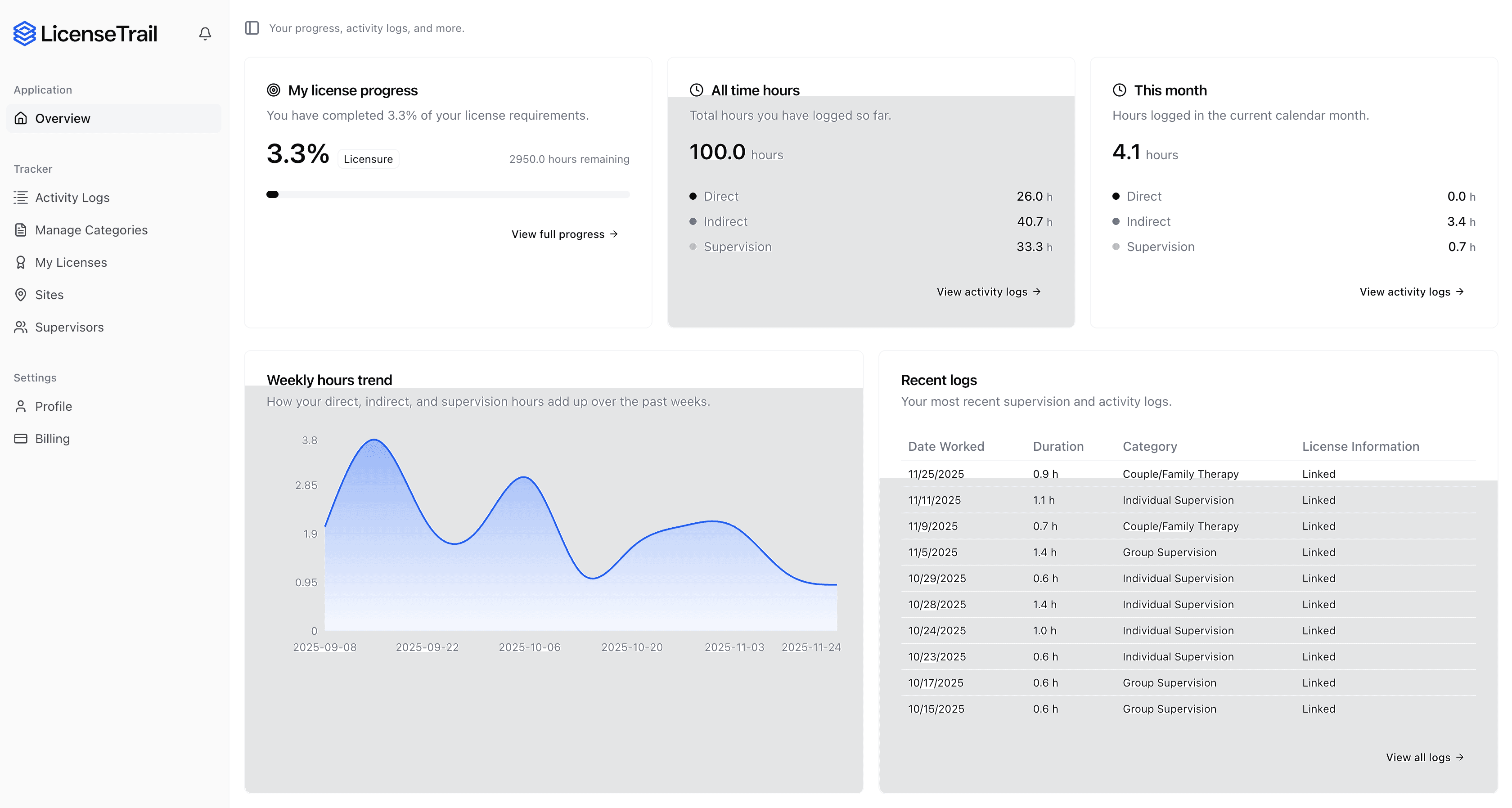
License Trail checks your direct, indirect, and supervision hours against Illinois LCP requirements continuously and flags mismatches before you submit.
 Start Tracking for Free
No credit card required · Free plan available
Related Licenses
Is your spreadsheet hiding Illinois LCP risks?
Stop guessing if your categories match Illinois Department of Financial and Professional Regulation (Clinical Psychologist Licensing and Disciplinary Board) requirements. License Trail checks your direct, indirect, and supervision hours continuously and flags mismatches before you submit.
Import or log
Bring your spreadsheet or start fresh
Upload your existing tracking spreadsheet and we'll map every hour into the right Illinois Department of Financial and Professional Regulation (Clinical Psychologist Licensing and Disciplinary Board) categories automatically.
Verify against Illinois
Catch mismatches before the board does
License Trail checks your direct, indirect, and supervision hours against Illinois LCP requirements continuously.
Export board-ready
One-click clean reports
Generate professional, board-ready reports for supervision meetings and Illinois Department of Financial and Professional Regulation (Clinical Psychologist Licensing and Disciplinary Board) submissions in seconds.
No credit card required · Free plan available