
Illinois RxP Requirements: Hours, Exams & Step-by-Step Guide
Stop guessing if your categories match Illinois requirements. License Trail checks your direct, indirect, and supervision hours against RxP requirements continuously and flags mismatches before you submit.
No credit card required · Free plan available
Quick Requirements Overview
- Must already hold an active Illinois Clinical Psychologist license (IDFPR; 68 Ill. Adm. Code 1400 / Clinical Psychologist Licensing Act)
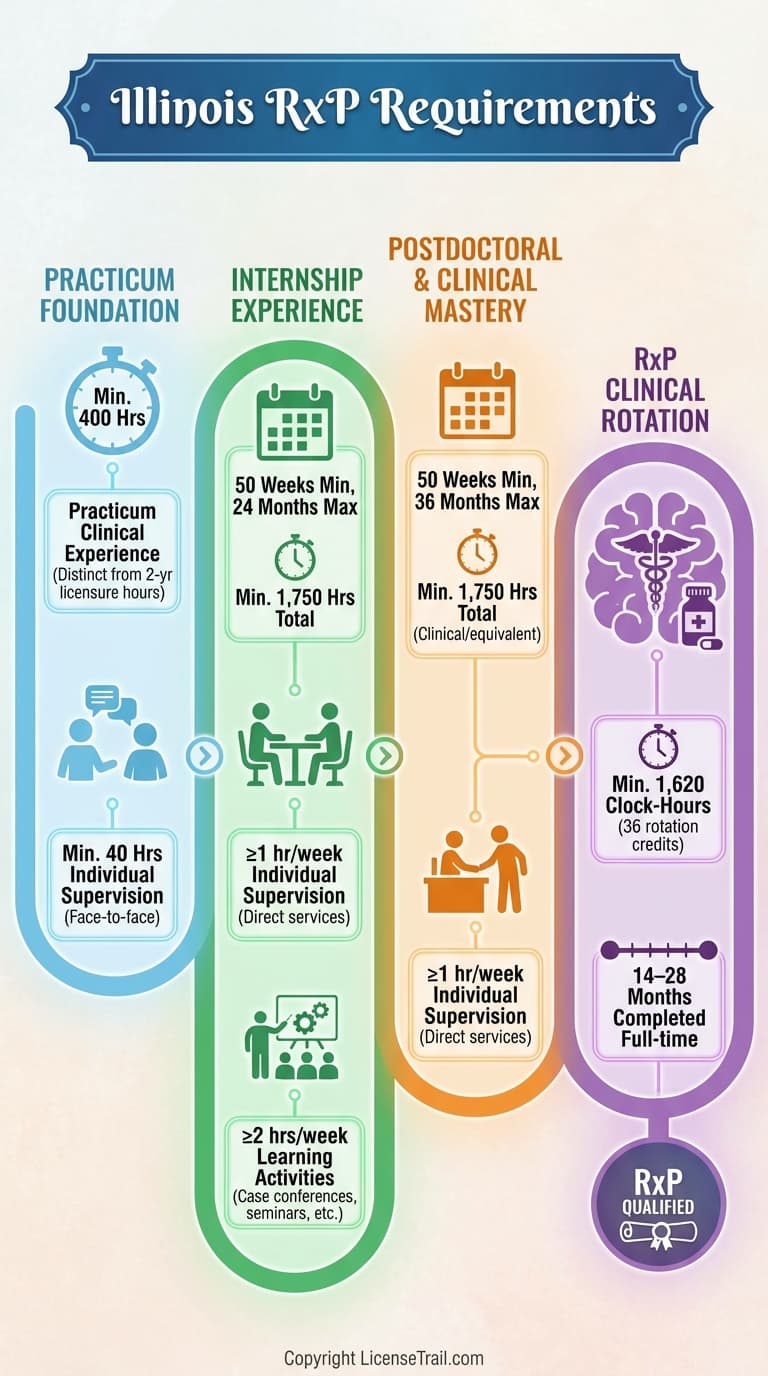
- Clinical psychology pathway (baseline): practicum ≥400 hrs (incl. ≥40 hrs face-to-face supervision) + internship ≥1,750 hrs (≥50 weeks) + total supervised experience = 2 years (each year = 1,750 hrs/≥50 weeks; ≥1 year postdoc)
- RxP biomedical prerequisites: specified coursework (e.g., medical terminology, chem/biochem w/lab, anatomy, physiology, microbiology w/lab, biology/cell-molecular)
- RxP didactic education: ≥60 graduate semester credits, incl. ≥3 credits in each of 10 required psychopharmacology/medical subject areas
- RxP clinical rotations/practicum: full-time ≥14 months; ≥20 rotation clock-hours/week; 36 rotation credits completed in 14–28 months; minimum 1,620 clock-hours
- Required rotations include: emergency med, family med, geriatrics, internal med, OB/GYN, pediatrics, psychiatry, surgery + 1 elective
- Exam: pass the Psychopharmacology Examination for Psychologists (PEP)
- Renewal/maintenance: +20 hours pharmacology CE (in addition to clinical psychologist CE requirements)
License Details
Procedures
Illinois recognizes a separate “prescribing psychologist” (RxP) license for doctoral‑level clinical psychologists who complete additional education and supervised medical training in psychopharmacology. The license is issued by the Illinois Department of Financial and Professional Regulation (IDFPR), and the standards are set in the Clinical Psychologist Licensing Act and IDFPR’s rules (68 Ill. Adm. Code 1400), under the Clinical Psychologists Licensing and Disciplinary Board.(ilga.gov)
Below is a structured guide focused on the hour and training requirements and how the Board itself defines them.
1. Big picture: What you must have before RxP
To qualify for a prescribing psychologist license in Illinois you must:
- Already hold a current Illinois license to practice clinical psychology.(ilga.gov)
- Have completed the standard clinical‑psychology training path (doctoral program + practicum + APA‑style internship + two years of supervised experience, including at least one postdoc year), with specific minimum hours defined by the Board.(ilga.gov)
- Complete additional biomedical coursework, at least 60 graduate‑level semester credits in specified psychopharmacology‑related subjects, and a full‑time 14‑month clinical practicum/rotation (minimum 1,620 clock‑hours) that meets detailed medical‑training standards.(ilga.gov)
- Pass the Psychopharmacology Examination for Psychologists (PEP).(ilga.gov)
The sections below unpack exactly what that means in terms of hours and Board language.
2. Baseline: Becoming an Illinois‑licensed clinical psychologist (required before RxP)
2.1 Statutory supervised‑experience requirement
The Clinical Psychologist Licensing Act requires that, to be licensed as a clinical psychologist, an applicant must have:
“2 years of satisfactory supervised experience in clinical, school or counseling psychology at least one of which is an internship and one of which is postdoctoral.” (ilga.gov)
The IDFPR rules then specify what counts as a practicum, an internship, and “two years of supervised experience,” including the exact hours.
2.2 Practicum (pre‑internship) – minimum 400 hours
The Board’s rules define the doctoral practicum as follows:(ilga.gov)
- When: After enrollment in a doctoral psychology program.
- Role: Must involve the practice of clinical psychology (assessment, diagnosis, and treatment of individuals with mental, emotional, behavioral, or nervous disorders or developmental disabilities).
- Minimum total hours:
- The practicum must be “a minimum of 400 hours in duration”.
- It must “involve the applicant in direct clinical psychology services to the client.”
- Supervision requirement:
- Supervision must be by a licensed clinical psychologist (or equivalent qualified psychologist) and must include at least 40 hours of face‑to‑face supervision.
- Separation from later supervised experience:
- The practicum “shall be wholly separate from the two years of supervised experience required for licensure.”
So at the practicum stage you must have ≥400 hours of supervised, direct clinical work, distinct from the later “two years” of supervised experience.
2.3 Internship – minimum 1,750 hours
The Board defines the qualifying internship or equivalent supervised clinical experience as:(ilga.gov)
- Structured training program: It must be an organized, pre‑planned training program with documented goals and objectives—not just “on‑the‑job” experience.
- Direct clinical work: Must involve the provision of direct clinical psychology services to clients, with weekly individual supervision plus additional didactic/clinical learning activities.
- Minimum total hours & timing:
- The internship “shall … include a minimum of 1,750 hours completed within 24 months.”
- Those 1,750 hours may not be completed in less than 50 weeks, regardless of weekly hours.
- Full‑time vs. part‑time definitions:
- Full‑time: at least 35 hours per week in a single setting for a minimum of 6 months.
- Part‑time: counted only if 18 or more hours per week for at least 9 months in a single setting.
In practical terms, the Board is equating one internship “year” with 1,750 hours over at least 50 weeks.
2.4 Two years of supervised experience (including at least one postdoc year)
Beyond the practicum, the Board sets quantitative standards for the two supervised‑experience years required by statute:(ilga.gov)
- Content: Must be clinical‑psychology experience; at least one year must be post‑doctoral.
- Practicum cannot count: Practicum experience “may not be counted toward fulfilling the two years of supervised experience.”
- How the Board defines one “year” for this purpose:
- “A year of experience is defined as 1,750 hours obtained in not less than 50 weeks and completed within a 36 month period.”
- Full‑time: at least 35 hours per week in a single setting for at least 6 months.
- Part‑time: at least 18 hours per week in a single setting for at least 9 months.
Since the statute demands two years of such supervised experience (one internship year and one postdoc year), in Board terms that works out to at least:
- Internship year: 1,750 hours
- Additional supervised year (postdoc or equivalent): 1,750 hours
Minimum supervised “professional” hours before RxP (not counting the separate practicum):
- Practicum: ≥400 hours (distinct from the two years)
- Internship: ≥1,750 hours
- Additional supervised experience (including ≥1 year postdoc): ≥1,750 hours
So, before even beginning the RxP‑specific training, the Board expects a clinical psychologist to have at least 3,500 hours of qualifying supervised experience plus the separate 400‑hour practicum, for a combined minimum of 3,900+ hours of supervised clinical work, all under the definitions above.
3. RxP‑specific requirements: becoming a Prescribing Psychologist
Once you hold an Illinois clinical psychologist license, you must satisfy additional requirements set out in Section 4.2 of the Act and Subpart C of the IDFPR rules.(ilga.gov)
The rules explicitly state that an applicant for licensure as a prescribing psychologist must meet the following educational and experience requirements.
3.1 Maintain an active Illinois clinical psychologist license
- You “must hold a current license to practice clinical psychology in Illinois.”(ilga.gov)
- This links the RxP license directly to the underlying clinical psychologist license; you cannot hold RxP without it.
3.2 Biomedical prerequisite coursework (undergraduate or graduate)
The Board requires specific minimum biomedical coursework, taken either during your doctoral psychology program or in an accredited undergraduate or master’s program. Each course is typically ≥3 semester credits (or equivalent).(ilga.gov)
The required subject areas include (paraphrased from the rule):
- Medical terminology (course or demonstrated proficiency)
- Chemistry or biochemistry with lab (the rule specifies two semesters)
- Human physiology
- Human anatomy
- Anatomy and physiology (an additional course)
- Microbiology with lab
- General biology for science majors or a cell/molecular biology course
These are not hour‑based clinical experiences, but the Board lists them as required biomedical prerequisites.
3.3 Graduate didactic coursework – minimum 60 semester credits
The rules then require at least 60 semester credit hours (or quarter‑hour equivalent) of didactic coursework, with at least 3 credits in each of ten specified subject areas.(ilga.gov)
Those ten areas are:
- Pharmacology
- Clinical psychopharmacology
- Clinical anatomy and integrated science
- Patient evaluation
- Advanced physical assessment
- Research methods
- Advanced pathophysiology
- Diagnostic methods
- Problem‑based learning
- Clinical and procedural skills
The Board explicitly states that, for this requirement, graduate‑level coursework satisfies the didactic requirement.(ilga.gov)
While these are measured in academic credits, not direct clinical hours, in practice 60 graduate credits represent a substantial classroom/contact‑time commitment (commonly in the neighborhood of 900+ classroom contact hours, depending on the institution).
3.4 Clinical practicum/rotations – full‑time 14‑month program, minimum 1,620 clock‑hours
This is the RxP component where the Board spells out specific clinical‑training hours in medical settings.
3.4.1 Basic structure and duration
The rules require:(ilga.gov)
- A “full‑time practicum of at least 14 months of supervised clinical training, including a research project” as part of a clinical rotation program.
- This practicum must be completed either:
- within an APA‑approved or equivalent doctoral or pre‑doctoral program, or
- during a postdoctoral master’s program in clinical psychopharmacology, housed in a regionally accredited institution.
The clinical rotation program must include required rotations in at least these areas:(ilga.gov)
- Emergency medicine
- Family medicine
- Geriatrics
- Internal medicine
- Obstetrics and gynecology
- Pediatrics
- Psychiatry
- Surgery
- One elective rotation of the participant’s choice
3.4.2 How the Board defines “full‑time” and calculates hours
The rules set very specific hour requirements for this practicum:(ilga.gov)
- To be considered full‑time, the clinical rotation program must:
- Require at least 20 clock‑hours of rotations per week, and
- Require all 36 credits of rotations to be completed within a minimum of 14 months and a maximum of 28 months after rotations begin.
- The Board then defines the total required hours:
“To earn 36 hours of clinical rotation training credits, a participant must complete a minimum of 1,620 clock‑hours of clinical rotation training.”
So, for the RxP practicum/rotations, the Board’s quantitative requirement is:
- Minimum clinical‑rotation hours: 1,620 clock‑hours
- Weekly minimum: 20 clock‑hours/week of rotations
- Time window: All 36 rotation credits and 1,620 hours must be completed over 14–28 months.
3.4.3 Standards for the training environment
The Board specifies that the clinical training must meet standards equivalent to those used for:(ilga.gov)
- Physician assistant education (ARC‑PA standards), or
- Advanced practice nurse education (relevant nursing accreditation standards), or
- Graduate medical education (ACGME standards).
Programs must also provide:
- Adequate labs and medical rotation sites
- Clinical support services (pharmacy, lab, imaging) so trainees are not used as staff replacements
- Progressive responsibility for patient management, under supervision by physicians, advanced practice nurses, or prescribing psychologists
- Systematic, documented evaluation of the trainee’s clinical competence
These requirements do not add more numeric hours beyond the 1,620, but they define what those hours must look like.
3.5 Examination – Psychopharmacology Examination for Psychologists (PEP)
The Board requires prescribing‑psychologist applicants to:(ilga.gov)
- Achieve a passing score on the Psychopharmacology Examination for Psychologists (PEP).
- The rules specify that a passing score is whatever is required by the PEP as administered by the American Psychological Association’s College of Professional Psychology (or its successor).
There is no additional “hours” requirement tied to the PEP beyond the education and rotations already described, but proof of a passing score must be sent directly from the testing entity to IDFPR as part of the RxP application.
4. Application to IDFPR as a Prescribing Psychologist
Once all prerequisites are completed, the application itself is fairly straightforward but must document the hour‑ and credit‑based requirements.
Under Section 1400.210, an RxP applicant must submit an application to IDFPR that includes:(ilga.gov)
- Official transcripts showing completion of the biomedical prerequisite coursework.
- Official transcripts documenting completion of the required didactic coursework in the 10 psychopharmacology‑related subject areas (the 60 credits).
- Proof of passing the PEP, sent directly from the testing body.
- The prescribed fee (currently set in Section 1400.40 as a $150 application fee for prescribing psychologist licensure).(ilga.gov)
The Clinical Psychologists Licensing and Disciplinary Board reviews each application and recommends approval or denial; the Division then issues the license or explains any deficiency.
5. Continuing‑education obligations after RxP licensure (for context)
While your question focuses on initial licensure, the Board also imposes ongoing psychopharmacology CE requirements:
- To renew a prescribing psychologist license, the rules require 20 hours of continuing education in pharmacology in addition to the 24 hours required for the underlying clinical psychologist license.(ilga.gov)
This is not part of the “hours to become licensed,” but it is part of maintaining the RxP credential once obtained.
6. Hour requirements – condensed reference
To summarize the Illinois Board‑defined hour requirements that matter for an RxP applicant:
Before RxP (for the clinical psychologist license) (ilga.gov)
- Practicum:
- ≥ 400 hours direct clinical psychology services
- ≥ 40 hours face‑to‑face supervision
- Internship:
- ≥ 1,750 hours
- Completed in ≥ 50 weeks within 24 months
- Full‑time = ≥35 hrs/week; part‑time = ≥18 hrs/week in a single setting
- Supervised experience (two years total, including internship and ≥1 postdoc year):
- Board definition of a year: 1,750 hours in not less than 50 weeks
- Total supervised experience: 2 years × 1,750 hours = 3,500 hours, separate from practicum hours
RxP‑specific (on top of the above) (ilga.gov)
- Biomedical prerequisites:
- 7 specified biomedical subjects, typically ≥3 semester credits each
- Didactic coursework:
- ≥ 60 semester credits graduate‑level in 10 specified psychopharmacology‑related areas (≥3 credits in each area)
- Clinical rotations/practicum:
- Full‑time 14‑month supervised clinical‑training program
- Weekly minimum: 20 clock‑hours of rotations
- Program must require 36 clinical rotation credits, all completed in 14–28 months
- Total clinical‑rotation hours required: minimum 1,620 clock‑hours
- Examination:
- Passing score on the PEP psychopharmacology exam
These figures and definitions are taken directly from the Clinical Psychologist Licensing Act and IDFPR’s rules (68 Ill. Adm. Code 1400), which are administered under the Clinical Psychologists Licensing and Disciplinary Board.
Track your RxP hours with confidence
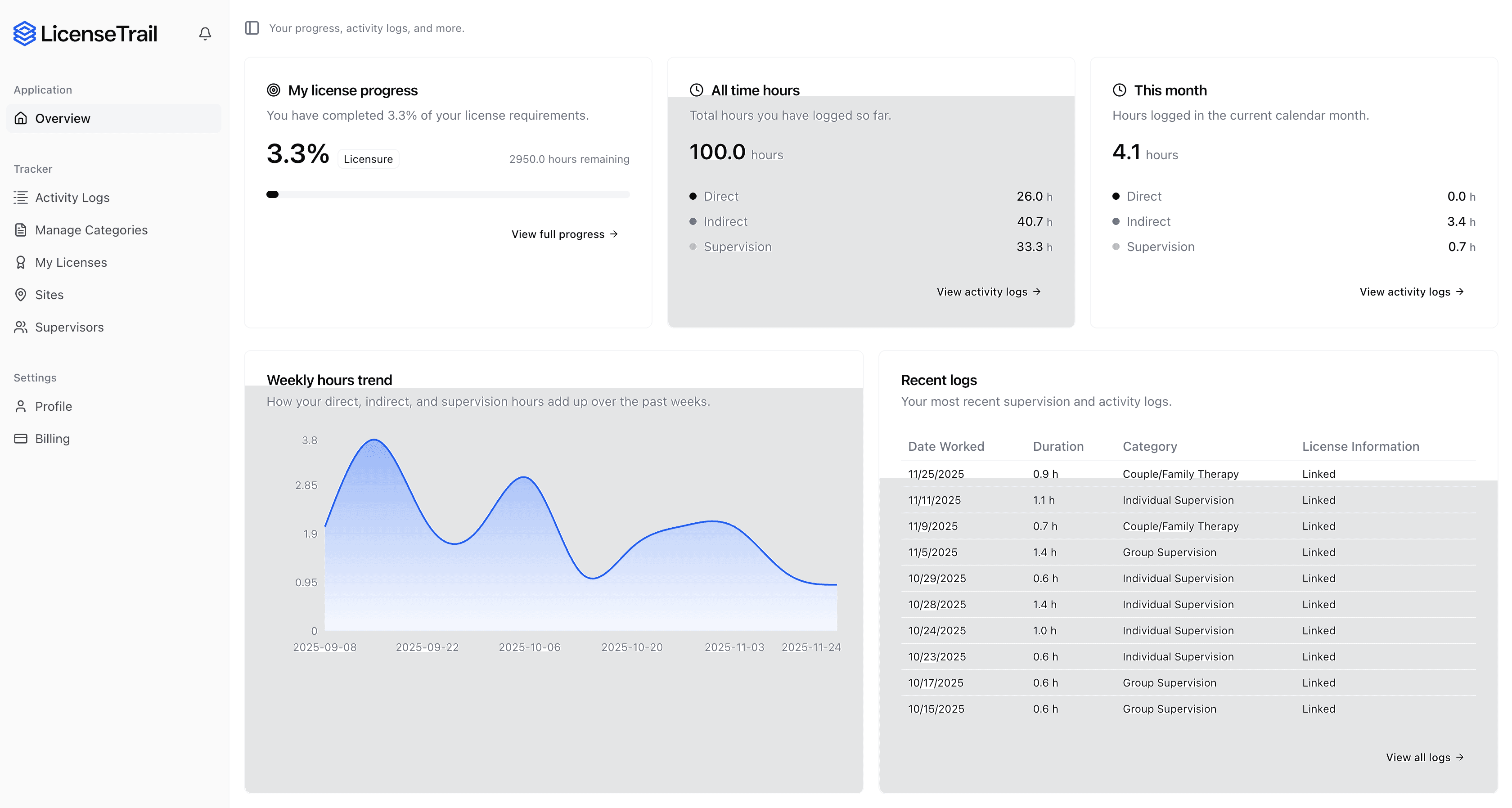
License Trail checks your direct, indirect, and supervision hours against Illinois RxP requirements continuously and flags mismatches before you submit.
 Start Tracking for Free
No credit card required · Free plan available
Related Licenses
Is your spreadsheet hiding Illinois RxP risks?
Stop guessing if your categories match Illinois Department of Financial and Professional Regulation (Clinical Psychologist Licensing and Disciplinary Board) requirements. License Trail checks your direct, indirect, and supervision hours continuously and flags mismatches before you submit.
Import or log
Bring your spreadsheet or start fresh
Upload your existing tracking spreadsheet and we'll map every hour into the right Illinois Department of Financial and Professional Regulation (Clinical Psychologist Licensing and Disciplinary Board) categories automatically.
Verify against Illinois
Catch mismatches before the board does
License Trail checks your direct, indirect, and supervision hours against Illinois RxP requirements continuously.
Export board-ready
One-click clean reports
Generate professional, board-ready reports for supervision meetings and Illinois Department of Financial and Professional Regulation (Clinical Psychologist Licensing and Disciplinary Board) submissions in seconds.
No credit card required · Free plan available