
Illinois LPC Requirements: Hours, Exams & Step-by-Step Guide
Stop guessing if your categories match Illinois requirements. License Trail checks your direct, indirect, and supervision hours against LPC requirements continuously and flags mismatches before you submit.
No credit card required · Free plan available
Quick Requirements Overview
- Governing authority: IDFPR under 225 ILCS 107 and 68 Ill. Admin. Code Part 1375
- Degree required: Master’s or doctoral in counseling/psychology/rehab counseling from a regionally accredited school
- Credit hours: 48 semester hrs through 6/30/2026; 60 semester hrs starting 7/1/2026 (with 13 required core content areas; no double-counting)
- Program residency: 24 semester hrs at one institution through 6/30/2026; 30 semester hrs starting 7/1/2026
- Practicum/Internship: 700 clock hrs on-site, including 280 direct face-to-face client hours (completed within the degree)
- Post-degree hours for LPC: None required to obtain LPC, but must practice under supervision (not independent)
- Exam: Pass NCE (NBCC) or CRC/CRCE (CRCC)
- Renewal/CE: Expires March 31 of odd-numbered years; 30 CE hrs/24 months incl. 3 ethics (CE waived for first renewal); statewide mandated topics apply (e.g., cultural competency for renewals on/after 1/1/2025)
License Details
Procedures
Licensure as a Licensed Professional Counselor (LPC) in Illinois is governed by the Professional Counselor and Clinical Professional Counselor Licensing and Practice Act (225 ILCS 107) and its implementing rules in Title 68, Part 1375 of the Illinois Administrative Code. The Illinois Department of Financial and Professional Regulation (IDFPR), with advice from the Professional Counselor Licensing and Disciplinary Board, administers these requirements.
This guide walks through the specific educational, hour-based, examination, and renewal requirements for the LPC—with statutory language and numbers where the Board has defined them.
1. Overview: LPC vs. LCPC in Illinois
Illinois has two counseling licenses under IDFPR:
-
LPC – Licensed Professional Counselor
Entry-level/provisional license. You cannot practice independently; you must practice under a qualified supervisor (LCPC, LCSW, psychologist, psychiatrist, or similar). (imhca.org) -
LCPC – Licensed Clinical Professional Counselor
Independent clinical license that requires substantial post‑degree supervised clinical experience (3,360 hours, discussed briefly in Section 4 for context). (law.cornell.edu)
The question here is specifically about the LPC. The crucial distinction for hours is:
-
For LPC licensure:
Illinois does not require any post‑degree supervised work hours to issue the LPC. All hour requirements are embedded in your graduate practicum/internship. -
For LCPC licensure:
Illinois requires two years (3,360 hours) of supervised clinical professional counseling experience after the qualifying degree (details in Section 4). (law.cornell.edu)
2. Required Education for the LPC
2.1 Degree level and accreditation
For LPC licensure, the Administrative Code requires:
- A master’s or doctoral degree in counseling, psychology, or rehabilitation counseling from a regionally accredited institution recognized by the U.S. Department of Education, or a similar program approved under the rules. (law.cornell.edu)
2.2 Minimum credit hours and transition to 60 credits
The rules draw a clear line between applicants before and after mid‑2026:
-
Through June 30, 2026
Your program must require at least 48 semester hours (72 quarter hours) and include one 3‑semester‑hour (or 4.5‑quarter‑hour) course in each of 13 core content areas listed below. (law.cornell.edu) -
Beginning July 1, 2026
New applicants must graduate from a program with at least 60 semester hours (90 quarter hours) with one full course in each of the same 13 core areas. (law.cornell.edu)
Programs with fewer than 39 semester hours are not acceptable; programs between 39 and the required total may be “topped up” with additional graduate coursework in acceptable counseling programs. (law.cornell.edu)
2.3 The 13 required core course areas
The LPC education rule (Section 1375.45) lists these 13 content areas, each requiring at least one full graduate course: (law.cornell.edu)
- Human Growth and Development
- Counseling Theory
- Counseling Techniques
- Group Dynamics, Processing and Counseling
- Appraisal of Individuals
- Research and Evaluation
- Professional, Legal and Ethical Responsibilities Relating to Professional Counseling (including Illinois law)
- Social and Cultural Foundations
- Lifestyle and Career Development
- Practicum/Internship
- Psychopathology and Maladaptive Behavior
- Addictions (sometimes labeled “Substance Abuse”)
- Family Dynamics
The rules specify that one course cannot be “double‑counted” to satisfy two core areas; content and objectives must stand alone for each area. (law.cornell.edu)
2.4 One‑year residency within the program
Illinois also requires an in‑program “residency”:
-
Through June 30, 2026:
A one‑year residence is defined as 24 semester hours completed at a single institution’s program within the time frame of the degree. (law.cornell.edu) -
Beginning July 1, 2026:
The residency requirement increases to 30 semester hours at that institution. (law.cornell.edu)
This is not “clinical” hours; it is a credit‑hour residency ensuring sustained enrollment in one program.
3. Practicum / Internship Hours Required for LPC Education
Illinois embeds specific clinical hour requirements inside the definition of the Practicum/Internship core course.
In the course descriptions (Appendix A to Part 1375), the state spells out:
“These courses shall include a minimum of 700 clock hours on‑site, with a minimum of 280 hours of direct, face‑to‑face client contact.” (ilga.gov)
So, at the master’s/doctoral program level, the minimum clinical experience for LPC eligibility is:
- Total on‑site practicum/internship hours:
700 clock hours - Direct client contact requirement (within those 700):
280 hours of direct, face‑to‑face client contact
The remaining hours can be indirect activities (documentation, case consultation, training, etc.) as structured by your program, but they must be part of formally supervised practicum/internship courses in counseling or a closely related area. (ilga.gov)
Important:
These 700/280 hours are pre‑licensure, completed as part of your degree. Illinois does not currently require additional, post‑degree hours to issue the LPC license itself.
4. Post‑Degree Supervised Hours: LPC vs. LCPC
4.1 For the LPC license
For LPC initial licensure, neither the statute (225 ILCS 107/45(a)) nor the Administrative Code subpart on LPCs imposes a numerical post‑degree supervised experience requirement.
Instead, the Board and IDFPR emphasize:
- Completion of the qualifying degree and practicum/internship (700/280 hours as above).
- A passing exam score (Section 1375.60, discussed in Section 5).
- Age, conduct, and fee requirements. (law.justia.com)
Professional organizations and IDFPR‑linked resources summarize this plainly:
- For LPC: “No experience required” for licensure beyond the graduate program requirements. (ilschoolcounselor.org)
However, once you hold the LPC, you must practice under supervision and may not open an independent practice. (imhca.org) The law does not set a specific number of supervised hours you must log as an LPC; instead, it focuses on supervision quality, scope of practice, and, later, LCPC requirements.
4.2 For the LCPC (for context and comparison)
Because you asked specifically about hour breakdowns, here is how Illinois defines the supervised experience for the LCPC, which you typically complete while working as an LPC:
-
The LCPC rule requires two years of full‑time supervised clinical professional counseling experience after the qualifying degree (or its equivalent, with some flexibility for doctoral internships). (law.cornell.edu)
-
The Administrative Code states:
“One year of supervised clinical professional counseling experience shall be 1680 clock hours obtained in not less than 48 weeks. At least 50% of those hours must consist of direct face‑to‑face service to clients…” (law.cornell.edu)
Putting this into numbers:
- Total supervised experience for LCPC (master’s):
- 3,360 clock hours (1,680 per year × 2 years)
- At least 50% direct face‑to‑face client service (i.e., ≥1,680 direct hours), though some professional summaries cite 1,920 face‑to‑face hours when counting typical full‑time distributions. (law.cornell.edu)
Again, these hours are for LCPC, not for LPC. They are completed under a “qualified supervisor” as defined in the Act (LCPC, LCSW, licensed clinical psychologist, psychiatrist, etc.). (law.cornell.edu)
5. Examination Requirement for the LPC
Illinois defines the LPC examination explicitly in the Administrative Code:
-
Primary exam:
Section 1375.60 provides that the exam for licensure as a professional counselor “shall be the National Counselor Examination (NCE) of the National Board for Certified Counselors (NBCC).” (regulations.justia.com) -
Alternative exam accepted:
The same section states that the Division “also shall accept passage of the Certified Rehabilitation Counselor Examination (CRCE) of the Commission on Rehabilitation Counselor Certification (CRCC).” (regulations.justia.com)
In practice:
- Most LPC candidates take and pass the NCE.
- Some rehabilitation‑counseling graduates use the CRC exam instead.
You must first be approved by IDFPR (via its online portal) to sit for the exam; IDFPR then authorizes NBCC/CRCC to schedule you. Scores are transmitted back to IDFPR, which uses them to finalize licensure. (idfpr.illinois.gov)
6. Application Steps and Fees (LPC)
The Act and rules provide the framework; IDFPR operationalizes the process via its online licensing portal. As of 2025, the essentials are:
-
Create an IDFPR online account and begin a new application for Licensed Professional Counselor. (idfpr.illinois.gov)
-
Submit the required forms and documentation, typically including:
- Proof of education (IDFPR form ED‑PC plus official graduate transcripts). (idfpr.illinois.gov)
- Application form with personal and professional disclosures. (law.justia.com)
-
Pay the LPC application fee:
- The Administrative Code sets the application fee at $150 for a professional counselor license. (law.cornell.edu)
-
Obtain exam authorization and test:
- Once your application is preliminarily approved, IDFPR authorizes you to take the NCE (or CRC).
- You sit for the exam through NBCC or CRCC; passing scores are sent to IDFPR. (regulations.justia.com)
-
Final review and issuance:
- IDFPR reviews that you have met all statute and rule requirements (degree, practicum/internship, exam, conduct, and fees) and issues your LPC license. (law.justia.com)
7. After Licensure: Supervision, Scope, and Title Use
7.1 Scope and supervision as an LPC
Once licensed:
-
You may use the protected title “Licensed Professional Counselor” (LPC) and practice professional counseling only under supervision; you may not present yourself as an independent practitioner. (imhca.org)
-
Your supervisor must be a qualified supervisor under the Act (LCPC, LCSW, clinical psychologist, psychiatrist, or equivalent, including certain out‑of‑state supervisors if they meet licensure criteria). (law.cornell.edu)
Illinois does not assign a fixed numerical total of supervised hours at the LPC stage; instead, those hours become critical when you apply for LCPC (3,360 hours as described in Section 4.2).
8. Renewal, Continuing Education, and Mandated Topics
8.1 Renewal cycle and fees
Illinois sets a uniform renewal schedule:
- “Every license issued under the Act shall expire on March 31 of odd numbered years.” (law.cornell.edu)
- To renew, you must:
- Pay the renewal fee of $120 per renewal period; (law.cornell.edu)
- Complete the required continuing education (CE) described below.
8.2 Continuing Education hours and content
The CE rule for both LPCs and LCPCs states:
- “A licensee shall complete 30 hours of CE during the 24 months preceding renewal.” (law.cornell.edu)
- At least 3 of those 30 hours must be in ethics in the practice of counseling. (law.cornell.edu)
- First renewal exception: “A renewal applicant shall not be required to comply with CE requirements for the first renewal of an Illinois license.” (law.cornell.edu)
For LCPCs only, upon second renewal, 9 of the 30 hours must be in clinical supervision training (a one‑time lifetime requirement). (law.cornell.edu)
8.3 Statewide mandated topics for health‑care licensees
In addition to the 30 CE hours, Illinois law imposes topic‑specific training mandates across many health professions licensed by IDFPR, including professional counselors. Statutes now require, among other things:
- At least one hour of cultural competency training for license or registration renewals occurring on or after January 1, 2025, for “health care professionals” (a category that expressly includes licensees under the Professional Counselor and Clinical Professional Counselor Licensing and Practice Act). (witnessslips.ilga.gov)
Separate sections of the Civil Administrative Code impose additional periodic requirements, such as training in sexual harassment prevention and implicit bias, which apply across multiple IDFPR‑regulated professions; counselors must incorporate these into their CE planning during each renewal period. (witnessslips.ilga.gov)
9. Summary of Key Numeric Requirements for LPC in Illinois
To distill the hour‑based requirements specifically for LPC licensure under IDFPR:
-
Graduate program credit hours
- Through June 30, 2026: Minimum 48 semester hours (72 quarter hours).
- On/after July 1, 2026: Minimum 60 semester hours (90 quarter hours). (law.cornell.edu)
-
Residency within the program
- One‑year residence at the institution offering the degree, defined as:
- 24 semester hours before July 1, 2026;
- 30 semester hours starting July 1, 2026. (law.cornell.edu)
- One‑year residence at the institution offering the degree, defined as:
-
Practicum/Internship clinical experience (educational requirement)
- 700 clock hours on‑site practicum/internship.
- 280 of those hours must be direct, face‑to‑face client contact. (ilga.gov)
-
Post‑degree supervised hours for LPC licensure
- None specified by statute or rule for obtaining the LPC itself.
- You must still practice under a qualified supervisor as an LPC, but the state only defines hour counts (1,680 per year; 3,360 total) when you later apply for LCPC. (law.cornell.edu)
-
Examination
- Pass either the National Counselor Examination (NCE) or the Certified Rehabilitation Counselor Exam (CRC), as specified in Section 1375.60. (regulations.justia.com)
-
Renewal and continuing education
- License expires March 31 of odd‑numbered years. (law.cornell.edu)
- 30 CE hours in the 24 months preceding renewal, including 3 hours of ethics, plus statewide mandated topics (e.g., 1 hour cultural competency for renewals on or after January 1, 2025). (law.cornell.edu)
Taken together, the Illinois LPC path is built around a defined graduate curriculum with 700/280 practicum‑internship hours and a national exam, followed by supervised but numerically un‑capped practice as an LPC until you choose to meet the 3,360‑hour supervised experience requirement for the LCPC.
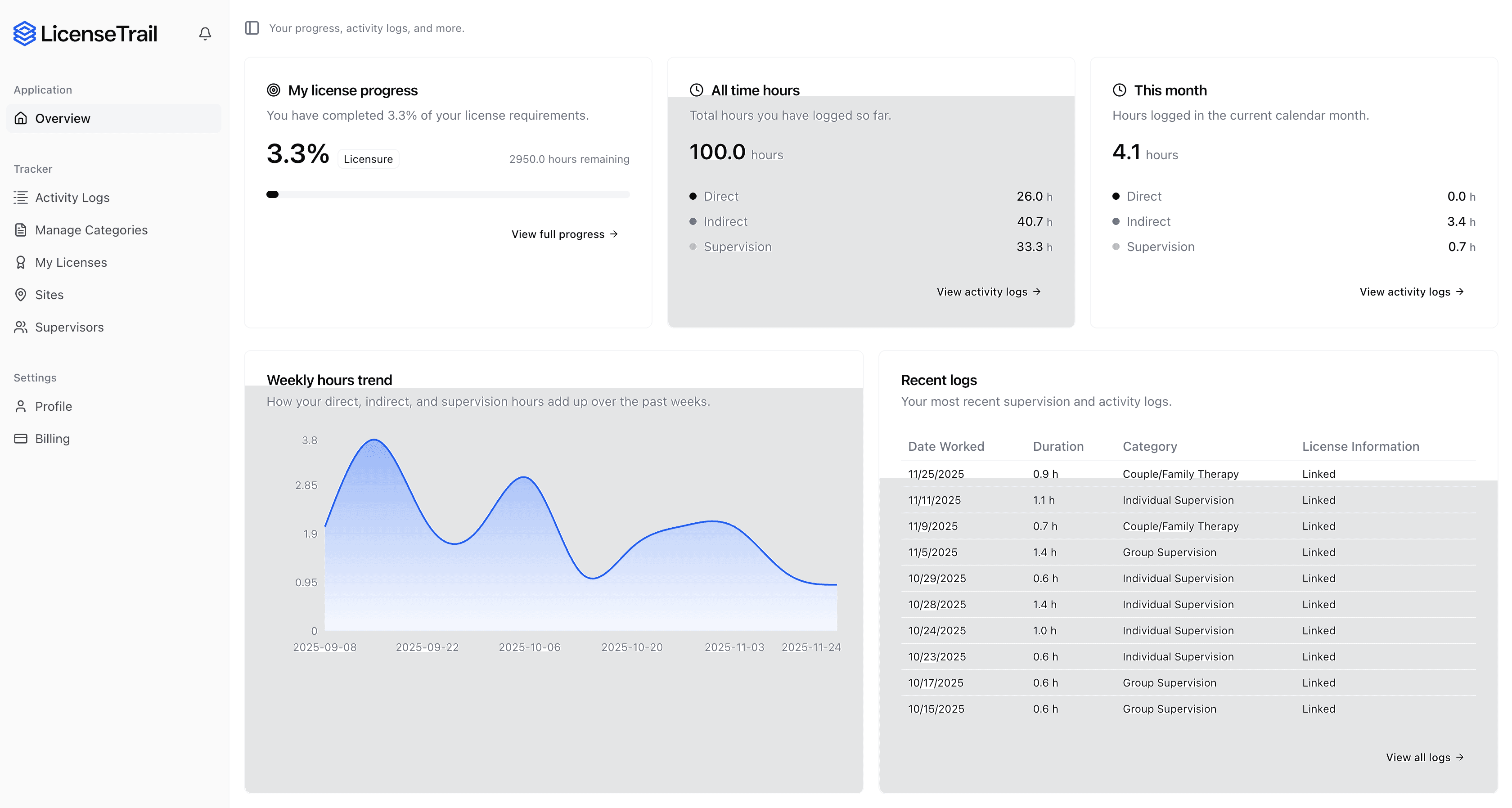
Track your LPC hours with confidence
License Trail checks your direct, indirect, and supervision hours against Illinois LPC requirements continuously and flags mismatches before you submit.
 Start Tracking for Free
No credit card required · Free plan available
Related Licenses
Is your spreadsheet hiding Illinois LPC risks?
Stop guessing if your categories match Illinois Department of Financial and Professional Regulation (Counselor Licensing and Disciplinary Board) requirements. License Trail checks your direct, indirect, and supervision hours continuously and flags mismatches before you submit.
Import or log
Bring your spreadsheet or start fresh
Upload your existing tracking spreadsheet and we'll map every hour into the right Illinois Department of Financial and Professional Regulation (Counselor Licensing and Disciplinary Board) categories automatically.
Verify against Illinois
Catch mismatches before the board does
License Trail checks your direct, indirect, and supervision hours against Illinois LPC requirements continuously.
Export board-ready
One-click clean reports
Generate professional, board-ready reports for supervision meetings and Illinois Department of Financial and Professional Regulation (Counselor Licensing and Disciplinary Board) submissions in seconds.
No credit card required · Free plan available