
Illinois LSW Requirements: Hours, Exams & Step-by-Step Guide
Stop guessing if your categories match Illinois requirements. License Trail checks your direct, indirect, and supervision hours against LSW requirements continuously and flags mismatches before you submit.
No credit card required · Free plan available
Quick Requirements Overview
- Governed by IL Clinical Social Work & Social Work Practice Act (225 ILCS 20) and 68 Ill. Adm. Code Part 1470; administered by IDFPR
- Eligibility (MSW path): Graduate from Division‑approved MSW program; no post‑degree experience required
- Eligibility (BSW path): Graduate from Division‑approved BSW program plus 3 years supervised professional experience after degree (years, not total hours)
- Supervision (BSW experience): Direct supervision by LSW/LCSW or other Board‑approved credential; supervision average ≥4 hours/month and supervisor deems experience satisfactory
- Exam: No LSW exam required for applications on/after 1/1/2022 (including endorsement)
- Practice limits: LSW cannot independently practice clinical social work; clinical services only under order/control/full responsibility of LCSW, licensed clinical psychologist, or psychiatrist
- Renewal: Expires Nov 30 of odd‑numbered years; renew with fee and CE (first renewal after initial IL licensure: no CE)
- CE for renewal: 30 hours/24 months, incl. 3 ethics + 3 cultural competence
License Details
Procedures
Licensure as a Licensed Social Worker (LSW) in Illinois is governed by the Clinical Social Work and Social Work Practice Act (225 ILCS 20) and the implementing rules in Title 68, Part 1470 of the Illinois Administrative Code, administered by the Illinois Department of Financial and Professional Regulation (IDFPR), Social Work Examining and Disciplinary Board. (ilga.gov)
Below is a structured guide focused specifically on what the Board actually requires—including how it describes experience, supervision, and any “hours” or time requirements.
1. What the LSW License Authorizes
The Act defines a “licensed social worker” as someone authorized “to practice social work,” including social services to individuals, groups, or communities in areas such as social casework, group work, community organization, administration, and education. Clinical social work activities may be included, but only if they are not conducted as independent clinical practice; independent clinical practice is reserved for Licensed Clinical Social Workers (LCSWs). (ilga.gov)
Separate Board rules clarify that a licensed social worker may not engage in the independent practice of clinical social work and may provide clinical services only under the order, control, and full professional responsibility of an LCSW, licensed clinical psychologist, or psychiatrist. (ilga.gov)
2. Two Main Eligibility Paths to the LSW
The Board recognizes two education-based routes to LSW licensure, with different experience requirements:
Path A – Master’s degree in Social Work (MSW)
For applicants with a master’s degree in social work:
- You must have graduated from a master’s program in social work approved by the Division under Section 1470.30 (generally CSWE-accredited or otherwise approved). (ilga.gov)
- No post‑degree professional experience is required for the LSW if you qualify via an approved MSW program.
- No licensing examination is required for LSW applicants on or after January 1, 2022. The rule states that from that date forward, “an applicant for licensure as a licensed social worker is not required to take an examination.” (ilga.gov)
In other words, with an approved MSW, you go straight to application—no hours, years, or exam.
Path B – Baccalaureate degree in Social Work (BSW)
For applicants with only a baccalaureate (undergraduate) degree in social work:
- You must have a baccalaureate degree in social work from a program approved by the Division under Section 1470.30. (ilga.gov)
- You must complete “3 years of supervised professional experience” after receiving the BSW. This is not expressed as a number of hours in the Illinois rules; the Board uses years of supervised experience, not an hour count. (ilga.gov)
The Board’s rule at Section 1470.20(b) is the controlling language for this experience.
3. How the Board Defines the Required BSW Experience
The three years of experience for BSW‑based LSW applicants are described in rule, not in terms of 1,500 or 3,000 hours. The key elements are:
3.1 “Supervised professional experience”
Section 1470.20(b) states that for BSW applicants:
- They “shall complete 3 years of supervised professional experience subsequent to obtaining the baccalaureate degree.” (ilga.gov)
- “Supervised professional experience” is defined as experience directly related to social work as defined in Section 3(9) of the Act. (ilga.gov)
That is the Board’s own wording structure: “3 years,” “supervised professional experience,” and “directly related to social work” as defined in the statute—not a breakdown into specific hour totals or “direct vs. indirect” hours.
3.2 Who can supervise
The same rule specifies that this supervised professional experience must be:
- Obtained under the direct supervision of:
- a licensed social worker (LSW), or
- a licensed clinical social worker (LCSW), or
- certain other senior social work credentials (e.g., diplomate in clinical social work, designated member of ACSW), or
- another supervisor the Board approves as “appropriate.” (ilga.gov)
The Act and rules consistently frame this as direct supervision by a qualified social work (or Board‑approved) professional.
3.3 Minimum supervisory contact
The Board further requires that:
- The supervisor must meet with the supervisee an average of at least 4 hours per month, and must evaluate the experience as satisfactory. (ilga.gov)
This “4 hours per month” requirement is the closest the rules come to quantifying time. There is no total hour figure (e.g., 1,500 hours); instead the regulation ties supervision to years of experience with a minimum of monthly supervisory contact.
3.4 No hour‑by‑hour breakdown
Crucially, the Illinois rules for the LSW:
- Do not say “1,500 hours of direct experience and 1,500 hours of supervised experience” or anything similar.
- They only specify:
- Three years of supervised professional experience for BSW applicants,
- The experience must be directly related to social work, and
- A minimum supervisory contact of 4 hours per month, with supervision deemed satisfactory by the supervisor. (ilga.gov)
By contrast, the rules do define specific hour counts (2,000 or 3,000 hours) for supervised clinical professional experience, but that applies only to the LCSW, not to the LSW. (ilga.gov)
4. Application Routes: New License vs. Endorsement
4.1 New Illinois LSW (first‑time license in Illinois)
New applications for Licensed Social Worker (license type 150) are filed through IDFPR’s online licensing system (CORE) as “new applications.” (idfpr.illinois.gov)
For a new LSW, the Board’s rules require you to submit an application under Section 7 of the Act and the detailed application requirements in the rules. For LSWs, the necessary elements are captured by Section 1470.60(a)(2) (which mirrors what is required for endorsements):
- Option 1 (MSW):
- Certification of graduation from a master’s program in social work approved under Section 1470.30.
- Option 2 (BSW):
- Certification of graduation from a baccalaureate program in social work approved under Section 1470.30, and
- Verification of completion of 3 years of supervised professional experience after receiving the degree, in accordance with Section 1470.20. (ilga.gov)
For both options, you must also pay the required application fee listed in Section 1470.55. (ilga.gov)
4.2 Endorsement (already licensed as LSW in another U.S. jurisdiction)
If you are already licensed in another state and seeking an Illinois LSW by endorsement:
- You file an endorsement application under Section 12.5 of the Act and Section 1470.60 of the rules.
- For LSW endorsement, Section 1470.60(a)(2) again requires either:
- an approved MSW, or
- an approved BSW plus 3 years of supervised professional experience. (ilga.gov)
- You pay the endorsement fee (listed with other fees in Section 1470.55).
There is no LSW examination requirement even in endorsement, since the exam requirement for LSWs was removed effective January 1, 2022. (ilga.gov)
5. Documenting Supervised Experience (BSW Route)
Although the experience itself is defined in rule, IDFPR expects formal documentation:
- On the IDFPR Social Work page, the Department provides a VE‑SW form (“Verification of Experience – Social Work,” 2024 version), which is typically used to verify supervised professional experience for social work applicants. (idfpr.illinois.gov)
- Supervisors generally must attest to:
- Dates of employment or experience,
- The nature of the work (that it was directly related to social work),
- Their own credentials (e.g., LSW, LCSW, ACSW, etc.),
- Their evaluation that the experience was satisfactory. (ilga.gov)
The Board rules are clear that experience must be satisfactory in the supervisor’s evaluation and that supervision must meet the minimum monthly contact requirement. (ilga.gov)
6. Practice and Supervision Limits Once You Are Licensed
Even after licensure as an LSW, the rules place important limitations on how you can practice:
-
You may not:
- Present yourself to the public as a “clinical social worker” or “licensed clinical social worker,” or
- Offer clinical social work services where the words “licensed clinical social worker” or “clinical social work” are used to describe you or your services, unless you hold an LCSW. (ilga.gov)
-
Providing clinical social work services as an LSW:
- You may provide clinical social work services (as defined in the Act), but only under the order, control, and full professional responsibility of an LCSW, licensed clinical psychologist, or psychiatrist.
- You may not regulate or be responsible for your own clinical practice or treatment procedures—that is what the rules call “independent practice of clinical social work,” which is reserved to LCSWs. (ilga.gov)
This is an important distinction for career planning: an LSW is a practice license, but not a license for independent clinical practice.
7. Renewal, Continuing Education, and Ongoing Requirements
7.1 Renewal schedule
- Every license issued under the Act—including LSWs—expires on November 30 of each odd‑numbered year.
- You can renew during the month before expiration by paying the renewal fee and meeting the CE requirements in Section 1470.95. (ilga.gov)
7.2 Continuing education (CE) for LSW renewal
Under Section 1470.95:
- Every licensee renewing as a licensed social worker must complete 30 hours of continuing education during each 24‑month pre‑renewal period (the 24 months before November 30 of each odd‑numbered year). (ilga.gov)
- Of those 30 hours:
- At least 3 hours must address ethical practice of social work, and
- At least 3 hours must address cultural competence in social work practice. (ilga.gov)
- These CE requirements are the same for LSWs and LCSWs (with one additional clinical supervision‑training requirement that applies only to LCSWs starting with the 2027 renewal; LSWs are not subject to that extra requirement). (ilga.gov)
- The first renewal after initial licensure in Illinois does not require CE. (ilga.gov)
8. Summary of “Hours” and Time Requirements for Illinois LSWs
To directly address the kind of breakdown you mentioned (e.g., “1,500 hours of direct experience and 1,500 hours of supervised experience”):
-
For MSW‑route LSWs:
- The Board requires no post‑degree experience hours or years.
- The rules specifically state there is no exam required for LSWs after January 1, 2022. (ilga.gov)
-
For BSW‑route LSWs:
- The Board requires “3 years of supervised professional experience” after the BSW.
- The experience must be directly related to social work as defined in the Act and obtained under direct supervision of an LSW, LCSW, or other Board‑approved supervisor.
- The supervisor must meet with the supervisee at least 4 hours per month on average and must evaluate the experience as satisfactory. (ilga.gov)
- No total number of hours (such as 1,500 or 3,000) is specified anywhere in the rules for LSW qualification.
-
Hour‑based requirements (2,000–3,000 hours) exist only for the LCSW supervised clinical experience and do not apply to LSW licensure. (ilga.gov)
In practical terms, for an Illinois LSW, you either (1) qualify with an approved MSW and go straight to application, or (2) qualify with an approved BSW and document three full years of supervised, directly related social work experience under Board‑defined supervision, without any Board‑mandated total hour count.
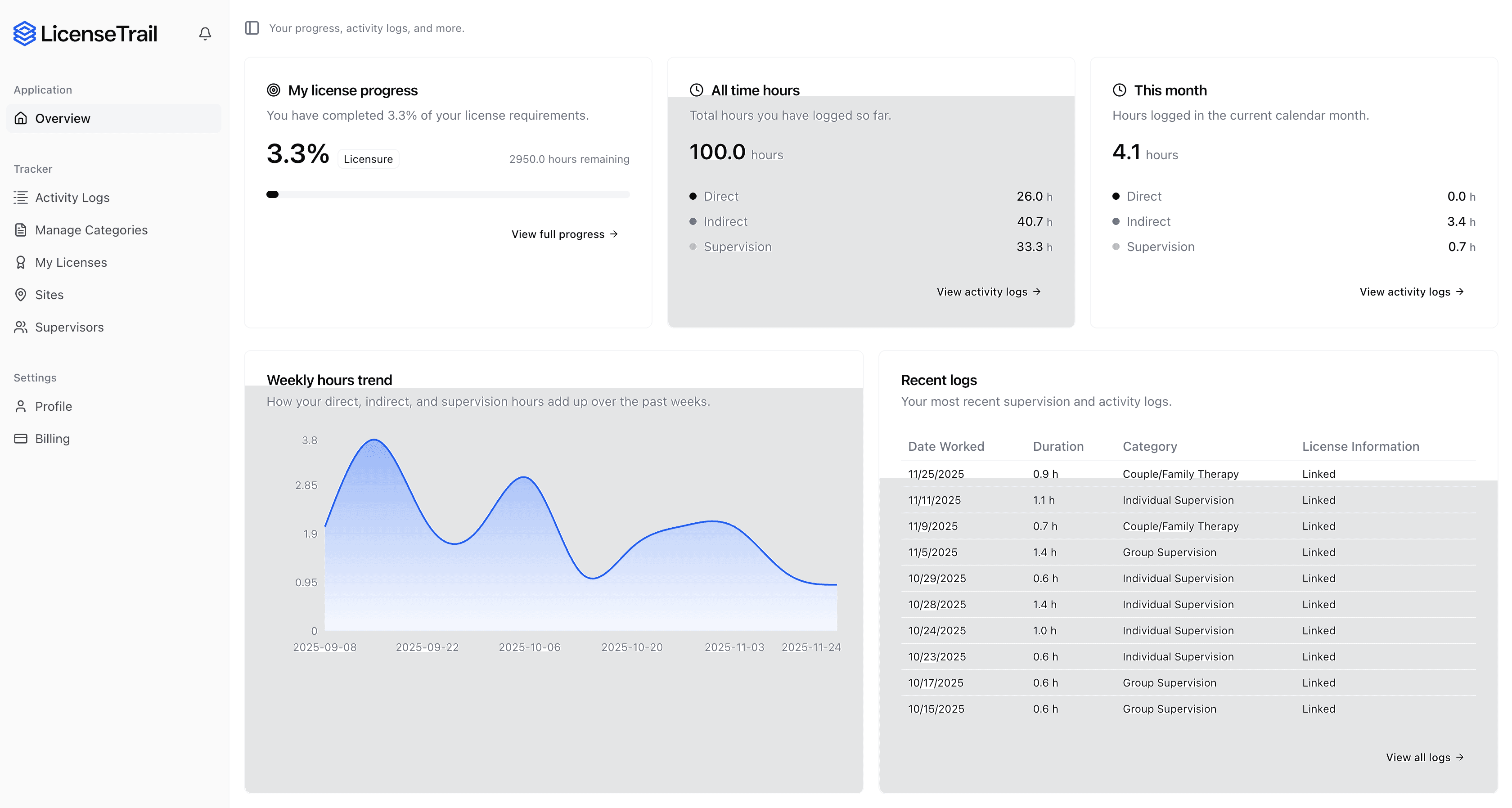
Track your LSW hours with confidence
License Trail checks your direct, indirect, and supervision hours against Illinois LSW requirements continuously and flags mismatches before you submit.
 Start Tracking for Free
No credit card required · Free plan available
Related Licenses
Is your spreadsheet hiding Illinois LSW risks?
Stop guessing if your categories match Illinois Department of Financial and Professional Regulation (Social Work Examining and Disciplinary Board) requirements. License Trail checks your direct, indirect, and supervision hours continuously and flags mismatches before you submit.
Import or log
Bring your spreadsheet or start fresh
Upload your existing tracking spreadsheet and we'll map every hour into the right Illinois Department of Financial and Professional Regulation (Social Work Examining and Disciplinary Board) categories automatically.
Verify against Illinois
Catch mismatches before the board does
License Trail checks your direct, indirect, and supervision hours against Illinois LSW requirements continuously.
Export board-ready
One-click clean reports
Generate professional, board-ready reports for supervision meetings and Illinois Department of Financial and Professional Regulation (Social Work Examining and Disciplinary Board) submissions in seconds.
No credit card required · Free plan available