
Indiana LCAC Requirements: Hours, Exams & Step-by-Step Guide
Stop guessing if your categories match Indiana requirements. License Trail checks your direct, indirect, and supervision hours against LCAC requirements continuously and flags mismatches before you submit.
No credit card required · Free plan available
Quick Requirements Overview
- Master’s (or higher) degree in addiction counseling/therapy or board-accepted related area; submit Form C + official transcripts (certifications don’t substitute).
- Graduate practicum/internship: ≥700 clock hours incl. ≥280 face-to-face client contact + ≥35 supervision hours; document via Form P.
- Practicum supervisor must be a qualified, actively licensed behavioral health professional with ≥5 years addictions experience.
- Post-degree experience: 2 years of clinical addiction counseling, completed in 21–48 months; verify via Form E2 (limits on unsupervised/away-from-supervisor-premises private practice).
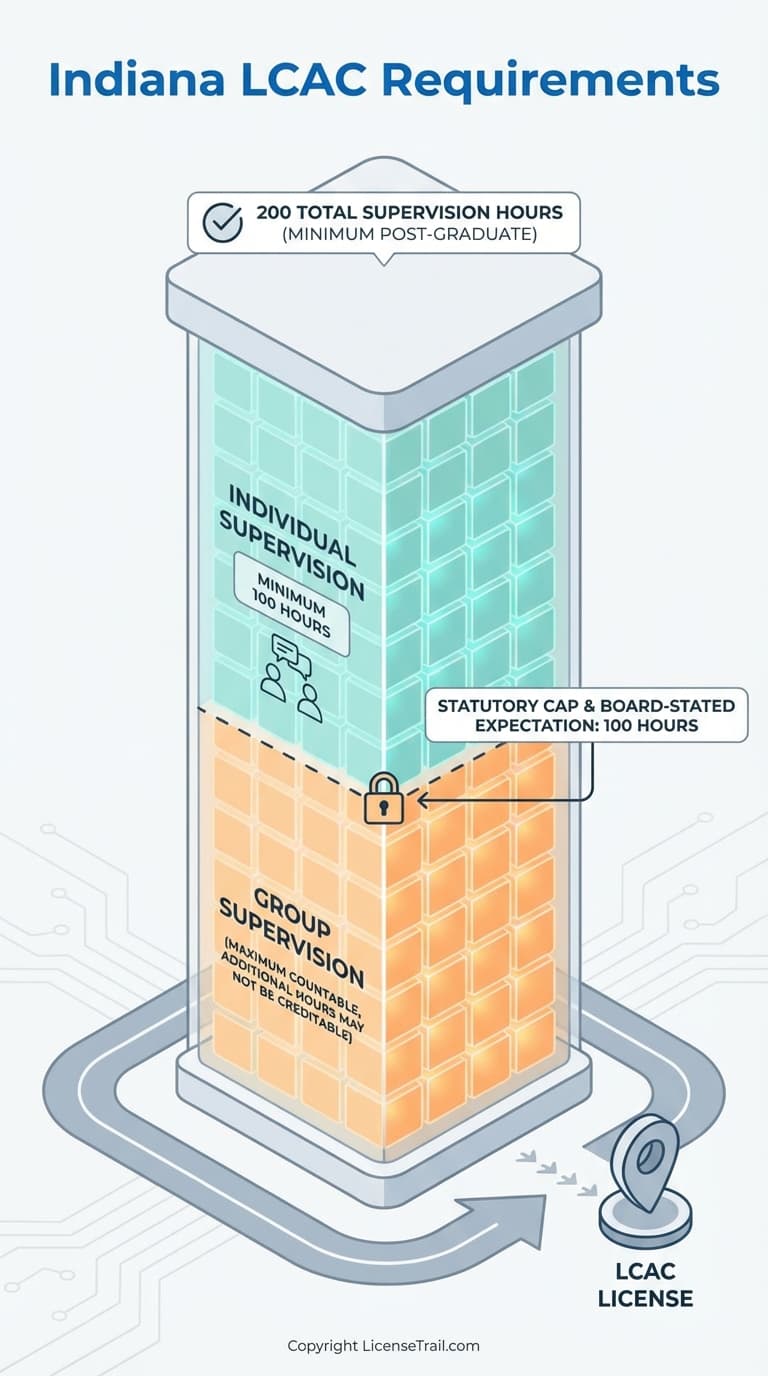
- Post-degree supervision: 2 years while employed + ≥200 supervision hours (100 individual + 100 group); document via Form S2 (period must align with E2).
- Exam: pass AADC (IC&RC) or MAC (NAADAC); if not yet taken, must test within 1 year of board exam approval.
- Application items: online application + $50 fee + criminal background check; include legal/name-change docs as needed; out-of-state license verification and official exam score report if applicable.
License Details
Procedures
Licensed Clinical Addiction Counselor (LCAC) in Indiana is a master’s‑level license regulated by the Indiana Behavioral Health and Human Services Licensing Board under the Professional Licensing Agency (PLA). It is typically the second step after holding a Clinical Addiction Counselor Associate (LCACA), and it requires specific education, practicum hours, post‑degree experience, supervision, and a national exam.
Below is a step‑by‑step breakdown using the board’s own structure (Forms C, P, E2, S2) and language.
1. Educational foundation (Form C – Graduate Coursework)
To qualify for LCAC by examination, you must hold a graduate degree that matches the statute and board rules.
The board states that an LCAC applicant must have “a graduate in addiction counseling, addiction therapy, or in a related area as determined by the board from an eligible postsecondary educational institution that meets the requirements of the board.” All education requirements must be met through postsecondary coursework; certifications cannot be used to meet educational requirements. (secure.in.gov)
Key points:
- Degree level: Master’s (or higher) in:
- Addiction counseling,
- Addiction therapy, or
- A related area acceptable to the board.
- Institution: Must be an “eligible postsecondary educational institution” meeting board requirements.
- Documentation: You submit:
- Form C – Verification of Graduate Coursework, and
- Official transcripts showing degree awarded and date conferred. (secure.in.gov)
2. Graduate practicum / internship hours (Form P – Practicum)
The board requires structured supervised practicum / internship / field experience at the graduate level.
For LCAC (master’s level with 2 years’ experience), the board’s instructions specify that applicants must complete at least one supervised practicum, internship, or field experience in a counseling setting that includes:
- Minimum 700 clock hours total.
- Within those 700 hours:
- At least 280 face‑to‑face client contact hours of addiction counseling services.
- At least 35 hours of supervision by a qualified supervisor with at least five years’ experience in addiction counseling. (secure.in.gov)
The board defines a “qualified supervisor” for this practicum as someone who is supervising within their scope of experience and training, holds an active license at the time of supervision, and is one of:
- Clinical addiction counselor
- Clinical social worker
- Marriage and family therapist
- Physician with training in psychiatric medicine
- Psychologist
- Clinical nurse specialist in psychiatric or mental health nursing
- Another state‑regulated addiction counseling professional (or an equivalent behavioral health professional where no regulation exists)
and who has at least five (5) years of experience in providing addiction services. (secure.in.gov)
You document this using Form P – Verification of Practicum.
3. Post‑degree clinical addiction counseling experience (Form E2)
Beyond the graduate practicum, the LCAC license requires post‑degree clinical addiction counseling experience, typically obtained under an LCACA (Clinical Addiction Counselor Associate) license.
For LCAC, the board’s LCAC section (Form E2) specifies:
- You must have at least two (2) years of clinical addiction counseling experience.
- Those two years must span no less than 21 months and no more than 48 months. (secure.in.gov)
Important nuances:
- The board does not specify a numeric total of “X hours” for LCAC experience (unlike some other licenses where they note that 1,500 hours equals one year).
- Instead, the LCAC requirement is expressed in years and months of experience, plus separate, explicit supervision‑hour requirements (see next section).
- The board also restricts where this experience can occur. According to the LCAC instructions, the experience cannot be performed away from the qualified supervisor’s premises if:
- The work is independent private practice of addiction therapy, and
- The work is not performed at a place that has the supervision of a qualified supervisor. (secure.in.gov)
You document your clinical addiction counseling work history using Form E2 – Verification of Experience. The board also clarifies elsewhere that Form E2 verifies your post‑degree experience and employment, and it must match the timeframe shown on your supervision form (S2). (in.gov)
4. Post‑degree supervision requirements (Form S2 – Supervision)
In addition to raw experience, Indiana requires structured clinical addiction supervision after the degree.
In the LCAC section, the board’s instructions for Form S2 – Verification of Supervision specify that applicants:
- Must have at least two (2) years of clinical addiction supervision while being employed.
- This supervision must include at least 200 hours under supervision, broken down as:
- 100 hours of individual supervision, and
- 100 hours of group supervision. (secure.in.gov)
Supervision must be provided by a qualified supervisor (using the same licensed categories and experience standard defined for practicum supervision: clinical addiction counselor, clinical social worker, MFT, psychiatrist‑trained physician, psychologist, or clinical psychiatric/mental health nurse specialist, or equivalent state‑regulated addiction professional with at least five years’ experience in addictions counseling). (secure.in.gov)
The time period covered on Form S2 (supervision) must align with the period reported on Form E2 (experience), and both must fall between 21 and 48 months. (in.gov)
Note on “direct hours” vs “supervised hours”:
- The board does not state LCAC requirements in the form of “1,500 hours of direct experience and 1,500 hours of supervised experience.”
- Instead, it uses:
- Graduate practicum/internship clock hours (700, with defined client‑contact and supervision portions), and
- Post‑degree time‑based experience (2 years / 21–48 months), plus a fixed minimum number of supervision hours (200, split 100 individual / 100 group).
5. National examination requirement
To become an LCAC, you must take and pass a board‑approved national addictions examination. Indiana has adopted two exams:
- AADC (Advanced Alcohol and Drug Counselor) exam – IC&RC / ICAADA
- MAC (Master Addiction Counselor) exam – NAADAC‑NCC AP / IAAP (in.gov)
The board’s LCAC instructions describe the exam process:
- Once all required documentation is reviewed and approved, applicants who have not yet taken a national exam receive an examination approval from the PLA.
- After approval, you must take the exam within one (1) calendar year from the date of initial board approval, or the approval becomes invalid and a new application (with new documentation) is required. (secure.in.gov)
- If you have already passed one of the accepted national exams, you must have the exam agency send an official score report directly to the PLA or upload it per instructions. (in.gov)
6. Application & documentation checklist for LCAC (by exam)
For “Clinical Addiction Counselor (LCAC) – Master level with 2 years experience,” the PLA outlines a specific checklist. For applicants who have completed a master’s in addictions‑focused education and obtained post‑degree experience and supervision (typically under an LCACA), you must submit: (secure.in.gov)
- Completed online application for LCAC.
- Application fee of $50.00 (paid online; nonrefundable).
- Criminal Background Check.
- Positive Response Documentation if you answer “Yes” to any legal/disciplinary application questions (a narrative including violation, location, date, cause number, disposition, and supporting court/disciplinary records).
- Name change documentation if your name differs from your academic or other records (e.g., marriage certificate, divorce decree).
- Official transcripts from each school listed on Form C, with your degree and conferral date clearly shown.
- Form C – Verification of Graduate Coursework (documenting that the degree and coursework meet the LCAC requirements).
- Form P – Verification of Practicum (showing the minimum 700 clock hours, with 280 face‑to‑face client hours and 35 supervision hours, under a qualified supervisor).
- Form E2 – Verification of Experience (documenting at least 2 years / 21–48 months of clinical addiction counseling experience; not in disallowed independent private practice settings).
- Form S2 – Verification of Supervision (documenting at least 2 years of clinical addiction supervision during employment, with at least 200 total supervision hours: 100 individual and 100 group, from a qualified supervisor).
- Verification of licensure, if you currently hold or have held a license/certification in another state (via that state’s official verification, not just a license card).
- Official exam score report for the AADC or MAC exam, or, if not yet taken, use the process to obtain exam approval and then have the exam body release your scores to PLA upon completion.
The board also notes that if you already hold an LCACA in Indiana, you typically only need to resubmit certain forms (Form C, Form P, and transcripts) upon request, since your associate‐level application already documented much of the educational foundation. (secure.in.gov)
7. Reciprocity route (briefly)
For professionals already licensed at an equivalent level in another state and who have passed an equivalent national exam, Indiana offers LCAC reciprocity. This has its own checklist (application, fee, criminal background check, verification of active equivalent license, national exam score report, etc.). (secure.in.gov)
The reciprocity path does not recalculate your clinical and supervision hours in Indiana; instead, it relies on verification of your out‑of‑state license and exam.
8. Consolidated view of time and hour requirements for LCAC (by exam)
Graduate practicum (Form P) – LCAC level
- ≥ 700 clock hours in a counseling setting.
- Within those 700 hours:
- ≥ 280 hours of face‑to‑face client contact (addiction counseling).
- ≥ 35 hours of supervision by a qualified supervisor with ≥ 5 years of addiction counseling experience. (secure.in.gov)
Post‑degree clinical experience (Form E2)
- 2 years of clinical addiction counseling experience,
- Spanning no less than 21 months and no more than 48 months,
- Not performed as independent private practice away from a qualified supervisor’s premises (if it would lack on‑site supervision). (secure.in.gov)
Post‑degree supervision (Form S2)
- 2 years of clinical addiction supervision while employed.
- At least 200 total supervision hours, consisting of:
- 100 hours individual supervision, and
- 100 hours group supervision,
provided by a qualified supervisor as defined in statute and board guidance. (secure.in.gov)
National exam
- Pass AADC (IC&RC) or MAC (NAADAC) examination adopted by the board.
- Take the exam within 1 year of board approval, or reapply. (in.gov)
Final clarification on “hour‑type” requirements
For LCAC in Indiana, the Behavioral Health and Human Services Licensing Board currently frames requirements as:
- Explicit clock hours in the graduate practicum (700 total; 280 direct client‑contact; 35 supervised), and
- Defined supervision hours post‑degree (200 total: 100 individual, 100 group),
- Plus time‑based clinical experience requirements (2 years / 21–48 months), rather than a single fixed number such as “1,500 direct experience hours and 1,500 supervised hours.”
That structure is what governs LCAC licensure as of late 2025 on the PLA’s official Behavioral Health and Human Services Licensing Board pages. (secure.in.gov)
Track your LCAC hours with confidence
License Trail checks your direct, indirect, and supervision hours against Indiana LCAC requirements continuously and flags mismatches before you submit.
 Start Tracking for Free
No credit card required · Free plan available
Is your spreadsheet hiding Indiana LCAC risks?
Stop guessing if your categories match Indiana Behavioral Health and Human Services Licensing Board requirements. License Trail checks your direct, indirect, and supervision hours continuously and flags mismatches before you submit.
Import or log
Bring your spreadsheet or start fresh
Upload your existing tracking spreadsheet and we'll map every hour into the right Indiana Behavioral Health and Human Services Licensing Board categories automatically.
Verify against Indiana
Catch mismatches before the board does
License Trail checks your direct, indirect, and supervision hours against Indiana LCAC requirements continuously.
Export board-ready
One-click clean reports
Generate professional, board-ready reports for supervision meetings and Indiana Behavioral Health and Human Services Licensing Board submissions in seconds.
No credit card required · Free plan available