
Indiana LMHC Requirements: Hours, Exams & Step-by-Step Guide
Stop guessing if your categories match Indiana requirements. License Trail checks your direct, indirect, and supervision hours against LMHC requirements continuously and flags mismatches before you submit.
No credit card required · Free plan available
Quick Requirements Overview
- Graduate degree (master’s or doctorate) in counseling/related mental health field from an eligible, regionally accredited institution; coursework must cover 12 required content areas
- Graduate credit hours: ≥48 semester (master’s) or ≥96 semester (doctorate); and ≥60 semester hours in mental health counseling or related field
- Pre-degree clinical training (statutory minimum): 700 clock hours total = 100-hour practicum + 600-hour internship, with ≥66 face-to-face supervision hours
- Board rule model (may be required by program): 1,000-hour “clinical experience” = practicum (100) + internship (600) + advanced internship (300), with ≥100 face-to-face supervision hours
- LMHCA first (if graduated after 7/1/2014): must hold LMHCA before post-graduate hours will count toward LMHC
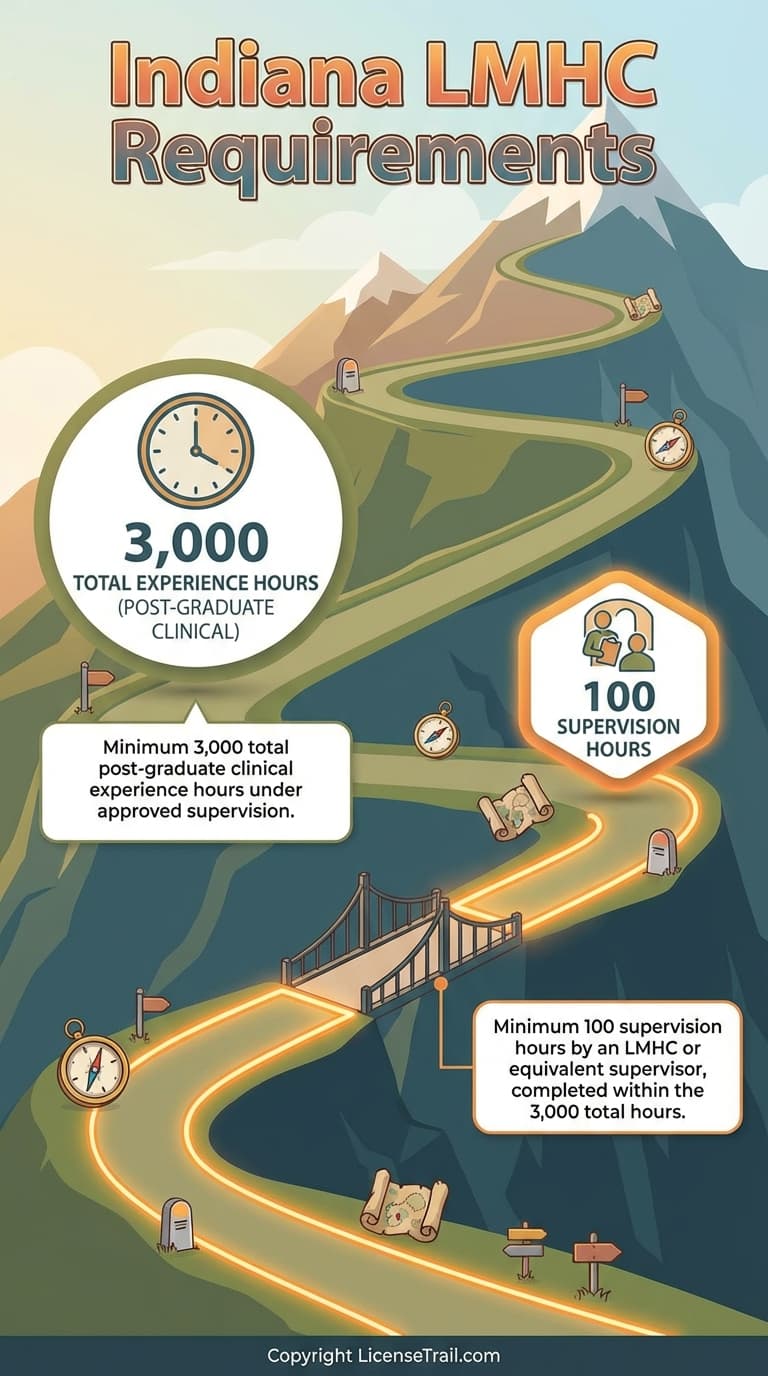
- Post-graduate experience: 3,000 hours under approved supervision, completed in 21–48 months after degree completion, including ≥100 supervision hours (≤50% virtual)
- Supervision/setting limits: supervisor must be LMHC or Board-recognized equivalent; unsupervised independent private practice hours won’t count
- Exam: pass Board-approved exam (PLA currently lists NCMHCE); “first available exam” timing affects whether hours can be accrued/count and may cap pre-exam countable hours at 1,500 if passed first available exam
License Details
Procedures
Becoming a Licensed Mental Health Counselor (LMHC) in Indiana is governed by the Behavioral Health and Human Services Licensing Board under Indiana Code 25‑23.6 and Title 839 of the Indiana Administrative Code. The Board is very specific about the type and amount of clinical and supervision hours you must complete, both during your graduate program and after graduation.
Below is a step‑by‑step breakdown focused on the hour requirements and the Board’s own terminology.
1. Educational foundation and program type
1.1. Acceptable degree and institution
To be eligible for an LMHC (or LMHCA), you must:
- Hold a master’s or doctoral degree in counseling or in an area related to mental health counseling from an “eligible postsecondary educational institution.”
- That institution must have been regionally accredited (if in the U.S.) or an approved Canadian institution at the time you graduated. (codes.findlaw.com)
Regulations define a “master’s degree in an area related to mental health counseling” to include programs such as clinical social work, psychology, human services, human development, family relations, counseling, or CACREP/CORE‑accredited counseling programs. (law.cornell.edu)
1.2. Required counseling coursework
Indiana Code requires that your graduate counseling coursework include at least one master’s or doctoral degree in counseling and cover 12 specified content areas: (law.justia.com)
- Human growth and development
- Social and cultural foundations of counseling
- Helping relationship (counseling theory and practice)
- Group dynamics, processes, counseling, and consultation
- Lifestyle and career development
- Assessment and appraisal of individuals
- Research and program evaluation
- Professional orientation and ethics
- Foundations of mental health counseling
- Contextual dimensions of mental health counseling
- Knowledge and skills for the practice of mental health counseling and psychotherapy
- Clinical instruction
Board rules also require:
- At least 48 semester (72 quarter) graduate hours for a master’s, or
- 96 semester (144 quarter) graduate hours for a doctorate, and
- At least 60 semester (90 quarter) hours in mental health counseling or a related field. (law.cornell.edu)
2. Graduate practicum and internship hours (pre‑degree)
Indiana law and Board rule jointly govern your pre‑licensure clinical training during the degree.
2.1. Statutory minimum clinical hours
The statute now sets a minimum requirement for supervised clinical experience in your degree program:
- At least 700 clock hours of supervised clinical practicum, internship, or field experience in a counseling setting; made up of:
- One practicum of 100 hours, and
- One internship of 600 hours
- With at least 66 hours of face‑to‑face supervision across that practicum and internship. (law.justia.com)
This 700‑hour / 66‑supervision‑hour requirement is the current minimum in Indiana Code 25‑23.6‑8.5‑3(2).
2.2. Board rule definitions: practicum, internship, and “advanced internship”
The Board’s rule goes further and defines these experiences in detail and describes a 1,000‑hour model (practicum + internship + advanced internship), even though the statute now only mandates 700 hours.
Practicum (as defined in 839 IAC 1‑5‑1)
“Practicum” is defined as a supervised curricular experience aimed at basic counseling skills. The rule requires: (law.cornell.edu)
- Minimum 100 clock hours, including:
- At least 40 hours of direct service with clients (individual and group; at least ¼ in group work).
- Weekly supervision requirements during at least one academic term:
- Minimum 1 hour/week of individual supervision by faculty or a faculty‑supervised supervisor, using audio/video or direct observation.
- Minimum 1.5 hours/week of group supervision with other practicum students.
- Ongoing evaluation with a formal evaluation at the end.
Internship (as defined in 839 IAC 1‑5‑1)
“Internship” is a more advanced supervised curricular experience that refines skills. The rule requires: (law.cornell.edu)
- 600 clock hours of supervised internship, begun after successful completion of practicum.
- Within those 600 hours:
- At least 240 hours of direct service with clients.
- At least 1 hour/week of individual supervision by the onsite supervisor throughout the internship.
- At least 1.5 hours/week of group supervision (usually by program faculty) throughout the internship.
- Opportunities to engage in non‑direct service professional activities, use professional resources, and develop audio/video material for supervision.
- A formal evaluation of performance by the program faculty supervisor, in consultation with the site supervisor.
Advanced internship and total “clinical experience requirement”
Board rule also describes an “advanced internship”: (law.cornell.edu)
- Minimum 300 clock hours of supervised experience in a mental health services setting, under a qualified professional.
When practicum (100), internship (600), and advanced internship (300) are all used, the rule refers to a total “clinical experience requirement” of 1,000 hours. It adds:
“One hundred (100) hours of face‑to‑face supervision” refers to the entire clinical experience requirement of 1,000 hours, including individual and group supervision, and the student must document at least 100 face‑to‑face supervision hours across practicum, internship, and advanced internship. (law.cornell.edu)
Key point:
- Statute requires at least 700 hours (100 practicum + 600 internship, 66 face‑to‑face supervision). (law.justia.com)
- Board rule still describes a 1,000‑hour model with 100 face‑to‑face supervision hours and an advanced internship. (law.cornell.edu)
- In practice, many Indiana programs meet or exceed 700 hours, often aligning with the Board’s 1,000‑hour model.
3. Mental Health Counselor Associate (LMHCA) and when hours start to “count”
Indiana uses a two‑step license path: LMHCA (associate) → LMHC (independent).
The state Professional Licensing Agency (PLA) notes:
- Applicants who graduated after July 1, 2014 are required to obtain a Mental Health Counselor Associate (LMHCA) license before accruing postgraduate clinical experience hours that will count toward LMHC licensure. (in.gov)
Practically, that means:
- If you graduated after July 1, 2014 and start working before you hold an LMHCA or other qualifying status, those hours generally will not count toward the 3,000‑hour post‑graduate requirement for LMHC.
The LMHCA application itself requires your degree, coursework, and graduate practicum/internship to already meet the statutory and regulatory standards described above. (codes.findlaw.com)
4. Post‑graduate supervised clinical experience hours (after the degree)
After your qualifying degree, you must complete a defined amount of post‑graduate clinical experience under supervision.
4.1. Total hours and time frame
Indiana Code requires:
- “Three thousand (3,000) hours of post‑graduate clinical experience over a two (2) year period.” (law.justia.com)
The Board further defines how this is interpreted:
- These 3,000 hours must be:
- Under “approved supervision”,
- Acquired in no less than 21 months and no more than 48 months, and
- Accrued after the date the institution certifies that all master’s degree requirements were completed. (law.cornell.edu)
So although the statute uses “over a two‑year period,” the Board allows a 21–48 month window to realistically accumulate the 3,000 hours.
4.2. Supervision hours within the 3,000 hours
Indiana Code specifies a supervision requirement inside those 3,000 hours:
- The 3,000 hours “must consist of one hundred (100) hours of supervision” under a licensed mental health counselor or an “equivalent supervisor,” as determined by the Board. (law.justia.com)
Additional statutory details:
- Up to 50% of the supervised post‑graduate clinical experience may be accounted for through virtual supervision by a licensed LMHC or equivalent supervisor. (codes.findlaw.com)
Important clarification on “type” of hours:
- Indiana does not split the 3,000 hours into separate quotas like “1,500 hours of direct client contact and 1,500 hours of other activities.”
- The law simply requires 3,000 hours of “post‑graduate clinical experience” with at least 100 hours of supervision within that total. (law.justia.com)
- “Clinical experience” is not broken down by the statute into specific minimum direct vs. indirect service hours (unlike the detailed breakdown in the graduate practicum/internship rules).
4.3. Who qualifies as an “equivalent supervisor”
The Board defines “equivalent supervisor” for these post‑graduate hours as a professional supervising within their scope of training who is licensed as one of the following: (law.cornell.edu)
- Clinical social worker
- Marriage and family therapist
- Physician with training in psychiatric medicine
- Psychologist
- Clinical nurse specialist in psychiatric or mental health nursing
- A mental health professional of equivalent status in a state with no relevant regulation
All of these may serve as supervisors if they are within scope and recognized by the Board as “equivalent.”
4.4. Where the post‑graduate hours can be earned
Indiana Code allows flexibility but imposes safeguards: (law.justia.com)
- Generally permitted: Work may be performed at or away from the premises of the supervising LMHC.
- Not permitted away from premises (subject to certain exceptions) if:
- The work is the independent private practice of mental health counseling, and
- The work is not at a site that has supervision by an LMHC or equivalent supervisor.
In other words, hours from unsupervised solo private practice will not count.
4.5. Interaction with the examination timing (the “first available examination” rule)
Indiana has a technical rule about when you can start or continue counting hours relative to the licensing examination (“first available examination”):
- If you apply for, take, and pass the first available examination, you may not count more than 1,500 of the required 3,000 hours that were accumulated before taking the exam. (law.justia.com)
- If you do not pass the first available exam, you:
- Keep the hours already accumulated,
- Can continue working,
- But cannot accumulate any additional hours toward LMHC until you pass the exam. (law.justia.com)
- If you do not take the first available exam at all, you may not begin accumulating any post‑degree clinical hours toward LMHC until you eventually pass the exam. (law.justia.com)
The “first available examination” itself is defined as the first exam date that falls after your graduation (or move to Indiana) with an application deadline at least 30 days after that date, or during your final academic term if you’re allowed to test then. (law.justia.com)
5. Examination requirement
Indiana Code requires that applicants pass an examination approved by the Board for licensure as a mental health counselor (or associate). (law.justia.com)
According to the Indiana Professional Licensing Agency’s Behavioral Health and Human Services page:
- For LMHC applications (with post‑degree experience and supervision), the Board currently lists the NBCC National Clinical Mental Health Counseling Examination (NCMHCE) as the required exam. (in.gov)
Board rule on examination logistics adds that: (regulations.justia.com)
- Once the Board approves you to sit for the exam, you must take the exam within one year of that approval or your approval lapses and you must reapply.
- If you fail three times, you must appear before the Board prior to retaking.
Because exam designations can change over time (e.g., NCE vs. NCMHCE), you should always confirm on the PLA/BHHS website which exam is currently accepted at the time you apply. (in.gov)
6. Applying for LMHC: putting the pieces together
Once all requirements are met, a complete LMHC application generally requires:
- Completed LMHC application and fee to the Indiana Professional Licensing Agency. (in.gov)
- Official graduate transcripts showing:
- Master’s or doctoral degree in counseling or related field,
- Required coursework areas, and
- Required practicum/internship hours as certified by the institution. (law.justia.com)
- Proof of post‑graduate clinical experience, documenting:
- At least 3,000 hours of post‑graduate clinical experience,
- Completed within 21–48 months after degree completion,
- Under approved supervision, with at least 100 hours of supervision (up to 50% of which may be virtual),
- Supervisor credentials satisfying LMHC or “equivalent supervisor” categories. (law.cornell.edu)
- Proof of passing the Board‑approved examination (currently NCMHCE via NBCC). (in.gov)
- Criminal background check and any required positive‑response documentation, if applicable. (in.gov)
7. Hour requirements in plain numbers
Putting the main hour‑based requirements together:
During graduate training (minimum statutory requirements): (law.justia.com)
- Practicum:
- 100 clock hours total
- Includes 40+ hours of direct service (per Board rule).
- Internship:
- 600 clock hours total
- Includes 240+ hours of direct service (per Board rule).
- Supervision during practicum + internship:
- At least 66 hours of face‑to‑face supervision (statute).
- Board rule describes a fuller model with practicum + internship + advanced internship totaling 1,000 hours with 100 face‑to‑face supervision hours, but this exceeds the statutory minimum and is partly program‑dependent.
After graduation (post‑graduate LMHC requirement): (law.justia.com)
- 3,000 hours of post‑graduate clinical experience
- Must be under approved supervision.
- Must be completed in 21–48 months after degree completion.
- Must include at least 100 hours of supervision (individual/group; up to 50% may be virtual).
- The law does not divide these 3,000 hours into specified amounts of direct vs. indirect service—only that they be “clinical experience” with required supervision.
These are the core, board‑defined hour requirements you must satisfy to become licensed as an LMHC in Indiana.
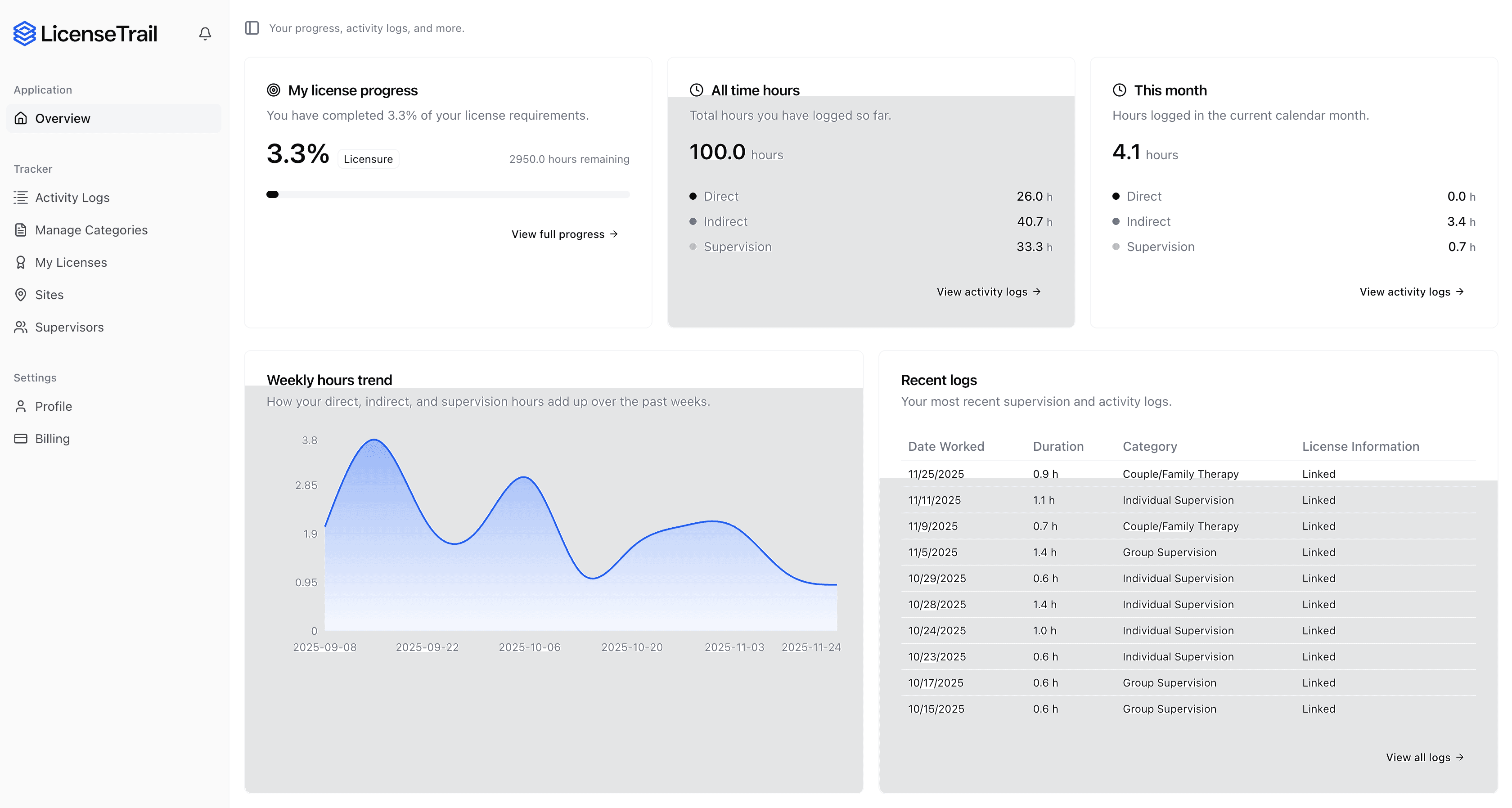
Track your LMHC hours with confidence
License Trail checks your direct, indirect, and supervision hours against Indiana LMHC requirements continuously and flags mismatches before you submit.
 Start Tracking for Free
No credit card required · Free plan available
Is your spreadsheet hiding Indiana LMHC risks?
Stop guessing if your categories match Indiana Behavioral Health and Human Services Licensing Board requirements. License Trail checks your direct, indirect, and supervision hours continuously and flags mismatches before you submit.
Import or log
Bring your spreadsheet or start fresh
Upload your existing tracking spreadsheet and we'll map every hour into the right Indiana Behavioral Health and Human Services Licensing Board categories automatically.
Verify against Indiana
Catch mismatches before the board does
License Trail checks your direct, indirect, and supervision hours against Indiana LMHC requirements continuously.
Export board-ready
One-click clean reports
Generate professional, board-ready reports for supervision meetings and Indiana Behavioral Health and Human Services Licensing Board submissions in seconds.
No credit card required · Free plan available