
Iowa LMSW Requirements: Hours, Exams & Step-by-Step Guide
Stop guessing if your categories match Iowa requirements. License Trail checks your direct, indirect, and supervision hours against LMSW requirements continuously and flags mismatches before you submit.
No credit card required · Free plan available
Quick Requirements Overview
- Degree: MSW from a CSWE-accredited program (or board-approved DSW/PhD in social work); foreign grads need equivalency evaluation.
- Exam: Pass the ASWB Masters exam; Iowa uses the ASWB passing score; official results must come from ASWB/Registry.
- Early testing allowed: Can take ASWB Masters in last MSW semester with application/fee + school letter; final official transcript required after conferral.
- Application: Submit completed application + nonrefundable fee (≈$123).
- Documentation: Official transcript sent directly from school (or via ASWB Social Work Registry); license verification required if previously licensed elsewhere (or via Registry).
- No supervised hours for LMSW: 0 post-degree supervised practice hours required for initial LMSW (hours apply to LISW after LMSW).
- Renewal/maintenance: After first renewal, 27 CE hours per biennium; mandatory reporter training may apply (2-hour initial + 1-hour/3-year recert for child/dependent adult abuse).
License Details
Procedures
In Iowa, the Licensed Master Social Worker (LMSW) is the master’s‑level social work license regulated by the Iowa Board of Social Work under Iowa Code chapter 154C and Iowa Administrative Code chapter 645—280 (effective July 17, 2024). (rules.iowa.gov)
Below is a step‑by‑step description of how to qualify, with special attention to any hour‑based requirements and how the Board itself describes them.
1. Level and role of the LMSW in Iowa
The rules define:
- “LMSW” means licensed master social worker. (rules.iowa.gov)
Iowa has three levels:
- LBSW – Licensed Bachelor Social Worker
- LMSW – Licensed Master Social Worker (your target license)
- LISW – Licensed Independent Social Worker (independent/clinical level) (rules.iowa.gov)
The LMSW is the standard license you hold before completing post‑master’s supervised clinical hours required for independent (LISW) practice.
2. Educational requirement for the LMSW
For the master and independent levels, the Board’s educational rule states that an applicant must: (rules.iowa.gov)
- Hold either:
- A master’s degree in social work from a college or university accredited by the Council on Social Work Education (CSWE) at the time of graduation, or
- A doctoral degree in social work from a college or university approved by the Board.
Foreign‑trained social workers must obtain an equivalency evaluation (e.g., IERF or a CSWE certificate of equivalency) at their own expense. (rules.iowa.gov)
There is no separate minimum number of field/practicum hours specified by the Board beyond whatever CSWE requires for accreditation of your program.
3. Examination requirement (ASWB Masters exam)
Iowa uses the ASWB national exams and assigns them by level as follows: (rules.iowa.gov)
- LBSW – ASWB Bachelor (basic) exam
- LMSW – ASWB Masters (intermediate) exam
- LISW – ASWB Clinical exam
Key points from the exam rule: (rules.iowa.gov)
- You must “take and pass the ASWB examination at the appropriate level” (for LMSW, the intermediate/master level).
- Iowa uses the ASWB passing score as the Iowa passing score.
- The Board will accept only official exam results sent directly from ASWB or via the ASWB Social Work Registry.
Early testing while still in your MSW program
The rules allow a student to sit for the master‑level examination in the last semester of an approved MSW program, before the transcript is issued, if: (rules.iowa.gov)
- You submit an application for licensure at the master level and the required fee, and
- Your school sends a letter directly to the Board verifying that:
- You are currently enrolled in a master of social work program, and
- Your expected date of graduation.
After you complete degree requirements, your school must send the official transcript showing the degree and date of conferral directly to the Board.
4. Application process and documentation
The general licensure rule for all social work levels provides that: (rules.iowa.gov)
-
Application and fee
- You must submit a completed application for licensure.
- You must pay a nonrefundable licensure fee (the Board’s website currently lists this as $123).
-
Official academic transcript
- The Board will not consider the application until official transcripts have been received, except for the early‑exam situation described above. (rules.iowa.gov)
- Transcripts must be sent directly from the university (or via the ASWB Social Work Registry) to the Iowa Board of Social Work. (rules.iowa.gov)
-
Verification of other licenses (if applicable)
- If you have been licensed elsewhere, you must provide verification from the jurisdiction where you were most recently licensed. The verification must include:
- Licensee’s name
- Date of initial licensure
- Current licensure status
- Any disciplinary action taken against the license (rules.iowa.gov)
- If you have been licensed elsewhere, you must provide verification from the jurisdiction where you were most recently licensed. The verification must include:
-
Using the ASWB Social Work Registry
- Instead of sending separate transcripts and license verifications, the Board will accept ASWB Social Work Registry verification that covers both education and licensure in other states. (rules.iowa.gov)
On the Board’s public site, under “Application Requirements,” the items are summarized as:
- Complete application
- Payment of the $123 fee
- Official transcript showing your social work degree (sent directly from the university). (dial.iowa.gov)
5. Hour‑based requirements: what is and is not required for the LMSW
A. Pre‑licensure practice hours for the LMSW
For initial LMSW licensure, Iowa’s rules do not require any post‑master’s supervised practice hours.
The hour requirements in rule 645—280.6(154C) Supervised clinical experience are explicitly written for “an applicant for licensure as an independent level social worker” (LISW), and the supervised clinical experience “cannot begin until after licensure as a master level social worker.” (rules.iowa.gov)
So, in direct answer to your example:
- Iowa does not require something like “1,500 hours of direct experience and 1,500 hours of supervised experience” for the LMSW license itself.
- Instead, 0 hours of post‑degree supervised professional practice are required to obtain the LMSW (beyond your MSW program’s internal practicum hours).
You become an LMSW once you meet education + exam + application requirements; you only accumulate supervised practice hours after that, if you choose to pursue LISW.
B. Post‑LMSW supervised clinical hours for LISW (relevant future step)
Although not required to become an LMSW, most LMSWs eventually seek LISW. Those hour requirements are clearly quantified in the Iowa rules and often cause confusion, so it is useful to see the Board’s own structure: (rules.iowa.gov)
For LISW, your supervised clinical experience must:
- Begin only after you are licensed as a master level social worker (i.e., after you are an LMSW).
- Last a minimum of two years.
- Consist of at least 3,000 hours of practice.
- Include at least 1,500 hours of direct client contact.
- Include at least 110 hours of direct supervision, equitably distributed, and:
- At least 24 hours must be live or recorded direct observation of client interaction.
- Up to 50 hours of supervision may be in group supervision.
- Direct supervision may occur in person or via videoconferencing.
These hours are documented via a Supervision Plan Form (before supervision starts) and a Supervision Report Form (when supervision ends), which the Board lists among the documentation required for licensure. (dial.iowa.gov)
Again, these hour requirements are for LISW, not for initial LMSW licensure.
C. Continuing education and other hour‑based obligations after licensure
Once you are licensed (including LMSW), additional hour‑based requirements apply for license maintenance, not for getting the license:
-
Continuing education
- After your first renewal, you must complete a minimum of 27 hours of continuing education per biennium. (rules.iowa.gov)
- New licensees do not need CE for their first renewal; CE accrued between initial licensing and the second renewal can be counted toward that second renewal period.
-
Mandatory reporter training hours
- If you regularly work with children, you must:
- Complete an initial two‑hour child abuse mandatory reporter training within six months of employment (or before your current certificate expires), and
- Then complete one‑hour recertification training every three years.
- The same structure applies for dependent adult abuse training: an initial two‑hour course, then one‑hour recertification every three years. (rules.iowa.gov)
- If you regularly work with children, you must:
-
Hours for reactivation (if you go inactive)
- If your license is inactive and you want to reactivate, one option to show current competence is documentation of “active practice, consisting of a minimum of 2,080 hours” in another jurisdiction during the two years before reactivation. (rules.iowa.gov)
These hour benchmarks affect renewal, reactivation, or advancement to LISW, not the initial issuance of an LMSW license.
6. Putting it all together: practical pathway to LMSW in Iowa
For a typical new graduate with no prior license in another state, the sequence to become an LMSW in Iowa looks like this:
- Complete an MSW from a CSWE‑accredited program (or a board‑approved doctoral degree in social work). (rules.iowa.gov)
- Apply for licensure at the master level (LMSW) via the Iowa Board of Social Work:
- Submit the online or paper LMSW application.
- Pay the nonrefundable licensure fee (currently $123). (dial.iowa.gov)
- Have your school send your official transcript directly to the Board (or arrange for the ASWB Social Work Registry to transmit educational verification). (rules.iowa.gov)
- Register for and pass the ASWB Masters (intermediate) exam. ASWB sends your results directly to the Board or via the ASWB Registry. (rules.iowa.gov)
- Receive your LMSW license once all application materials and exam results are approved.
There is no Iowa Board requirement for a fixed number of supervised practice hours to obtain the LMSW. All of the post‑master’s practice‑hour thresholds (3,000 total hours; 1,500 direct client hours; 110 supervision hours, etc.) belong to the LISW supervised clinical experience that you can begin only after you are already licensed as an LMSW. (rules.iowa.gov)
Track your LMSW hours with confidence
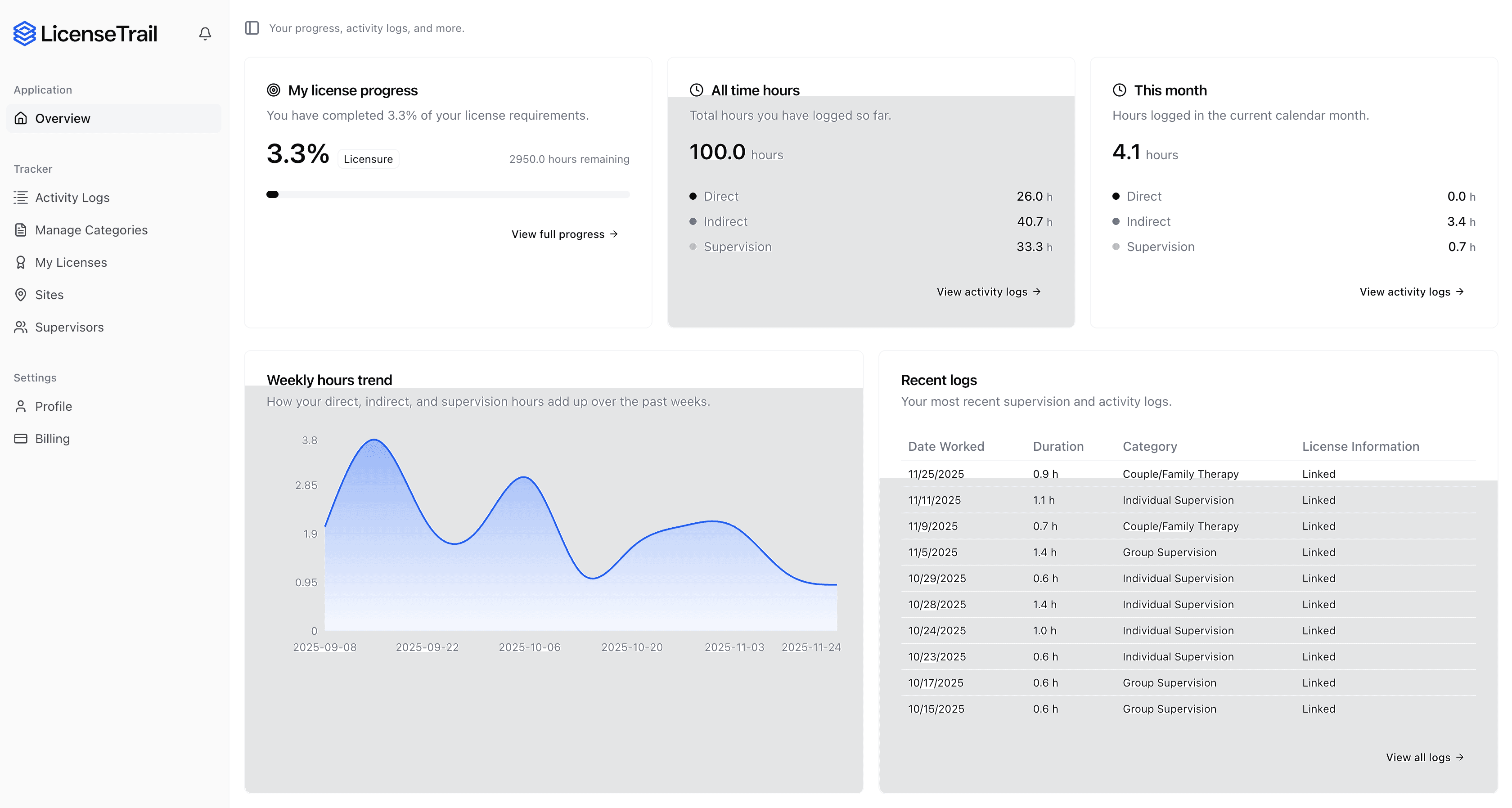
License Trail checks your direct, indirect, and supervision hours against Iowa LMSW requirements continuously and flags mismatches before you submit.
 Start Tracking for Free
No credit card required · Free plan available
Related Licenses
Is your spreadsheet hiding Iowa LMSW risks?
Stop guessing if your categories match Iowa Board of Social Work requirements. License Trail checks your direct, indirect, and supervision hours continuously and flags mismatches before you submit.
Import or log
Bring your spreadsheet or start fresh
Upload your existing tracking spreadsheet and we'll map every hour into the right Iowa Board of Social Work categories automatically.
Verify against Iowa
Catch mismatches before the board does
License Trail checks your direct, indirect, and supervision hours against Iowa LMSW requirements continuously.
Export board-ready
One-click clean reports
Generate professional, board-ready reports for supervision meetings and Iowa Board of Social Work submissions in seconds.
No credit card required · Free plan available