
Iowa HSP Requirements: Hours, Exams & Step-by-Step Guide
Stop guessing if your categories match Iowa requirements. License Trail checks your direct, indirect, and supervision hours against HSP requirements continuously and flags mismatches before you submit.
No credit card required · Free plan available
Quick Requirements Overview
- Must first hold an Iowa psychologist license (doctoral degree + EPPP + postdoc residency 1,500 hrs in ≥10 months).
- HSP certification requires 2 years supervised clinical health service experience: 1 year organized internship + 1 year postdoctoral.
- Alternate pathway: submit current National Register of Health Service Psychologists verification in lieu of detailed training documentation.
- Internship (organized health service training program): 1,500 hrs, ≥12 months (within 24 consecutive months), ≥375 hrs direct patient contact.
- Internship supervision/training: ≥2 hrs/week face-to-face individual supervision + ≥2 hrs/week additional clinical learning; typically ≥2 interns and ≥2 doctoral-level psychologist supervisors.
- Postdoctoral residency (health service setting): 1,500 hrs in ≥10 months with ≥45 hrs individual supervision (group supervision doesn’t count) and weekly supervisor-supervisee contact.
- Supervisor rules: licensed/active in jurisdiction; max 3 full-time supervisees; must ensure availability and crisis plan when offsite.
- Application/maintenance: submit required confirmation forms (internship + postdoc supervisor), pay $60 fee; renew biennially with psychology license and meet 40 CE hours/2 years.
License Details

Procedures
Becoming a certified Health Service Provider (HSP) psychologist in Iowa is essentially a two‑step process: first qualifying for psychologist licensure, then meeting and documenting a specific pattern of clinical training so the Board can certify you as a “health service provider in psychology.”
Below is a structured guide based on current Iowa law and administrative rules as of mid‑2025.
1. What “Health Service Provider in Psychology” Means in Iowa
Under Iowa law, a certified health service provider in psychology is:
- A person licensed to practice psychology in Iowa,
- Who has a doctoral degree in psychology, and
- Who has at least two years of clinical experience in a recognized health service setting, or meets the standards of a national register of health service providers in psychology (i.e., the National Register of Health Service Psychologists). (law.justia.com)
Once certified, the psychologist is “deemed qualified to diagnose or evaluate mental illness and nervous disorders, and to treat mental illnesses and nervous disorders” with certain medical-etiology exceptions. (law.justia.com)
The Iowa Department of Inspections, Appeals, and Licensing (DIAL) and the Iowa Board of Psychology (now under Chapter 481‑885 of the Iowa Administrative Code) administer this credential.
2. Baseline: Licensure as an Iowa Psychologist
You cannot obtain HSP certification until you are already a licensed psychologist in Iowa.
Key licensure elements (in brief):
- Doctoral degree in psychology from an APA/CPA‑accredited or ASPPB‑designated program (or ABPP diploma), with official transcripts sent directly to the Board. (dial.iowa.gov)
- Examination: Passing score on the EPPP, reported directly to the Board. (dial.iowa.gov)
- Supervised professional experience (postdoctoral residency):
- Iowa’s rules specify that the postdoctoral residency must consist of a minimum of 1,500 hours completed in no less than 10 months. (law.cornell.edu)
- The DIAL licensure instructions mirror this, requiring “verification of 1,500 hours of supervised professional experience completed in no less than 10 months” meeting the Board’s postdoctoral residency rule. (dial.iowa.gov)
During this residency, you must be under supervision by a licensed psychologist and follow the Board’s supervision standards (weekly individual supervision, supervisor availability, limits on the number of supervisees, etc.; details in Section 4 below). (law.cornell.edu)
Once you satisfy these and other administrative requirements, you can be licensed as a psychologist in Iowa. Only then are you eligible to apply for HSP certification. (dial.iowa.gov)
3. The Core HSP Requirement: Two Years of Supervised Clinical Experience
The Board’s long‑standing substantive standard is:
Two years of supervised clinical experience in health service in psychology, of which at least one year is in an organized health service training program and one year is postdoctoral. (legis.iowa.gov)
This has now been restated in the current rules as follows:
- The HSP applicant must “verify at least one year of clinical experience in an organized health service training program” meeting the internship criteria in the HSP rule, and at least one year of clinical experience in a health service setting that meets the postdoctoral residency requirements. (law.cornell.edu)
In practice, Iowa expects a specific structure:
- Year 1 – Organized health service training program (predoctoral internship)
- Year 2 – Postdoctoral residency in a health service setting
You may bypass documenting these details if you qualify through the National Register:
- If you provide verification of current doctoral‑level registration with the National Register of Health Service Psychologists, the Board will accept that as proof that you have completed the required clinical experience. (law.cornell.edu)
If you do not use the National Register route, you must meet and document the exact training pattern below.
4. Year 1: Organized Health Service Training Program (Internship)
The “organized health service training program” is your predoctoral internship. Under the current HSP rule, APA‑ or CPA‑accredited internships and APPIC‑member internships are automatically accepted; otherwise, the program must document that it meets all of the Board’s criteria. (law.cornell.edu)
The Board’s rule requires that this internship:
-
Be a structured sequence of training experiences
The program must be designed as a planned, programmed sequence focused on breadth and quality of training, not just a job in a service setting. (law.cornell.edu) -
Be supervised by doctoral‑level psychologists
- There must be a clearly designated doctoral‑level staff psychologist responsible for the integrity and quality of the training program, actively licensed where the program is located.
- There must be at least two doctoral‑level psychologists on staff as supervisors, with at least one actively licensed in that jurisdiction. (law.cornell.edu)
-
Require substantial direct clinical work with patients
- The program must ensure at least 375 hours of direct patient contact for each trainee. (law.cornell.edu)
- “Direct patient contact” here refers to psychological assessment and treatment activities conducted directly with recipients of psychological services. (law.cornell.edu)
-
Mandate weekly supervision and clinical learning activities
The rule specifies that the internship must:- Include a minimum of two hours per week of regularly scheduled, formal, face‑to‑face individual supervision, focused on psychological services you personally provide; and
- Provide at least two additional hours per week of clinical learning activities, such as case conferences for cases you are involved in, seminars on clinical issues, cotherapy with staff plus discussion, group supervision, or additional individual supervision. (law.cornell.edu)
-
Involve multiple interns and be at the appropriate level of training
- Training must be post‑clerkship, post‑practicum, and post‑externship, i.e., at the true internship level.
- The program must have at least two interns at the internship level during any training period. (law.cornell.edu)
-
Meet explicit title and documentation requirements
- Trainees must be designated with titles such as “intern,” “resident,” or “fellow,” clearly indicating trainee status.
- The program must have a written statement or brochure describing goals, content, and expectations for the quantity and quality of the intern’s work, available to prospective interns. (law.cornell.edu)
-
Provide a defined minimum number of total training hours
- The internship must provide a minimum of 1,500 hours of training experience,
- Completed in no less than 12 months,
- Within a 24‑consecutive‑month period. (law.cornell.edu)
In other words, Iowa’s Board effectively requires your internship year to include:
- At least 1,500 total internship hours,
- Of which at least 375 hours are direct patient contact, and
- Weekly supervision and learning activities as specified.
These internship hours are not labeled separately as “direct” versus “supervised” in a 1:1 way, but:
- 375 hours are explicitly required direct patient contact, and
- The entire 1,500‑hour internship is structured and supervised clinical training in a health service setting.
5. Year 2: Postdoctoral Residency in a Health Service Setting
For HSP certification, Iowa requires a postdoctoral year of supervised clinical experience that meets the Board’s postdoctoral residency rule.
The current postdoctoral residency rule provides that: (law.cornell.edu)
-
Minimum hours and duration
- The postdoctoral residency must consist of at least 1,500 hours,
- Completed in no less than ten months.
-
Weekly individual supervision and total supervision requirement
- The supervisee and supervisor must meet individually in person or via videoconferencing each week in which residency hours are accrued,
- With no less than 45 hours of individual supervision over the entire postdoctoral residency.
- Group supervision hours do not count toward the 45 required individual supervision hours.
-
Supervising psychologist requirements
- The supervisor must be a licensed psychologist actively licensed in the jurisdiction where the supervision occurs.
- A supervisor cannot supervise more than three full‑time supervisees (or equivalent in part‑time) at once. (law.cornell.edu)
-
Supervisor availability and crisis planning
- The supervisor must provide supervision “at all times,” meaning they are readily available on site or via electronic/telephonic means whenever the supervisee is providing services, so the supervisee can obtain advice or instruction as needed.
- When the supervisor is not onsite, there must be a crisis plan and identified licensed mental health providers who can be contacted in the supervisor’s absence. (law.cornell.edu)
This year functions as a supervised health service postdoctoral residency, and, for HSP purposes, it must occur in a health service setting (e.g., clinics, hospitals, community mental health centers, or similar environments delivering direct preventive, assessment, and therapeutic services). (legis.iowa.gov)
Thus, for the postdoctoral year Iowa requires:
- 1,500 hours of supervised professional experience,
- Over at least 10 months,
- With at least 45 hours of documented individual supervision, plus ongoing availability and oversight.
6. Documentation and Application for HSP Certification
Once you are a licensed psychologist and have the required training pattern, you apply for HSP certification through DIAL.
Key elements of the HSP application:
-
Prerequisite: You must already be a licensed Iowa psychologist. (dial.iowa.gov)
-
Experience requirement (two options): (dial.iowa.gov)
- National Register route – Submit verification of current registration at the doctoral level with the National Register of Health Service Psychologists; or
- Two‑year supervised clinical experience route – Provide proof of two years of supervised clinical experience in health service in psychology, specifically:
- One year in an organized health service training program meeting the 1,500‑hour/375‑direct‑hours internship criteria, and
- One year meeting the postdoctoral residency rule (1,500 hours in ≥10 months with required supervision).
-
Board forms (for the two‑year route):
- Organized Health Service Training Program Confirmation Form – completed by your internship site.
- Supervisor Confirmation Form (HSP) – completed by your postdoctoral supervisor. (dial.iowa.gov)
-
Fee and renewal:
- There is a nonrefundable HSP application fee (listed by DIAL as $60). (dial.iowa.gov)
- The HSP certificate is renewed biennially at the same time as your psychology license, and you must meet the Board’s continuing education requirements (40 hours every two years for psychologists). (license.iasourcelink.com)
If your HSP application file remains incomplete for more than two years without new documentation, the rules allow the Board either to deem it invalid and destroy it or to maintain it at your written request. (law.cornell.edu)
7. Putting the Hour Requirements Together
When you follow the standard, non–National Register pathway, Iowa’s HSP framework effectively looks like this:
-
Predoctoral organized health service training program (internship)
- At least 1,500 hours of total training experience, completed in no less than 12 months and within a 24‑month window;
- Within those hours, at least 375 hours of direct patient contact;
- Weekly: at least 2 hours of individual supervision plus 2 hours of additional learning activities. (law.cornell.edu)
-
Postdoctoral residency (health service setting)
- At least 1,500 hours of supervised professional experience, completed in no less than 10 months;
- At least 45 hours of individual supervision during the residency, with weekly contact and continuous supervisory availability. (law.cornell.edu)
Taken together, Iowa’s HSP standard is not phrased as “1,500 hours of direct experience and 1,500 hours of supervised experience,” but rather as:
- Two years of supervised clinical experience in health service in psychology,
- First year: A 1,500‑hour organized health service internship with at least 375 hours of direct patient contact and specified supervision;
- Second year: A 1,500‑hour postdoctoral residency with defined supervision requirements.
Unless you qualify through the National Register, you will need to document both years—using the Board’s internship and supervisor confirmation forms—to obtain the Psychologist, Health Service Provider certification from the Iowa Board of Psychology.
Track your HSP hours with confidence
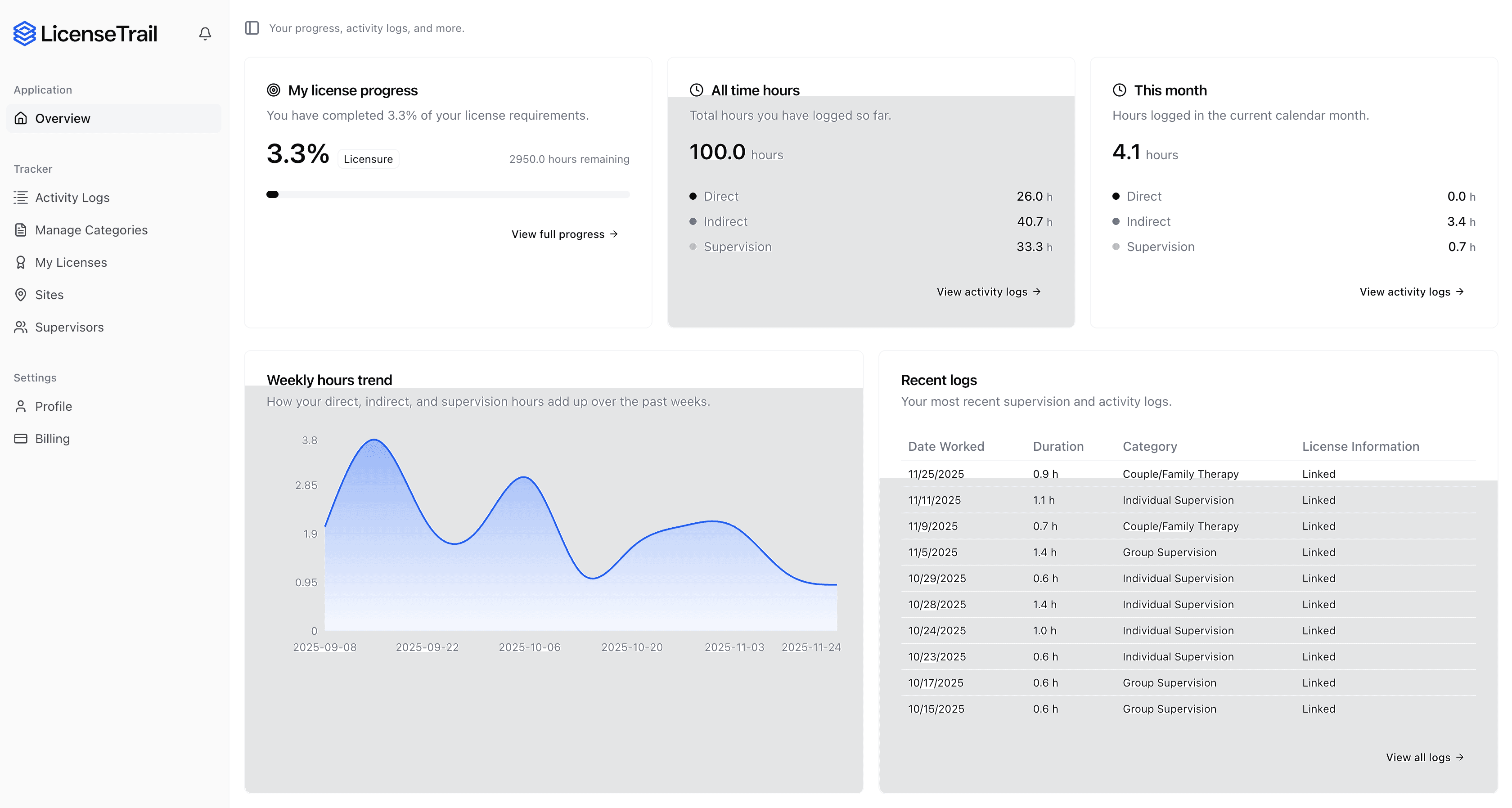
License Trail checks your direct, indirect, and supervision hours against Iowa HSP requirements continuously and flags mismatches before you submit.
 Start Tracking for Free
No credit card required · Free plan available
Related Licenses
Is your spreadsheet hiding Iowa HSP risks?
Stop guessing if your categories match Iowa Board of Psychology requirements. License Trail checks your direct, indirect, and supervision hours continuously and flags mismatches before you submit.
Import or log
Bring your spreadsheet or start fresh
Upload your existing tracking spreadsheet and we'll map every hour into the right Iowa Board of Psychology categories automatically.
Verify against Iowa
Catch mismatches before the board does
License Trail checks your direct, indirect, and supervision hours against Iowa HSP requirements continuously.
Export board-ready
One-click clean reports
Generate professional, board-ready reports for supervision meetings and Iowa Board of Psychology submissions in seconds.
No credit card required · Free plan available