
Iowa PSY Requirements: Hours, Exams & Step-by-Step Guide
Stop guessing if your categories match Iowa requirements. License Trail checks your direct, indirect, and supervision hours against PSY requirements continuously and flags mismatches before you submit.
No credit card required · Free plan available
Quick Requirements Overview
- Doctoral degree in psychology from regionally accredited institution; program must be APA/CPA accredited, ASPPB/National Register designated, ABPP-certified, or equivalent respecialization route (official transcripts sent directly to Board).
- Apply via DIAL for Psychologist Permanent License; $120 nonrefundable fee.
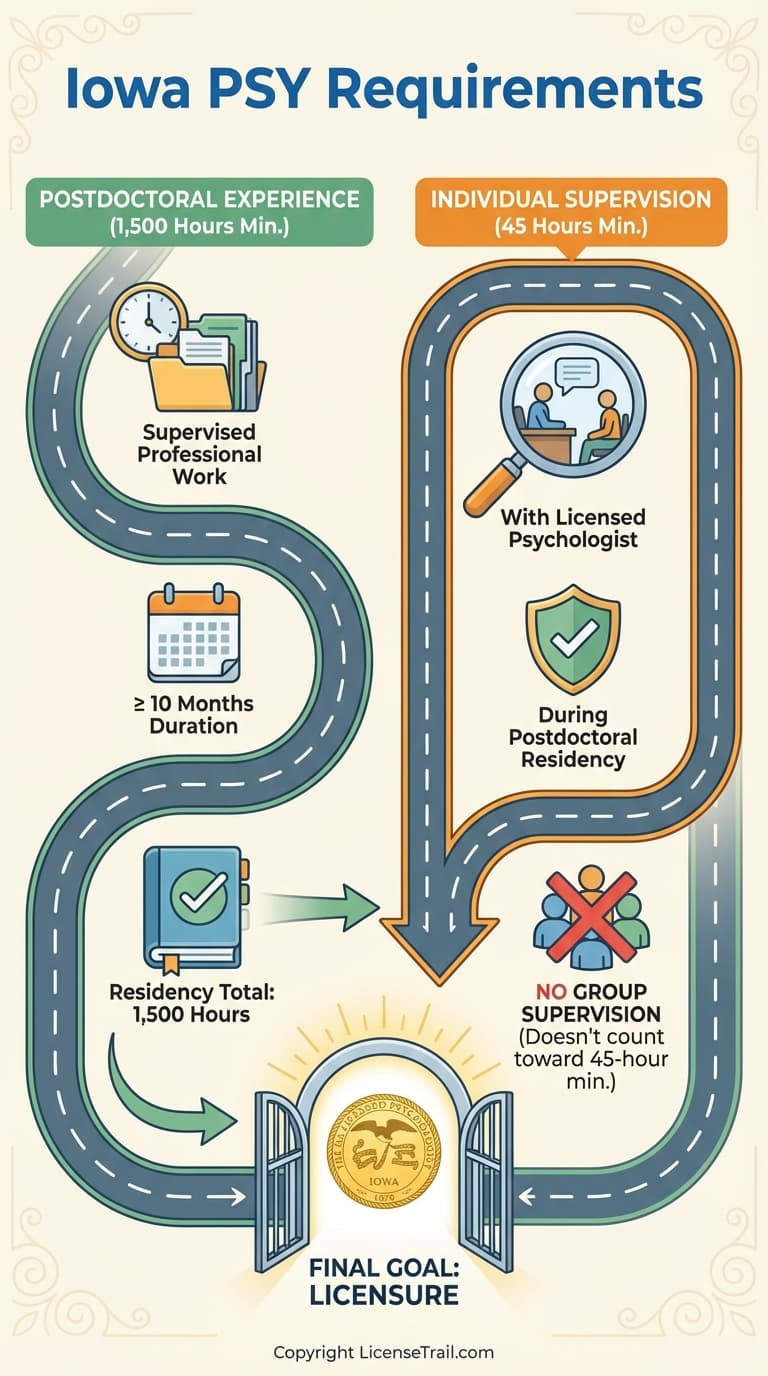
- Supervised professional experience: 1,500 hours completed in ≥10 months (full- or part-time; part-time prorated); may count only after all doctoral academic requirements are completed/verified.
- Supervision must be by a licensed psychologist; ≥1 hour/week face-to-face individual supervision; generally same setting unless approved off-site arrangement; services provided in supervisor’s name; supervisor access to records.
- Supervision Registration Form (plan) required before EPPP authorization; supervisor later submits Supervision Completion/Report directly to Board.
- Pass the EPPP (recommended passing score); scores sent directly from ASPPB to Iowa Board.
- No separate jurisprudence/oral exam currently required.
- Foreign-trained: credential equivalency evaluation (National Register or NACES member), certified translations if needed, notarized diploma copy, and Board determination.
License Details
Procedures
Becoming licensed as a psychologist (PSY – Permanent License) in Iowa involves meeting specific educational, supervised-experience, and examination requirements set out in the Iowa Administrative Code and implemented through the Department of Inspections, Appeals, & Licensing (DIAL).
Below is a step‑by‑step guide written from those primary sources, with particular attention to the hour requirements and how Iowa defines them.
1. Core requirements at a glance (initial Iowa licensure)
For a first‑time Iowa psychologist permanent license (not by endorsement), you must:
- Hold a qualifying doctoral degree in psychology from an approved program. (dial.iowa.gov)
- Complete at least 1,500 hours of supervised professional experience in no less than 10 months, meeting the Board’s definition of “supervised professional experience.” (dial.iowa.gov)
- Submit a supervision plan (Supervision Registration Form) before you are allowed to take the EPPP. (dial.iowa.gov)
- Pass the Examination for Professional Practice in Psychology (EPPP), with the score sent directly to the Board. (dial.iowa.gov)
- File the online application for a Psychologist Permanent License and pay the $120 nonrefundable application fee. (dial.iowa.gov)
2. Educational requirements: the doctoral degree
2.1 Basic degree requirement
Iowa requires that you “possess a doctoral degree in psychology” to be licensed as a psychologist. The degree must be granted by an institution accredited by the North Central Association (or an equivalent regional accreditor). (dial.iowa.gov)
Official transcripts conferring the doctoral degree in psychology must be sent directly from the university to the Board office. (dial.iowa.gov)
2.2 Program accreditation / recognition
At the time of your graduation, your psychology program must meet one of the following, per Iowa Administrative Code 645—240.3 and the Board’s licensing page: (dial.iowa.gov)
- Accredited by the American Psychological Association (APA), or
- Accredited by the Canadian Psychological Association (CPA), or
- Designated by the Association of State and Provincial Psychology Boards (ASPPB)/National Register as a doctoral program in psychology, or
- You hold board certification from the American Board of Professional Psychology (ABPP) (specialty diploma by examination).
The rules also allow a postdoctoral APA‑accredited respecialization certificate as another route to equivalency when applicable. (rules.iowa.gov)
2.3 Foreign‑trained psychologists
If your doctoral degree is from outside the U.S. or Canada, Iowa requires: (rules.iowa.gov)
- An equivalency evaluation of your educational credentials by the National Register of Health Service Psychologists or a member service of the National Association of Credential Evaluation Services (NACES).
- A certified translation for documents not in English.
- A notarized copy of your doctoral diploma.
- Evidence that all other licensure requirements are met, after which the Board makes a final determination.
3. Supervised professional experience: hours and structure
This is the heart of Iowa’s requirements and the part that turns your doctoral training into licensable independent practice.
3.1 When and how the Board tracks your hours
Before you may sit for the EPPP, Iowa requires that you file a Supervision Registration Form with the Board. This form lays out your supervision plan and must be accepted before EPPP approval is granted. (dial.iowa.gov)
While gaining your experience, you will typically hold a provisional psychologist license and/or use the title “psychology resident” under supervision, depending on your status (predoctoral internship vs. postdoctoral residency). (dial.iowa.gov)
3.2 Required number and timing of hours
Iowa Board rules in 645—240.6(1)(a), as amended, define the minimum supervised professional experience as follows: (rules.iowa.gov)
- It must “be a minimum of one year on a full‑ or part‑time basis for no less than 1,500 hours, or be a minimum of 1,500 hours that are completed in no less than ten months.”
This means:
- You must complete at least 1,500 total hours of supervised professional experience.
- Those 1,500 hours must be spread over a minimum of 10 months (you cannot compress them into a very short time).
- There is not a second, separate 1,500‑hour requirement; the 1,500 hours themselves are the supervised experience requirement for licensure.
3.3 What counts as “supervised professional experience”
Under 645—240.6(1), that supervised experience must: (legis.iowa.gov)
- Apply the principles of psychology in a professional setting.
- Be supervised by a licensed psychologist who meets the Board’s criteria.
- Be performed competently, as attested to by the supervisor.
- Have all fees and payment schedules remain under the control of the employing agency or supervising psychologist (not the supervisee).
The rules further specify the expectations for both the supervisee and the supervisor.
3.3.1 Requirements for the supervisee
To meet Iowa’s definition of qualifying supervised professional experience, a supervisee must, among other things: (legis.iowa.gov)
- Meet with the supervisor at least one hour per week, face‑to‑face and individually.
- Receive training that is appropriate to the functions performed.
- Work in the same physical setting as the supervisor unless an off‑site supervision arrangement has been approved and safety/consultation conditions are met.
- Provide services in the name of the supervising psychologist (the supervisor carries ultimate professional responsibility).
- Begin counting supervised professional experience only after all academic requirements for the doctoral degree are met and verified in writing by the program—pre‑doctoral employment before that point does not count.
- Have part‑time work prorated toward the 1,500‑hour requirement.
3.3.2 Requirements for the supervisor
The supervisor must: (legis.iowa.gov)
- Be a licensed psychologist actively licensed in the jurisdiction where supervision occurs.
- Complete the Board’s supervision form and approve the plan.
- Meet with the supervisee at least one hour per week, face‑to‑face and individually.
- Provide training suited to the supervisee’s role and ensure work is offered in the supervisor’s name.
- Have reasonable access to the clinical records corresponding to the work being supervised.
- If the supervisee is working off‑site, ensure the location has an on‑site licensed mental health provider or primary care provider for emergency consultation, except that K–12 school settings are specifically allowed without this requirement.
- Supervise only practices the supervisor can competently perform and limit the number of supervisees to a manageable number (Iowa historically capped this at three full‑time equivalencies).
3.4 Verification of your hours
Once you have completed your 1,500 hours under these conditions:
- Your supervisor must submit a Supervision Report form (Supervision Completion Report) directly to the Board.
- The Board’s permanent licensure page explicitly requires verification of 1,500 hours of supervised professional experience completed in no less than 10 months meeting the requirements of 645—240.6. (dial.iowa.gov)
This supervision completion report is a key document in your permanent license application.
4. Examination requirement: EPPP
Iowa requires passage of the Examination for Professional Practice in Psychology (EPPP) as the national examination. (dial.iowa.gov)
Key points from 645—240.4 and the Board’s guidance: (rules.iowa.gov)
- You must have:
- Submitted your licensure application,
- Ensured official transcripts are on file, and
- Submitted a completed Supervision Registration Form
before the Board will authorize you to sit for the EPPP.
- The Board transmits your eligibility to the ASPPB online examination portal.
- Iowa uses the EPPP recommended passing score as its passing standard.
- Your EPPP score must be sent directly to the Iowa Board from ASPPB or, in some endorsement situations, from the state of initial licensure.
As of the current rules, Iowa does not require a separate jurisprudence (law and ethics) examination; the old oral/jurisprudence regime has been rescinded. (legis.iowa.gov)
5. Step‑by‑step path to an Iowa Psychologist Permanent License (PSY)
Putting the requirements together, a typical sequence for someone seeking first‑time licensure in Iowa is:
-
Complete a qualifying doctoral degree in psychology
- Ensure your program is APA/CPA accredited, ASPPB/National Register designated, or that you meet ABPP/APA respecialization criteria. (dial.iowa.gov)
-
If still in training, obtain a provisional psychologist license
- For predoctoral internship: submit an acceptance letter to the internship site.
- For postdoctoral residency: submit official transcripts showing the conferred doctoral degree. (dial.iowa.gov)
-
Submit a Supervision Registration Form
- File this with the Board before the EPPP is approved. It describes where and under whom you will complete your supervised professional experience. (dial.iowa.gov)
-
Take and pass the EPPP
- After the Board transmits your eligibility, sit for the exam and meet or exceed the EPPP passing score. Have results sent directly to the Board. (dial.iowa.gov)
-
Complete at least 1,500 hours of supervised professional experience
- Over no fewer than 10 months, under a licensed psychologist who meets Iowa’s supervisory requirements, in settings where you apply psychological principles and provide professional services. (rules.iowa.gov)
-
Have your supervisor submit the Supervision Report
- This verifies that you completed the 1,500 hours under conditions that meet 645—240.6.
-
Apply for the Psychologist Permanent License
- Submit the online application through DIAL, ensure all supporting documents (transcripts, EPPP score, supervision report) are on file, and pay the $120 nonrefundable fee. (dial.iowa.gov)
-
Receive your PSY permanent license
- Once approved, you are licensed as a psychologist in Iowa and renew on the Board’s biennial schedule under Chapter 240 renewal rules. (legis.iowa.gov)
6. Additional “health service provider” credential and its hours (optional but important to understand)
Iowa also offers a separate credential, Certified Health Service Provider in Psychology, for licensed psychologists working in clinical/health service roles. This is not required for basic licensure but is relevant to clinical practitioners.
6.1 Overall clinical experience requirement
Under 645—240.7(1) as amended, to be certified as a health service provider you must: (rules.iowa.gov)
- Verify at least one year of clinical experience in an organized health service training program that meets the requirements of 240.7(2) (essentially your internship year), and
- Verify at least one year of clinical experience in a health service setting that meets the same supervised professional experience rules in 240.6(1) and 240.6(2) (generally postdoctoral practice).
Alternatively, you may submit current registration at the doctoral level with the National Register of Health Service Psychologists as evidence that you have already met these training standards. (rules.iowa.gov)
6.2 Internship / organized health service training program hours
For organized health service training programs that are not already APA‑ or CPA‑accredited or members of APPIC, Iowa requires documentation that the program meets several conditions, including specific hour requirements. (rules.iowa.gov)
Key quantitative requirements in 645—240.7(2) include:
- A minimum of 375 hours of the trainee’s time in direct patient contact.
- A minimum of two hours per week of formally scheduled, face‑to‑face, individual supervision focused on psychological services rendered directly by the intern.
- At least two additional hours per week in clinical learning activities such as case conferences, seminars, group supervision, or co‑therapy with staff.
- A total of at least 1,800 hours of training completed in no less than 12 months and no more than 24 consecutive months.
These internship requirements are distinct from—and in addition to—the 1,500 hours of supervised professional experience used for basic licensure. For many APA/CPA/APPIC internships, these standards are met automatically by virtue of accreditation or membership. (rules.iowa.gov)
7. Applicants already licensed elsewhere: licensure by endorsement
If you are already licensed as a psychologist in another jurisdiction and are seeking an Iowa PSY permanent license, Iowa offers multiple “endorsement” routes. The DIAL permanent licensure page lists options A–E for applicants who are not foreign‑trained: (dial.iowa.gov)
In addition to verification of every license you have held, you may qualify by:
- Option A: At least 5 years of licensure to practice psychology with no disciplinary history, plus verification of your doctoral degree.
- Option B: A current Certificate of Professional Qualification (CPQ) from ASPPB.
- Option C: Evidence of a passing EPPP score plus current National Register credentialing as a health service provider in psychology at the doctoral level.
- Option D: Evidence of a passing EPPP score plus ABPP board certification (initially granted on or after January 1, 1983).
- Option E: EPPP passing score plus official transcripts from an APA/CPA‑accredited or ASPPB‑designated doctoral program and satisfactory documentation of supervised experience (often via Iowa’s Supervision Report form or equivalent documentation from the original licensing state).
These pathways recognize prior licensure and credentials in place of re‑documenting every Iowa‑specific step, but all still require an application, fees, and license verifications.
Summary of hour requirements specific to Iowa psychologists
For Iowa PSY permanent licensure itself:
- 1,500 hours of supervised professional experience, completed in no fewer than 10 months, under a licensed psychologist and meeting detailed supervision standards in 645—240.6. (dial.iowa.gov)
For optional Health Service Provider certification (in addition to licensure):
- Two years of clinical experience in health service settings, typically composed of:
- One year of organized health service training (internship) meeting criteria such as 1,800 total training hours and 375 hours of direct patient contact, plus structured weekly supervision; and
- One year of supervised postdoctoral clinical experience meeting the same supervised professional experience rules as the 1,500‑hour licensure requirement. (rules.iowa.gov)
Iowa does not split the 1,500 hours into separate blocks of “direct” and “indirect” experience in the way some other states do; instead, it requires a single block of 1,500 supervised professional hours under clearly defined supervision conditions.
Track your PSY hours with confidence
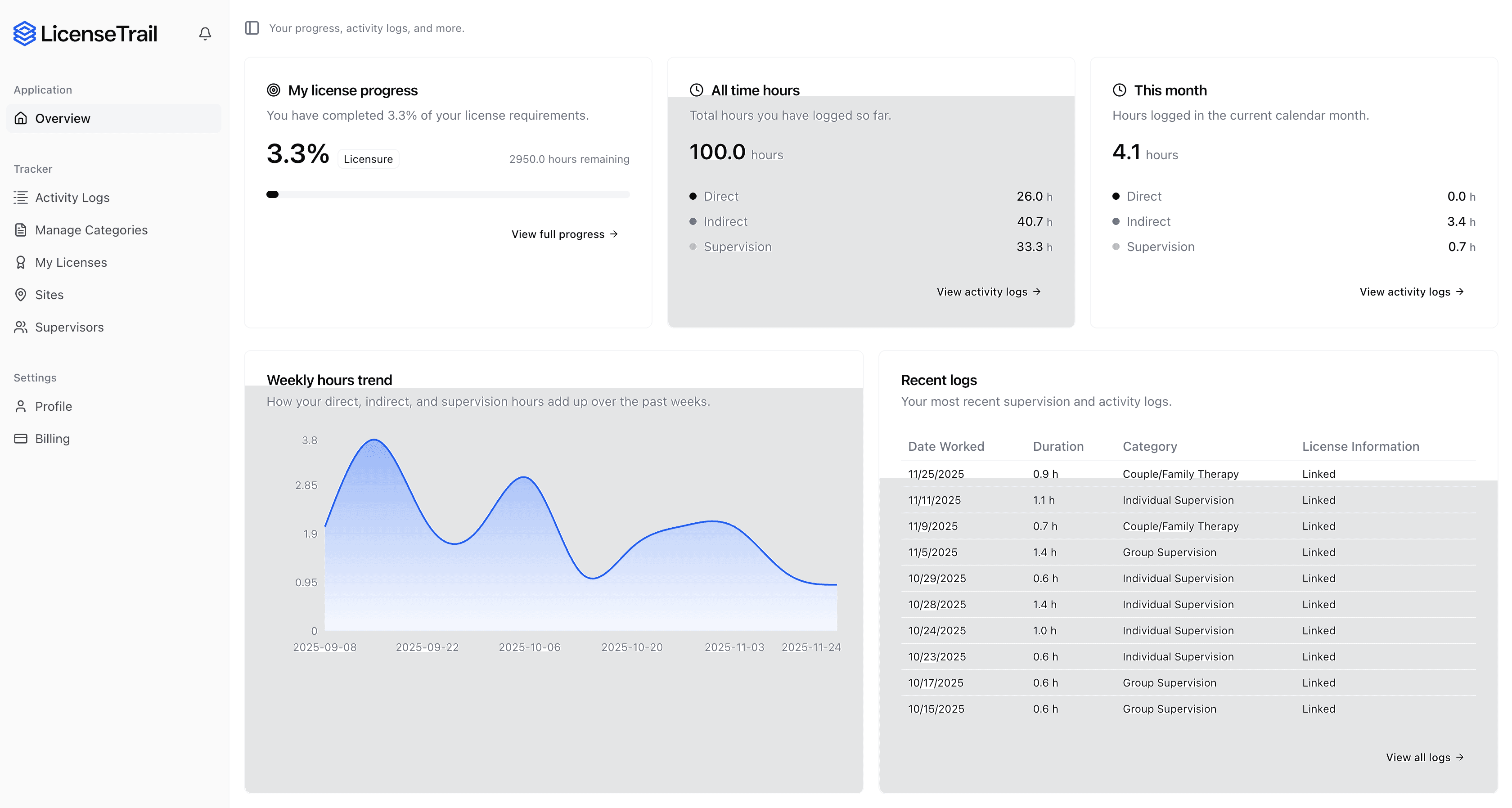
License Trail checks your direct, indirect, and supervision hours against Iowa PSY requirements continuously and flags mismatches before you submit.
 Start Tracking for Free
No credit card required · Free plan available
Related Licenses
Is your spreadsheet hiding Iowa PSY risks?
Stop guessing if your categories match Iowa Board of Psychology requirements. License Trail checks your direct, indirect, and supervision hours continuously and flags mismatches before you submit.
Import or log
Bring your spreadsheet or start fresh
Upload your existing tracking spreadsheet and we'll map every hour into the right Iowa Board of Psychology categories automatically.
Verify against Iowa
Catch mismatches before the board does
License Trail checks your direct, indirect, and supervision hours against Iowa PSY requirements continuously.
Export board-ready
One-click clean reports
Generate professional, board-ready reports for supervision meetings and Iowa Board of Psychology submissions in seconds.
No credit card required · Free plan available