
Kansas LMSW Requirements: Hours, Exams & Step-by-Step Guide
Stop guessing if your categories match Kansas requirements. License Trail checks your direct, indirect, and supervision hours against LMSW requirements continuously and flags mismatches before you submit.
No credit card required · Free plan available
Quick Requirements Overview
- Provided text describes Arkansas (AR) LMSW, not Kansas (KS)—KS LMSW requirements may differ; confirm with KS BSRB
- Education: MSW from CSWE/CASWE-accredited program (limited pre-1986 exception noted)
- Exam: Pass ASWB Master’s exam (Board-approved)
- Background/fitness: Criminal background check + good moral character; must not have disqualifying offenses or impairing substance/health issues
- Pre-licensure hours: No specific practice-hour requirement to obtain LMSW (hours apply for later clinical licensure)
- Supervision (as LMSW): Ongoing supervision required; minimum weekly supervision by LMSW/LCSW/other qualified professional (structure/frequency vs. total hours)
- Provisional LMSW (AR): One-time 1-year provisional license; up to 3 exam attempts while practicing under supervision
- If pursuing LCSW later (AR): 24 months + 4,000 hours supervised experience + 100 hours direct supervision (≤2 hrs/week; group ≤50%, max 4 supervisees) and supervision plan due within 60 days of start
License Details
Procedures
Licensure as a Licensed Master Social Worker (LMSW) in Arkansas is governed by the Arkansas Social Work Licensing Act (Ark. Code §17‑103‑306) and the Arkansas Social Work Licensing Board’s rules. The LMSW is the master’s‑level, non‑independent license; it is also the level you must hold while you complete supervised experience toward the LCSW.
A key point: Arkansas does not require a specific number of pre‑licensure practice hours (such as “1,500 direct + 1,500 supervised”) to obtain an LMSW. Hour requirements come into play only if you later seek the LCSW.
Below is a step‑by‑step guide using the Board’s own language and structure where possible.
1. Understand what the Arkansas LMSW license is
Under Arkansas law, the Board “shall issue a Licensed Master Social Worker license” to applicants who meet the educational, examination, background, and character requirements in §17‑103‑306(b). (law.justia.com)
At the LMSW level you:
- Hold a master’s degree in social work.
- May perform advanced social work functions (assessment, treatment planning, some clinical services), but not independent clinical practice; that is reserved for LCSWs.
- Practice under supervision of an LCSW or other qualified professional as outlined in the Board’s supervision rules. (law.cornell.edu)
2. Educational requirement
Arkansas statute requires:
- A master’s degree in social work from a program accredited by:
- The Council on Social Work Education (CSWE) or
- The Canadian Association for Social Work Education (CASWE);
- or a pre‑June 17, 1986 master’s in social work from an accredited institution. (law.justia.com)
University of Arkansas and other Arkansas programs summarize this as: LMSW = MSW from a CSWE‑accredited program + exam. (studylib.net)
There is no separate, state‑specified clock‑hour requirement beyond successfully completing the accredited MSW program (which itself includes practicum hours defined by CSWE, not by the Arkansas Board).
3. Examination requirement
The Board uses the ASWB (Association of Social Work Boards) Master’s exam for the LMSW level. (theraworkspllc.com)
The statute requires that an LMSW applicant:
- “Has passed an examination approved by the board for this purpose and level of practice.” (law.justia.com)
Practically, that means:
- Apply to the Arkansas Social Work Licensing Board and be approved as an exam candidate.
- Register for and pass the ASWB Master’s examination.
- Have the passing score reported to the Board.
The Board’s rules also state that applicants generally have a limited number of exam attempts per approval period (up to three tries per approval), and must observe a 90‑day wait between re‑takes, following ASWB policy. (law.cornell.edu)
4. Criminal background check and fitness to practice
Arkansas law is unusually explicit about character and fitness for LMSWs. To qualify, you must: (law.justia.com)
- Apply for a criminal background check and meet the qualifications in Ark. Code §17‑103‑307 (which cross‑references disqualifying offenses in §17‑3‑102).
- Have good moral character.
- Be physically and mentally competent to provide social work services with reasonable skill and safety.
- Not be afflicted by a mental or physical condition that would impair your competency.
- Not have pleaded guilty, nolo contendere, or been found guilty of a listed felony or other serious offenses involving violence, dishonesty, fraud, deceit, breach of client trust, or abuse of the vulnerable.
- Not abuse drugs or alcohol in a way that affects professional competency.
- Not have engaged in fraud or deceit in making the application.
Therapist‑facing summaries that quote the Board’s “Levels and Qualifications” section reiterate that an LMSW must: hold a CSWE‑accredited MSW, pass a Board‑approved exam, and pass a criminal background check without disqualifying offenses under Ark. Code §17‑103‑307. (theraworkspllc.com)
5. Provisional Licensed Master Social Worker (Provisional LMSW)
Arkansas law provides for a one‑time, one‑year provisional LMSW license for first‑time master’s‑level applicants:
- The Board “shall issue a Provisional Licensed Master Social Worker license one (1) time only to an applicant who qualifies under this subsection.”
- The provisional license is good for one (1) year and up to three (3) attempts to pass the approved exam. (law.justia.com)
Board‑aligned summaries further emphasize that: (theraworkspllc.com)
- Provisional licenses are issued to first‑time LMSW applicants after application approval and background check initiation.
- Provisional licensing is not available at the LCSW level.
Functionally:
- You submit your full LMSW application and background check.
- If approved, you may receive a Provisional LMSW license.
- You may begin practicing at the master’s level under required supervision while you prepare for and take the ASWB Master’s exam (up to three attempts within that year).
- Once you pass the exam and the Board finalizes your file, your license converts from Provisional LMSW to LMSW.
6. Supervision requirements while you are an LMSW
Arkansas rules make supervision ongoing for LSWs and LMSWs; it isn’t only for those seeking LCSW. Board rules define supervision as:
“a professional relationship between a supervisor and a supervisee designed to promote responsibility, competency and accountability to the agency, clients and community.” (law.cornell.edu)
For all licensed social workers (including LMSWs and provisional licensees), the rules state: (law.cornell.edu)
- Once licensed as an LSW or LMSW, “the LSW or LMSW must obtain supervision from a licensed social worker or other qualified professional from a related field.”
- “The supervision may be within or outside the agency.”
- Specifically for LMSWs, “The social work practice of an LMSW shall be supervised by an LMSW, an LCSW or other qualified professional from a related field on a minimum of a weekly basis.”
If you are working in a non‑clinical position, direct (face‑to‑face) supervision is not mandated, but you must report to a supervisor, and the Board’s supervision rules still apply in addition to any employer supervision. (law.cornell.edu)
Important clarification on hours:
These supervision rules do not specify a required number of total supervised hours to obtain or maintain the LMSW license. They specify frequency and structure (at least weekly supervision; appropriate supervisor qualifications), not a total hour count.
7. Hours and supervision if you later pursue the LCSW
This is where Arkansas uses precise hour and month requirements. An LMSW who wants to become a Licensed Certified Social Worker (LCSW) must complete post‑master’s supervised experience under an LCSW.
Under the Board’s rules for LCSW licensure: (regulations.justia.com)
-
Duration and total hours
- You must document twenty‑four (24) months post‑master’s social work experience.
- Within that period, you must complete four thousand (4,000) hours in a supervised master’s‑level social work position under an LCSW (or a social worker the Board deems equivalently qualified).
-
Direct supervision hours
- During the same 24‑month period, you must have at least one hundred (100) hours of direct supervision by your LCSW supervisor.
- No more than two (2) supervision hours may occur in any one‑week period.
- Group supervision is allowed only if:
- There are no more than four supervisees in the group, and
- Group supervision does not exceed one‑half of the total supervisory time.
-
Structure and documentation
- You must create a written Supervision Plan with your LCSW supervisor, on a Board‑approved form.
- The Board must receive this plan within 60 days of the start of supervision, and it is your responsibility as the supervisee to verify the Board has received it. (regulations.justia.com)
-
Equivalency of hours to years
- Separate Board and regulatory language clarifies that for LCSW purposes, two years of supervised social work experience is equivalent to 4,000 hours. (law.cornell.edu)
Many secondary sources (e.g., state‑by‑state licensure guides) describe this for Arkansas as:
- 4,000 hours of supervised post‑master’s work over a minimum of two years, with regular (about weekly) supervision and specific limits on group versus individual supervision. (publicservicedegrees.org)
Again, these 4,000 supervised hours and 100 supervision hours are not a requirement for initial LMSW licensure. They are the requirement to move from LMSW to LCSW.
8. Summary of “hours” as they relate to the Arkansas LMSW
To answer your example directly:
-
To obtain an LMSW license in Arkansas
- The Board and statute do not specify a required number of pre‑licensure hours such as “1,500 hours of direct experience and 1,500 hours of supervised experience.”
- Instead, you must:
- Hold a CSWE/CASWE‑accredited MSW. (law.justia.com)
- Pass the ASWB Master’s exam (Board‑approved). (law.justia.com)
- Apply for and clear a criminal background check and meet the moral/fitness requirements in Arkansas law. (law.justia.com)
-
Once you are an LMSW
- You must receive ongoing supervision, at minimum weekly, from an LMSW, LCSW, or other qualified professional, but:
- The rules do not impose a fixed total hour count for LMSW‑level supervision; they focus on frequency and qualifications of supervision. (law.cornell.edu)
-
If you later pursue LCSW
- You must complete:
- 4,000 hours of supervised master’s‑level social work over at least 24 months, and
- 100 hours of direct supervision, with no more than 2 hours per week, and group supervision capped at half of total supervision time. (regulations.justia.com)
- You must complete:
That is the Board‑defined hour structure you will encounter in Arkansas, but it applies to LCSW licensure after you are already an LMSW, not to the initial LMSW itself.
Track your LMSW hours with confidence
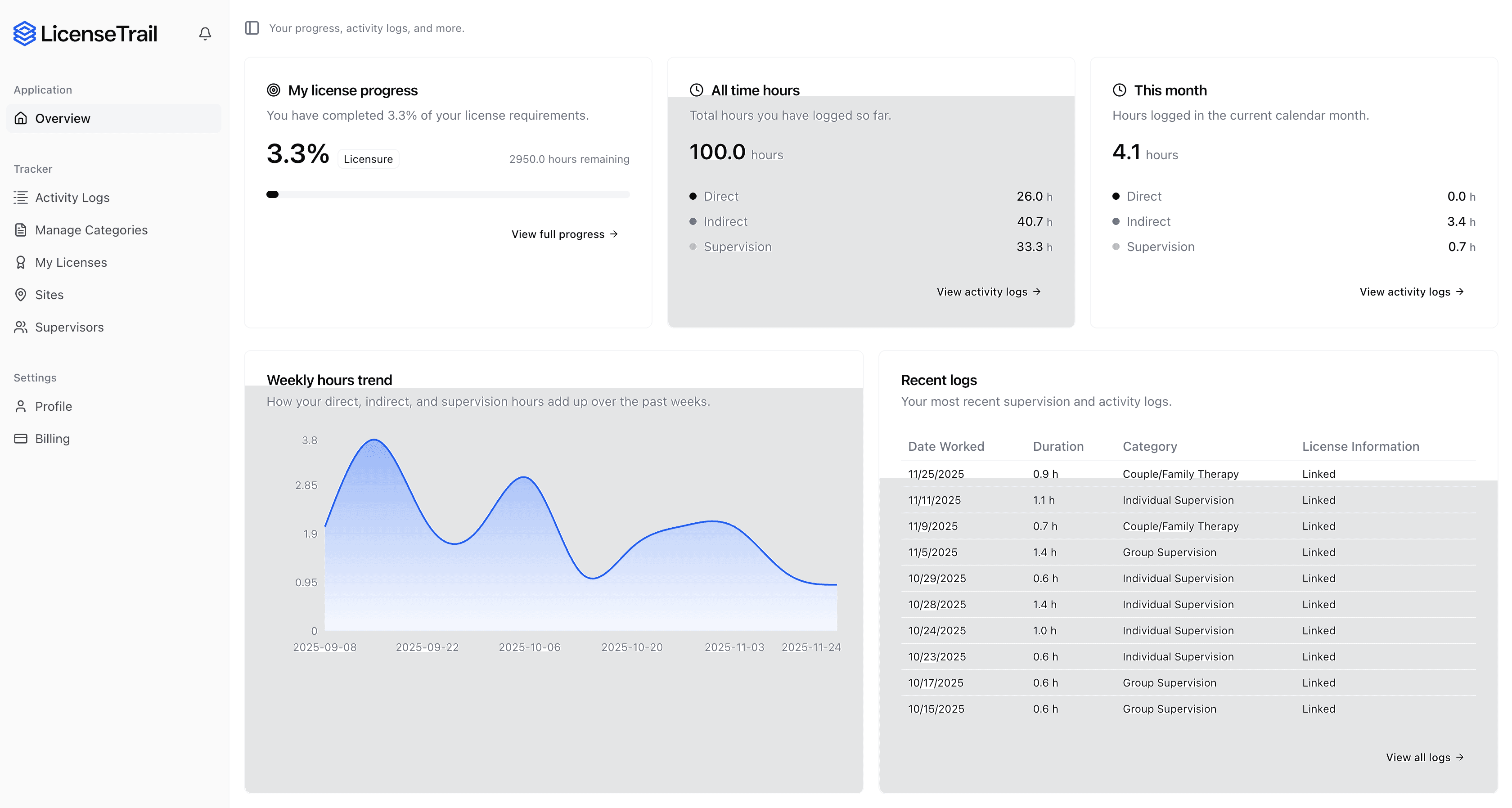
License Trail checks your direct, indirect, and supervision hours against Kansas LMSW requirements continuously and flags mismatches before you submit.
 Start Tracking for Free
No credit card required · Free plan available
Related Licenses
Is your spreadsheet hiding Kansas LMSW risks?
Stop guessing if your categories match Arkansas Social Work Licensing Board requirements. License Trail checks your direct, indirect, and supervision hours continuously and flags mismatches before you submit.
Import or log
Bring your spreadsheet or start fresh
Upload your existing tracking spreadsheet and we'll map every hour into the right Arkansas Social Work Licensing Board categories automatically.
Verify against Kansas
Catch mismatches before the board does
License Trail checks your direct, indirect, and supervision hours against Kansas LMSW requirements continuously.
Export board-ready
One-click clean reports
Generate professional, board-ready reports for supervision meetings and Arkansas Social Work Licensing Board submissions in seconds.
No credit card required · Free plan available