
Kansas LPC Requirements: Hours, Exams & Step-by-Step Guide
Stop guessing if your categories match Kansas requirements. License Trail checks your direct, indirect, and supervision hours against LPC requirements continuously and flags mismatches before you submit.
No credit card required · Free plan available
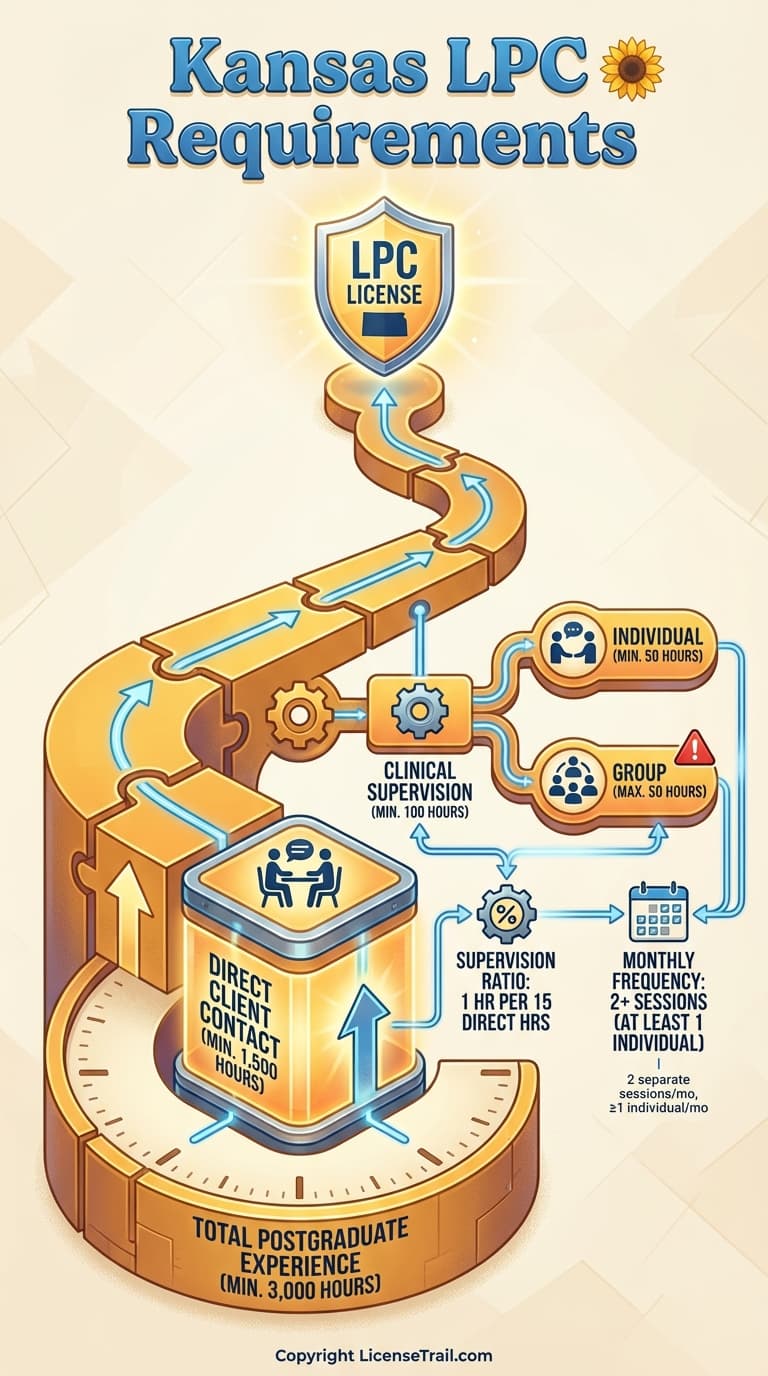
Quick Requirements Overview
- Provided text outlines Arkansas (AR) LPC pathway (via LAC → LPC), not Kansas (KS); KS-specific LPC requirements aren’t stated here
- Education: graduate degree primarily in counseling from regionally accredited school; minimum 60 graduate semester hours meeting Board core curriculum
- Initial license (LAC): pass required exams (noted: NCE, AR jurisprudence, Board oral exam); background check; legal work status; Board-approved supervision agreement before practice
- Supervised experience for LPC: 3,000 client contact hours (CCH) under supervision
- Direct/Indirect split: ≥2,200 direct (face-to-face); ≤800 indirect (related non-face-to-face); first 500 must be direct (no indirect allowed in this phase)
- Supervision hours: 175 clock hours total (Level 1: 1:10 for first 500 direct; Level 2: 1:20 for remaining 2,500 CCH)
- Documentation/compliance: supervision/CCH reports every 6 months; hours can be rejected if agreement/reports aren’t Board-approved/timely
- Possible hour reductions: extra post-master’s coursework can reduce CCH (up to 2,000); passing NCMHCE after Level 1 can reduce by 500
License Details
Procedures
Becoming a Licensed Professional Counselor (LPC) in Arkansas is essentially a two‑stage process: you first become a Licensed Associate Counselor (LAC), then complete a defined set of supervised client contact hours and supervision to qualify for the LPC. The Arkansas Board of Examiners in Counseling and Marriage & Family Therapy sets these requirements in its rules and in Arkansas Administrative Code.
Below is a structured explanation with the Board’s own terminology (“client contact hours,” “direct client contact,” “indirect client contact,” etc.) and the current 2024 rule revisions.
1. Licensure Structure in Arkansas
The Board regulates four counseling licenses: LAC, LPC, LAMFT, and LMFT. For professional counseling, you must move from LAC → LPC.
- A Licensed Associate Counselor (LAC) is defined as a person who meets the requirements in Section 3.2 of the Board’s rules and “holds a current, valid license to practice counseling under the supervision of a Licensed Professional Counselor.” (scribd.com)
- A Licensed Professional Counselor (LPC) is a person who meets Section 3.3 requirements and “holds a current valid license to practice counseling/psychotherapy.” (scribd.com)
The LAC license “is not intended to be a permanent license.” (scribd.com) The intent of the three years of supervision is to train you toward LPC.
2. Educational Foundation
2.1 Graduate degree and credit‑hour requirement
To even be eligible for LAC (and ultimately LPC), the Board requires:
- A graduate degree primarily in professional counseling (or therapy) from a regionally accredited institution. (scribd.com)
- Completion of a minimum of 60 graduate semester hours in counseling/therapy‑content coursework that meets academic and training standards established by the Board and aligned with CACREP/CORE (or COAMFTE for MFT). (scribd.com)
Arkansas programs (for example, UA Little Rock) explicitly tell prospective LPCs that “Applicants need a minimum of 60 hours” to meet Board requirements. (ualr.edu)
The Board’s “Core Curriculum for LAC or LPC” includes required graduate hours in areas such as Professional Identity, Social and Cultural Diversity, Human Growth and Development, Helping Relations, Group Work, Assessment, Research and Program Evaluation, Practicum/Internship, and specific courses like Psychopathology, Family and Relationship, and Psychopharmacology. (law.cornell.edu)
3. Step One: Licensure as a Licensed Associate Counselor (LAC)
3.1 LAC eligibility
Under the 2024 Rules, to be eligible as an LAC an applicant: (scribd.com)
-
Education
- Must have a graduate degree primarily in professional counseling from a regionally accredited institution, with graduate semester hours meeting or exceeding CACREP‑based standards.
-
Examinations
- Must “demonstrate professional competencies by passing written examinations and/or oral interviews as prescribed by the Board.” (scribd.com)
In practice, Arkansas programs prepare students to: - Pass the National Counselor Examination (NCE), and
- Sit for an oral examination before the Board after the NCE. (ualr.edu)
The Board also contracts for the Arkansas Jurisprudence Examination with NBCC. (codeofarrules.arkansas.gov)
- Must “demonstrate professional competencies by passing written examinations and/or oral interviews as prescribed by the Board.” (scribd.com)
-
Supervision arrangement
- Must “arrange supervision with a Board‑approved LAC supervisor and have the agreement for the supervision approved by the Board prior to license issue.” (scribd.com)
-
Background check and legal status
- Must pass a criminal background check mandated by Ark. Code Ann. § 17‑27‑313 and be a U.S. citizen or have current documentation of legal work status. (scribd.com)
Once these are met and the Board approves the application and exams, the applicant is issued an LAC license. UA Little Rock summarizes this as: pass the NCE, pass the Board’s oral exam, then you “become a licensed associate counselor (LAC).” (ualr.edu)
4. Step Two: Supervised Experience Required for LPC
The heart of the LPC requirement in Arkansas is the supervised client contact hour system.
4.1 Board’s core LPC requirement
Under Section 3.3 of the 2024 Rules:
To be eligible as an LPC, an applicant “must provide evidence of three thousand (3000) client contact hours of supervised experience in professional counseling acceptable to the Board.” (scribd.com)
You accrue these hours while licensed as an LAC (or LAMFT for the MFT route), under a Board‑approved supervisor.
4.2 How the 3,000 Client Contact Hours (CCH) are structured
The 2024 Supervision section breaks the 3,000 hours down as follows: (scribd.com)
-
Total required Client Contact Hours (CCH)
- “Counselors or Marriage and Family Therapists licensed at the associate level must complete 3000 Client Contact Hours (CCH) with supervision.”
-
Direct vs. indirect client contact
- You must have at least 2,200 hours of direct client contact:
- “The LAC and LAMFT are required to have a minimum of 3000 hours of client contact, 2200 hours defined as direct client contact.”
- You may count no more than 800 hours of indirect client contact:
- “No more than 800 hours of indirect client contact may be counted in Level 2.”
The Board defines these terms:
- Direct client contact hour
- “A direct client contact hour is defined as face‑to‑face contact with a client(s) in a therapeutic interaction with individuals or groups.” (scribd.com)
- Indirect Client Contact
- “Indirect Client Contact means consultation, case management, paperwork, staffing, billing and test administration when the clinician is not working face‑to‑face with the individuals or groups, but the services are related to the direct care of the individual or groups.” (scribd.com)
- You must have at least 2,200 hours of direct client contact:
-
Level 1 vs. Level 2 hours
The 3,000 CCH are split into two levels with different supervision ratios: (scribd.com)
- Level 1 (first 500 direct hours)
- First 500 hours must be direct client contact (“first five hundred (500) direct CCH”).
- During Level 1, no indirect hours can be counted: “During the first 500 direct client hours (Level 1), no indirect hours can be counted.”
- Level 2 (remaining 2,500 hours)
- The remaining 2,500 hours may include both direct and indirect CCH, subject to the minimum 2,200 direct and maximum 800 indirect totals above.
- Level 1 (first 500 direct hours)
-
Supervision hour requirement and ratios
Supervision is tracked separately as clock hours of supervision, not CCH. The Board states:
- “The total hours of supervised practice are 175 clock hours of supervision.” (scribd.com)
These 175 hours arise from mandatory supervision ratios:
- For Level 1 (first 500 direct CCH):
- “One (1) hour of supervision for every ten (10) hours of client contact” → 500 ÷ 10 = 50 hours of supervision. (scribd.com)
- For Level 2 (remaining 2,500 CCH):
- “One (1) hour of supervision for every twenty (20) CCH” → 2,500 ÷ 20 = 125 hours of supervision.
Total = 50 + 125 = 175 supervision hours.
Additional supervision rules:
- Supervision for an LAC must be provided by an Arkansas LPC with Board‑approved supervisor status; similarly an LMFT supervises LAMFT. (scribd.com)
- Dyadic (1 supervisor + 2 supervisees) counts as individual supervision;
- Group supervision (3–6 supervisees) “may not exceed half of the 175 hours of supervision.”
- Technology‑assisted supervision cannot exceed 50% of supervision hours in Level 1. (scribd.com)
-
What counts as the 3,000 CCH?
- CCH must align with your Board‑approved Statement of Intent (population, settings, and modalities you claimed you would practice). (scribd.com)
- You must have a current Board‑approved supervision agreement on file before seeing any clients; otherwise hours may not be accepted and your license can be suspended or revoked. (scribd.com)
- Supervision reports and Client Contact Hours reports are submitted every six months, and late or missing reports can cause hours to be rejected. (scribd.com)
4.3 Summary of the Arkansas hour structure for LPC
Putting the Board’s numbers together:
-
Client work (CCH, under supervision)
- Total: 3,000 Client Contact Hours (CCH)
- Minimum 2,200 direct client contact hours (face‑to‑face therapy)
- Maximum 800 indirect client contact hours
- First 500 hours must be direct; no indirect credit during this phase
-
Clinical supervision
- Total: 175 clock hours of supervision
- Supervision ratios:
- 1 hour supervision / 10 CCH for first 500 direct hours
- 1 hour supervision / 20 CCH for remaining 2,500 hours
All of these CCH are, by definition, “supervised experience” leading to full LPC licensure; you do not have one bucket of “direct experience” plus a separate, unrelated bucket of “supervised experience.” The entire 3,000 CCH are under supervision, with direct vs. indirect categories and minimum/maximums.
5. Limited Ways to Reduce Required CCH
The 2024 rules allow limited reductions in the number of CCH you must accrue, but they do not change the requirement that your education meet the 60‑hour standard, nor can you use your original master’s practicum/internship to satisfy the supervised practice requirement:
- “Post‑master’s course work necessary for application for an Arkansas license may not be applied to the required supervised work experience.” (scribd.com)
However, additional acceptable post‑master’s coursework and exams can reduce CCH:
-
Extra graduate coursework beyond the master’s degree
- “One hundred (100) CCH may be gained for each three (3) graduate semester hours earned beyond the master’s degree, provided that the hours are clearly related to the field of counseling or marriage and family therapy and are acceptable to the Board,” up to 2,000 CCH for 60 such hours. (scribd.com)
-
Passing the NCMHCE after Level 1
- The LAC/LAMFT may petition to take the National Clinical Mental Health Counseling Examination (NCMHCE) after completing Level 1; a passing score “will reduce the number of CCH required by 500.” (scribd.com)
Even with reductions, the Board still expects the final supervised experience to reflect the same structure of direct vs. indirect work and supervision ratios, and you must document everything as required.
6. Step Three: Upgrading from LAC to LPC
Once you have:
- Completed the 3,000 CCH (with at least 2,200 direct and no more than 800 indirect),
- Met the 175 hours of Board‑compliant supervision with required ratios,
- Submitted timely supervision reports and evaluations every six months, and
- Met all exam and ethics requirements,
you may apply to the Board to change your license from LAC to LPC. The Board verifies your CCH, supervision hours, and compliance with all rules before issuing the full LPC license. (law.cornell.edu)
At that point, you are a Licensed Professional Counselor and may practice independently within the scope defined in your current Board‑approved Statement of Intent, under the ACA Code of Ethics as adopted by the Arkansas Board. (codeofarrules.arkansas.gov)
In Plain Numbers (Arkansas LPC via LAC)
-
Graduate education:
- Master’s or higher in counseling/therapy, minimum 60 graduate semester hours meeting Board‑approved core curriculum.
-
Entry exams:
- National Counselor Examination (NCE) and Arkansas jurisprudence exam, plus Board‑prescribed oral/situational exam(s) for initial licensure.
-
Supervised practice for LPC:
- 3,000 Client Contact Hours (CCH) under supervision
- At least 2,200 direct (face‑to‑face)
- Up to 800 indirect
- 175 clock hours of supervision
- 1:10 ratio for first 500 direct hours
- 1:20 ratio for the remaining 2,500 hours
- 3,000 Client Contact Hours (CCH) under supervision
All hours must be accumulated while licensed as an LAC under a Board‑approved supervision agreement, in accordance with the Arkansas Board of Examiners in Counseling and Marriage & Family Therapy Rules (2024 revision) and the Arkansas Administrative Code.
Track your LPC hours with confidence
License Trail checks your direct, indirect, and supervision hours against Kansas LPC requirements continuously and flags mismatches before you submit.
 Start Tracking for Free
No credit card required · Free plan available
Related Licenses
Is your spreadsheet hiding Kansas LPC risks?
Stop guessing if your categories match Arkansas Board of Examiners in Counseling and Marriage & Family Therapy requirements. License Trail checks your direct, indirect, and supervision hours continuously and flags mismatches before you submit.
Import or log
Bring your spreadsheet or start fresh
Upload your existing tracking spreadsheet and we'll map every hour into the right Arkansas Board of Examiners in Counseling and Marriage & Family Therapy categories automatically.
Verify against Kansas
Catch mismatches before the board does
License Trail checks your direct, indirect, and supervision hours against Kansas LPC requirements continuously.
Export board-ready
One-click clean reports
Generate professional, board-ready reports for supervision meetings and Arkansas Board of Examiners in Counseling and Marriage & Family Therapy submissions in seconds.
No credit card required · Free plan available