
Kansas LMFT Requirements: Hours, Exams & Step-by-Step Guide
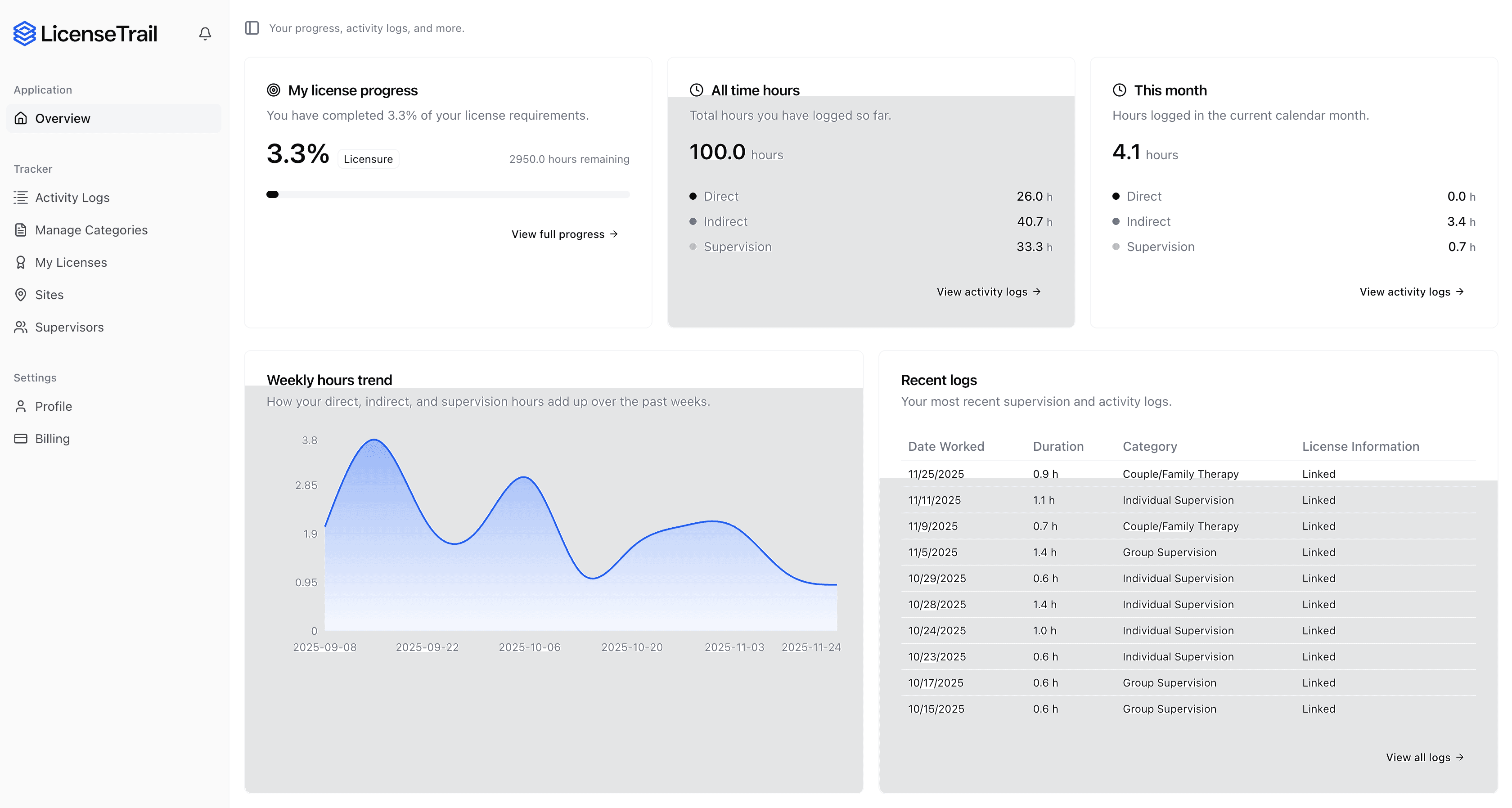
Stop guessing if your categories match Kansas requirements. License Trail checks your direct, indirect, and supervision hours against LMFT requirements continuously and flags mismatches before you submit.
No credit card required · Free plan available
Quick Requirements Overview
- Provided text describes Arkansas (AR) LMFT path; Kansas (KS) LMFT requirements are not included, so KS snapshot can’t be derived from this text.
- AR process is two-stage: earn LAMFT, then upgrade to LMFT after supervised practice.
- Education (AR): regionally accredited graduate degree in MFT/related field with ≥60 semester hours meeting COAMFTE/CACREP-aligned core curriculum.
- Supervised experience (AR): 3,000 client contact hours total; ≥2,200 direct and ≤800 indirect (no indirect in first 500 direct hours).
- Relational requirement (AR): ≥1,000 direct hours in family/relational/group therapy.
- Supervision (AR): 175 hours total; ratios 1:10 for first 500 direct hours, then 1:20; group supervision ≤50%.
- Exams (AR): pass AMFTRB plus Board oral & situational exams; background check and Board-approved supervision plan required.
License Details
Procedures
Licensure as a Licensed Marriage and Family Therapist (LMFT) in Arkansas is a two‑stage process: you first become a Licensed Associate Marriage and Family Therapist (LAMFT), complete a substantial block of supervised clinical experience, and then upgrade to full LMFT status through the Arkansas Board of Examiners in Counseling and Marriage & Family Therapy.
Below is a structured overview of what the Board itself requires, with an emphasis on how many hours you need, what kind of hours they must be, and how the Board defines them.
1. Big‑picture path to LMFT in Arkansas
To practice independently as an LMFT in Arkansas, you must:
- Complete an approved graduate degree in Marriage and Family Therapy (MFT) or a closely related field.
- Obtain a Licensed Associate Marriage and Family Therapist (LAMFT) license.
- Under LAMFT status, complete 3,000 client contact hours (CCH) of supervised marriage and family therapy practice, following the Board’s specific breakdown of direct/indirect hours and supervision ratios.
- Pass the national AMFTRB MFT examination plus Board‑prescribed oral and situational examinations.
- Apply for and be granted full LMFT licensure by the Arkansas Board.
The LAMFT license is explicitly not intended to be permanent; its purpose is to provide supervised training leading to LMFT.(law.cornell.edu)
2. Educational requirements
2.1 Type of degree
For both LAMFT and LMFT, the Board requires a graduate degree in MFT or a related field from a regionally accredited institution:
- For LAMFT: the degree must be in marriage and family therapy or a related field, and the coursework must meet or exceed national academic and training standards adopted from COAMFTE or CACREP (or equivalent).(law.cornell.edu)
- For LMFT: an applicant must have received a graduate degree in MFT or related field from a regionally accredited institution, with coursework meeting COAMFTE‑ or CACREP‑based standards adopted by the Board.(law.cornell.edu)
2.2 Minimum graduate hours and core curriculum
Arkansas rules require a minimum of 60 graduate semester hours in counseling/therapy‑related coursework for licensure.(law.cornell.edu)
For LAMFT/LMFT, the “Core Curriculum” includes, among other things, foundations of relational/systemic practice, clinical treatment with individuals, couples and families, multicultural work, research and evaluation, ethics and law, lifespan biopsychosocial development, systemic assessment and diagnosis, practicum/internship, and technology‑assisted counseling.(law.cornell.edu)
3. Step One: Licensed Associate Marriage and Family Therapist (LAMFT)
Before you can accrue qualifying LMFT hours, you must hold LAMFT status.
3.1 Basic LAMFT eligibility
To qualify as a LAMFT, you must:(law.cornell.edu)
- Hold the required graduate degree (MFT or related) meeting Board‑adopted COAMFTE/CACREP standards.
- Demonstrate professional competency by passing Board‑prescribed examinations (written, oral, and/or situational).
- Arrange supervision with a Board‑approved LMFT supervisor and have a supervision agreement/plan approved in writing by the Board prior to license issue.
- Complete the required state criminal background check.
- Be a U.S. citizen or have documented legal authorization to work in the U.S.
The Board explicitly states the LAMFT license “is not intended to be a permanent license”; its purpose is supervised training on the way to LMFT.(law.cornell.edu)
3.2 Time frame for LAMFT supervision
Arkansas law and rules contemplate approximately three years (3,000 hours) of supervised practice as an LAMFT as training toward LMFT. LAMFT supervised experience (Phases I–III / Levels 1–2) generally must be completed within six calendar years from the date the LAMFT license is issued, unless the Board grants an extension based on documented extenuating circumstances.(law.cornell.edu)
4. Step Two: Supervised experience requirements (the core numbers)
4.1 Total supervised hours required
To be eligible for LMFT, the Arkansas Board requires that you:
- “Provide evidence of three thousand (3000) client contact hours of supervised experience in marriage and family therapy” (for LMFT applicants).(law.cornell.edu)
This is stated in two complementary ways in the rules:
- LMFT qualifications: 3,000 client contact hours of supervised experience in marriage and family therapy.(law.cornell.edu)
- Supervision section: LACs and LAMFTs “must complete 3000 Client Contact Hours (CCH) with supervision” at specified ratios.(law.cornell.edu)
In practice, these refer to the same supervised practice requirement for movement from associate‑level to full licensure.
4.2 Breakdown of the 3,000 hours: direct vs. indirect
Within the 3,000 total client contact hours for LAMFT/LMFT, the Board specifies:(law.cornell.edu)
- Minimum 2,200 hours must be direct client contact.
- No more than 800 hours may be indirect client contact, and these can only be counted in Level 2 (after the first 500 direct hours).
- During the first 500 direct client hours (Level 1), no indirect hours can be counted toward the 3,000.
Definitions used by the Board:
- A “direct client contact hour” is defined as face‑to‑face contact with a client or clients in a therapeutic interaction (individuals or groups).(law.cornell.edu)
- Indirect client contact includes activities such as consultation, case management, paperwork, staffing, billing, and test administration when the clinician is not working face‑to‑face with clients, but the activities are related to the direct care of those clients.(law.cornell.edu)
4.3 Required family/relational hours
The Board places an additional requirement specifically on the type of direct hours for LAMFTs:
- At least 1,000 of your direct client contact hours must be in family/relational/group therapy.(law.cornell.edu)
This is expressed in the rules as a minimum of 1,000 direct hours in family, relational, or group therapy within the supervised experience.
Note: Some secondary summaries (e.g., AAMFT) describe this as 1,500 hours with families/couples/groups; however, the current Arkansas Board rule text specifies 1,000 hours, and that Board rule is what governs licensure decisions.(law.cornell.edu)
4.4 Supervision ratios and total supervision hours
The Board is very specific about the supervision structure for LACs and LAMFTs:(law.cornell.edu)
- You must complete 3,000 CCH “with supervision.”
- Level 1 (first 500 direct CCH):
- 1 hour of supervision for every 10 hours of direct client contact.
- Indirect hours cannot be counted in this first 500 hours.
- Level 2 (remaining 2,500 CCH):
- 1 hour of supervision for every 20 client contact hours (direct + allowable indirect).
- Total supervision over the entire 3,000 hours must equal 175 clock hours of supervision.
- Group supervision may not exceed half of the 175 supervision hours; dyadic supervision (1 supervisor, 2 supervisees) is counted as individual supervision.
Put numerically:
- 500 direct hours × (1 supervision hour / 10 direct hours) = 50 supervision hours in Level 1.
- 2,500 hours × (1 supervision hour / 20 hours) = 125 supervision hours in Level 2.
- 50 + 125 = 175 total supervision hours.
4.5 How education and exams can reduce required hours
The rules allow limited substitution of post‑master’s coursework and certain exams for a portion of the 3,000 CCH:(law.cornell.edu)
- For graduate coursework beyond the master’s:
- The Board states that one year of experience may be gained for each 30 semester hours of graduate work beyond the master’s, provided the hours are clearly related to marriage and family therapy and acceptable to the Board.
- In the supervision section, this is operationalized as: 100 CCH may be credited for each 3 graduate semester hours beyond the master’s, up to a maximum of 2,000 CCH for 60 graduate hours.(law.cornell.edu)
- For the NCMHCE examination (optional): after completing Level 1, an LAC or LAMFT may petition to take the National Clinical Mental Health Counseling Examination. A passing score can reduce the required client contact hours by 500.(law.cornell.edu)
However, even with substitutions, you must still meet the Board’s minimum direct practice requirements, including:
- At least 2,200 direct client contact hours overall (unless the Board applies substitutions in accordance with their rules), and
- At least 1,000 direct hours in family/relational/group therapy, which is a minimum requirement that is not erased by education substitutions.(law.cornell.edu)
5. Step Three: Examinations
5.1 Written (national) examination
For marriage and family therapists, Arkansas requires passing the national Association of Marital and Family Therapy Regulatory Boards (AMFTRB) examination, meeting the national cut score adopted by the Board.(law.cornell.edu)
5.2 Oral and situational examinations
In addition to the written exam, both LAMFT and LMFT applicants must “demonstrate professional competencies by passing written, oral, and situational examinations” prescribed by the Board.(law.cornell.edu)
These are Board‑run evaluations of your clinical judgment, ethics, and ability to practice within your scope.
6. Step Four: Applying for full LMFT licensure
Once you have:
- Completed the required degree and 60+ graduate hours,
- Held an LAMFT license,
- Accrued 3,000 supervised client contact hours in MFT meeting the Board’s breakdown (2,200 direct, ≤800 indirect, at least 1,000 direct family/relational/group hours, 175 hours of Board‑structured supervision),
- Passed the AMFTRB MFT exam and the Board’s oral and situational exams, and
- Satisfied background check and legal‑status requirements,
you may apply to the Arkansas Board for LMFT licensure.(law.cornell.edu)
The application will typically include:
- Official graduate transcripts showing compliant coursework and total hours,
- Documentation of your LAMFT licensure and supervision agreement(s),
- Detailed supervision and client contact logs signed by your approved LMFT supervisor(s), reflecting:
- Total 3,000 CCH,
- Direct vs. indirect hours,
- Number of family/relational/group hours,
- Supervision hours, format, and ratios,
- Proof of passing the required exams,
- Background check results, and
- Required fee(s) and any Board‑specified references.
7. Numeric summary of Arkansas LMFT supervised experience
Focusing just on the supervised experience and hours, Arkansas currently requires:
- Total supervised experience:
- 3,000 client contact hours (CCH) in marriage and family therapy, under an approved LMFT supervisor.
- Direct vs. indirect hours:
- At least 2,200 hours must be direct client contact (face‑to‑face therapeutic interaction).
- Up to 800 hours may be indirect client contact (non–face‑to‑face but clinically related tasks).
- No indirect hours can be counted during the first 500 direct hours.
- Family/relational practice minimum:
- At least 1,000 direct client contact hours must be in family/relational/group therapy.
- Supervision:
- 3,000 CCH must be completed with supervision.
- First 500 direct hours: 1 hour supervision / 10 hours direct contact.
- Next 2,500 hours (direct + indirect): 1 hour supervision / 20 hours contact.
- Total supervision required: 175 clock hours, with group supervision ≤ half of these hours.
- Time frame:
- Designed as about three years of supervised full‑time experience, generally to be completed within six years of initial LAMFT licensure, barring Board‑approved exceptions.(law.cornell.edu)
Because Arkansas periodically revises its rules, it is wise to check the most recent Arkansas Administrative Rules for the Board of Examiners in Counseling and Marriage & Family Therapy, or contact the Board directly, before relying on any set of numbers for planning your own licensure path.
Track your LMFT hours with confidence
License Trail checks your direct, indirect, and supervision hours against Kansas LMFT requirements continuously and flags mismatches before you submit.
 Start Tracking for Free
No credit card required · Free plan available
Related Licenses
Is your spreadsheet hiding Kansas LMFT risks?
Stop guessing if your categories match Arkansas Board of Examiners in Counseling and Marriage & Family Therapy requirements. License Trail checks your direct, indirect, and supervision hours continuously and flags mismatches before you submit.
Import or log
Bring your spreadsheet or start fresh
Upload your existing tracking spreadsheet and we'll map every hour into the right Arkansas Board of Examiners in Counseling and Marriage & Family Therapy categories automatically.
Verify against Kansas
Catch mismatches before the board does
License Trail checks your direct, indirect, and supervision hours against Kansas LMFT requirements continuously.
Export board-ready
One-click clean reports
Generate professional, board-ready reports for supervision meetings and Arkansas Board of Examiners in Counseling and Marriage & Family Therapy submissions in seconds.
No credit card required · Free plan available