
Kansas LCPC Requirements: Hours, Exams & Step-by-Step Guide
Stop guessing if your categories match Kansas requirements. License Trail checks your direct, indirect, and supervision hours against LCPC requirements continuously and flags mismatches before you submit.
No credit card required · Free plan available
Quick Requirements Overview
- Regulator/Credential: Kansas BSRB issues LCPC (independent clinical level; typically after LPC).
- Base education (LPC-level): 60 graduate semester hours with ≥45 counseling credits covering required core areas incl. practicum/internship; meet age/character and board exam requirements.
- LCPC coursework: 15 graduate credits focused on DSM diagnosis/treatment (psychopathology, diagnostic assessment, referral/collaboration, treatment approaches, ethics).
- Clinical practicum: Graduate supervised clinical practicum with ≥280 direct client contact hours (psychotherapy + assessment; DSM-integrated). If short, make up extra direct hours beyond the 3,000 postgrad hours.
- Pre-approval required: Submit board forms for a clinical supervision training plan (co-signed) and obtain BSRB approval before hours count; amend plan if supervisor/site changes.
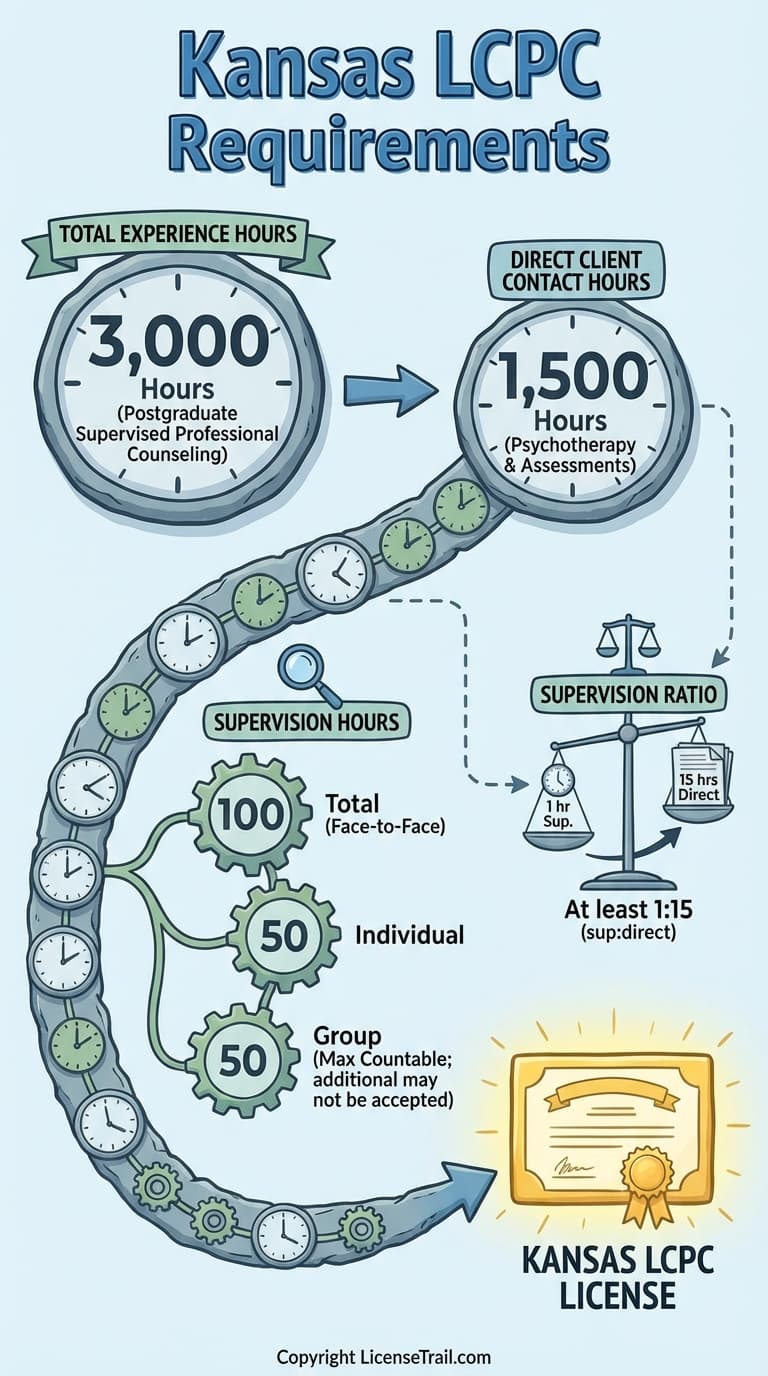
- Postgrad experience: ≥3,000 hours over ≥2 years, incl. ≥1,500 direct client contact hours (psychotherapy/assessment).
- Supervision rules: 1 hour supervision per 15 direct hours; ≥100 total supervision hours with ≥50 individual (group allowed up to 50, max 6 supervisees); meet at least twice/month with ≥1 individual/month; typically face-to-face (in person or secure video).
- Exam/competency: Pass board-approved clinical exam and demonstrate competence to diagnose & treat DSM mental disorders (doctoral degree may allow up to 50% waiver of hours/supervision; remaining in ≥1 year).
License Details
Procedures
Kansas licenses Licensed Clinical Professional Counselors (LCPCs) through the Behavioral Sciences Regulatory Board (BSRB) under the Professional Counselors Licensure Act. The LCPC is the independent, clinical level—distinct from the Licensed Professional Counselor (LPC), which is the entry/“dependent” level.
What follows organizes the statutory and regulatory requirements into a step‑by‑step path, with emphasis on the exact types of hours and supervision the BSRB requires.
1. Understand the Basic Structure of Licensure
Kansas law and regulation lay out LCPC requirements primarily in:
- K.S.A. 65‑5804a – applications and requirements for professional counselor and clinical professional counselor licensure. (ksrevisor.org)
- K.A.R. 102‑3‑3a – education requirements for professional counselors (including LCPC‑level practicum language). (law.cornell.edu)
- K.A.R. 102‑3‑7a – postgraduate supervised professional experience required to be licensed as a clinical professional counselor. (law.cornell.edu)
In practice, you:
- Qualify for (and usually obtain) LPC licensure.
- Complete LCPC‑specific education (additional diagnosis/treatment coursework and a qualifying practicum).
- Complete postgraduate supervised professional experience under an approved clinical supervision training plan.
- Pass the board‑approved clinical examination and meet the competency requirements to diagnose and treat mental disorders.
- Apply to the BSRB for LCPC.
2. Educational Foundation (LPC‑Level)
2.1 Graduate degree and credit hours
To qualify for professional counselor licensure (LPC)—which is the educational base for LCPC—you must show: (ksrevisor.org)
- At least 21 years of age.
- Completion of 60 graduate semester hours, including a graduate degree in counseling or a related field, from a college or university approved by the BSRB.
- Those 60 hours must include at least 45 graduate semester hours of counseling coursework distributed among all of these ten content areas:
- Counseling theory and practice
- The helping relationship
- Group dynamics, processing and counseling
- Human growth and development
- Lifestyle and career development
- Appraisal of individuals
- Social and cultural foundations
- Research and evaluation
- Professional orientation
- Supervised practicum and internship
You must also pass an examination required by the board and satisfy the board that you are a person who merits the public trust. (ksrevisor.org)
Most applicants become LPCs first, then work under clinical supervision toward LCPC.
3. Additional Education Required Specifically for LCPC
Kansas law adds extra educational requirements for the clinical level beyond the LPC. (ksrevisor.org)
3.1 LCPC diagnosis/treatment coursework (15 graduate credits)
For LCPC, you must show you:
- Are licensed as an LPC (or meet all LPC requirements), and
- Have completed 15 graduate semester hours (either as part of or in addition to your 60 hours) that specifically support diagnosis or treatment of mental disorders using the DSM in all of these content areas:
- Psychopathology
- Diagnostic assessment
- Interdisciplinary referral and collaboration
- Treatment approaches
- Professional ethics
These 15 credits may be embedded in your degree or in post‑degree graduate coursework, but they must be clearly identifiable in these DSM‑oriented content areas.
3.2 LCPC‑level practicum / clinical experience during graduate study
You must also have completed a graduate‑level supervised clinical practicum of professional experience that: (ksrevisor.org)
- Includes psychotherapy and assessment with individuals, couples, families, or groups,
- Integrates diagnosis and treatment of mental disorders using the DSM, and
- Contains at least 280 hours of direct client contact.
Kansas administrative regulation 102‑3‑3a clarifies two routes: (law.cornell.edu)
- Standard route (preferred): Your graduate practicum itself includes ≥ 280 hours of direct client contact meeting the above criteria; or
- Supplemental route:
- Your practicum had fewer than 280 direct client contact hours, and
- You make up the shortfall with additional direct client contact hours providing psychotherapy and assessment as part of your postgraduate supervised experience,
- Such that practicum direct hours + these extra direct hours = at least 280.
Crucially, the regulation states that any additional direct client contact hours used to reach the 280‑hour minimum are “in addition to” the 3,000 hours of postgraduate supervised experience required for LCPC (see below). (law.cornell.edu)
4. Plan Your LCPC Postgraduate Supervised Experience
4.1 Clinical supervision training plan (must be approved before hours count)
Before you begin counting any LCPC‑level supervised hours, you and your clinical supervisor must develop and co‑sign a written clinical supervision training plan on board forms and submit it to the BSRB. The plan must be approved by the board before supervised professional experience hours can accrue. (law.cornell.edu)
The plan must:
- Describe the supervisory context and setting,
- Summarize anticipated client populations and services,
- Outline goals, methods, frequency, and format of supervision,
- Clarify responsibilities, authority, and payment arrangements,
- Include the supervisee’s informed consent for the supervisor to consult with other responsible parties or the board, and
- Include a statement signed by both parties acknowledging they have read and agree to the postgraduate supervised professional experience requirements in K.A.R. 102‑3‑7a. (law.cornell.edu)
If your supervision situation changes (supervisor, site, etc.), you must submit training plan amendments within the timeframes set by the board, or hours during the gap may not be credited.
5. Postgraduate Supervised Experience Requirements for LCPC
This is where the state’s hour requirements become very specific.
5.1 Total hours and type of experience
Under K.S.A. 65‑5804a(c)(1)(D) and K.A.R. 102‑3‑7a, to qualify for LCPC you must complete: (ksrevisor.org)
- At least two years of postgraduate supervised professional experience in professional counseling,
- In accordance with your board‑approved clinical supervision training plan,
- Consisting of not less than 3,000 hours of supervised professional experience,
- Of which at least 1,500 hours must be direct client contact conducting psychotherapy and assessments with individuals, couples, families, or groups.
A practical way to think of this:
- 3,000 total supervised hours of professional counseling experience, over no less than 24 months,
- Broken down as:
- ≥ 1,500 hours of direct client contact
- ≤ 1,500 hours of other professional counseling activities (e.g., documentation, treatment planning, case consultation, professional development within your counseling role), as allowed under your training plan.
The statute also requires “not less than 100 hours of face‑to‑face clinical supervision,” including at least 50 hours of individual supervision, integrated with DSM‑based diagnosis and treatment. (ksrevisor.org)
5.2 Supervision ratio and distribution
K.A.R. 102‑3‑7a tightens this into operational rules for supervision: (law.cornell.edu)
- Supervision ratio
- You must receive 1 hour of clinical supervision for each 15 hours of direct client contact throughout the 3,000‑hour experience.
- Minimum total supervision hours
- At least 100 hours of clinical supervision in total.
- Of these, at least 50 hours must be individual supervision (supervisor and supervisee only).
- Up to 50 hours may be group supervision, with one supervisor and no more than six supervisees.
- Frequency and format
- You must meet with your supervisor for at least one hour, at least twice per month, and at least one of those sessions each month must be individual supervision.
- Supervision is ordinarily “face‑to‑face” either in person or, if confidentiality is protected, by synchronous videoconferencing. Under extenuating circumstances approved by the board, phone supervision may be allowed, but the baseline rule is face‑to‑face (in person or secure televideo). (law.cornell.edu)
The ratio and minimums are designed so that if you complete 1,500 direct client contact hours, you will naturally meet or exceed the minimum 100 supervision hours when you follow the 1:15 rule.
5.3 Supervisor qualifications
Your clinical supervisor must be a board‑approved clinical supervisor and, at the time they are providing supervision, must fit one of these categories: (law.cornell.edu)
- A Licensed Clinical Professional Counselor (LCPC) in Kansas (or licensed/registered as an equivalent in another jurisdiction) with at least two years of post‑licensure practice as a clinical professional counselor; or
- If an LCPC is not available, someone who is educationally qualified for LCPC licensure and has at least five years of postgraduate professional experience in clinical professional counseling; or
- Under extenuating circumstances approved by the board, a person licensed at the graduate level in a behavioral science whose scope of practice permits independent practice of counseling, therapy, or psychotherapy, with at least two years of clinical practice beyond their qualifying licensure date.
Supervisors must have professional authority over and responsibility for your clinical functioning, maintain documentation of supervision, and provide the board with the required verification when you complete your hours. (law.cornell.edu)
5.4 Doctoral‑level applicants (reduced hours)
Both statute and regulation allow a reduction in required hours for applicants with a qualifying doctoral degree:
- The board may waive one‑half of the 3,000‑hour and supervision requirement for an individual who holds a doctoral degree in professional counseling or a related field approved by the board, as long as the applicant completes the remaining half in at least one year of supervised professional experience. (ksrevisor.org)
- K.A.R. 102‑3‑7a specifies that such applicants must complete at least half of the usual supervised experience, with a minimum of:
- 25 hours of individual supervision,
- Up to 25 hours of group supervision, and
- At least two supervisory sessions per month, one of which must be individual. (law.cornell.edu)
6. Examination and Demonstration of Clinical Competence
Under K.S.A. 65‑5804a(c)(1), LCPC applicants must: (ksrevisor.org)
- Pass an examination approved by the board; and
- Demonstrate competence to diagnose and treat mental disorders using the DSM.
Current practice (as reflected in board materials and widely used guidance) is that LCPC applicants take a national clinical counseling examination (commonly the NCMHCE). However, the statute itself is framed more generally—“an examination approved by the board”—so applicants should confirm the current required exam on the BSRB’s Professional Counselors page or in the LCPC application packet. (ksbsrb.ks.gov)
In addition, K.S.A. 65‑5804a details pathways for demonstrating competence to diagnose and treat mental disorders (for example, via graduate coursework, clinical examination, and/or documented clinical practice). (ksrevisor.org)
7. Application and Licensure as an LCPC
After you have:
- Met all LPC requirements (and typically hold LPC licensure),
- Completed the 15 graduate credits in DSM‑based diagnosis and treatment content,
- Completed the qualifying practicum (and any additional direct contact hours needed to reach 280),
- Completed at least 3,000 hours of approved postgraduate supervised professional experience, including:
- ≥ 1,500 hours direct client contact,
- 100+ hours of clinical supervision with ≥ 50 individual, at a 1:15 supervision‑to‑direct‑hours ratio, over no less than two years, and
- Passed the board‑approved clinical exam and satisfied the board’s competence standards in diagnosing and treating mental disorders,
you submit the LCPC Application Packet to the Kansas BSRB, along with required fees. (ksbsrb.ks.gov)
Upon approval, the board issues your Licensed Clinical Professional Counselor credential, which authorizes you to engage in independent practice of professional counseling and to diagnose and treat mental disorders specified in the DSM edition designated by the board. (ksrevisor.org)
8. Hour Requirements – Concise Summary
For quick reference, under current Kansas statute and regulations (as of late 2025), the key LCPC hour requirements are:
-
Graduate education
- 60 graduate semester hours and a counseling/related master’s degree (LPC base). (ksrevisor.org)
- 15 additional graduate credits in DSM‑oriented psychopathology, diagnosis, treatment, collaboration, and ethics. (ksrevisor.org)
- Practicum: at least 280 hours of direct client contact in psychotherapy and assessment with individuals, couples, families, or groups, integrating DSM‑based diagnosis and treatment. If the practicum fell short, the shortfall must be made up with additional direct client contact hours beyond the 3,000 postgraduate hours. (law.cornell.edu)
-
Postgraduate supervised experience (LCPC)
- Total hours: 3,000 hours of postgraduate supervised professional counseling experience, over no less than two years. (ksrevisor.org)
- Direct client contact: at least 1,500 hours conducting psychotherapy and assessment with individuals, couples, families, or groups. (ksrevisor.org)
- Other professional hours: up to 1,500 hours of other supervised professional counseling activities (indirect services) under your training plan.
- Clinical supervision:
- Supervision ratio: 1 hour of clinical supervision per 15 hours of direct client contact.
- Minimum 100 hours of clinical supervision.
- At least 50 hours must be individual supervision; up to 50 hours may be group supervision (max six supervisees per group).
- At least two supervision sessions per month, at least one of which must be individual. (law.cornell.edu)
-
Doctoral exception
- With a board‑approved doctoral degree in professional counseling or a related field, the board may waive up to one‑half of the 3,000 hours and corresponding supervision, with the remaining half completed in not less than one year. (ksrevisor.org)
These are the controlling statutory and regulatory standards the Kansas Behavioral Sciences Regulatory Board applies when determining eligibility for LCPC licensure.
Track your LCPC hours with confidence
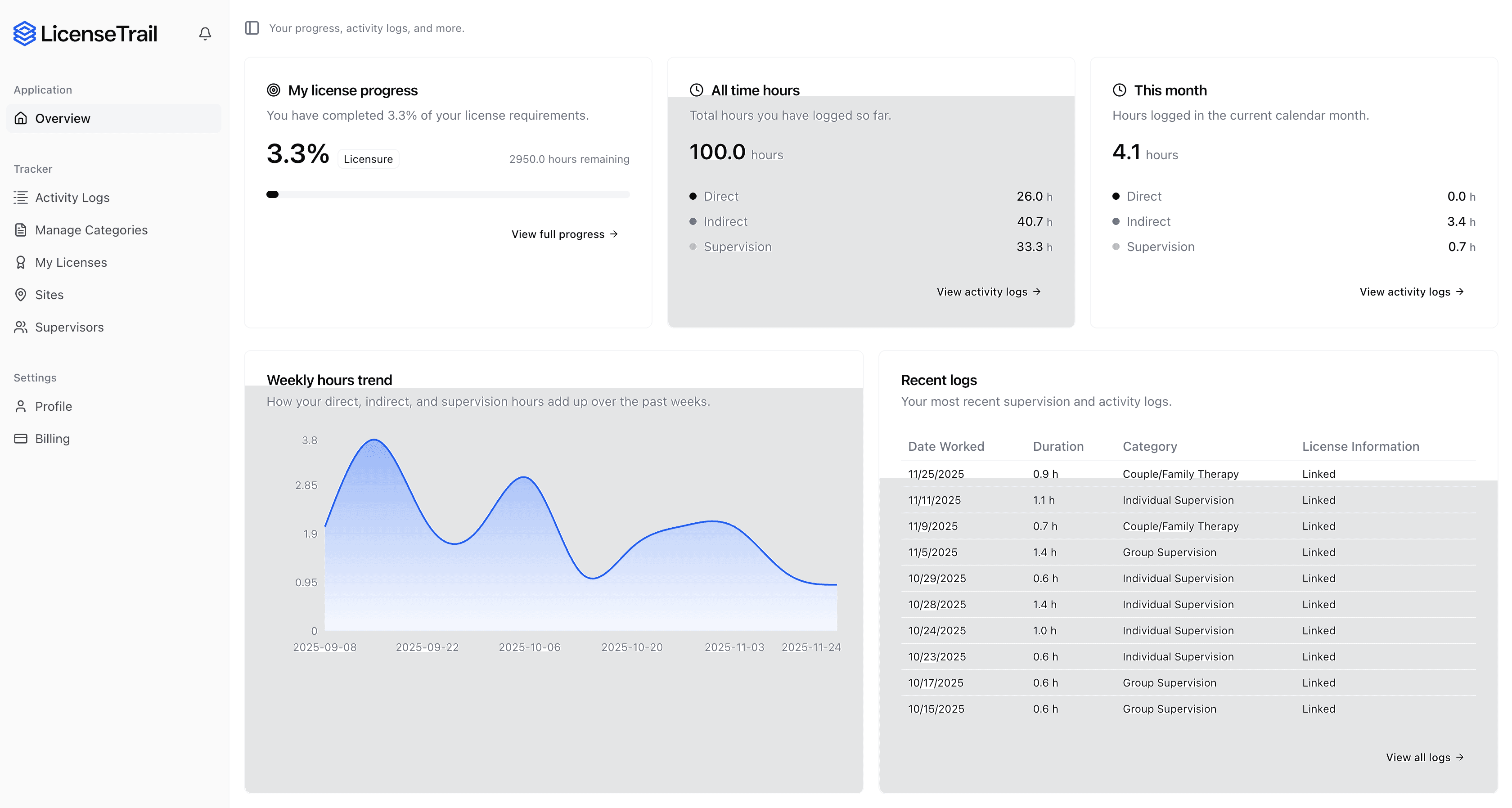
License Trail checks your direct, indirect, and supervision hours against Kansas LCPC requirements continuously and flags mismatches before you submit.
 Start Tracking for Free
No credit card required · Free plan available
Related Licenses
Licensed Addiction Counselor
LAC
Licensed Behavior Analyst
LBA
Licensed Clinical Addiction Counselor
LCAC
Licensed Clinical Marriage and Family Therapist
LCMFT
Licensed Clinical Psychotherapist
LCP
Licensed Marriage and Family Therapist
LMFT
Licensed Psychologist
LP
Licensed Specialist Clinical Social Worker
LSCSW
Is your spreadsheet hiding Kansas LCPC risks?
Stop guessing if your categories match Kansas Behavioral Sciences Regulatory Board requirements. License Trail checks your direct, indirect, and supervision hours continuously and flags mismatches before you submit.
Import or log
Bring your spreadsheet or start fresh
Upload your existing tracking spreadsheet and we'll map every hour into the right Kansas Behavioral Sciences Regulatory Board categories automatically.
Verify against Kansas
Catch mismatches before the board does
License Trail checks your direct, indirect, and supervision hours against Kansas LCPC requirements continuously.
Export board-ready
One-click clean reports
Generate professional, board-ready reports for supervision meetings and Kansas Behavioral Sciences Regulatory Board submissions in seconds.
No credit card required · Free plan available