
Kansas LSCSW Requirements: Hours, Exams & Step-by-Step Guide
Stop guessing if your categories match Kansas requirements. License Trail checks your direct, indirect, and supervision hours against LSCSW requirements continuously and flags mismatches before you submit.
No credit card required · Free plan available
Quick Requirements Overview
- Regulator: Kansas Behavioral Sciences Regulatory Board (BSRB); authority: K.S.A. 65-6306 & K.A.R. 102-2-12
- Education: MSW/DSW from BSRB-recognized program + required DSM-based clinical coursework + graduate supervised clinical practicum
- Training plan: Board-approved clinical supervision training plan must be submitted/approved before counting postgrad hours
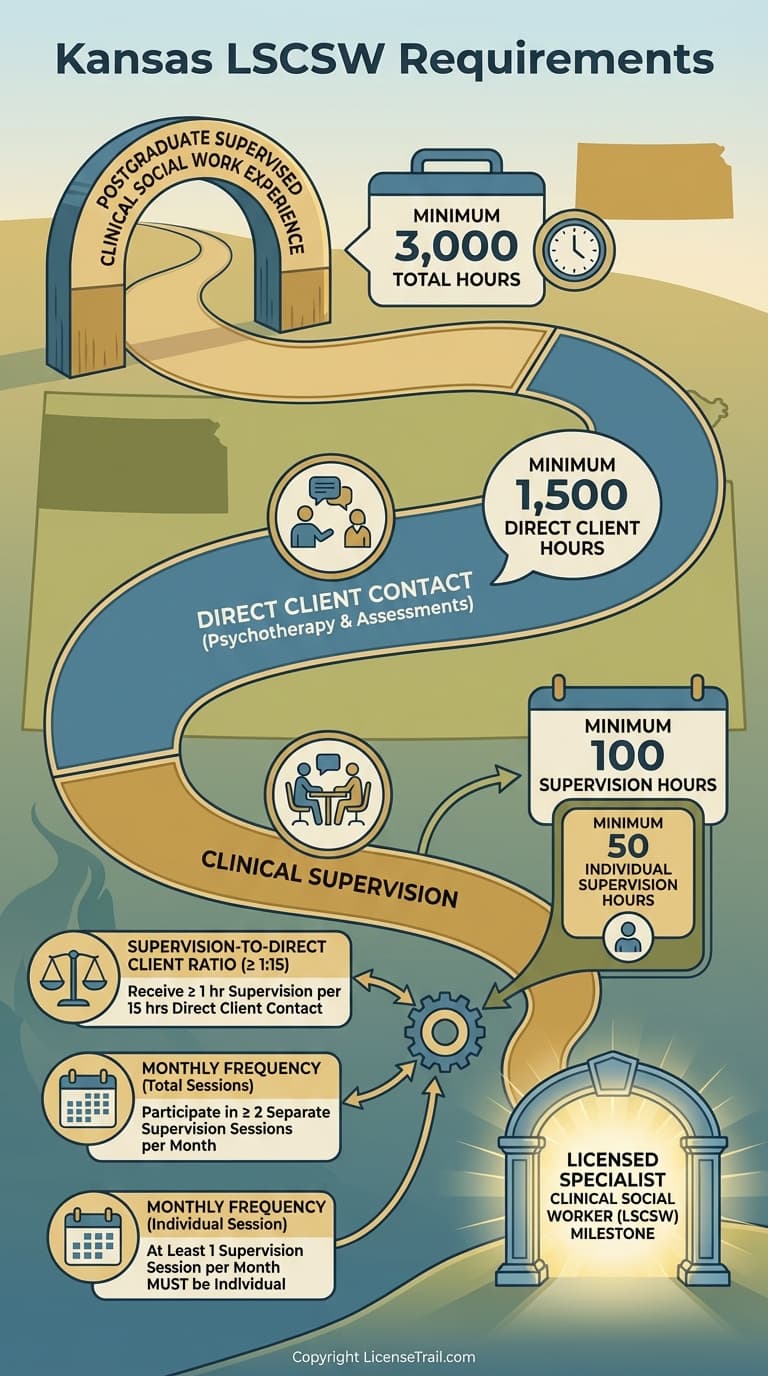
- Postgrad experience: 3,000 hours supervised clinical social work practice (completed in 2–6 years)
- Direct client contact: 1,500 of the 3,000 hours in psychotherapy and assessment (individual/couple/family/group)
- Supervision: 100 hours minimum; at least 50 hours individual; ratio ≥1 hour supervision per 15 direct client hours; at least 2 supervision sessions/month (≥1 individual); generally face-to-face (in-person or secure video)
- Supervisor: KS LSCSW (or BSRB-accepted equivalent out-of-state independent clinical social worker)
- Exam/other: pass board-approved clinical exam; meet “public trust”/character and application/fee requirements
License Details
Procedures
Kansas regulates the Licensed Specialist Clinical Social Worker (LSCSW) credential through the Behavioral Sciences Regulatory Board (BSRB). The core legal requirements are in K.S.A. 65‑6306 and K.A.R. 102‑2‑12, which together define the education, experience, and supervision standards you must meet. (law.justia.com)
Below is a structured guide focused on the type and number of hours required, along with the key statutory/regulatory language (paraphrased and highlighted).
1. Big-picture summary of LSCSW requirements
To be licensed as an LSCSW in Kansas, you must:
-
Hold a master’s or doctoral degree in social work from a program recognized/approved by the BSRB. (law.justia.com)
-
Qualify for social work specialty licensure (i.e., meet the requirements that build on the master’s level license). (law.justia.com)
-
Complete specific clinical coursework and a supervised clinical practicum focused on diagnosis and treatment of mental disorders using the DSM. (law.cornell.edu)
-
Complete postgraduate supervised clinical experience that meets all of these minimums (current law and regulations):
-
Total supervised professional experience:
- At least 3,000 hours of postgraduate supervised professional experience / “postgraduate, supervised clinical social work practice experience.” (law.justia.com)
-
Direct client contact (psychotherapy & assessment):
- At least 1,500 hours of those 3,000 hours must be direct client contact conducting psychotherapy and assessments with individuals, couples, families, or groups. (law.justia.com)
-
Clinical supervision hours:
- At least 100 hours of clinical supervision, of which at least 50 hours must be individual supervision, generally face‑to‑face (in person or secure synchronous video). (law.justia.com)
- Supervision must occur at a ratio of at least one hour of supervision for each 15 hours of direct client contact, with at least two supervision sessions per month, and at least one of those sessions individual. (law.cornell.edu)
-
Timeframe for accruing hours:
- These 3,000 hours must be completed in not less than two years and not more than six years. (law.cornell.edu)
-
-
Be supervised according to a board‑approved clinical supervision training plan, under a qualified LSCSW (or equivalent out‑of‑state clinical social worker). (law.cornell.edu)
-
Pass a board‑approved examination for clinical social work (currently the national clinical social work exam) and meet the Board’s character and fee requirements. (law.justia.com)
In other words: Kansas does not split the requirement into “1,500 hours direct experience + 1,500 hours separate supervised experience.” Instead, it requires 3,000 total supervised hours, of which at least 1,500 must be direct client contact, all under an approved supervisor and supervision plan.
2. Educational and practicum requirements (pre‑ and co‑requisites)
2.1 Degree and base licensure
Under K.S.A. 65‑6306, to even be considered for specialist clinical licensure, you must: (law.justia.com)
- Have a master’s or doctorate in social work from an accredited graduate school and a program approved by the BSRB.
- Meet the requirements for a social work specialty license (i.e., beyond the basic master’s license).
- Pass a board‑approved exam and demonstrate that you are “a person who merits the public trust.”
In practice, this means you are typically already licensed at the master’s level (LMSW) and then pursue the LSCSW.
2.2 Clinical coursework in diagnosis/treatment
Current statute and regulation together require clinically focused coursework tied to the DSM: (law.justia.com)
-
Statute (K.S.A. 65‑6306(f)(1)(B)) requires at least 3 graduate credit hours supporting diagnosis or treatment of mental disorders using the DSM, specifically in psychopathology.
-
Regulation (K.A.R. 102‑2‑12(b)), as currently published, requires for degrees earned on or after July 1, 2003:
- 15 graduate‑level credit hours supporting diagnosis or treatment of mental disorders using the DSM,
- including a discrete 3‑credit course whose primary focus is psychopathology and DSM‑based diagnosis and treatment.
Because the statute has been amended more recently and now specifies 3 credits, but the regulation still references 15 credits, the Board resolves how this is implemented through its forms and review process. Your LSCSW Training Plan and Application Packet from BSRB will reflect the operative standard.
2.3 Graduate‑level supervised clinical practicum
Both statute and regulation require a graduate‑level supervised clinical practicum involving psychotherapy and assessment that integrates DSM‑based diagnosis and treatment. (law.justia.com)
The practicum must be:
- A structured, academically supervised experience,
- in a practice setting that supports clinical social work practice,
- with opportunities for supervised application of clinical skills with a diverse client population.
This practicum is separate from, and in addition to, your post‑graduate supervised experience hours.
3. The LSCSW clinical supervision training plan
Before your post‑graduate hours can count toward LSCSW, you must have a clinical supervision training plan on file.
K.A.R. 102‑2‑12 requires that each applicant: (law.cornell.edu)
- Develop and co‑sign with the supervisor a “clinical supervision training plan for the postgraduate supervised clinical experience”, using the forms provided by the Board.
- Submit this plan to the Board for consideration for approval before beginning clinical supervision.
- Ensure the plan complies with K.A.R. 102‑2‑8(d) (the supervision regulation).
- Submit any changes or amendments to the plan to the Board for approval.
In practical terms:
- You and your LSCSW supervisor design a plan describing the setting, duties, caseload, types of clinical work, and how supervision will be provided (individual vs. group, frequency, modality).
- You submit that plan to BSRB, and your countable “postgraduate supervised clinical social work experience” is expected to start only after the plan is approved.
4. Post‑graduate supervised clinical experience: hours and definitions
4.1 Total supervised experience requirement
Both the statute and the regulation now require 3,000 hours of post‑graduate supervised experience: (law.justia.com)
-
Statute (K.S.A. 65‑6306(f)(1)(D)):
- “not less than 3,000 hours of supervised professional experience including at least 1,500 hours of direct client contact…”
-
Regulation (K.A.R. 102‑2‑12(c)(2)):
- “at least 3,000 hours of satisfactorily evaluated postgraduate, supervised clinical social work practice experience under the supervision of a qualified licensed specialist clinical social worker.”
All 3,000 hours are supervised. There is no separate pool of unsupervised hours.
4.2 Direct client contact requirement (1,500 hours)
Within those 3,000 hours, at least 1,500 hours must be direct client contact:
- Statute and regulation require that at least 1,500 hours are direct client contact conducting psychotherapy and assessments with individuals, couples, families, or groups. (law.justia.com)
In practical terms, “direct client contact” means:
- Face‑to‑face (in person or secure video) psychotherapy sessions,
- Clinical intake and diagnostic assessments,
- Family, couple, or group therapy sessions,
- Any billable/clinical contact where you are directly providing psychotherapy or diagnostic/clinical assessment services as a social worker.
4.3 The remaining 1,500 hours
The other up to 1,500 hours (3,000 total minus 1,500 direct) are still supervised clinical social work practice, but not necessarily direct client contact. They typically include, for example:
- Case documentation and record‑keeping,
- Treatment planning and review,
- Case consultation and clinical team meetings,
- Collateral contacts with family, schools, or other providers,
- Researching interventions or best practices for your caseload.
The regulation characterizes this generally as postgraduate, supervised clinical social work practice experience rather than specifying a strict breakdown for non‑direct hours. (law.cornell.edu)
4.4 Timeframe for completing hours
The regulation sets strict timing parameters:
- You must complete the **3,000 hours in not less than two years and not more than six years. (law.cornell.edu)
This essentially means:
- You cannot compress everything into a one‑year intensive; you need at least 24 months of supervised clinical practice.
- You cannot take longer than six years once you start counting postgraduate clinical hours under your approved plan.
5. Clinical supervision: amount, structure, and modality
5.1 Required number of supervision hours
Kansas ties supervision to your direct client hours and sets a minimum total:
-
Ratio requirement (regulation):
- You must receive at least one hour of clinical supervision for each 15 hours of direct client contact, “to total 100 hours of clinical supervision.” (law.cornell.edu)
-
Minimum total supervision (statute and regulation):
- At least 100 hours of clinical supervision overall. (law.justia.com)
-
Individual supervision minimum:
- At least 50 of those 100 hours must be individual supervision (one‑on‑one with your supervisor). (law.justia.com)
Since you must accrue at least 1,500 direct client hours, the 1:15 ratio naturally yields 100 hours of supervision (1,500 ÷ 15 = 100).
5.2 Frequency and format of supervision
K.A.R. 102‑2‑12 also specifies how supervision must be structured: (law.cornell.edu)
- There must be at least two clinical supervision sessions per month.
- At least one of those monthly sessions must be individual supervision.
- Supervision must be face‑to‑face, either:
- In person, or
- Via synchronous videoconferencing if confidentiality is adequately protected.
- The Board may consider extenuating circumstances if the standard face‑to‑face requirement cannot be met (e.g., for remote or specialized settings).
5.3 Content and focus of supervision
Statute and regulation emphasize that supervision must integrate DSM‑based clinical work: (law.justia.com)
- Supervision should integrate diagnosis (or diagnostic impressions) and treatment of mental disorders using the DSM.
- The supervisor is expected to review, evaluate, and guide your psychotherapy and assessment work with individuals, couples, families, and groups.
6. Supervisor qualifications
K.A.R. 102‑2‑8(d) and related provisions specify who can supervise your LSCSW hours: (sos.ks.gov)
- Supervision must be provided by a Licensed Specialist Clinical Social Worker (LSCSW) in Kansas.
- Alternatively, for some applicants, a clinical social worker licensed in another state and authorized for independent practice may supervise, if they otherwise meet BSRB requirements.
- Supervisors are expected not to have disqualifying dual relationships and to meet professional standards outlined in the supervision regulation.
Your LSCSW Training Plan form will ask you to identify your supervisor and confirm that they meet the Board’s qualifications.
7. Documentation of supervised experience
At the time you apply for LSCSW, your supervisor must submit detailed documentation of your supervised experience. K.A.R. 102‑2‑12(d) requires documentation sufficient for the Board to evaluate the nature, quality, and quantity of your clinical practice. This includes, at minimum: (law.cornell.edu)
- A written summary of the types of clients and situations addressed during supervision.
- A summary of how supervision goals and objectives were met.
- A description of your practice setting and a summary of your practice activities and responsibilities while under supervision.
- A statement on whether you merit the public trust.
- An evaluation of your supervised clinical social work experience.
These materials, combined with your hours log and the Board’s forms, are used to determine whether you’ve truly met the LSCSW standard.
8. Examination and final licensure step
After fulfilling the education and supervised experience requirements, you must:
-
Pass a Board‑approved clinical social work examination.
- K.S.A. 65‑6306 requires passing “an examination approved by the board” for specialty and specialist clinical licensure. (law.justia.com)
- BSRB’s fee schedule identifies a higher “Clinical” examination fee (currently $260), reflecting the clinical‑level exam requirement. (ksbsrb.ks.gov)
-
Submit the LSCSW Application Packet and fees, including:
- Proof of education and required clinical coursework,
- Proof of supervised practicum,
- Supervisor verification of 3,000 hours with 1,500 direct client hours and 100 supervision hours,
- Any other Board forms (e.g., training plan approval, disciplinary history answers).
-
Demonstrate that you “merit the public trust” and have no disqualifying disciplinary or criminal history, as required for social work licensure in Kansas. (law.justia.com)
9. Quick checklist of hour and supervision requirements
For an LSCSW in Kansas, the key quantitative requirements are:
-
Total post‑graduate supervised experience:
- 3,000 hours of postgraduate supervised professional experience / supervised clinical social work practice.
-
Direct client contact within those 3,000 hours:
- At least 1,500 hours of direct client contact conducting psychotherapy and assessments with individuals, couples, families, or groups.
-
Clinical supervision hours:
- At least 100 hours of clinical supervision,
- At least 50 hours must be individual (one‑to‑one) supervision.
-
Supervision ratio and structure:
- ≥ 1 supervision hour for every 15 hours of direct client contact.
- At least two supervision sessions per month, including at least one individual session.
- Supervision generally face‑to‑face (in person or secure synchronous video).
-
Timeframe:
- Must complete these hours in not less than 2 years and not more than 6 years.
-
Supervisor:
- Qualified LSCSW (or an out‑of‑state clinical social worker authorized for independent practice and accepted by BSRB).
These numbers and terms—“postgraduate supervised professional experience,” “postgraduate, supervised clinical social work practice experience,” “direct client contact,” and “clinical supervision”—are drawn directly from Kansas statute and administrative regulation governing LSCSW licensure. (law.justia.com)
Track your LSCSW hours with confidence
License Trail checks your direct, indirect, and supervision hours against Kansas LSCSW requirements continuously and flags mismatches before you submit.
 Start Tracking for Free
No credit card required · Free plan available
Related Licenses
Licensed Addiction Counselor
LAC
Licensed Behavior Analyst
LBA
Licensed Clinical Addiction Counselor
LCAC
Licensed Clinical Marriage and Family Therapist
LCMFT
Licensed Clinical Psychotherapist
LCP
Licensed Clinical Professional Counselor
LCPC
Licensed Marriage and Family Therapist
LMFT
Licensed Psychologist
LP
Is your spreadsheet hiding Kansas LSCSW risks?
Stop guessing if your categories match Kansas Behavioral Sciences Regulatory Board requirements. License Trail checks your direct, indirect, and supervision hours continuously and flags mismatches before you submit.
Import or log
Bring your spreadsheet or start fresh
Upload your existing tracking spreadsheet and we'll map every hour into the right Kansas Behavioral Sciences Regulatory Board categories automatically.
Verify against Kansas
Catch mismatches before the board does
License Trail checks your direct, indirect, and supervision hours against Kansas LSCSW requirements continuously.
Export board-ready
One-click clean reports
Generate professional, board-ready reports for supervision meetings and Kansas Behavioral Sciences Regulatory Board submissions in seconds.
No credit card required · Free plan available