
Kansas LCMFT Requirements: Hours, Exams & Step-by-Step Guide
Stop guessing if your categories match Kansas requirements. License Trail checks your direct, indirect, and supervision hours against LCMFT requirements continuously and flags mismatches before you submit.
No credit card required · Free plan available
Quick Requirements Overview
- Regulator: Kansas Behavioral Sciences Regulatory Board (BSRB); authority K.S.A. 65‑6404 & K.A.R. 102‑5‑7a
- Prereq: Must be KS LMFT (or meet all LMFT requirements) + qualifying master’s (or higher) degree
- Clinical coursework: 15 graduate credits in DSM-based diagnosis/treatment (psychopathology, assessment, referral/collab, treatment approaches, ethics)
- Practicum: Graduate supervised practicum incl. DSM diagnosis/treatment + ≥350 hours direct client contact
- Training plan: Board-approved clinical supervision training plan required before hours count; no backdating; report supervisor/setting changes within 45 days or lose hours until reapproved
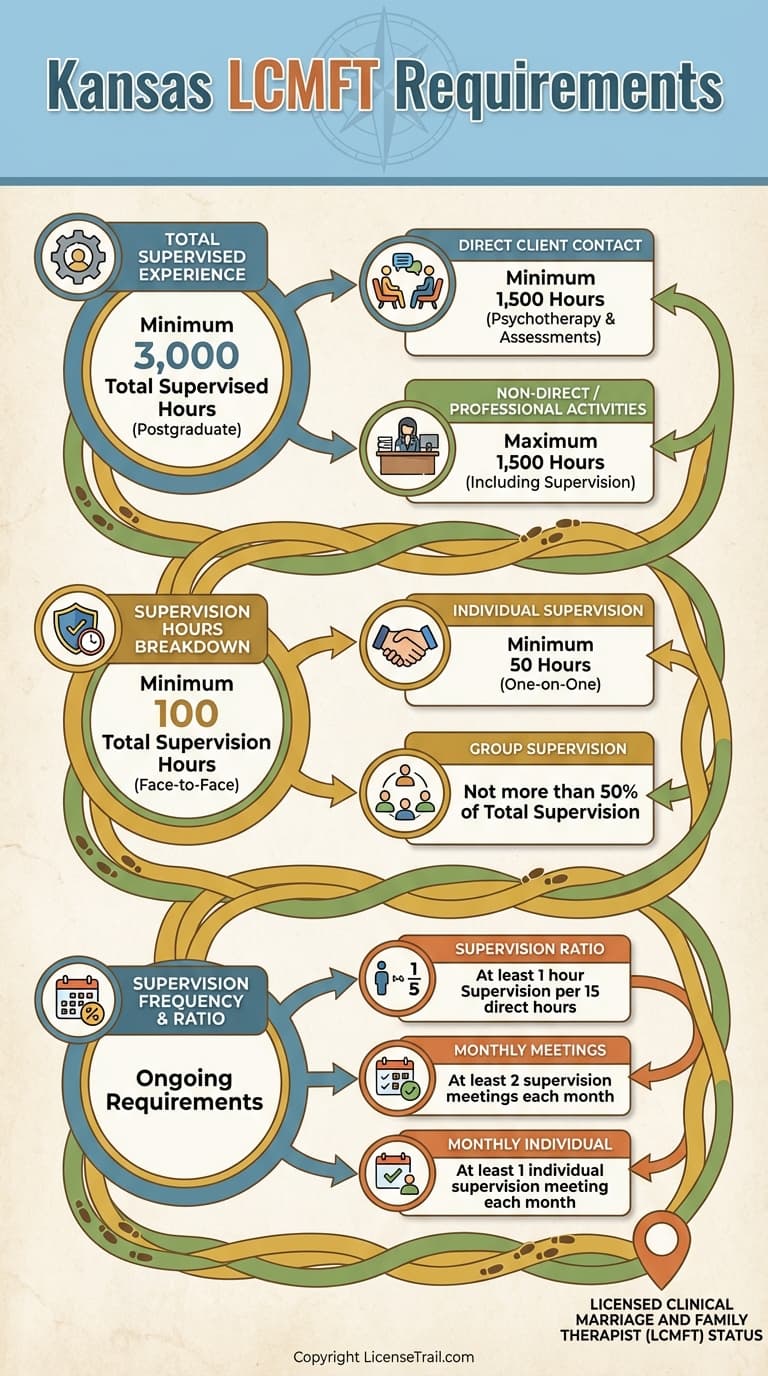
- Postgrad experience: ≥3,000 hours over ≥24 months, incl. ≥1,500 direct client contact (psychotherapy/assessments) + up to 1,500 other professional hours
- Supervision: ≥100 hours face-to-face (in-person or secure live video); ≥50 individual; ratio 1 hr supervision per 15 hrs direct contact; meet ≥2x/month (≥1 individual); group ≤6 supervisees and ≤50% of total supervision hours
- Exam: Pass National Marriage and Family Therapy Examination after BSRB verifies eligibility (typically after experience/supervision complete)
License Details
Procedures
In Kansas, the Licensed Clinical Marriage and Family Therapist (LCMFT) credential is the independent clinical level of marriage and family therapy licensure. It is regulated by the Kansas Behavioral Sciences Regulatory Board (BSRB) under K.S.A. 65‑6404 and K.A.R. 102‑5‑7a. (kslegislature.gov)
Becoming an LCMFT is essentially a two‑stage process:
- Qualify for and obtain LMFT licensure (or meet all LMFT requirements), and
- Complete additional clinical coursework and a substantial period of postgraduate supervised professional experience to qualify for LCMFT. (kslegislature.gov)
Below is a step‑by‑step guide emphasizing the types and amounts of hours Kansas requires and the key statutory/regulatory language.
1. Baseline eligibility: LMFT status and graduate degree
Kansas statute requires that an LCMFT applicant either:
- “is licensed by the board as a licensed marriage and family therapist or meets all requirements for licensure as a marriage and family therapist.” (kslegislature.gov)
In practice, almost all applicants are already Licensed Marriage and Family Therapists (LMFTs) in Kansas.
Graduate degree and clinical coursework
Under K.S.A. 65‑6404, an LCMFT applicant must: (kslegislature.gov)
-
Hold a qualifying master’s (or higher) degree in marriage and family therapy or a related field acceptable to the board (meeting the LMFT education regulations in K.A.R. 102‑5‑3).
-
Have at least 15 graduate credit hours (as part of, or in addition to, the LMFT degree) in coursework specifically supporting the “diagnosis or treatment of mental disorders” using the DSM, including identifiable study of:
- Psychopathology
- Diagnostic assessment
- Interdisciplinary referral and collaboration
- Treatment approaches
- Professional ethics
-
Have completed a graduate‑level supervised clinical practicum (or equivalent supervised professional experience) that:
- Integrates diagnosis and treatment of mental disorders using the DSM, and
- Includes “not less than 350 hours of direct client contact” with individuals, couples, families, or groups. (kslegislature.gov)
2. Clinical supervision training plan (required before counting hours)
Before you can start counting hours toward LCMFT, Kansas requires a board‑approved clinical supervision training plan.
- You must already be licensed as an LMFT in Kansas to submit this plan. (ksbsrb.ks.gov)
- The supervision plan must be submitted to and approved by BSRB before any hours can count.
- The BSRB is explicit that it “will not backdate any training plans”; hours accrued before written approval cannot be counted. (ksbsrb.ks.gov)
- Any change in supervisor, setting, or other key elements must be reported to the BSRB within 45 days, or you lose the hours accrued after the unreported change until the revised plan is approved. (ksbsrb.ks.gov)
The training plan (on board forms) must outline, among other things: the practice setting, types of clients, supervision schedule and format, documentation methods, and how clients are informed that you are practicing **“under supervision.” (law.cornell.edu)
3. Required postgraduate supervised professional experience
The centerpiece of LCMFT licensure is the postgraduate supervised professional experience in clinical marriage and family therapy.
Total required hours and time frame
Kansas law and regulation state that an LCMFT applicant must complete not less than two years of supervised clinical experience consisting of: (kslegislature.gov)
- 3,000 hours of postgraduate supervised professional experience in marriage and family therapy,
- Inclusive of at least 1,500 hours of direct client contact, and
- The remaining up to 1,500 hours may be other “professional hours.”
The BSRB’s FAQ further specifies: (ksbsrb.ks.gov)
- These 3,000 hours must be completed over a minimum of 24 months from the date supervision begins.
- There is no maximum time limit to finish the hours.
- There is no required weekly or monthly minimum number of work hours, apart from meeting supervision‑session requirements.
Breakdown of experience hours
Kansas uses the following categories:
-
Direct client contact (min. 1,500 hours)
- Defined in statute as direct client contact “conducting psychotherapy and assessments” with individuals, couples, families, or groups, integrating DSM‑based diagnosis and treatment of mental disorders. (kslegislature.gov)
- The FAQ echoes this: at least 1,500 hours must be “direct client contact providing psychotherapy and assessments.” (ksbsrb.ks.gov)
-
Professional hours (up to 1,500 hours)
- The balance of the 3,000‑hour requirement—up to 1,500 hours—may be “professional hours” as described by the BSRB. (ksbsrb.ks.gov)
- While the FAQ does not give an exhaustive list, these hours generally encompass other professional activities within the LCMFT scope of practice (e.g., clinical documentation, case consultation, treatment planning, indirect client work) under supervision.
In plain terms, you must accumulate 3,000 total hours, with at least half of those hours (1,500) being hands‑on psychotherapy and assessment with clients.
4. Supervision hour requirements and format
Kansas couples the experience requirement with detailed clinical supervision requirements, set out in K.S.A. 65‑6404(d)(1)(D) and K.A.R. 102‑5‑7a. (kslegislature.gov)
Amount of supervision
Across your 3,000 hours of professional experience, you must receive:
- At least 100 hours of face‑to‑face clinical supervision,
- At least 50 hours must be individual supervision.
This emerges from two complementary rules:
- Statute: minimum 100 hours of face‑to‑face clinical supervision, at least 50 individual. (kslegislature.gov)
- Regulation and FAQ: “one hour of clinical supervision… for each 15 hours of direct client contact”, with a minimum of 100 hours and at least 50 individual. With 1,500 hours of direct client contact, this 1:15 ratio yields 100 supervision hours. (sos.ks.gov)
Frequency and modality
K.A.R. 102‑5‑7a and the FAQ add more structure: (sos.ks.gov)
- Supervision ratio:
- 1 hour of clinical supervision for every 15 hours of direct client contact.
- Minimum supervision sessions:
- Meet with your supervisor at least twice per month,
- At least one of those sessions each month must be individual supervision.
- Minimum total supervision hours:
- 100 hours total clinical supervision.
- At least 50 hours must be individual supervision.
- Group supervision limits:
- Group supervision may include no more than six supervisees at a time.
- No more than half of your total supervision hours may be group supervision.
- Face‑to‑face requirement:
- Supervision must be conducted face‑to‑face, either:
- In person, or
- By synchronous videoconferencing when confidentiality is adequately protected. (sos.ks.gov)
- Supervision must be conducted face‑to‑face, either:
In other words, you cannot fulfill the requirement solely by occasional phone calls or email consultation; supervision is a structured, scheduled, face‑to‑face clinical process.
5. Supervisor qualifications
Your supervisor must be a board‑approved clinical supervisor and must meet specific criteria. (sos.ks.gov)
For supervised experience in Kansas
Per BSRB FAQ and K.A.R. 102‑5‑7a: (ksbsrb.ks.gov)
- Preferred supervisor:
- A Kansas Licensed Clinical Marriage and Family Therapist (LCMFT) with at least two years of independent clinical practice (including diagnosis and treatment of mental disorders) beyond the date of clinical licensure.
- If an LCMFT is not available:
- A Licensed Psychologist (LP),
- A Licensed Specialist Clinical Social Worker (LSCSW),
- A Licensed Clinical Professional Counselor (LCPC), or
- A Licensed Clinical Psychotherapist (LCP),
- Each with at least two years of clinical practice beyond their qualifying license date.
For out‑of‑state supervision, similar but slightly adjusted criteria apply, including options for experienced clinicians in related fields whose scope of practice includes diagnosis and treatment of mental disorders. (ksbsrb.ks.gov)
The regulations also state that the supervisor must:
- Have professional authority and responsibility for your clinical work,
- Avoid a dual relationship with you,
- Not be under disciplinary sanction (unless specifically waived by the board), and
- Have knowledge of your client population, methods of practice, and the policies of your practice setting. (law.cornell.edu)
6. Reduced-hour option for doctoral graduates
Kansas allows a partial waiver of the supervised experience requirement for applicants with a qualifying doctoral degree.
Under K.S.A. 65‑6404(d)(1)(D) and K.A.R. 102‑5‑7a(b): (kslegislature.gov)
- Applicants who hold a doctor’s degree in marriage and family therapy or a closely related field acceptable to the board may have up to one‑half of the 3,000 hours waived.
- Such applicants must still complete:
- At least 1,500 hours of postgraduate supervised professional experience, and
- Supervision consistent with the reduced‑hour provisions (including at least 25 hours of individual supervision, 25 group, and a minimum of two supervisory sessions per month, one of which must be individual).
Even with the waiver, the remaining supervised experience must be completed in no less than one year. (kslegislature.gov)
7. Examination requirement
Both LMFT and LCMFT applicants must pass the National Marriage and Family Therapy Examination approved by the BSRB. (ksbsrb.ks.gov)
For LCMFT:
- You submit an LCMFT licensure application after:
- Completing all education and practicum requirements,
- Completing the 3,000 hours of postgraduate supervised professional experience (or approved doctoral‑level equivalent), and
- Completing the required supervision. (ksbsrb.ks.gov)
- Once the board verifies that all requirements (except the exam) are met, it authorizes you to register for the exam.
- After you pass, you pay the original LCMFT license fee and the board issues your clinical license.
8. Putting the hours together: quick reference
Postgraduate supervised professional experience (standard master’s‑level LCMFT route):
-
Total professional experience:
- 3,000 hours “postgraduate supervised professional experience” in marriage and family therapy. (kslegislature.gov)
-
Direct client contact:
- At least 1,500 hours of direct client contact
- These hours must be psychotherapy and assessment with individuals, couples, families, or groups, integrating DSM‑based diagnosis and treatment of mental disorders. (kslegislature.gov)
-
Professional hours (other):
- Up to 1,500 hours may be “professional hours” (non‑direct services and related professional activities in the practice of MFT). (ksbsrb.ks.gov)
-
Supervision hours:
- At least 100 hours of face‑to‑face clinical supervision,
- At least 50 hours individual supervision,
- No more than half of total supervision hours may be in group format,
- Supervision ratio of 1 hour per 15 hours of direct client contact,
- At least two supervision sessions per month, with one being individual. (sos.ks.gov)
-
Time frame:
- Must be completed in no less than 24 months from the start of supervised experience (no maximum time limit). (ksbsrb.ks.gov)
- Hours accrue only after the BSRB approves your clinical supervision training plan in writing. (ksbsrb.ks.gov)
9. Practical sequence for a Kansas applicant
- Complete a qualifying master’s degree in MFT or related field meeting K.A.R. 102‑5‑3.
- Obtain LMFT licensure in Kansas (or meet all requirements for LMFT). (ksbsrb.ks.gov)
- Confirm you have:
- The required 15 graduate credits in diagnosis/treatment of mental disorders using the DSM.
- A practicum with at least 350 hours of direct client contact (or approved equivalent). (kslegislature.gov)
- Develop and submit an LCMFT clinical supervision training plan with a qualified, board‑approved clinical supervisor; wait for written BSRB approval. (ksbsrb.ks.gov)
- After approval, begin accruing your 3,000 postgraduate supervised professional experience hours:
- At least 1,500 hours direct client contact,
- Up to 1,500 hours professional hours,
- With supervision meeting the 1:15 ratio, 100 total hours, 50 individual minimum, group limits, and twice‑monthly meetings. (sos.ks.gov)
- Once all experience and supervision requirements are completed, submit the LCMFT application (including supervisor attestations). (law.cornell.edu)
- After the board verifies your file, take and pass the National Marriage and Family Therapy Examination at the clinical level. (ksbsrb.ks.gov)
- Pay the required fees and obtain your Licensed Clinical Marriage and Family Therapist (LCMFT) credential, which authorizes you to independently diagnose and treat mental disorders under Kansas law. (kslegislature.gov)
This reflects the current statutory and regulatory framework as of late 2025. For any borderline or unusual experience (e.g., unusual work settings, out‑of‑state supervision, or mixed roles), the BSRB strongly encourages direct consultation to confirm that hours will be accepted under K.A.R. 102‑5‑7a.
Track your LCMFT hours with confidence
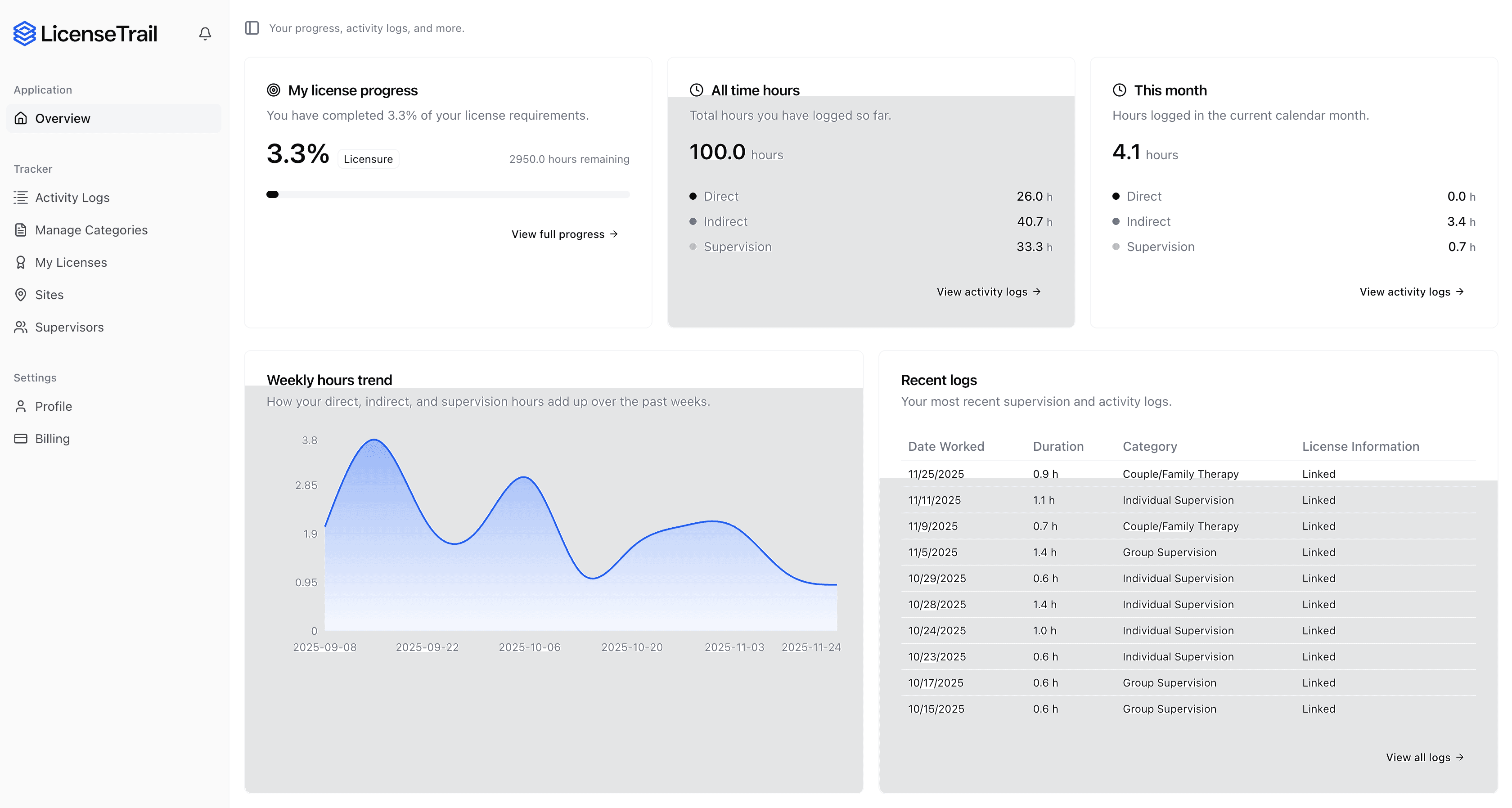
License Trail checks your direct, indirect, and supervision hours against Kansas LCMFT requirements continuously and flags mismatches before you submit.
 Start Tracking for Free
No credit card required · Free plan available
Related Licenses
Licensed Addiction Counselor
LAC
Licensed Behavior Analyst
LBA
Licensed Clinical Addiction Counselor
LCAC
Licensed Clinical Psychotherapist
LCP
Licensed Clinical Professional Counselor
LCPC
Licensed Marriage and Family Therapist
LMFT
Licensed Psychologist
LP
Licensed Specialist Clinical Social Worker
LSCSW
Is your spreadsheet hiding Kansas LCMFT risks?
Stop guessing if your categories match Kansas Behavioral Sciences Regulatory Board requirements. License Trail checks your direct, indirect, and supervision hours continuously and flags mismatches before you submit.
Import or log
Bring your spreadsheet or start fresh
Upload your existing tracking spreadsheet and we'll map every hour into the right Kansas Behavioral Sciences Regulatory Board categories automatically.
Verify against Kansas
Catch mismatches before the board does
License Trail checks your direct, indirect, and supervision hours against Kansas LCMFT requirements continuously.
Export board-ready
One-click clean reports
Generate professional, board-ready reports for supervision meetings and Kansas Behavioral Sciences Regulatory Board submissions in seconds.
No credit card required · Free plan available