
Kansas LCAC Requirements: Hours, Exams & Step-by-Step Guide
Stop guessing if your categories match Kansas requirements. License Trail checks your direct, indirect, and supervision hours against LCAC requirements continuously and flags mismatches before you submit.
No credit card required · Free plan available
Quick Requirements Overview
- Regulator/credential: Kansas BSRB — Licensed Clinical Addiction Counselor (LCAC) (K.S.A. 65‑6610; K.A.R. 102‑7‑3/4/5/6)
- Basic eligibility: Age 21+; meet “public trust” standard; pay fees
- Education: Master’s meeting K.A.R. 102‑7‑3 (or non-addiction master’s + ≥30 graduate credits in SUD diagnosis/treatment content areas); includes practicum ≥300 client-contact hours with 1:10 supervision
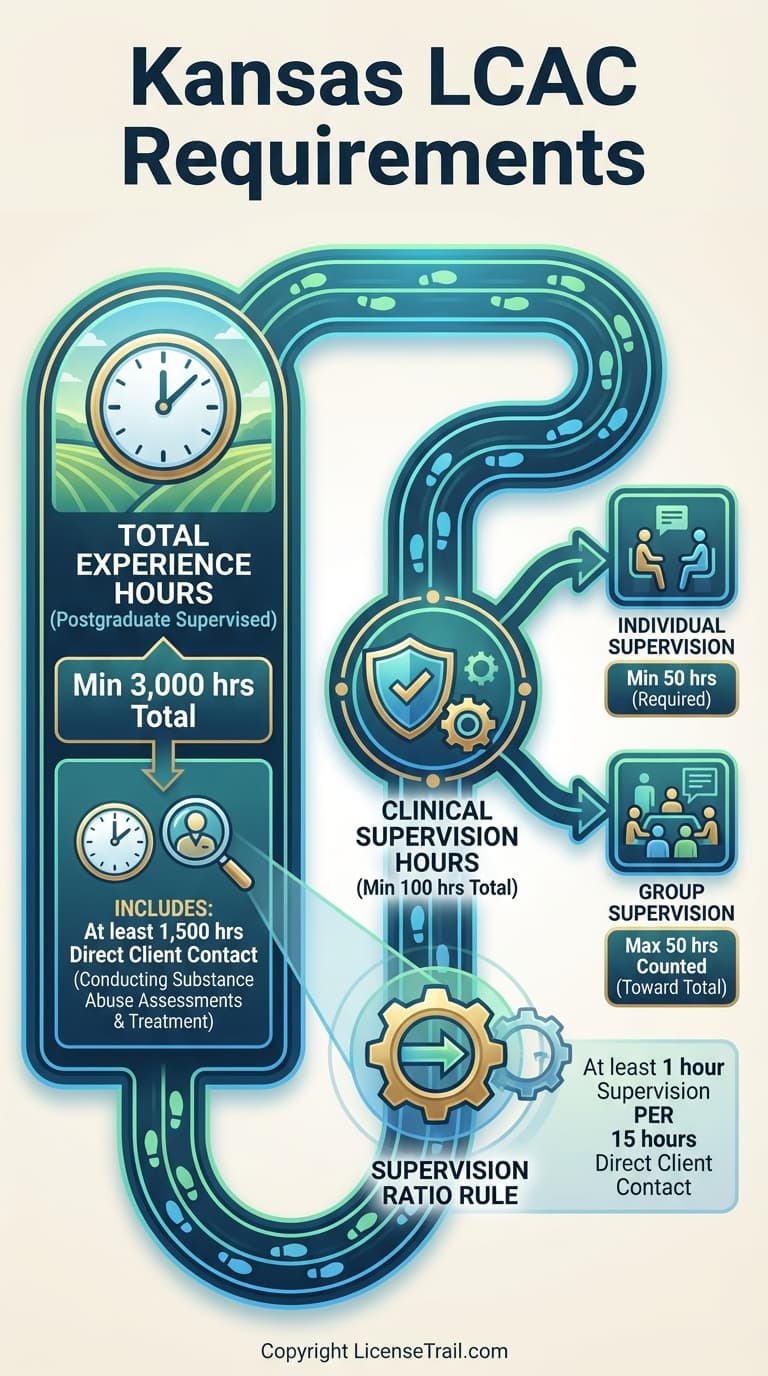
- Postgrad experience: 3,000 hours supervised addiction-counseling experience over ≥2 years, including 1,500 hours direct client contact (SUD assessment & treatment)
- Direct client contact definition: In-person or real-time, two-way audio/visual; email/text/etc. don’t count
- Clinical supervision: 1 hour per 15 direct hours ⇒ typically ≥100 hours, with ≥50 individual and ≤50 group (max 6 supervisees); meet 2x/month (≥1 individual/month); generally face-to-face or secure video
- Supervision plan: Board-approved Clinical Supervision Training Plan required before hours count (and changes filed within 45 days)
- Exam: Pass a national clinical exam approved by BSRB (possible waiver for substantially equivalent prior exam)
License Details
Procedures
Kansas licenses clinical addiction counselors at the independent level as Licensed Clinical Addiction Counselors (LCAC) through the Kansas Behavioral Sciences Regulatory Board (BSRB). The requirements are defined both in statute (K.S.A. 65‑6610) and in administrative regulations (K.A.R. 102‑7‑3, 102‑7‑4, 102‑7‑5, 102‑7‑6).(ksrevisor.gov)
What follows is a step‑by‑step outline with emphasis on the types of hours and the precise structure of supervised experience.
1. Basic eligibility for LCAC
To be licensed as an LCAC, an applicant must:(ksrevisor.gov)
- Be at least 21 years old.
- Hold at least a master’s degree meeting the addiction‑counseling education requirements in K.A.R. 102‑7‑3 (see Section 2).
- Have the appropriate license and level of training, typically:
- Be licensed (or license‑eligible) as a Licensed Master’s Addiction Counselor (LMAC) in Kansas; or
- Already hold a Kansas clinical‑level license (psychologist, specialist clinical social worker, clinical professional counselor, clinical psychotherapist, or clinical marriage and family therapist) plus specific addiction‑competence attestation (see Section 6 for this alternative pathway).(ksrevisor.gov)
- Complete the required postgraduate supervised professional experience in addiction counseling under a board‑approved clinical supervision training plan (Section 3–4).(sos.ks.gov)
- Pass a nationally administered clinical examination approved by the BSRB (Section 5).(law.cornell.edu)
- Be a person who “merits the public trust” and pay the required fees.(ksrevisor.gov)
2. Graduate education requirements (master’s level)
The education requirements for LCAC are set in K.A.R. 102‑7‑3. In brief:(sos.ks.gov)
-
Degree level and program accreditation
To qualify as a master’s addiction counselor or clinical addiction counselor, an applicant must either:
- Hold a master’s degree in addiction counseling from a program that met board‑approved standards at the time of graduation; or
- Hold a master’s degree in another course of study from a board‑approved college or university and complete at least 30 graduate semester hours (or equivalent) of coursework supporting diagnosis and treatment of substance use disorders, distributed across specified content areas (e.g., addiction and recovery services, advanced individual/group counseling, assessment and diagnosis, treatment planning, ethics, applied research, etc.).(sos.ks.gov)
Many pathways are satisfied if the master’s program is accredited by the National Addiction Studies Accreditation Commission (NASAC).(sos.ks.gov)
-
Graduate practicum / clinical training built into the degree
For master’s‑level preparation relevant to LMAC/LCAC, K.A.R. 102‑7‑3 requires a graduate practicum or equivalent that must:(sos.ks.gov)
- Integrate didactic learning with clinical experience in diagnosis and treatment of substance use disorders.
- Include at least 300 hours of client contact.
- Provide at least 1 hour of supervision for every 10 hours of client contact, with supervision from program faculty and agency supervisors, at least one of whom is licensed at or above the level being pursued.
These are academic hours and supervision embedded in the degree; they are distinct from the postgraduate 3,000 hours discussed below.
3. Postgraduate supervised professional experience: total hours and types of hours
After completing the qualifying master’s program, LCAC applicants must complete a postgraduate supervised professional experience in addiction counseling defined jointly by statute (K.S.A. 65‑6610(c)) and regulation (K.A.R. 102‑7‑6).(ksrevisor.gov)
3.1 Total required hours
K.A.R. 102‑7‑6 states that the postgraduate supervised experience:
“…shall consist of 3,000 hours of professional experience, including 1,500 hours of direct client contact conducting substance abuse assessments and treatment.” (sos.ks.gov)
This means, in practice:
- 3,000 total hours of supervised professional addiction‑counseling experience, completed after the qualifying master’s degree (or as specified for some transition cases).
- Within those 3,000 hours:
- 1,500 hours must be direct client contact providing substance use assessments and treatment with individuals, couples, families, or groups.(ksrevisor.gov)
- The remaining 1,500 hours may be other professional addiction‑counseling activities under supervision (documentation, case conferences, collateral contacts, team meetings, program development consistent with the role, etc.).
Statute further requires that these 3,000 hours represent “not less than two years of postgraduate supervised professional experience” for the standard (non‑doctoral) path.(ksrevisor.gov)
3.2 What counts as “direct client contact”?
For addiction counselors, “direct client contact” is defined in K.A.R. 102‑7‑1 as providing addiction‑counseling services in individual, family, or group format where interaction is:(sos.ks.gov)
- In person or via real‑time, two‑way interactive audio, visual, or audiovisual communications (e.g., secure videoconferencing), with confidentiality protected;
- Email, instant messaging, texting, or fax do not count as direct client contact.
So, the 1,500 direct hours must be face‑to‑face (in person or synchronous telehealth) clinical work with clients on substance use assessment and treatment.
4. Required clinical supervision hours and structure
The supervision requirements are spelled out in K.A.R. 102‑7‑6(b)–(c) and are also reflected in statute.(sos.ks.gov)
4.1 Supervision ratio and minimum supervision hours
For the standard (non‑doctoral) LCAC path:
- Supervision ratio:
- 1 hour of clinical supervision for every 15 hours of direct client contact.(sos.ks.gov)
- Given 1,500 required direct hours, this ratio produces 100 hours of clinical supervision over the course of the post‑master’s experience.(ksrevisor.gov)
Statute separately requires “not less than 100 hours of face‑to‑face clinical supervision,” including at least 50 hours of individual supervision, with the face‑to‑face requirement waivable for extenuating circumstances.(ksrevisor.gov)
4.2 Breakdown of the 100 supervision hours
K.A.R. 102‑7‑6(b) gives more detail on how those supervision hours must be structured:(sos.ks.gov)
- At least 50 hours of individual clinical supervision (one supervisor and one supervisee).
- Up to 50 hours may be group clinical supervision, with one supervisor and no more than six supervisees.
- Supervision meetings must occur at least one hour, two times per month, and at least one of those monthly sessions must be individual supervision.
- Supervision must be face‑to‑face in person, or by secure, real‑time videoconferencing, unless the board approves exceptions for extenuating circumstances.
Putting the numbers together for a typical applicant:
- 3,000 total supervised hours, including
- 1,500 hours direct client contact, and
- 1,500 hours other professional addiction‑counseling experience;
- 100 hours of clinical supervision total, of which
- ≥ 50 hours individual,
- ≤ 50 hours group,
- Completed over at least two years, with two supervision sessions per month.
4.3 Doctoral‑level applicants (reduced hours option)
Both statute and regulation provide a reduced‑hours pathway if you hold a doctoral degree in addiction counseling or a related field approved by the board:(ksrevisor.gov)
- K.S.A. 65‑6610 allows the board to waive one‑half of the 3,000‑hour requirement (and associated direct‑contact and supervision hours) for doctoral graduates, provided:
- The remaining half of the hours is completed in not less than one year of supervised professional experience; and
- The doctorate is in addiction counseling or a board‑approved related field.(ksrevisor.gov)
- K.A.R. 102‑7‑6(c) then specifies that doctoral applicants must complete at least:
- Half of the usual supervision hours, with at least 25 individual supervision hours,
- Up to 25 group supervision hours,
- And two clinical supervision sessions per month, at least one individual.(sos.ks.gov)
In practice, this means a doctoral‑level applicant can often qualify with 1,500 total supervised hours (approximately 750 direct‑contact hours) and 50 supervision hours (approximately 25 individual + up to 25 group), completed in no less than one year, but the board retains discretion in how the waiver is applied.(ksrevisor.gov)
5. Clinical examination requirement
Under both statute and K.A.R. 102‑7‑5:(ksrevisor.gov)
- Every LCAC applicant (who is not coming in under reciprocity/102‑7‑4b) must pass a nationally administered, standardized written clinical examination approved by the BSRB.
- You cannot register for the LCAC clinical exam (or qualify for an exam waiver) until:
- You have completed all educational requirements, and
- You have satisfied the board that you “merit the public trust.”
- The board may waive the exam if you previously obtained a passing score on another nationally administered clinical exam that the board deems substantially equivalent to the Kansas LCAC exam.
The regulations do not name a single specific test vendor in the regulation text; the board publishes approved exams and cut scores in its licensing materials and policies.
6. Application process and documentation (LCAC)
K.A.R. 102‑7‑4 lays out the application steps for LCAC in detail. Key pieces, focusing on hours and proof:(sos.ks.gov)
-
Complete/meet master’s education requirements
- Demonstrate that you either:
- Are already licensed by the BSRB as an LMAC, or
- Meet all LMAC educational requirements under K.A.R. 102‑7‑3 (30+ graduate credits in addiction‑related coursework, required practicum, etc.).
- Demonstrate that you either:
-
Secure a board‑approved clinical supervision training plan (for hours after August 1, 2011)
For any supervised hours accrued on or after August 1, 2011, K.A.R. 102‑7‑6(i) requires:(sos.ks.gov)
- Supervisor and supervisee must jointly develop and sign a written Clinical Supervision Training Plan on BSRB forms at the beginning of the supervisory relationship.
- The plan must be submitted to the board with:
- The supervisee’s official position description, and
- All required details: supervision goals, format and schedule, documentation method, conflict‑resolution plan, how clients will be informed that the supervisee practices under supervision, etc.(sos.ks.gov)
- No supervised hours may be credited toward LCAC until the plan is approved by the board.
Any later changes to the plan must be submitted within 45 days; if that deadline is missed, no supervised hours are credited from the date of the change until the revised plan is approved.(sos.ks.gov)
-
Complete the 3,000 hours / supervision requirements under an approved supervisor
- Accumulate the 3,000 hours of supervised professional experience, respecting the 1,500 direct‑contact requirement and 1:15 supervision ratio, with properly qualified supervisors (see Section 7).(sos.ks.gov)
-
Document your hours and supervision
- Supervisors must maintain documentation of supervision, including dates, length and type (individual/group), modality, and the supervisee’s hours and progress.(sos.ks.gov)
- Upon completion, each supervisor must provide an attestation on board‑approved forms that you have satisfactorily completed the required postgraduate supervised experience under the approved plan.(sos.ks.gov)
-
Professional references and practicum verification
LCAC applicants must provide, on board forms:(sos.ks.gov)
- Professional references (typically two), not related to you.
- At least one reference typically must be your graduate practicum supervisor (or, if unavailable, the program director or someone who can verify your practicum based on records).
-
Exam, fees, and final approval
- Once the board determines that educational and experience requirements are met, you:
- Take and pass the LCAC clinical examination (or qualify for a waiver).(law.cornell.edu)
- Pay the original licensure fee for the two‑year license period.(sos.ks.gov)
- Once the board determines that educational and experience requirements are met, you:
7. Supervisor qualifications and supervision conditions
The BSRB is specific about who may supervise LCAC candidates and under what conditions, in K.A.R. 102‑7‑6(d)–(g).(sos.ks.gov)
-
Who can be a clinical supervisor?
While supervising your LCAC hours, the supervisor must be one of:
- A Licensed Clinical Addiction Counselor (LCAC) in Kansas (or comparably licensed/certified clinical addiction counselor in another jurisdiction) who has, since at least January 1, 2014, at least two years of independent practice diagnosing and treating substance use disorders after clinical licensure; or(sos.ks.gov)
- A graduate‑level behavioral health professional whose independent scope of practice includes diagnosis and treatment of mental disorders (e.g., clinical psychologist, specialist clinical social worker, clinical professional counselor, clinical psychotherapist, clinical MFT), with at least two years of clinical professional experience after their clinical licensure/certification.(sos.ks.gov)
-
Additional requirements for supervisors
Each supervisor must also:(sos.ks.gov)
- Have professional authority over and responsibility for your clinical functioning.
- Not have a harmful dual relationship with you (e.g., close family, financial dependence, conflicting supervisory roles).
- Not be under disciplinary sanction, unless the board expressly waives this for good cause.
- Have knowledge of your client population and methods of practice.
- Understand your practice setting’s policies and procedures.
- Either be staff in your practice setting or meet special conditions when supervising from outside the setting (clear definition of roles, responsibility, and payment; external supervisor still retains clinical responsibility for clients).
-
Supervisor duties
Supervisors are required to:(sos.ks.gov)
- Provide oversight, guidance, and direction for your clinical work;
- Keep supervision distinct from personal therapy or didactic teaching;
- Periodically evaluate your clinical functioning;
- Follow the approved supervision training plan and maintain required documentation;
- Submit complete documentation to the board at the end, enabling the board to evaluate your experience;
- Ensure that clients are informed that you are practicing addiction counseling under supervision.
8. Alternative pathway for already‑licensed clinical professionals
K.S.A. 65‑6610(c)(2)(D) and K.A.R. 102‑7‑4(e) create a special path for individuals who already hold certain clinical‑level licenses in Kansas.(ksrevisor.gov)
If you are already licensed in Kansas as a:
- Psychologist,
- Licensed Specialist Clinical Social Worker (LSCSW),
- Licensed Clinical Professional Counselor (LCPC),
- Licensed Clinical Psychotherapist (LCP), or
- Licensed Clinical Marriage and Family Therapist (LCMFT),
you may qualify for LCAC by:
- Submitting a complete LCAC application and fees;(sos.ks.gov)
- Providing an attestation from a professional who is independently licensed to diagnose and treat mental and/or substance use disorders or licensed to practice medicine and surgery, stating that you are competent to diagnose and treat substance use disorders;(ksrevisor.gov)
- Meeting any additional board requirements (exam, education specific to SUD, etc.).
Under this pathway, the statute does not explicitly restate the 3,000‑hour requirement, because the board may rely on your established clinical‑level license and attestation of competence. Applicants using this route should confirm with the BSRB exactly which portions of the LCAC hour and coursework requirements are deemed satisfied by their existing license.
9. Summary of key hour requirements for LCAC in Kansas
Putting the main pieces together for a typical master’s‑level LCAC applicant:
-
Graduate preparation
- Master’s degree meeting K.A.R. 102‑7‑3 requirements.
- Embedded graduate practicum of at least 300 client‑contact hours and 1:10 supervision ratio (academic, not post‑master’s).(sos.ks.gov)
-
Postgraduate supervised professional experience (after master’s)
- 3,000 hours total supervised professional addiction‑counseling experience.
- Within that, 1,500 hours of direct client contact providing substance abuse assessments and treatment (face‑to‑face in person or secure synchronous telehealth).(ksrevisor.gov)
- Remaining 1,500 hours may be related professional practice under supervision.
- Experience must cover at least two years.(ksrevisor.gov)
-
Supervision during the 3,000 hours
- 1 hour of clinical supervision per 15 direct‑contact hours → typically 100 total supervision hours.(sos.ks.gov)
- At least 50 hours individual supervision; up to 50 hours group supervision.(sos.ks.gov)
- Supervision must meet twice‑monthly minimum, with at least one individual session per month.(sos.ks.gov)
- Supervision must be face‑to‑face (in person or secure synchronous video) unless the board approves exceptions.(sos.ks.gov)
-
Doctoral‑level applicants
- Board may allow half the usual hours (≈ 1,500 total, ≈750 direct, 50 supervision hours), completed in at least one year, if the doctorate is in addiction counseling or a related field and meets statutory and regulatory criteria.(ksrevisor.gov)
-
Examination
- Must pass a nationally administered, standardized clinical addiction‑counseling examination approved by BSRB, unless granted an exam waiver based on a substantially equivalent prior exam.(law.cornell.edu)
All of these requirements are enforced by the Kansas Behavioral Sciences Regulatory Board, and both statutes and regulations are periodically amended. Before planning your own pathway, it is prudent to verify current forms, policies, and any board interpretations directly with the BSRB or in the latest Kansas Register publications.
Track your LCAC hours with confidence
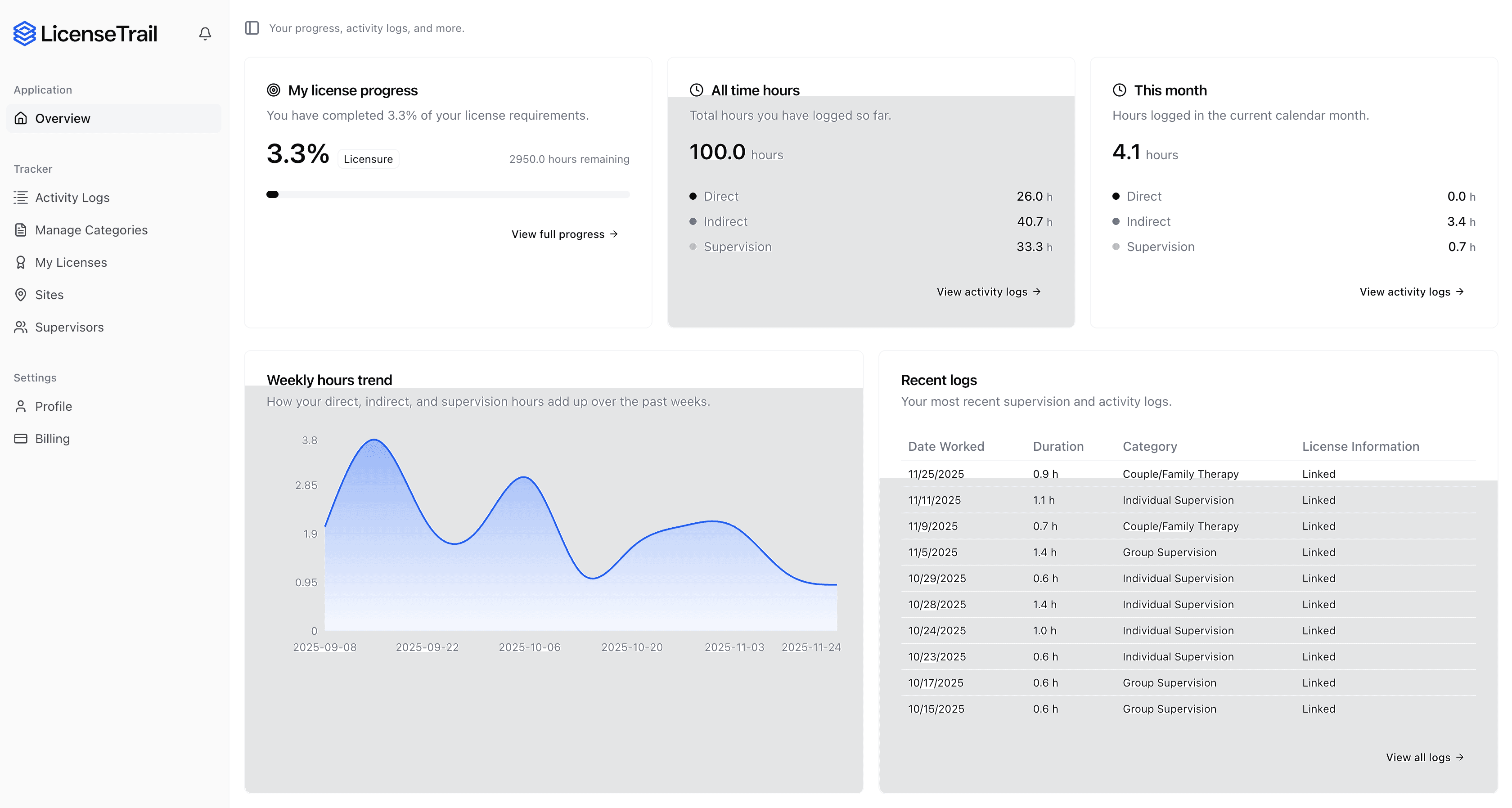
License Trail checks your direct, indirect, and supervision hours against Kansas LCAC requirements continuously and flags mismatches before you submit.
 Start Tracking for Free
No credit card required · Free plan available
Related Licenses
Licensed Addiction Counselor
LAC
Licensed Behavior Analyst
LBA
Licensed Clinical Marriage and Family Therapist
LCMFT
Licensed Clinical Psychotherapist
LCP
Licensed Clinical Professional Counselor
LCPC
Licensed Marriage and Family Therapist
LMFT
Licensed Psychologist
LP
Licensed Specialist Clinical Social Worker
LSCSW
Is your spreadsheet hiding Kansas LCAC risks?
Stop guessing if your categories match Kansas Behavioral Sciences Regulatory Board requirements. License Trail checks your direct, indirect, and supervision hours continuously and flags mismatches before you submit.
Import or log
Bring your spreadsheet or start fresh
Upload your existing tracking spreadsheet and we'll map every hour into the right Kansas Behavioral Sciences Regulatory Board categories automatically.
Verify against Kansas
Catch mismatches before the board does
License Trail checks your direct, indirect, and supervision hours against Kansas LCAC requirements continuously.
Export board-ready
One-click clean reports
Generate professional, board-ready reports for supervision meetings and Kansas Behavioral Sciences Regulatory Board submissions in seconds.
No credit card required · Free plan available