
Kansas LAC Requirements: Hours, Exams & Step-by-Step Guide
Stop guessing if your categories match Kansas requirements. License Trail checks your direct, indirect, and supervision hours against LAC requirements continuously and flags mismatches before you submit.
No credit card required · Free plan available
Quick Requirements Overview
- Minimum eligibility: Age 21+ and must “merit the public trust” (BSRB/KS statute).
- Education pathway (common): Bachelor’s degree (board‑approved) plus 30 semester hours (or equivalent) of substance use disorder coursework across required content areas.
- Practicum (embedded in education): 6 semester credit hours practicum including ≥400 clock hours of practice.
- Practicum supervision: 1 hour supervision per 10 hours of practice; supervision by faculty/agency with ≥1 behavioral sciences‑licensed supervisor.
- Exam: Pass a nationally administered, standardized written exam approved by BSRB (unless reciprocity/approved prior equivalent score).
- Application/fees (noted): Submit BSRB packet + transcripts/docs; fees listed as $50 application / $150 exam / $100 initial license.
- Provisional LAC (if deficient): Up to 12 months, non‑renewable; must use “provisional” in title (cannot use LAC alone).
- Renewal/CE: 30 CE hours every 2 years, including 3 ethics and 6 SUD diagnosis/treatment hours.
License Details
Procedures
In Kansas, the Licensed Addiction Counselor (LAC) is the entry‑level state license for addiction counseling under the Behavioral Sciences Regulatory Board (BSRB). The core requirements are set out in Kansas statutes (primarily K.S.A. 65‑6610 and 65‑6621) and BSRB regulations in Article 7 (K.A.R. 102‑7‑1 through 102‑7‑12).(ksrevisor.gov)
Below is a step‑by‑step guide, with a focus on the hours and “verbiage” the Board itself uses.
1. Basic statutory eligibility for LAC
Kansas law requires that an applicant for licensure as an addiction counselor (LAC):
-
Be at least 21 years of age.
“Has attained 21 years of age” (K.S.A. 65‑6610(a)(1)).(ksrevisor.gov)
-
Meet specific education criteria (discussed in detail in Section 2 below). The statute describes alternative educational paths (baccalaureate degree in addiction counseling, related degrees with specified coursework, or certain existing Kansas licenses).(ksrevisor.gov)
-
Pass a Board‑approved examination.
Each applicant “shall be required to pass a nationally administered, standardized written examination approved by the board,” unless qualifying for a reciprocity route.(law.cornell.edu) -
“Merit the public trust.”
The statute requires that the applicant “has satisfied the board that the applicant is a person who merits the public trust.” (K.S.A. 65‑6610(a)(4)).(ksrevisor.gov) -
Pay required fees.
- Application, exam, and license fees are set by regulation (K.A.R. 102‑7‑2) and summarized on the BSRB site as:
• Application fee: $50
• Examination: $150
• Original LAC license fee: $100(ksbsrb.ks.gov)
- Application, exam, and license fees are set by regulation (K.A.R. 102‑7‑2) and summarized on the BSRB site as:
2. Educational routes to LAC and required coursework hours
Kansas allows several pathways to meet the education requirement for LAC, all of which are fleshed out in K.S.A. 65‑6610(a)(2) and K.A.R. 102‑7‑3.(ksrevisor.gov)
2.1. Core bachelor’s‑level routes
Under K.S.A. 65‑6610(a)(2), you may qualify for LAC by meeting one of these:
-
Baccalaureate degree in addiction counseling
- “Has completed at least a baccalaureate degree from an addiction counseling program that is part of a college or university approved by the board.”(ksrevisor.gov)
-
Baccalaureate degree in another field plus addiction‑specific coursework
- “Has completed at least a baccalaureate degree from a college or university approved by the board” and, as part of or in addition to that degree, completes “a minimum number of semester hours of coursework on substance use disorders as approved by the board.”(ksrevisor.gov)
- K.A.R. 102‑7‑3 then specifies that this must include at least 30 semester hours (or academic equivalent) in coursework on substance use disorders, distributed across defined content areas (introduction to addiction, individual counseling methods, group methods, pharmacology, co‑occurring disorders, etc.).(law.cornell.edu)
-
Licensed Baccalaureate Social Worker (LBSW) route
- The statute allows applicants “currently licensed in Kansas as a licensed baccalaureate social worker” who have completed “a minimum number of semester hours of coursework on substance use disorders as approved by the board.”(ksrevisor.gov)
- K.A.R. 102‑7‑3(d) adds that to qualify via this route, an LBSW must complete at least the coursework specified in paragraphs (c)(1), (4), and (9): introduction to addiction, addiction pharmacology, and the practicum requirement (discussed below).(law.cornell.edu)
-
Existing Kansas license at a higher level
- Individuals already licensed by BSRB as an LMSW, LSCSW, LPC, LCPC, LMFT, LCMT, LMLP, clinical psychotherapist, or psychologist are statutorily eligible to take the LAC exam (65‑6610(a)(2)(D)).(ksrevisor.gov)
2.2. “Semester credit hour” and how it converts to clock hours
The addiction counseling regulations define a semester credit hour as “at least 13 clock‑hours of formal, didactic classroom instruction” during an academic semester, for which academic credit is awarded.(sos.ks.gov)
That definition is key when interpreting the hour counts in practicum requirements.
3. Practicum and supervision hours embedded in the degree
Even though LAC itself does not have a separate, post‑degree supervised experience requirement (those large post‑graduate hour totals apply to the clinical addiction counselor level), Kansas does require a substantial practicum within your qualifying addiction‑counseling coursework.
3.1. Bachelor’s‑level practicum requirement (for LAC)
For the undergraduate route, K.A.R. 102‑7‑3(c)(9) requires at least six semester credit hours (or equivalent) of practicum that must include:(law.cornell.edu)
- At least 400 clock‑hours of practice.
- Supervision ratio: At least one hour of supervision for every 10 hours of practice.
- Supervisors: Supervision must be provided by the education program’s faculty and agency staff, with at least one supervisor licensed in the behavioral sciences.
In plain terms, for a standard LAC‑qualifying bachelor’s path you are expected to complete:
- 400+ hours of hands‑on addiction counseling practice in your practicum; and
- 40+ hours of supervision tied directly to that practicum (because of the 1:10 supervision ratio).
These hours are educational/practicum hours, not post‑licensure work experience.
3.2. Master’s‑level practicum (relevant if you later pursue LMAC/LCAC)
The master’s‑level addiction counseling or related graduate programs that feed into the Licensed Master’s Addiction Counselor (LMAC) and Licensed Clinical Addiction Counselor (LCAC) have their own practicum requirements (K.A.R. 102‑7‑3(f)(8)):(law.cornell.edu)
- At least 300 hours of client contact, and
- At least one hour of supervision for every 10 hours of client contact, provided by faculty and agency supervisors, with at least one supervisor licensed at or above the level being pursued.
Again, these are graduate practicum hours, distinct from the later, post‑graduate supervised experience required only for LCAC.
4. Examination requirements for LAC
K.A.R. 102‑7‑5 governs the examination:(law.cornell.edu)
-
Who must test:
“Each applicant for licensure as an addiction counselor who does not meet the requirements of K.A.R. 102‑7‑4b [reciprocity] shall be required to pass a nationally administered, standardized written examination approved by the board.” -
When you may register:
You cannot be authorized to register until you are within four months of anticipated completion of your degree and the Board is satisfied you “merit the public trust.” -
Exam waiver:
The Board may waive the Kansas exam if you previously obtained a passing score on a nationally administered exam that the Board deems “substantially equivalent” to the Kansas exam.
The Board’s website indicates a current exam fee of $150 and handles exam registration through the LAC Application Packet.(ksbsrb.ks.gov)
5. Application, fees, and provisional LAC
5.1. Standard application and fees
For a straightforward, by‑examination applicant:
- Request and complete the LAC Application Packet from BSRB.(ksbsrb.ks.gov)
- Submit:
- Completed application form
- Official transcripts showing your degree and required addiction‑counseling coursework
- Any practicum documentation required by the Board
- Application fee (currently $50)
- Take and pass the exam (exam fee $150).
- Once the Board confirms you have met all education, exam, and character requirements, you pay the original LAC license fee of $100 and receive your license.(ksbsrb.ks.gov)
5.2. Provisional licensure as an addiction counselor (if you are deficient)
If, when evaluating your file, the Board finds deficiencies in your qualifications or in the quality of your educational experience compared to the requirements in K.S.A. 65‑6610 or rules and regulations, the Board may require you to complete remedial work.(ksrevisor.gov)
- Under K.S.A. 65‑6621, a person completing those remedial requirements may apply for provisional licensure as an addiction counselor.
- The provisional license:
- Is issued for up to 12 months and automatically ends when your full license is issued or denied.
- Cannot be renewed and cannot be reissued for the same license level on a later application.
- May not be used with the full “licensed” titles—under subsection (c), you may not use “LAC,” “LMAC,” or “LCAC” by themselves; the word licensed may be used only when preceded by provisional.(ksrevisor.gov)
6. Required hours after you become an LAC
6.1. Continuing education hours (for license renewal)
Once licensed, you must maintain your LAC via continuing education (CE).
While K.A.R. 102‑7‑9 contains the official CE rule text, CE‑oriented summaries that track the rule state that LACs (and LCACs/LMACs) must complete:(netce.com)
- 30 hours of continuing education every 2 years, including:
- At least 3 hours in ethics, and
- At least 6 hours in the diagnosis and treatment of substance use disorders.
Online/self‑study hours are generally allowed, subject to limits the Board may specify in or under K.A.R. 102‑7‑9.
6.2. No separate post‑graduate supervised‑experience hour requirement at the LAC level
Important clarification:
For LAC (non‑master’s, non‑clinical), Kansas does not require a specified number of post‑degree supervised practice hours prior to initial licensure. Once you meet the degree + coursework + practicum + exam requirements, you can be licensed as an LAC.
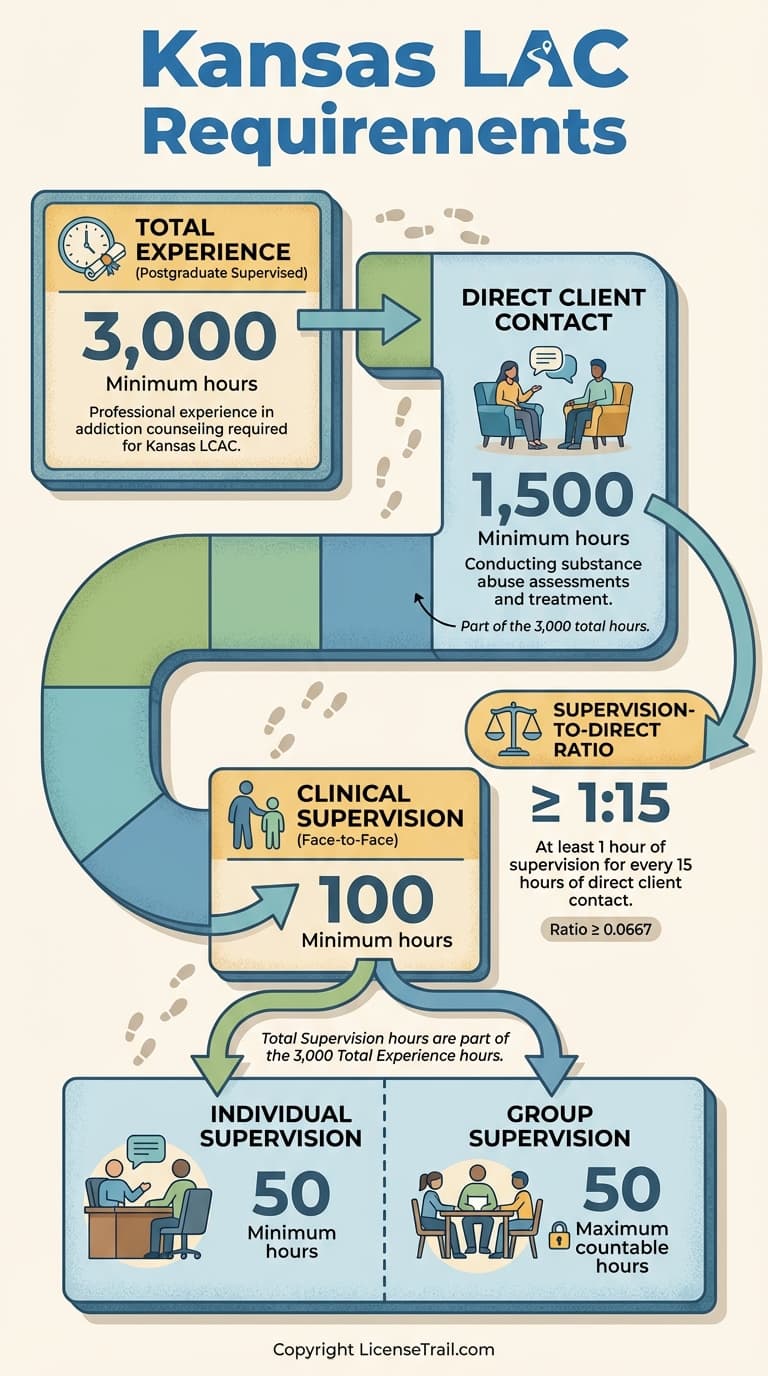
The large “3,000 hours / 1,500 direct hours” requirement that people often mention applies only to the Licensed Clinical Addiction Counselor (LCAC) level, not to the basic LAC license.
7. How the big hour requirement (3,000 hours / 1,500 direct) fits in
Because your question uses an example like “1,500 hours of direct experience and 1,500 hours of supervised experience,” it is worth tying that directly to the Kansas Board’s wording for clinical licensure.
For LCAC, Kansas law and regulations state that an applicant must complete at least two years of postgraduate supervised professional experience under a Board‑approved clinical supervision plan, consisting of:(ksrevisor.gov)
- 3,000 hours of supervised professional experience in addiction counseling, including:
- At least 1,500 hours of direct client contact conducting substance abuse assessments and treatment with individuals, couples, families, or groups.
- Clinical supervision requirement (K.A.R. 102‑7‑6):
- One hour of clinical supervision for each 15 hours of direct client contact.
- Within that supervision:
- At least 50 hours of individual clinical supervision with the supervisor and supervisee;
- Up to 50 hours of group clinical supervision (one supervisor, no more than six supervisees);
- Supervision must occur at least twice per month, with at least one individual session each month, and is expected to be face‑to‑face (in person or secure synchronous video) unless the Board approves extenuating circumstances.(sos.ks.gov)
Those 3,000 hours (with the 1,500 direct‑contact subset and formal supervision) are not part of becoming an LAC; they are the postgraduate experience you complete after your qualifying master’s education if you later seek LCAC.
8. Condensed checklist – becoming an LAC in Kansas
Putting it all together:
-
Confirm basic eligibility
- Age 21+ and capable of “meriting the public trust.”(ksrevisor.gov)
-
Complete an approved educational path
- Baccalaureate degree from a Board‑approved program (addiction counseling or another field) that includes:
- At least 30 semester hours of addiction‑related coursework distributed across specified content areas; and
- At least 6 credit hours of practicum including
• 400+ clock hours of practice, and
• 1 hour of supervision per 10 hours of practice, with required faculty/agency supervision.(law.cornell.edu)
- Or qualify through LBSW or another existing BSRB license plus the specified addiction‑counseling coursework.
- Baccalaureate degree from a Board‑approved program (addiction counseling or another field) that includes:
-
Complete practicum and have transcripts sent to BSRB.
-
Apply to BSRB for LAC
- Submit LAC Application Packet, transcripts, and fees (currently $50 application fee).(ksbsrb.ks.gov)
-
Take and pass the Board‑approved national exam
- Register only once you are within four months of finishing your degree and the Board has cleared you to sit (exam fee currently $150).(law.cornell.edu)
-
Receive your LAC
- After passing the exam and meeting all requirements, pay the original license fee (currently $100) and receive your LAC.(ksbsrb.ks.gov)
-
Maintain the license
- Every two years, complete 30 CE hours, including 3 ethics hours and 6 hours in diagnosis and treatment of substance use disorders, and renew with BSRB.(netce.com)
This framework captures both the hour‑based requirements (400 practicum hours + supervision hours for LAC; 3,000/1,500 + supervision structure for LCAC) and the key statutory “verbiage” the Kansas Behavioral Sciences Regulatory Board relies on.
Track your LAC hours with confidence
License Trail checks your direct, indirect, and supervision hours against Kansas LAC requirements continuously and flags mismatches before you submit.
 Start Tracking for Free
No credit card required · Free plan available
Related Licenses
Licensed Behavior Analyst
LBA
Licensed Clinical Addiction Counselor
LCAC
Licensed Clinical Marriage and Family Therapist
LCMFT
Licensed Clinical Psychotherapist
LCP
Licensed Clinical Professional Counselor
LCPC
Licensed Marriage and Family Therapist
LMFT
Licensed Psychologist
LP
Licensed Specialist Clinical Social Worker
LSCSW
Is your spreadsheet hiding Kansas LAC risks?
Stop guessing if your categories match Kansas Behavioral Sciences Regulatory Board requirements. License Trail checks your direct, indirect, and supervision hours continuously and flags mismatches before you submit.
Import or log
Bring your spreadsheet or start fresh
Upload your existing tracking spreadsheet and we'll map every hour into the right Kansas Behavioral Sciences Regulatory Board categories automatically.
Verify against Kansas
Catch mismatches before the board does
License Trail checks your direct, indirect, and supervision hours against Kansas LAC requirements continuously.
Export board-ready
One-click clean reports
Generate professional, board-ready reports for supervision meetings and Kansas Behavioral Sciences Regulatory Board submissions in seconds.
No credit card required · Free plan available