
Kansas LBA Requirements: Hours, Exams & Step-by-Step Guide
Stop guessing if your categories match Kansas requirements. License Trail checks your direct, indirect, and supervision hours against LBA requirements continuously and flags mismatches before you submit.
No credit card required · Free plan available
Quick Requirements Overview
- Must meet national certifying entity requirements (typically BACB/BCBA) before KS will license; BSRB won’t issue LBA without proof of certification eligibility/certification
- KS does not set its own hour totals or “direct vs supervised” split; it defers to BACB (or BSRB‑approved equivalent) training/fieldwork standards
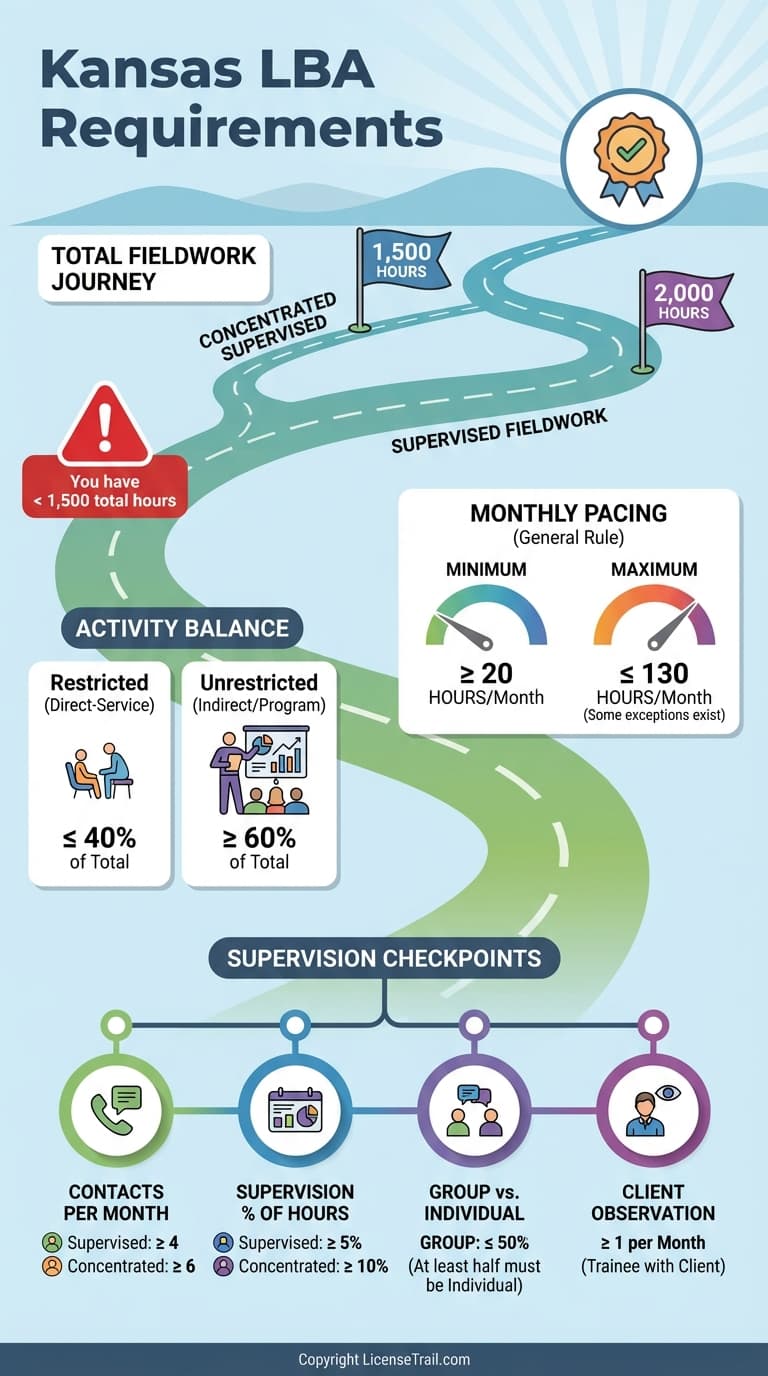
- BACB fieldwork (commonly used): 2,000 Supervised Fieldwork or 1,500 Concentrated Supervised Fieldwork
- BACB supervision intensity (by pathway): ≥5% supervised/month (2,000 route) or ≥10% supervised/month (1,500 route)
- Apply to KS BSRB: submit application + fee; provide proof of meeting certification requirements; send official graduate transcripts directly to BSRB (school or certifying entity)
- No additional KS exam beyond the national certification exam (per provided text)
- Renewal: biennial; 30 CE hours/2 years, including ≥4 ethics hours
License Details
Procedures
Licensure as a Licensed Behavior Analyst (LBA) in Kansas is built around two layers of requirements:
- Meeting all national certification requirements for a behavior analyst (through the “certifying entity,” i.e., the Behavior Analyst Certification Board, BACB).
- Submitting those credentials to the Kansas Behavioral Sciences Regulatory Board (BSRB) and satisfying its administrative requirements for state licensure.
Kansas law itself does not prescribe a specific number of “direct” vs “supervised” hours (e.g., “1,500 direct + 1,500 supervised”). Instead, it requires you to meet whatever supervised fieldwork/experience requirements are set by the BACB or another board-approved certifying entity. (ksrevisor.gov)
Below is a step‑by‑step guide, with the Kansas statutory and regulatory language highlighted where it affects hours and experience.
1. How Kansas Defines an LBA and the “Certifying Entity”
Kansas statutes define key terms for the Applied Behavior Analysis Licensure Act:
- A “licensed behavior analyst” or “LBA” is “an individual who is certified by the certifying entity as a certified behavior analyst and meets the licensing criteria as established by the board by rules and regulations.” (ksrevisor.gov)
- The “certifying entity” is “the national accredited behavior analyst certification board or other equivalent nationally accredited nongovernmental agency approved by the behavioral sciences regulatory board,” which certifies individuals who have completed academic, examination, training, and supervision requirements in applied behavior analysis. (ksrevisor.gov)
In practice, this “certifying entity” is the Behavior Analyst Certification Board (BACB).
Kansas also makes clear that the BSRB cannot issue a license until you have met the certifying entity’s requirements:
The board shall not issue a license under this act until the license applicant provides proof that such applicant has met the certification requirements of a certifying entity. (ksrevisor.gov)
2. Education and Certification Prerequisites
2.1 Graduate education
To become BACB‑certified (BCBA), and therefore eligible for Kansas LBA licensure, you must hold at least a master’s degree in behavior analysis, education, psychology, or a closely related field, with a BACB‑approved course sequence. Contemporary summaries of BCBA requirements and Kansas‑specific guidance describe this as the baseline education for practice in Kansas. (appliedbehavioranalysisedu.org)
Kansas regulations then require, at the application stage, that your graduate transcripts be sent directly to the BSRB:
- Applicants for behavior analyst licensure must:
- Submit the application fee (per K.A.R. 102‑8‑2),
- Submit proof that they have met the requirements for certification to practice applied behavior analysis, and
- Arrange for official transcripts for the required graduate degree to be sent directly to the board (either from the academic institution or via the certifying entity). (law.cornell.edu)
2.2 BACB certification as the substantive requirement
Kansas and professional licensure disclosures summarize the state’s stance as:
- Minimum educational pre‑requisite for a Kansas Behavior Analyst license: current BACB certification.
- Postgraduate training or work experience required by Kansas beyond BACB: none.
- Additional state exam beyond the BCBA exam: none. (waldenu.edu)
So the substantive “experience-hour” requirement for Kansas LBA licensure is whatever the BACB currently requires for BCBA certification.
3. Experience-Hour Requirements (Via BACB Fieldwork)
3.1 Overall fieldwork hours
Under current BACB rules (2024–2025), BCBA candidates—and therefore Kansas LBA candidates—must complete:
- Option 1 – Supervised Fieldwork:
- 2,000 total hours of supervised fieldwork, OR
- Option 2 – Concentrated Supervised Fieldwork:
- 1,500 total hours of concentrated supervised fieldwork. (studocu.com)
These totals are fieldwork hours, not separated by Kansas into “direct” vs “supervised” hour buckets. Instead, BACB rules distinguish between independent hours and supervised hours within that overall total.
3.2 Monthly structure and supervision percentages
Key BACB parameters for those hours (which Kansas effectively adopts by requiring BACB certification) include:
- Fieldwork must be accrued at no fewer than 20 and no more than 130 hours per month. (studocu.com)
- You must complete all required hours within five consecutive years from the onset of fieldwork. (studocu.com)
- Supervision intensity differs by fieldwork type:
- Supervised Fieldwork (2,000 hours): at least 5% of the hours each month must be supervised (directly involving your supervisor). (sidekicklearning.net)
- Concentrated Supervised Fieldwork (1,500 hours): at least 10% of the hours each month must be supervised. (sidekicklearning.net)
- You must have a minimum number of supervisor contacts and client observations per month (e.g., multiple supervision contacts and at least one client observation), and at least 50% of supervised time must be individual (not group). (sidekicklearning.net)
3.3 Types of activities counted toward hours
BACB distinguishes:
- Independent (unsupervised) fieldwork hours – typically include:
- Conducting behavior assessments,
- Designing and revising behavior intervention plans,
- Collecting and analyzing data,
- Training caregivers or staff,
- Writing behavior‑analytic reports.
- Supervised fieldwork hours – portions of time when:
- Your supervisor is present (in person or via synchronous video) observing your work,
- You receive feedback, case review, or instruction tied directly to your fieldwork activities.
BACB requires that at least 60% of total fieldwork hours be spent in “unrestricted activities” (the higher‑level analytic and supervisory tasks, not just implementing basic programming). (studocu.com)
Kansas law does not alter these categories; it simply requires that you satisfy them and then document that you have done so.
3.4 No Kansas‑specific numeric hour split
There is no Kansas statute or regulation stating something like “1,500 hours of direct experience and 1,500 hours of supervised experience.” Instead, Kansas:
- Defines LBAs as those “certified by the certifying entity” and
- Requires proof that you “have met the certification requirements” of that entity before issuing a license. (ksrevisor.gov)
So the only binding numbers for total and supervised hours are the BACB’s 2,000 vs 1,500 fieldwork totals and associated supervision percentages, as summarized above.
4. Kansas BSRB Application Process (After You Meet BACB Requirements)
Once you have:
- Completed your BACB‑required fieldwork (2,000 or 1,500 hours, depending on pathway),
- Passed the BCBA exam, and
- Been granted BCBA certification,
you then apply to the Kansas Behavioral Sciences Regulatory Board for LBA licensure.
4.1 Application elements required by regulation
Under K.A.R. 102‑8‑4, an applicant for licensure as a behavior analyst must: (law.cornell.edu)
- Request and complete the appropriate BSRB application forms.
- Submit the application fee specified in K.A.R. 102‑8‑2.
- Submit proof of certification requirements:
- Provide proof that you “have met the requirements for certification to practice applied behavior analysis.”
- In practice this is documentation of your current BCBA certification (or equivalent from another approved certifying entity).
- Arrange for graduate transcripts:
- Have official transcripts covering all applicable coursework, including the required graduate degree, sent directly to the BSRB by each academic institution or by the certifying entity.
- Once the BSRB determines that you’ve met all statutory and regulatory requirements and you pay the initial license fee, the board issues the LBA license. (law.cornell.edu)
Secondary summaries of BSRB practice note that the application typically also includes: identity information, a professional/disciplinary history questionnaire, proof of any out‑of‑state licenses, and an attestation that you are familiar with Kansas ABA statutes and regulations. (appliedbehavioranalysisedu.org)
5. After Licensure: Renewal and Continuing Education
Once you are licensed as an LBA in Kansas:
- License term: LBA licenses are issued for two years (24 months). (appliedbehavioranalysisedu.org)
- Renewal CE requirement: K.A.R. 102‑8‑9 requires each licensed behavior analyst to complete 30 hours of documented and approved continuing education during each two‑year renewal period. (law.cornell.edu)
- Of those 30 hours, at least 4 hours must be in professional ethics. (law.cornell.edu)
The CE requirement is ongoing; it is separate from, and in addition to, the pre‑licensure fieldwork hours required by BACB.
6. Key Kansas Verbiage Related to Experience and Certification
For clarity, these are the core Kansas phrases that control LBA experience requirements (paraphrased with close tracking to the statutory language):
-
Definition of certifying entity:
The “certifying entity” is the nationally accredited behavior analyst certification board (or other equivalent nationally accredited non‑governmental agency approved by the BSRB) that certifies individuals who have completed academic, examination, training, and supervision requirements in applied behavior analysis. (ksrevisor.gov) -
Definition of LBA:
An LBA is “an individual who is certified by the certifying entity as a certified behavior analyst and meets the licensing criteria as established by the board by rules and regulations.” (ksrevisor.gov) -
Condition for issuing a license:
The board “shall not issue a license under this act until the license applicant provides proof that [they have] met the certification requirements of a certifying entity.” (ksrevisor.gov) -
Application regulation (experience proof):
Each applicant must “submit proof that the applicant has met the requirements for certification to practice applied behavior analysis” at the behavior analyst level. (law.cornell.edu)
Taken together, these provisions mean:
- Kansas does not set its own numeric “experience hour” minimums in statute or regulation.
- Instead, meeting BACB (or equivalent) supervised fieldwork and experience standards—currently 2,000 supervised fieldwork hours or 1,500 concentrated supervised fieldwork hours with the specified supervision percentages—is the operative requirement for Kansas LBA licensure. (studocu.com)
Track your LBA hours with confidence
License Trail checks your direct, indirect, and supervision hours against Kansas LBA requirements continuously and flags mismatches before you submit.
 Start Tracking for Free
No credit card required · Free plan available
Related Licenses
Licensed Addiction Counselor
LAC
Licensed Clinical Addiction Counselor
LCAC
Licensed Clinical Marriage and Family Therapist
LCMFT
Licensed Clinical Psychotherapist
LCP
Licensed Clinical Professional Counselor
LCPC
Licensed Marriage and Family Therapist
LMFT
Licensed Psychologist
LP
Licensed Specialist Clinical Social Worker
LSCSW
Is your spreadsheet hiding Kansas LBA risks?
Stop guessing if your categories match Kansas Behavioral Sciences Regulatory Board requirements. License Trail checks your direct, indirect, and supervision hours continuously and flags mismatches before you submit.
Import or log
Bring your spreadsheet or start fresh
Upload your existing tracking spreadsheet and we'll map every hour into the right Kansas Behavioral Sciences Regulatory Board categories automatically.
Verify against Kansas
Catch mismatches before the board does
License Trail checks your direct, indirect, and supervision hours against Kansas LBA requirements continuously.
Export board-ready
One-click clean reports
Generate professional, board-ready reports for supervision meetings and Kansas Behavioral Sciences Regulatory Board submissions in seconds.
No credit card required · Free plan available