
Kansas LP Requirements: Hours, Exams & Step-by-Step Guide
Stop guessing if your categories match Kansas requirements. License Trail checks your direct, indirect, and supervision hours against LP requirements continuously and flags mismatches before you submit.
No credit card required · Free plan available
Quick Requirements Overview
- Governing body: Kansas Behavioral Sciences Regulatory Board (BSRB)
- Eligibility baseline: Age 21+, good moral character, doctoral degree in psychology (APA-accredited or meets K.A.R. 102-1-12 equivalency)
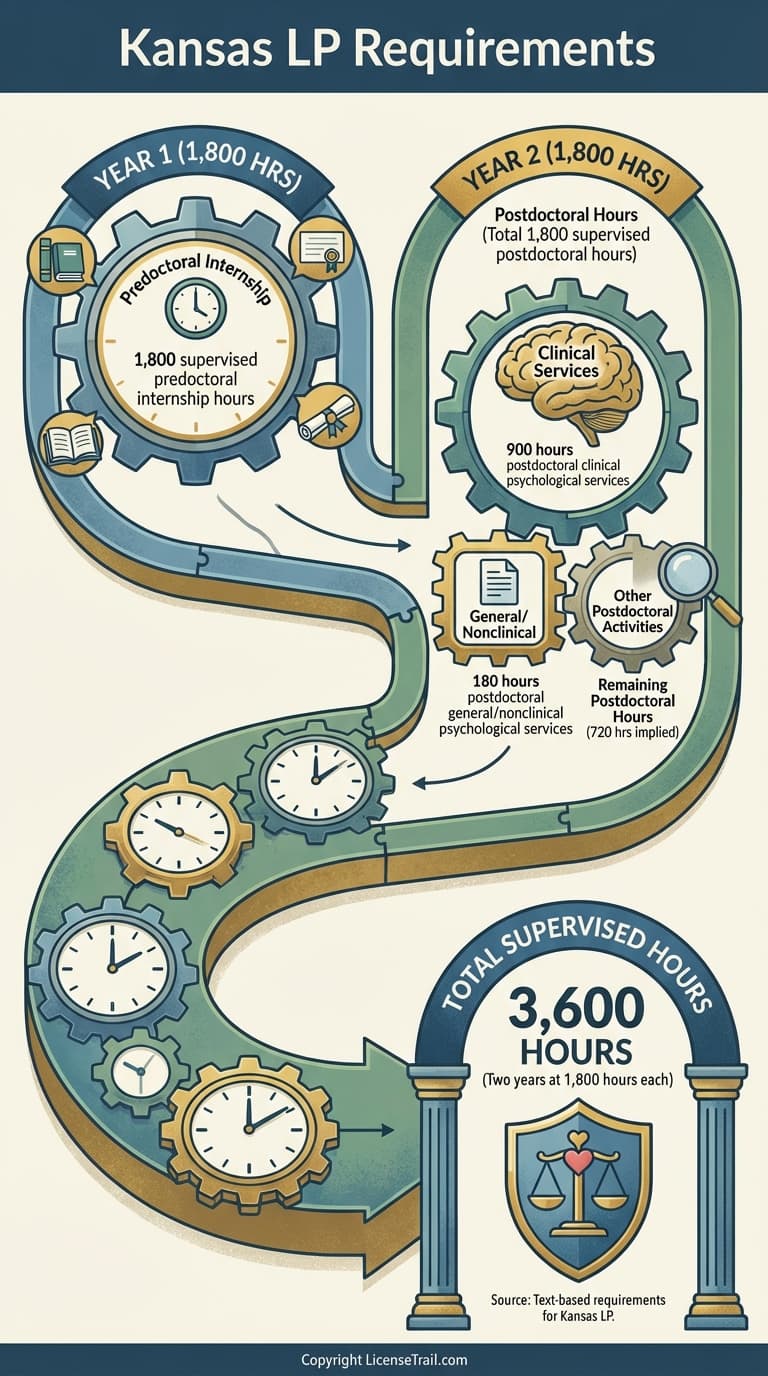
- Supervised experience total: 2 years = 3,600+ clock-hours (Kansas defines 1 year as 1,800+ hours)
- Predoctoral requirement: Doctoral internship = 1,800+ hours (1 full-time year or 2 half-time years) with required supervision ratios
- Postdoctoral requirement: At least 1 postdoc year = 1,800+ hours
- Postdoc hour mix (per year): ≥900 hours clinical psychological services + ≥180 hours general/nonclinical psychological services
- Postdoc supervision ratio: ≥1 hour individual clinical supervision per 20 hours direct client contact; supervisor must be doctoral-level licensed psychologist (≥2 years post-licensure)
- Exams/maintenance: Pass EPPP (≥70%); renew with 50 CE hours/2 years (incl. 3 ethics + 6 diagnosis/treatment)
License Details
Procedures
Licensure as a Licensed Psychologist (LP) in Kansas is governed by the Behavioral Sciences Regulatory Board (BSRB) through both statute and administrative regulations. The state defines supervised “years,” internship structure, and the mix of clinical and nonclinical hours quite specifically, even though it does not use the simple “X direct hours + Y supervised hours” formula some states use.
Below is an article‑style, step‑by‑step outline of what Kansas requires, with emphasis on hours and the Board’s own terminology.
1. Statutory baseline for LP licensure in Kansas
Under K.S.A. 74‑5310, the BSRB may issue a license as a psychologist to an applicant who: (ksrevisor.gov)
- Is at least 21 years old.
- “Merits the public trust” (good moral character).
- Has earned a doctoral degree “based on a program of studies in content primarily psychological” from a graduate institution with standards like Kansas state universities (or a substantial equivalent).
- Has completed at least two years of supervised experience, with a significant portion spent providing psychological services.
The specific hour requirements and what counts toward those two years are spelled out in regulations.
2. How Kansas defines a “year” and the total supervised hours
Kansas explicitly defines a “year of supervised experience” in its psychology regulations:
- A year of supervised experience means at least 1,800 clock‑hours of supervised experience that meets the Board’s supervision rules. (sos.ks.gov)
Because the BSRB requires two years of supervised experience for licensure, the minimum total is:
At least 3,600 clock‑hours of supervised experience (2 years × 1,800 hours).
Those two years are divided into:
- One year of predoctoral supervised experience (typically the doctoral internship); and
- At least one year of postdoctoral supervised experience, unless you use the special route for adding a new emphasis area described in 102‑1‑5a(b)(2). (regulations.justia.com)
3. Educational requirements and the internship year
3.1 Doctoral program requirements
Kansas recognizes two main paths for the doctoral degree: (law.cornell.edu)
- APA‑accredited doctoral program in psychology – If your program was accredited by the American Psychological Association when you graduated, it is deemed to meet the “content primarily psychological” requirement, assuming it includes certain in‑residence coursework.
- Non‑APA programs – Must meet detailed criteria in K.A.R. 102‑1‑12, including:
- At least three full‑time academic years of graduate study, with at least two years at the degree‑granting institution and at least two consecutive semesters in residence.
- A minimum of 90 semester credits of graduate‑level psychology, with extensive specified coursework in:
- Breadth of scientific psychology;
- Foundations of practice;
- Assessment and intervention (at least 24 semester credits in this last area, most in residence).
3.2 Predoctoral internship: hours and structure
Except for industrial/organizational psychology programs, Kansas requires a formal doctoral internship that: (law.cornell.edu)
- Consists of at least 1,800 hours over:
- One year of full‑time training; or
- Two consecutive years of half‑time training.
- Occurs after completion of all graduate coursework other than dissertation credits.
- Provides:
- A wide range of professional activities (diagnosis, treatment, consultation, etc.);
- A diverse client population;
- At least 4 hours of general training supervision for each 40 hours of training, including at least 1 hour of individual clinical supervision for every 10 hours of direct client contact.
Functionally, this 1,800‑hour internship is your “year of predoctoral supervised experience” for licensure, as long as it meets all of the internship criteria.
4. Postdoctoral supervised experience: hours, type of work, and supervision
4.1 Required years and hours
Regulation 102‑1‑5a requires: (regulations.justia.com)
- Two years of supervised experience in the practice of psychology.
- One year may be fulfilled by the qualifying predoctoral internship.
- At least one full year must be completed postdoctorally.
Because a “year of supervised experience” is defined as at least 1,800 clock‑hours, that means you must accumulate:
- Minimum 1,800 hours predoctoral (internship) +
- Minimum 1,800 hours postdoctoral =
- At least 3,600 hours total supervised experience across pre‑ and post‑doctoral periods.
4.2 Required mix of clinical and general/nonclinical work in the postdoc year(s)
Within each postdoctoral supervised year, the regulations further specify how your time must be allocated: (regulations.justia.com)
- At least 900 hours per year must be spent providing clinical psychological services.
- At least 180 hours per year must be spent providing general or nonclinical psychological services.
The Board defines these terms:
- “Clinical psychological services” include applying psychological principles to assess and treat individuals or groups with maladaptive emotions or behaviors (e.g., psychological assessment, psychotherapy, other clinical applications). (sos.ks.gov)
- “Nonclinical, general psychological services” include applied research, program evaluation, consultation, psychological supervision, teaching psychology relevant to clinical practice, and psychological testing that is not part of direct clinical treatment. (sos.ks.gov)
In practice, this means:
- Per supervised postdoctoral year (minimum 1,800 hours):
- ≥ 900 hours = direct clinical practice (assessment, therapy, etc.).
- ≥ 180 hours = research, teaching, consultation, testing, or other general psychological work.
- The remaining hours (up to the 1,800+ total) can be made up of a mix of additional clinical, general, or related supervised activities, meetings, documentation, etc., as allowed by the Board.
4.3 Supervision ratios during the postdoc
For postdoctoral supervised experience, the Board requires: (regulations.justia.com)
- At least 1 hour of individual clinical supervision for every 20 hours of direct client contact.
- Supervision must involve face‑to‑face (in person or secure televideo) discussion, observation, and review of documentation; phone may be allowed only under board‑approved extenuating circumstances.
Supervisors must be: (regulations.justia.com)
- Licensed at the doctoral level in psychology.
- For postdoc supervision, at least two years past doctoral licensure with clinical practice experience.
- In a position to oversee your work meaningfully (either employed in or formally authorized by your practice setting).
5. Putting the supervised‑experience pieces together
Minimum supervised‑experience profile for licensure
If you follow the usual clinical/counseling/school path:
-
Predoctoral internship (meets predoctoral supervised year):
- 1,800+ supervised hours, with substantial direct client contact and required supervision ratios. (law.cornell.edu)
-
Postdoctoral supervised experience (at least one year):
- 1,800+ supervised hours, including:
- ≥ 900 hours clinical psychological services;
- ≥ 180 hours general/nonclinical psychological services;
- supervision at 1 hr individual supervision per 20 hrs direct client contact. (regulations.justia.com)
- 1,800+ supervised hours, including:
Statewide minimums in hour terms:
- Total supervised experience:
- ≥ 3,600 clock‑hours over at least two years.
- Within at least one postdoctoral year (1,800 hours):
- ≥ 900 hours clinical + ≥ 180 hours general/nonclinical.
The regulations do not label a certain subset simply as “direct client hours” in a numeric total, but the “clinical psychological services” requirement effectively functions as a direct‑service minimum.
6. Applying for licensure: timing, temporary license, and exam
6.1 When and how to apply
Under K.A.R. 102‑1‑3a: (law.cornell.edu)
- If you have completed both the education and all supervised experience, you may apply directly:
- For LP licensure; and
- For approval to take the psychology licensure examination.
- If you have completed only the educational requirements, you may apply for a temporary license to practice psychology while you complete your postdoctoral supervised experience.
The application includes:
- Completed application form and fees (set in K.A.R. 102‑1‑13).
- Official graduate transcripts sent directly to the Board.
- Supervisor references:
- For internship: a reference from the official internship director or chair verifying internship hours and satisfactory completion.
- For postdoc: references from each supervising psychologist verifying your supervised experience, professional conduct, and fitness.
6.2 Temporary license and progress requirements
If you are still accruing postdoc hours, Kansas typically expects you to practice under a temporary license while supervised:
- You submit a temporary license request form outlining setting, supervisor qualifications, and supervision plan. (law.cornell.edu)
- Temporary licenses may be renewed once for an additional two‑year period, if you show satisfactory progress toward the required hours.
- For renewal, 102‑1‑3a expects at least 900 hours completed in two years to count as progress toward one 1,800‑hour year, or 1,800 hours completed toward two supervised years, unless the Board approves an extension for exigent circumstances. (law.cornell.edu)
6.3 Examination requirement
Kansas requires passage of a nationally administered psychology examination:
- The regulations refer to a “standard written examination” with a passing score of at least 70%. (regulations.justia.com)
- BSRB’s public materials specify this as the Examination for Professional Practice in Psychology (EPPP), a nationally standardized competency exam. (ksbsrb.ks.gov)
You must pass the EPPP (and comply with any Board‑specific procedures) before full licensure is granted.
7. After you become an LP: renewal and continuing education
Once licensed as a psychologist (LP), Kansas requires ongoing continuing education to maintain the license:
- 50 continuing‑education (CE) hours every two years for license renewal. (regulations.justia.com)
- Within those 50 hours each cycle:
- At least 3 hours must be in professional ethics; and
- At least 6 hours must be in diagnosis and treatment of mental disorders.
- Acceptable CE includes workshops, academic courses, self‑study with posttests, publications, supervision activities, and similar options, as long as content clearly relates to enhancing psychological practice.
Renewal also requires the standard renewal form and fee under K.A.R. 102‑1‑8 and K.A.R. 102‑1‑13. (law.cornell.edu)
8. Hour requirements summarized
By regulation, Kansas effectively requires the following supervised experience for LP licensure:
-
Total supervised experience:
- 2 years of supervised experience =
- ≥ 3,600 clock‑hours (each year = ≥ 1,800 hours). (sos.ks.gov)
-
Predoctoral internship (usually year 1):
- ≥ 1,800 supervised training hours over 1 full‑time year (or 2 half‑time years), taken after most coursework is complete. (law.cornell.edu)
-
Postdoctoral supervised experience (at least year 2):
- ≥ 1,800 supervised hours, including per year:
- ≥ 900 hours clinical psychological services (direct clinical work).
- ≥ 180 hours general/nonclinical psychological services (research, teaching, consultation, testing, etc.). (regulations.justia.com)
- Supervision: at least 1 hour of individual clinical supervision for every 20 hours of direct client contact.
- ≥ 1,800 supervised hours, including per year:
Kansas structures its requirements around these two 1,800‑hour supervised years, with detailed content rules (clinical vs nonclinical) rather than a single “X direct / Y indirect” formula. The key is to document that your internship and postdoctoral work together meet:
- The 3,600‑hour minimum,
- The clinical/nonclinical hour minimums within postdoctoral practice, and
- The supervision ratios and supervisor qualifications specified in the regulations.
Track your LP hours with confidence
License Trail checks your direct, indirect, and supervision hours against Kansas LP requirements continuously and flags mismatches before you submit.
 Start Tracking for Free
No credit card required · Free plan available
Related Licenses
Licensed Addiction Counselor
LAC
Licensed Behavior Analyst
LBA
Licensed Clinical Addiction Counselor
LCAC
Licensed Clinical Marriage and Family Therapist
LCMFT
Licensed Clinical Psychotherapist
LCP
Licensed Clinical Professional Counselor
LCPC
Licensed Marriage and Family Therapist
LMFT
Licensed Specialist Clinical Social Worker
LSCSW
Is your spreadsheet hiding Kansas LP risks?
Stop guessing if your categories match Kansas Behavioral Sciences Regulatory Board requirements. License Trail checks your direct, indirect, and supervision hours continuously and flags mismatches before you submit.
Import or log
Bring your spreadsheet or start fresh
Upload your existing tracking spreadsheet and we'll map every hour into the right Kansas Behavioral Sciences Regulatory Board categories automatically.
Verify against Kansas
Catch mismatches before the board does
License Trail checks your direct, indirect, and supervision hours against Kansas LP requirements continuously.
Export board-ready
One-click clean reports
Generate professional, board-ready reports for supervision meetings and Kansas Behavioral Sciences Regulatory Board submissions in seconds.
No credit card required · Free plan available