
Kansas LCP Requirements: Hours, Exams & Step-by-Step Guide
Stop guessing if your categories match Kansas requirements. License Trail checks your direct, indirect, and supervision hours against LCP requirements continuously and flags mismatches before you submit.
No credit card required · Free plan available
Quick Requirements Overview
- Regulator: Kansas Behavioral Sciences Regulatory Board (BSRB); LCP is the independent-practice credential for master’s-level psychology
- Prerequisite: Must be licensed/eligible as LMLP (Master’s in Psychology; ≥60 graduate semester hours)
- LMLP practicum/experience: 750 hrs academically supervised practicum or 1,500 hrs postgraduate supervised work experience
- Extra LCP coursework: 15 graduate credit hours covering DSM-focused psychopathology, diagnostic assessment, referral/collaboration, treatment approaches, ethics
- LCP clinical practicum: Graduate supervised clinical practicum with ≥350 hrs direct client contact (or board-approved supplemental postgrad direct hours to reach 350)
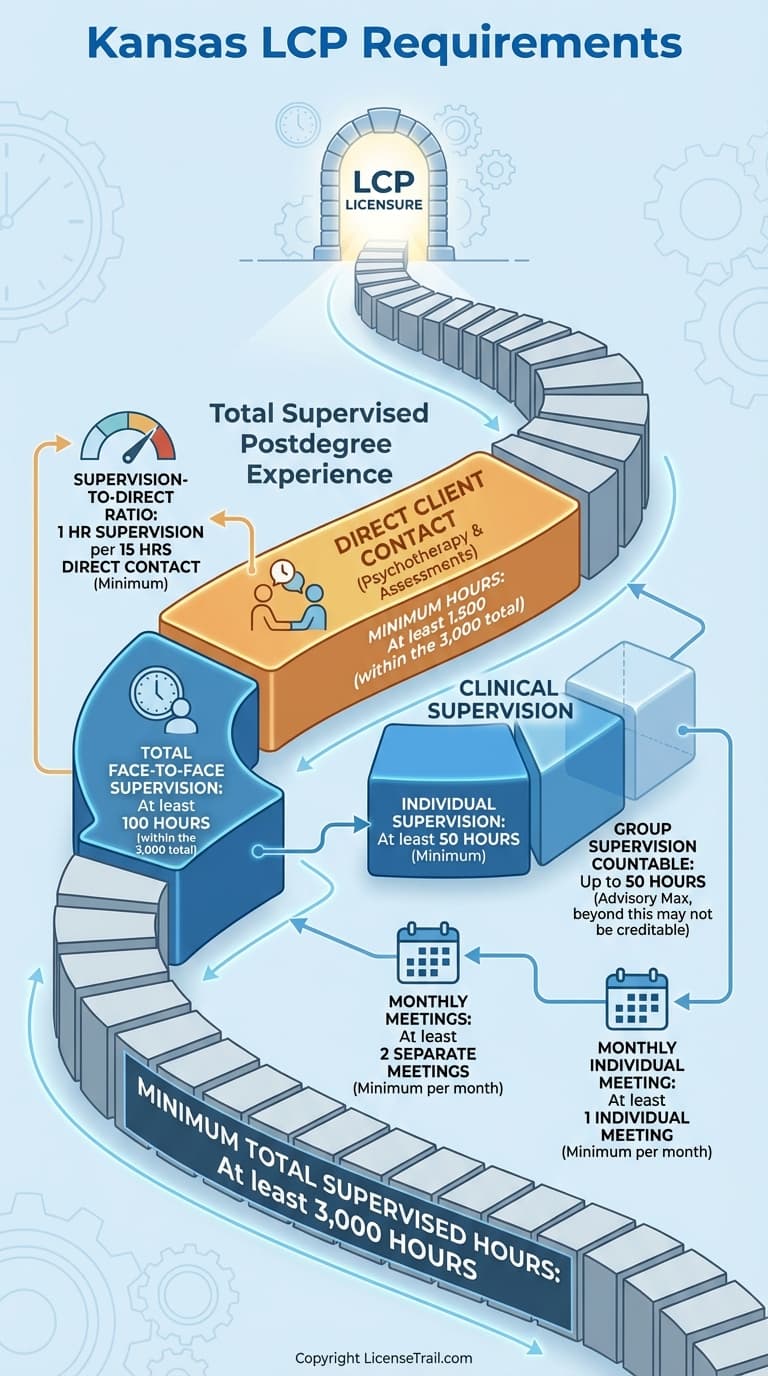
- Postgrad supervised experience (LCP): ≥2 years; 3,000 total hrs including ≥1,500 direct client hrs + ≥100 hrs face-to-face clinical supervision (≥50 individual)
- Supervision rules: Board-approved written supervision plan required before hours count; supervision ratio 1 hr per 15 direct hrs; at least 2 supervision meetings/month (≥1 individual); face-to-face in-person or secure live video
- Supervisor eligibility: Licensed psychologist or KS LCP with ≥2 years post-licensure or board-accepted equivalent; must avoid dual relationships and not be under sanction (unless waived)
License Details
Procedures
In Kansas, the Licensed Clinical Psychotherapist (LCP) credential is the independent‑practice license for master’s‑level psychologists. It is issued and regulated by the Behavioral Sciences Regulatory Board (BSRB) under the Licensure of Master’s Level Psychologists Act.(kslegislature.gov)
Below is a step‑by‑step breakdown of the requirements, with special focus on the exact types and amounts of hours the law and BSRB regulations require.
1. Baseline: Qualify as a Licensed Master’s Level Psychologist (LMLP)
You cannot become an LCP in Kansas without first being licensed (or eligible for licensure) as a Licensed Master’s Level Psychologist (LMLP). The statute explicitly requires that an LCP applicant either:
- “is licensed by the board as a licensed master’s level psychologist” or
- “meets all requirements for licensure as a master’s level psychologist.” (kslegislature.gov)
1.1 Graduate education
For the LMLP level, the statute requires:(kslegislature.gov)
- At least 60 graduate semester hours, including
- A master’s degree in psychology from a program with a graduate psychology program consistent with state universities of Kansas (or older, very specific coursework alternatives for degrees before July 1, 2003).
1.2 Foundational practicum / work‑experience hours
Before you even get to the LCP clinical requirements, you must satisfy the basic practicum/work‑experience requirement for master’s‑level psychology:
- Option A:
750 clock hours of academically supervised practicum in your master’s program; or - Option B:
1,500 clock hours of postgraduate supervised work experience. (kslegislature.gov)
This is the foundation that allows you to be licensed as an LMLP.
1.3 Exam and licensure
To be licensed as an LMLP you must also:
- Pass an examination approved by the board (minimum passing score set by BSRB),(kslegislature.gov)
- Apply on BSRB forms and pay board‑set fees.(kslegislature.gov)
Only once you meet all LMLP requirements (or their statutory equivalent) can you move to LCP.
2. Additional Clinical Coursework Required for LCP
On top of the 60 graduate hours required for LMLP, an LCP applicant must complete 15 graduate credit hours specifically focused on diagnosing and treating mental disorders using the DSM. The law says these credits must cover identifiable study in all of the following content areas:(kslegislature.gov)
- Psychopathology
- Diagnostic assessment
- Interdisciplinary referral and collaboration
- Treatment approaches
- Professional ethics
These 15 hours can be taken as part of, or in addition to, your master’s program.
3. Clinical Practicum Requirement for LCP (Direct Client Hours)
Separately from the 750/1,500 foundational hours above, LCP applicants must complete a graduate‑level supervised clinical practicum that:
- Involves psychotherapy and assessment with individuals, couples, families, or groups;
- Explicitly integrates diagnosis and treatment of mental disorders using the DSM; and
- Includes at least 350 hours of direct client contact or enough additional postgraduate supervised experience to bring your total direct client contact to not less than 350 hours.(kslegislature.gov)
In other words:
- Clinical practicum requirement:
- Minimum 350 hours of direct client contact at the practicum + any board‑approved supplemental postgraduate direct hours needed to reach 350.
4. Postgraduate Supervised Experience for LCP: The 3,000‑Hour Requirement
The heart of LCP licensure is the postgraduate supervised professional experience requirement.
4.1 Total hours, direct hours, and supervision hours
The current statute (2024 version, in force in 2025–26) requires that an LCP applicant:(kslegislature.gov)
- Has completed not less than two years of postgraduate supervised professional experience,
- Under a clinical supervision plan approved by the board,
- Consisting of at least 3,000 hours of supervised professional experience, which must include:
- At least 1,500 hours of direct client contact conducting psychotherapy and assessments with individuals, couples, families, or groups; and
- At least 100 hours of face‑to‑face clinical supervision, as defined in BSRB regulations, including at least 50 hours of individual supervision.
That means, in the clearest “hour breakdown” terms:
- 3,000 total supervised professional hours, over at least 2 years, broken down as:
- 1,500 hours = direct client contact (psychotherapy and assessment)
- 1,500 hours = other supervised professional activities in master’s‑level psychology/clinical psychotherapy (indirect services, documentation, consultation, etc.)
- Within that same period, 100 hours of clinical supervision, at least 50 individual
4.2 How BSRB regulations structure those hours
Kansas Administrative Regulation K.A.R. 102‑4‑7a (Postgraduate supervised professional work experience requirement) fills in the details the statute refers to.
It requires that all postgraduate supervised experience for LCP meet all of the following:(sos.ks.gov)
-
Supervision–to–direct‑contact ratio
- “One hour of clinical supervision shall be provided throughout the entirety of the postgraduate supervised professional experience for each 15 hours of direct client contact.”
- Practically, if you complete the minimum 1,500 direct hours, this ratio yields 100 hours of clinical supervision (1,500 ÷ 15 = 100), which matches the statutory minimum.
-
Face‑to‑face supervision requirement
- Supervision must be face‑to‑face, either:
- In person, or
- By real‑time, synchronous videoconferencing where confidentiality is protected.
- BSRB may waive face‑to‑face only in documented extenuating circumstances.
- Supervision must be face‑to‑face, either:
-
Individual vs. group supervision distribution
Within those 100+ hours of supervision, the regulation requires:- At least 50 hours of individual supervision (just you and your supervisor);
- Up to 50 hours of group supervision, with one supervisor and no more than six supervisees;
- Supervision meetings must occur at least two times per month,
- At least one of those sessions each month must be individual supervision.(sos.ks.gov)
-
Minimum duration
- The statute says you must complete the supervised experience in not less than two years. This means you cannot compress the 3,000 hours into less than two full years of supervised practice.(kslegislature.gov)
Taken together, this is the core Kansas “hours formula” for the LCP:
3,000 hours total supervised professional experience
– at least 1,500 hours direct client contact
– at least 100 hours of clinical supervision, with at least 50 individual,
over minimum 2 years and according to a board‑approved clinical supervision training plan.
5. Who Can Supervise Your LCP Hours?
K.A.R. 102‑4‑7a also spells out who may serve as your clinical supervisor for LCP‑level experience. At the time they supervise you, the supervisor must meet one of the following:(sos.ks.gov)
- Be a licensed psychologist; or
- Be a Kansas‑licensed clinical psychotherapist (LCP) who has practiced as an LCP for at least two years beyond their licensure date; or
- Be a person with qualifications substantially equivalent to Kansas LCP licensure, with at least two years of experience in practicing master’s‑level psychology beyond the date of their registration/licensure, as accepted by the board.
In addition, every clinical supervisor must:
- Have professional authority over and responsibility for your clinical functioning,
- Avoid dual relationships with you (e.g., familial, financial conflicts),
- Not be under disciplinary sanction (unless the board explicitly waives that bar), and
- Have sufficient knowledge of your client population, your methods, and your practice setting.(sos.ks.gov)
6. The Clinical Supervision Training Plan
Before any LCP supervised hours “count,” BSRB requires a written clinical supervision training plan:(sos.ks.gov)
- You and your supervisor must co‑develop and sign the plan on BSRB forms.
- The plan must be submitted to and approved by the BSRB before supervised hours begin accruing for LCP purposes.
- The plan must describe:
- Supervisory context and setting,
- Types of clients and services,
- Schedule and format of supervision (individual vs. group, in‑person vs. video),
- How you will document dates, duration, and type of each supervision session, and
- How clients will be informed that you are practicing under supervision and given the supervisor’s contact information.
If the plan changes (e.g., new supervisor, new job), amendments must be submitted; otherwise, hours may not be credited for periods where the plan is out of date.
7. How Kansas Defines Key Terms (Hours & Activities)
The Kansas regulations for master’s‑level psychologists include precise definitions that matter when counting hours and documenting duties.
7.1 Direct client contact
For master’s‑level psychology and clinical psychotherapy, “direct client contact” is defined as providing services to a client or clients in an individual, family, or group format with real‑time interaction, either:
- In person; or
- Remotely via live, two‑way, interactive audio/video where confidentiality is protected.
Importantly, email, instant messaging, texting, or fax do not count as direct client contact.(sos.ks.gov)
7.2 Clinical psychotherapy practice
The regulations define “clinical psychotherapy practice” as the independent practice of master’s‑level psychology applying psychology theory and methods to prevent and treat psychosocial dysfunction and behavioral, emotional, and mental disorders. It specifically includes:(sos.ks.gov)
- Assessment
- Diagnosis of mental disorders
- Treatment planning (including psychotherapy and counseling)
- Treatment interventions targeting interpersonal, intrapsychic, and life‑management issues
- Consultation, evaluation, referral, and collaboration
Your supervised hours toward LCP must fall within this general scope.
7.3 Postgraduate supervised professional experience
Regulations use the term “postgraduate supervised professional experience” (or “postgraduate work experience”) for the supervised master’s‑level psychology practice you complete after your qualifying degree.(sos.ks.gov)
For LCP, that postgraduate supervised experience must meet both:
- The statutory structure (3,000 total / 1,500 direct / 100 supervision over ≥ 2 years), and
- The regulatory structure (supervision ratio 1:15, face‑to‑face requirements, training plan, supervisor qualifications).
8. Final Licensure Steps as an LCP
Once you have:
- Met all LMLP requirements (education, foundational practicum or 1,500 hours work experience, and exam),(kslegislature.gov)
- Completed the 15 additional clinical credit hours and 350+ direct‑contact clinical practicum hours (or board‑approved alternate direct hours),(kslegislature.gov)
- Completed at least two years of postgraduate supervised professional experience meeting the 3,000 / 1,500 / 100 structure under a board‑approved supervision plan,(kslegislature.gov)
- Obtained all required documentation from your clinical supervisor(s),
you then:
- Submit the LCP Application Packet to the BSRB, with fees;(ksbsrb.ks.gov)
- Pass an exam approved by the board with the same minimum passing score as that required for licensed psychologists;(kslegislature.gov)
- Upon board approval and fee payment, you are licensed as a Licensed Clinical Psychotherapist (LCP) and may independently diagnose and treat DSM mental disorders within the scope of Kansas law.(kslegislature.gov)
9. Hour Requirements at a Glance (Kansas LCP)
Putting the numbers together in the way you requested:
-
Foundational (for LMLP):
- 60 graduate hours and master’s in psychology
- 750 clock hours of academically supervised practicum or
- 1,500 clock hours of postgraduate supervised work experience
-
Clinical Practicum (for LCP):
- ≥ 350 hours of direct client contact in a clinical practicum that integrates DSM‑based diagnosis and treatment (or equivalent postgraduate direct hours to reach 350)
-
Postgraduate Supervised Experience (for LCP):
- Minimum duration: 2 years
- Total hours: 3,000 hours of supervised professional experience in master’s‑level psychology/clinical psychotherapy
- Direct client contact: 1,500 hours (psychotherapy and assessments)
- Other supervised professional activities: effectively 1,500 hours (3,000 total – 1,500 direct)
- Clinical supervision:
- At least 100 hours of clinical supervision total
- At least 50 hours must be individual supervision
- Overall supervision must be provided at a 1:15 ratio (1 hour supervision for every 15 hours of direct client contact)
- Supervision must occur at least twice per month, with at least one session per month being individual, and normally must be face‑to‑face (in person or secure real‑time video).(kslegislature.gov)
Because Kansas has amended both its statute and regulations in recent years (including reductions from earlier 4,000‑hour/150‑hour‑supervision requirements), anyone planning a license application should always confirm the latest statute text and BSRB forms before relying on older summaries or study materials.
Track your LCP hours with confidence
License Trail checks your direct, indirect, and supervision hours against Kansas LCP requirements continuously and flags mismatches before you submit.
 Start Tracking for Free
No credit card required · Free plan available
Related Licenses
Licensed Addiction Counselor
LAC
Licensed Behavior Analyst
LBA
Licensed Clinical Addiction Counselor
LCAC
Licensed Clinical Marriage and Family Therapist
LCMFT
Licensed Clinical Professional Counselor
LCPC
Licensed Marriage and Family Therapist
LMFT
Licensed Psychologist
LP
Licensed Specialist Clinical Social Worker
LSCSW
Is your spreadsheet hiding Kansas LCP risks?
Stop guessing if your categories match Kansas Behavioral Sciences Regulatory Board requirements. License Trail checks your direct, indirect, and supervision hours continuously and flags mismatches before you submit.
Import or log
Bring your spreadsheet or start fresh
Upload your existing tracking spreadsheet and we'll map every hour into the right Kansas Behavioral Sciences Regulatory Board categories automatically.
Verify against Kansas
Catch mismatches before the board does
License Trail checks your direct, indirect, and supervision hours against Kansas LCP requirements continuously.
Export board-ready
One-click clean reports
Generate professional, board-ready reports for supervision meetings and Kansas Behavioral Sciences Regulatory Board submissions in seconds.
No credit card required · Free plan available