
Kansas LPE-I Requirements: Hours, Exams & Step-by-Step Guide
Stop guessing if your categories match Kansas requirements. License Trail checks your direct, indirect, and supervision hours against LPE-I requirements continuously and flags mismatches before you submit.
No credit card required · Free plan available
Quick Requirements Overview
- Source text describes Arkansas LPE‑I rules (not KS); KS LPE‑I requirements cannot be confirmed from this text
- LPE‑I is independent‑practice status added to an LPE (not a separate degree)
- Eligibility by LPE license date: pre‑12/31/1997 (no added supervision); 1/1/1998–12/31/2024 (requires added supervision); after 12/31/2024 ineligible for independent status
- Baseline LPE prerequisite: master’s in psychology/related + required coursework + 600‑hour supervised internship
- Post‑1997 pathway: Board‑approved supervision plan required before hours count
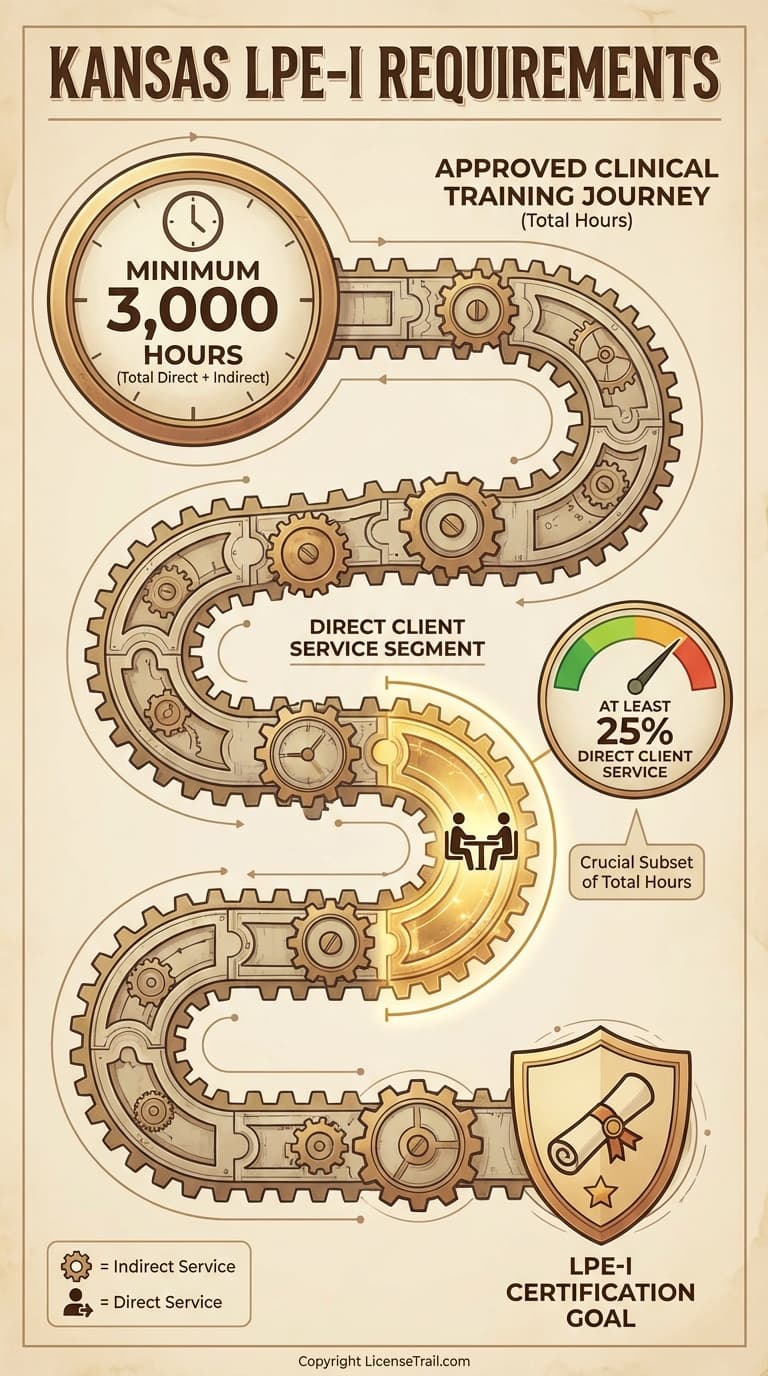
- Post‑1997 hours: 3,000 supervised clinical training hours (direct + indirect client service) with ≥25% direct service (≥750 hours)
- Independent practice exclusions (even with LPE‑I): neuropsychological, forensic, and projective personality assessments
License Details
Procedures
Licensure as a Licensed Psychological Examiner – Independent (LPE‑I / LPE‑1) in Arkansas is controlled by both Arkansas statute (Title 17, Chapter 97) and the Arkansas Psychology Board’s Rules, particularly §5.3 on Licensed Psychological Examiners and §5.3.G / §5.3.5 on independent practice privileges. (law.justia.com)
The Board also provides a practical summary for licensees on its website under “LICENSED PSYCHOLOGICAL EXAMINER – INDEPENDENT STATUS.” (psychologyboard.arkansas.gov)
The sections below pull those sources together into a structured, easy‑to‑follow explanation, with attention to the exact types and amounts of supervised hours required.
1. Who can become an LPE‑I in Arkansas?
The LPE‑I is not a separate degree; it is an independent‑practice privilege granted to a Licensed Psychological Examiner (LPE).
Under current law and rules, eligibility splits into three time‑based groups: (law.justia.com)
-
LPEs licensed before December 31, 1997
- May be granted independent practice without new supervision hours, subject to some content restrictions.
-
LPEs licensed after December 31, 1997 and on or before December 31, 2024
- May obtain independent practice only by completing an approved supervision plan that includes 3,000 hours of supervised clinical training.
-
LPEs licensed after December 31, 2024
- Cannot be granted independent practice status under current statute and rules, regardless of hours completed:
“A psychological examiner licensed after December 31, 2024, shall not be granted independent practice status…” (law.justia.com)
In all cases, a person must either already hold an LPE license or “meet all requirements for the LPE license with a master’s degree in Psychology” to be considered for LPE‑I. (law.cornell.edu)
2. Prerequisite: Becoming (or qualifying as) an LPE
Because LPE‑I status is an add‑on to LPE licensure, it helps to know the baseline LPE requirements. The Board rules provide, in substance: (law.cornell.edu)
-
Degree requirement
- A master’s degree in psychology or a closely related field from a regionally accredited institution, with the program meeting specific Board criteria.
-
Program & coursework criteria
- Graduate coursework must cover designated core areas in psychology and support the applicant’s intended scope of practice (Statement of Intent).
- The earlier rules specify that at least 15 graduate semester hours must directly support the Statement of Intent, and the Board’s licensee page stresses that applicants must meet course requirements—no substitution of “work or experience in lieu of course work or internship hours.” (psychologyboard.arkansas.gov)
-
Supervised internship for initial LPE licensure
- A minimum of 600 clock hours of supervised experience obtained via a formal internship, directly related to the intended use of the license and consistent with the Statement of Intent. (law.cornell.edu)
This 600‑hour internship is required for the LPE, not for LPE‑I per se. For LPE‑I, there is an additional, much larger supervised‑experience requirement described next.
3. Pathway 1: LPEs licensed before December 31, 1997
For psychological examiners originally licensed before 12/31/1997, the law and rules make the path to independent status relatively simple. (law.justia.com)
3.1. Application steps
The Board and statute indicate that such an LPE must:
- Write a letter to the Board requesting independent practice privileges.
- Submit a revised Statement of Intent for Independent Practice.
The Board’s licensee page provides a specific “Statement of Intent—Psychological Examiner Independent Practice—Pre‑1997” form and instructs that the form must match the most recent Board‑approved Statement of Intent on file; any changes to the underlying Statement of Intent must be approved first. (psychologyboard.arkansas.gov)
3.2. Supervision hours required
For this pre‑1997 group, the Arkansas Code expressly states:
- Once the Board has the letter and revised Statement of Intent, such an examiner “shall be granted independent practice… [and] No additional hours of clinical supervision shall be required” for this change in status. (law.justia.com)
In other words, there is no new 3,000‑hour requirement for LPEs licensed before 12/31/1997.
3.3. Practice limitations
Even with independent status, these LPE‑Is may not independently practice in certain areas. Current law and rules say that independent practice must exclude:
- Neuropsychological assessment
- Forensic psychological assessment
- Projective personality assessment (law.justia.com)
All other services listed in their approved Statement of Intent may be practiced without ongoing supervision, subject to these exclusions.
4. Pathway 2: LPEs licensed after December 31, 1997 (and on or before December 31, 2024)
For psychological examiners licensed in this period, the Board and statute impose both an administrative and a substantial supervised‑experience requirement to obtain independent status.
4.1. Administrative steps before any hours can be counted
The Arkansas Psychology Board’s current licensee guidance and rules agree on the following sequence: (psychologyboard.arkansas.gov)
-
Confirm you are an LPE licensed after 12/31/1997.
-
Submit a written request / cover letter to the Board applying for independent practice privileges.
-
File a revised Statement of Intent for Independent Practice (Post‑1997) that:
- Matches your current Board‑approved Statement of Intent (or first revise your basic LPE Statement of Intent and have that revision approved), and
- Excludes the independent practice of:
- Neuropsychological assessment
- Forensic psychological assessment
- Projective personality assessment (law.cornell.edu)
- Includes documentation of appropriate training and experience in the areas you do want to practice independently.
-
Submit a formal supervision plan for the independent‑practice hours.
Board Rule 5.3.G(3)(b) requires: (law.cornell.edu)- A “plan of supervision of 3000 hours of clinical training, defined as direct and indirect client service, by a Board approved supervisor with a minimum of 25% of the intern’s time in direct service.”
- The plan of supervision must be approved by the Board prior to implementation.
-
Do not begin counting hours until the Board’s approval.
The Board’s LPE‑I page is explicit: “You shall NOT begin accruing the 3000 hours of supervised experience towards Independent status until your request is approved by the Arkansas Psychology Board Members.” (psychologyboard.arkansas.gov)
Only after this approval can any of the supervised experience be credited toward the 3,000‑hour requirement.
4.2. The 3,000‑hour supervised experience requirement (core of LPE‑I)
This is the centerpiece of the LPE‑I requirement for post‑1997 LPEs.
4.2.1. Total hours and type of activity
The rule requires: (law.cornell.edu)
- A total of 3,000 hours of clinical training,
- And it defines that clinical training as “direct and indirect client service,”
- Conducted under a Board‑approved supervisor.
So, unlike a breakdown that might say “1,500 hours direct” and “1,500 hours supervised,” Arkansas specifies:
- 3,000 total hours of supervised clinical training, composed of:
- Direct client service, and
- Indirect client service (activities that support clinical work but are not face‑to‑face service).
All of these 3,000 hours are supervised hours; supervision is not a separate hour‑bank in the rule, but a required framework for the 3,000 clinical‑training hours.
4.2.2. Minimum direct‑service requirement
The same rule adds that there must be “a minimum of 25% of the intern’s time in direct service.” (law.cornell.edu)
From that percentage, you can infer a minimum number of direct‑service hours:
- Total required hours: 3,000
- Minimum percentage direct service: 25%
Therefore, at least:
- 750 hours must be direct client service (25% of 3,000), and
- The remaining up to 2,250 hours can be indirect client service.
The Board itself states the requirement in percentage form; the hour figures above are a straightforward calculation of what 25% of 3,000 necessarily implies.
Direct service typically includes:
- Face‑to‑face (or synchronous telehealth) assessment and intervention with clients,
- Administering and interpreting tests in real time with the client present,
- Conducting intake interviews and psychotherapy sessions.
Indirect service generally includes, for example:
- Scoring and writing reports,
- Case consultation and case conferences,
- Treatment planning,
- Collateral contacts and documentation.
The exact classification of activities (direct vs indirect) must be consistent with Board expectations and your supervising psychologist’s documentation.
4.2.3. Supervision structure and documentation
In practice, the 3,000 hours must be accrued according to your Board‑approved supervision plan and documented with:
- Supervision logs and Board forms (e.g., Supervision Log, Licensee Supervision Completion—PE Independent Practice), and
- Signatures of each Arkansas Psychology Board‑approved supervising psychologist who oversaw portions of the 3,000 hours. (psychologyboard.arkansas.gov)
When you have completed the 3,000 hours, you must:
- Submit the Licensee Supervision Completion—PE Independent Practice form (one from each supervising psychologist, if more than one),
- Ensure all forms are signed and accompanied by any required Supervision Agreement and Plan for services that will still require supervision, and
- Include a cover letter requesting that the Board grant Independent Status. (psychologyboard.arkansas.gov)
Independent status is not effective until the Board has reviewed and approved this completion packet.
4.3. Practice limitations after LPE‑I is granted
Upon approval, an LPE licensed after 12/31/1997 who has completed these requirements is “privileged to practice independently,” but not in certain specialty areas. Current statute and rules limit independent practice so that it excludes:
- Neuropsychological assessment
- Forensic psychological assessment
- Projective personality assessment (law.justia.com)
Any services outside these excluded areas that are listed and supported by training in your approved Statement of Intent may be provided without supervision.
5. Pathway 3: LPEs licensed after December 31, 2024
Recent statutory and rule changes created a hard cutoff:
- “A psychological examiner licensed after December 31, 2024, shall not be granted independent practice status if he or she submits an application to the board for independent practice.” (law.justia.com)
For LPEs first licensed on or after January 1, 2025, this means:
- You may still hold and practice as an LPE, under the usual supervision rules;
- You cannot obtain LPE‑I (independent practice) status under current law, regardless of hours or supervision completed.
6. Summary of hour requirements specifically related to LPE‑I
Putting the pieces together:
-
Hours for initial LPE licensure (prerequisite to LPE‑I)
- At least 600 clock hours of supervised experience via a formal internship related to your intended area of practice. (law.cornell.edu)
-
Additional hours required to move from LPE to LPE‑I (post‑1997 LPEs licensed through 12/31/2024) (law.cornell.edu)
- 3,000 hours of supervised clinical training, after the Board approves your supervision plan and Independent‑practice Statement of Intent.
- These 3,000 hours must:
- Consist of direct and indirect client service, and
- Include at least 25% of your time in direct service, implying:
- ≥ 750 hours direct client service, and
- ≤ 2,250 hours indirect client service, all under supervision.
-
Hours for pre‑1997 LPEs seeking LPE‑I
- No new supervised hours are required beyond those already completed for the original LPE license; the statute explicitly waives additional clinical supervision hours for this group. (law.justia.com)
7. Practical checklists by category
7.1. If you were licensed as an LPE before 12/31/1997
- Verify your original LPE license date is before 12/31/1997.
- Obtain a copy of your current Board‑approved Statement of Intent.
- If needed, update your basic LPE Statement of Intent and get it approved. (psychologyboard.arkansas.gov)
- Submit:
- A cover letter requesting independent practice, and
- The Pre‑1997 Statement of Intent—Psychological Examiner Independent Practice form.
- Await Board approval; no extra supervised hours are required, but independent practice will exclude neuropsychological, forensic psychological, and projective personality assessment.
7.2. If you were first licensed as an LPE between 1/1/1998 and 12/31/2024
- Confirm that your LPE license was issued in this window.
- Make sure your LPE coursework and 600‑hour internship requirements are fully documented. (law.cornell.edu)
- Draft and submit:
- A cover letter requesting independent practice,
- A revised Post‑1997 Statement of Intent for Independent Practice (excluding neuropsychological, forensic, and projective personality assessment), and
- Documentation of training and experience in each area you wish to practice independently. (law.cornell.edu)
- Prepare and submit a supervision plan that:
- Lists a Board‑approved supervising psychologist, and
- Commits to 3,000 hours of clinical training (direct + indirect client service) with at least 25% of your time in direct service. (law.cornell.edu)
- Wait for written Board approval of the plan before counting any hours.
- Complete the 3,000 supervised hours as approved.
- File the LPE‑I Supervision Completion form(s), supervision logs, and any needed ongoing supervision plans, with a cover letter asking to be granted LPE‑I. (psychologyboard.arkansas.gov)
- Once approved, practice independently within the boundaries of your Statement of Intent, excluding the prohibited specialty assessments.
7.3. If you are (or will be) licensed as an LPE after 12/31/2024
- You may pursue LPE licensure following current Board rules (degree, coursework, internship, etc.). (psychologyboard.arkansas.gov)
- Under current law and rules, you cannot be granted LPE‑I status, even if you complete a 3,000‑hour supervision plan; the statute explicitly bars independent practice status for LPEs licensed after 12/31/2024. (law.justia.com)
This is the framework currently in effect for becoming (or assessing whether you can become) an LPE‑I in Arkansas, with particular emphasis on the supervised‑experience requirements and how the Board’s rules define the 3,000 clinical‑training hours.
Track your LPE-I hours with confidence
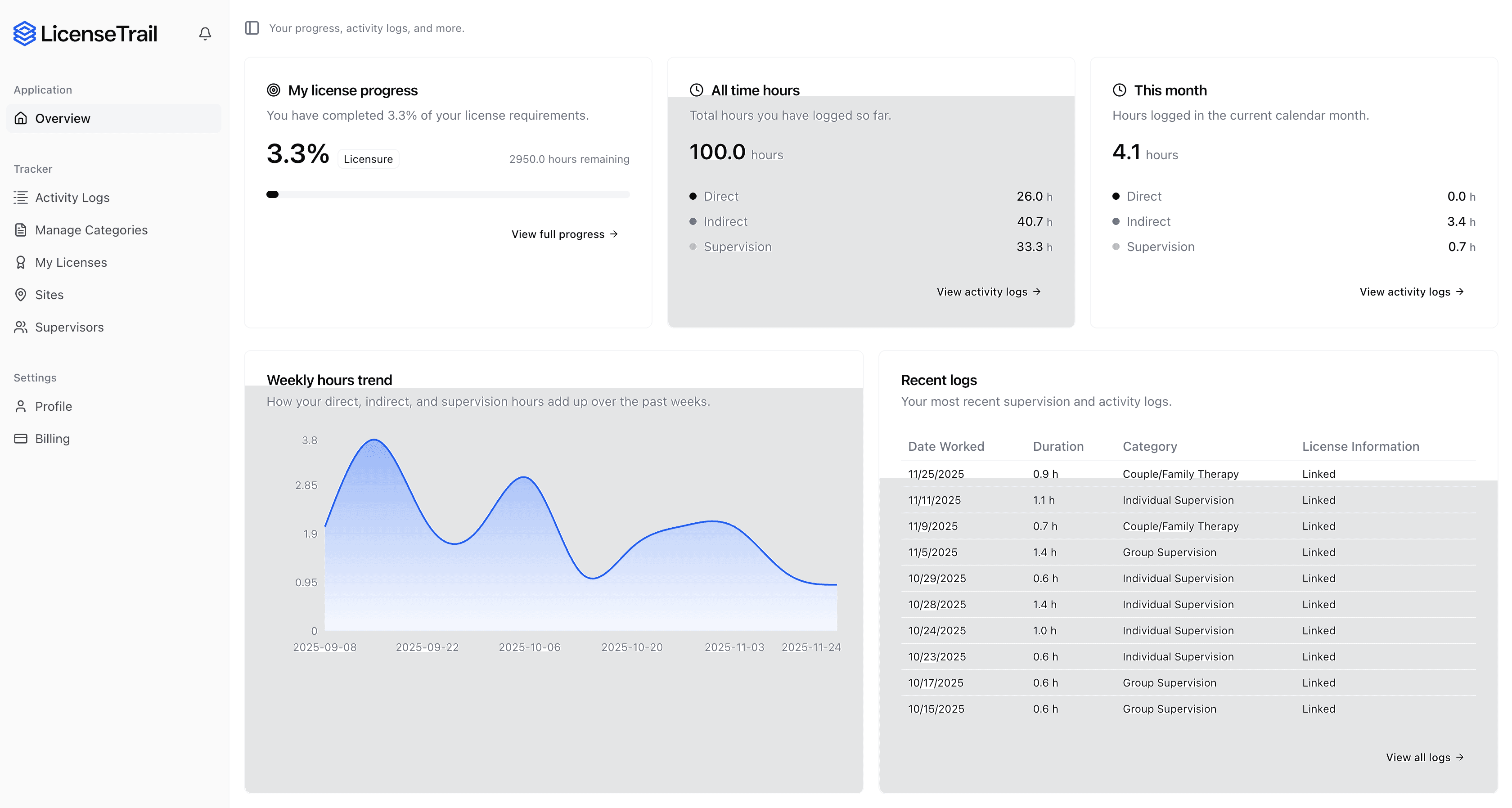
License Trail checks your direct, indirect, and supervision hours against Kansas LPE-I requirements continuously and flags mismatches before you submit.
 Start Tracking for Free
No credit card required · Free plan available
Related Licenses
Is your spreadsheet hiding Kansas LPE-I risks?
Stop guessing if your categories match Arkansas Psychology Board requirements. License Trail checks your direct, indirect, and supervision hours continuously and flags mismatches before you submit.
Import or log
Bring your spreadsheet or start fresh
Upload your existing tracking spreadsheet and we'll map every hour into the right Arkansas Psychology Board categories automatically.
Verify against Kansas
Catch mismatches before the board does
License Trail checks your direct, indirect, and supervision hours against Kansas LPE-I requirements continuously.
Export board-ready
One-click clean reports
Generate professional, board-ready reports for supervision meetings and Arkansas Psychology Board submissions in seconds.
No credit card required · Free plan available