
Kansas Psychologist Requirements: Hours, Exams & Step-by-Step Guide
Stop guessing if your categories match Kansas requirements. License Trail checks your direct, indirect, and supervision hours against Psychologist requirements continuously and flags mismatches before you submit.
No credit card required · Free plan available
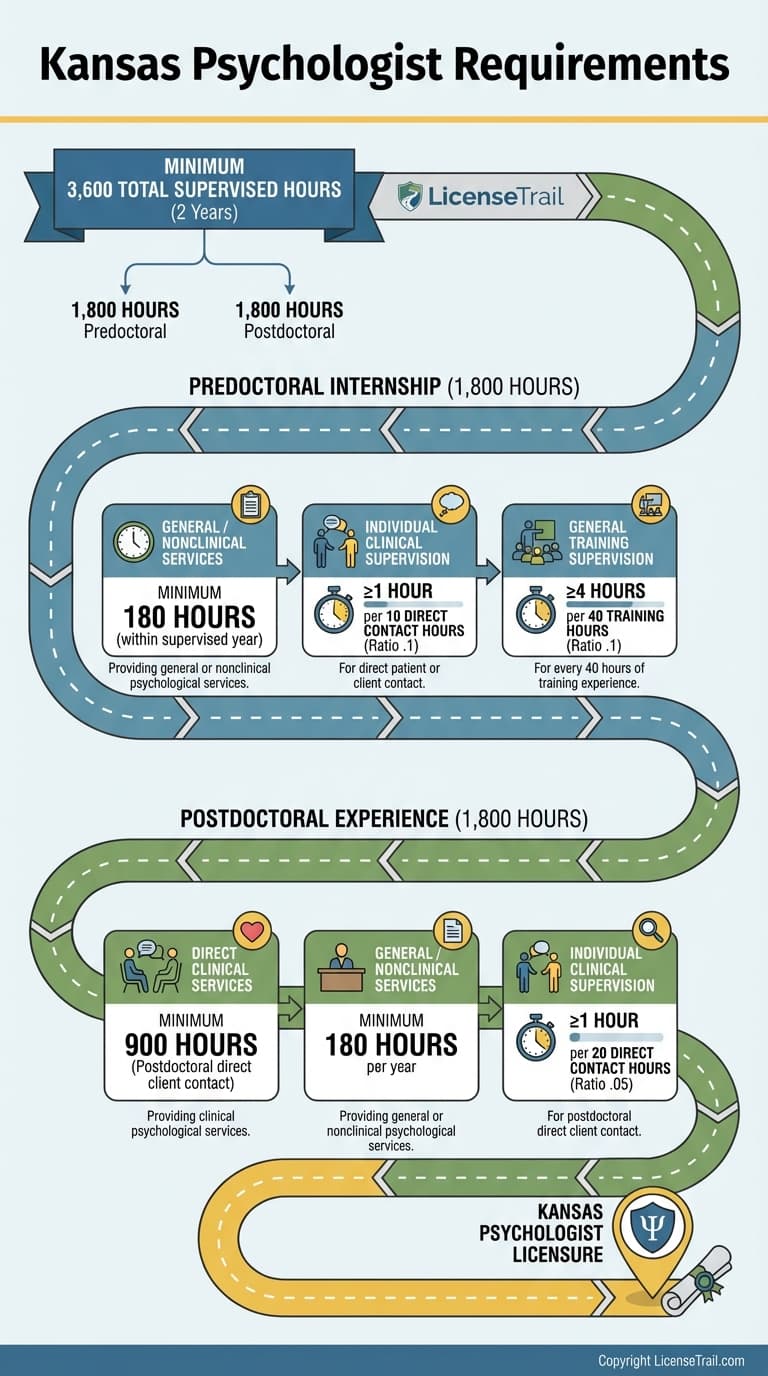
Quick Requirements Overview
- Provided text describes Arkansas psychologist licensure, not Kansas (KS)
- I can’t generate an accurate KS Psychologist requirements snapshot from this AR-specific content without risking errors
- Please paste/link the Kansas Behavioral Sciences Regulatory Board (BSRB) psychologist licensure requirements text (or tell me the source URL)
- Confirm whether you want Licensed Psychologist (LP) vs any temporary/supervised credential pathway in KS
- Once provided, I’ll summarize KS requirements in 5–8 bullets (education, supervised hours, exams, application items, key constraints)
License Details
Procedures
Licensure as a Psychologist in Arkansas: Supervised Hours and Key Requirements
The Arkansas Psychology Board sets out detailed rules for becoming a licensed psychologist. The core of the pathway is:
- A qualifying doctoral degree in psychology
- A 2,000‑hour doctoral internship that meets strict criteria
- At least 2,000 hours of postdoctoral supervised experience
- Passing the EPPP and completing the Board’s application process
Below is a step‑by‑step guide, with emphasis on the types and amounts of hours the Board requires and the specific language they use in their rules.
1. Educational foundation
Arkansas requires a doctoral degree in psychology from a regionally accredited institution and a program that meets the criteria in Section 5.4.A–E of the Arkansas Psychology Board Rules.(psychologyboard.arkansas.gov)
Key points:
- Program must be clearly identified as a psychology program and be a recognizable entity within the institution.(psychologyboard.arkansas.gov)
- You must complete specified core graduate courses (e.g., learning, statistics, individual intelligence testing with practicum, abnormal/behavior deviation, personality, developmental, psychotherapy theories and techniques, etc.).(psychologyboard.arkansas.gov)
Only after at least two years of graduate study can you begin the qualifying internship.(psychologyboard.arkansas.gov)
2. Predoctoral internship: 2,000 hours of “qualified experience”
2.1. Arkansas’s basic internship requirement
For psychologist licensure, Arkansas requires two years of qualified experience, one of which must be postdoctoral. The first year is satisfied by the internship.(psychologyboard.arkansas.gov)
Under Rule 5.4.F, the internship requirement can be met in one of two ways:
- An internship accredited by the American Psychological Association (APA) that is consistent with your doctoral program and your Statement of Intent, or
- “A 2000 hour internship” that meets a list of Board criteria.(psychologyboard.arkansas.gov)
On the Applicants page, the Board restates this plainly as: you must “Complete a 2000-hour internship that meets the criteria specified in Section 5.4.F of the Rules.”(psychologyboard.arkansas.gov)
So, in practical terms, Arkansas expects:
- 2,000 internship hours (usually over about 12 months, but can be up to 24 months) that either:
- Are APA‑accredited, or
- Meet the Board’s detailed standards listed below.
2.2. Required structure and supervision of the 2,000‑hour internship
For a non‑APA internship, Rule 5.4.F(2) specifies that the 2,000‑hour experience must:(psychologyboard.arkansas.gov)
- Be organized training, not just “supervised experience or on‑the‑job training,” and provide a programmed sequence of training experiences with emphasis on breadth and quality of training.
- Occur in an internship agency that:
- Has a clearly designated staff psychologist responsible for the integrity and quality of the training program, licensed/certified by the State Board of Examiners in Psychology.
- Has two or more psychologists on staff as supervisors, at least one of whom is actively licensed as a psychologist by the Board.
- Be in a multidisciplinary setting, with contributions from at least two other disciplines whose expertise is relevant to evaluation and intervention.
- Provide a range of assessment and treatment activities conducted directly with patients seeking health services.
- Ensure the intern has a title that clearly indicates training status.
- Be completed within 24 months.
2.3. Direct service and supervision hour minimums during internship
Within the 2,000‑hour internship, the Board specifies minimums for direct service and supervision:(psychologyboard.arkansas.gov)
- Direct patient contact:
- At least 25% of the intern’s time must be in direct patient contact, explicitly specified as a minimum of 375 hours of direct services to patients.
- Individual supervision:
- A minimum of two (2) hours per week of regularly scheduled, formal, face‑to‑face individual supervision, focused on health‑service work done directly by the intern (this applies regardless of whether the internship is one or two years in length).
- Additional learning activities:
- At least two (2) additional hours per week in learning activities, such as:
- Case conferences involving the intern’s own cases
- Seminars on clinical issues
- Co‑therapy with discussion
- Group supervision
- Additional individual supervision
- At least two (2) additional hours per week in learning activities, such as:
These requirements are part of the Board’s explicit definition of an acceptable “2,000 hour internship.”
2.4. Non–health-service internship option
For practice areas that are not health‑service related (i.e., do not provide “direct ameliorative services”), Arkansas allows a different internship structure:
- “2,000 hours of supervised training experience” consistent with your doctoral program and Statement of Intent may fulfill the internship requirement for non‑health‑service practice (e.g., some industrial/organizational, research, or purely academic roles).(psychologyboard.arkansas.gov)
3. Postdoctoral supervised experience: Another 2,000 hours
After the internship, Arkansas requires a postdoctoral year of supervised experience. This is a second year of “qualified experience,” and it is explicitly defined in Rule 5.4.H as postdoctoral supervised experience.(psychologyboard.arkansas.gov)
3.1. Amount and timing of postdoctoral hours
The rule states that at least one year of postdoctoral supervised experience is required and that it must:
- Be full time (40 hours per week) for at least one calendar year (50 weeks), or
- Total 2,000 hours of appropriate experience, or equivalent, completed within a period not to exceed 4 years.(psychologyboard.arkansas.gov)
So, the Board’s explicit hour expectation is:
- Postdoctoral supervised experience: 2,000 hours, in not more than 4 years.
A part‑time postdoctoral plan must be pre‑approved by the Board, and the experience must occur under supervision of a licensed psychologist whose Statement of Intent matches the supervised areas of practice.(psychologyboard.arkansas.gov)
3.2. Required supervision during postdoc
Within the postdoctoral year, Arkansas requires:
- A minimum of one (1) hour per week of regularly scheduled, formal, face‑to‑face supervision, explicitly directed at services the supervisee has rendered.(psychologyboard.arkansas.gov)
This is less supervision than the internship (which requires 2 hours/week of individual plus 2 additional hours/week of learning activities), reflecting your more advanced, postdoctoral level.
3.3. Types of activities that may count
The Board recognizes that professional psychology is broader than clinical work. Rule 5.4.H(2) lists types of activities that may count toward the 2,000 postdoctoral hours, so long as they align with your doctoral training and Statement of Intent:(psychologyboard.arkansas.gov)
- Teaching psychology at a recognized academic institution
- Use of teaching time is limited to 50% of the total postdoctoral hours (unless the teaching is by a clinical professor in a clinical setting).
- Research in psychology
- Psychological assessment
- Psychological therapy
- Consultation in psychology
- Psychological or mental health–related administration
The Board’s language here makes clear that postdoctoral hours can be a mix of direct clinical service and other professional activities, provided they are supervised and consistent with your training and intended practice.
3.4. Provisional licensure during postdoc
Applicants may be granted provisional licensure applicant status while completing their one‑year postdoctoral supervised experience. Rule 5.4.H(3) allows the Board to extend this status beyond one year at its discretion.(psychologyboard.arkansas.gov)
On the Applicants page, this is operationalized as a Provisionally Licensed Psychologist who:
- Must have written authorization from the Board to practice
- May work only under supervision
- Holds a provisional license for up to 18 months at a time (renewable, with fees)(psychologyboard.arkansas.gov)
4. Total supervised experience requirements (hours summary)
Putting the Arkansas rules together for a typical health‑service psychologist:
-
Internship (pre‑doctoral)
- Total hours: 2,000 hours minimum
- Direct patient contact: at least 25% of time, minimum 375 hours
- Supervision:
- ≥ 2 hours/week formal, face‑to‑face individual supervision
- ≥ 2 hours/week additional learning/supervisory activities
- Duration: completed within 24 months
-
Postdoctoral supervised experience
- Total hours: 2,000 hours of appropriate experience (full‑time 40 hrs/week for 50 weeks, or equivalent within ≤ 4 years)
- Supervision: at least 1 hour/week of formal, face‑to‑face supervision
- Activities: direct clinical services plus potential mix of teaching, research, assessment, therapy, consultation, administration, all aligned with doctoral training and Statement of Intent
In effect, Arkansas expects approximately 4,000 hours of supervised professional experience:
- 2,000‑hour “internship” year, with defined direct patient contact and intensive supervision
- 2,000‑hour postdoctoral supervised year, with defined minimum formal supervision and allowable range of professional activities
5. Examination requirements (beyond hours)
While your question centers on hours, full licensure also requires exams.
5.1. EPPP – written exam
Arkansas requires all psychologist applicants to take the Examination for Professional Practice in Psychology (EPPP). The Rules specify this as the Board’s written examination and note that ASPPB’s standard scores of 500 for psychologist level and 450 for psychological examiner are adopted.(psychologyboard.arkansas.gov)
The Applicants page confirms that the minimum passing score is 500 for psychologist applicants and that candidates may take the EPPP up to four times in one year, with a 60‑day waiting period between attempts.(psychologyboard.arkansas.gov)
5.2. Oral exam (historical vs. current practice)
The Rules still describe an interview and oral examination as part of the licensing process after passing the written exam.(psychologyboard.arkansas.gov)
However, the Applicants page contains an important qualification:
- It states that only applicants prior to July 3, 2020 may sit for an oral interview once provisionally licensed, after passing the EPPP and completing post‑doc requirements.(psychologyboard.arkansas.gov)
Practically, this means that as of the current guidance on the Board’s site, newer applicants are generally not taking an oral exam, although you should confirm any updates directly with the Board when you apply.
6. Application sequence with where the hours fit
Based on the Board’s Applicants page and Rules:(psychologyboard.arkansas.gov)
-
Doctoral education & coursework
- Complete qualifying doctoral program and required coursework (per Rule 5.4.A–E).
-
Internship (2,000 hours)
- Complete an APA‑accredited internship or a Board‑defined 2,000‑hour internship meeting all criteria (structure, supervision, direct patient hours).
-
Initial application & credential review
- Request and submit the psychologist application, pay application fee, complete background checks, and have transcripts sent.
- Once your credentials are approved, you are granted Applicant Psychologist—Provisional License status (or a mobility/senior path if applicable).(psychologyboard.arkansas.gov)
-
EPPP and file building
- Sit for the EPPP, achieve at least 500.
- Submit Statement of Intent, reference forms, and other required documentation.(psychologyboard.arkansas.gov)
-
Provisional practice and postdoctoral supervised experience (2,000 hours)
- Obtain Provisional Psychologist authorization and practice only under supervision.
- Complete at least one year (2,000 hours) of postdoctoral supervised experience meeting the Board’s hour and supervision requirements.
-
Convert to full psychologist license
- After completing postdoc hours and passing the EPPP (and any oral/interview requirement that might apply to your cohort), submit:
- Revised Statement of Intent as a psychologist
- Certification and license fees
- The Board issues your psychologist license and certificate.(psychologyboard.arkansas.gov)
- After completing postdoc hours and passing the EPPP (and any oral/interview requirement that might apply to your cohort), submit:
7. Special note for non–health-service careers
If your intended practice is not health‑service oriented (for example, purely academic, research, or some I/O psychology roles), Arkansas allows the internship year to be satisfied by 2,000 hours of supervised training experience consistent with your doctoral program and Statement of Intent, rather than a health‑service patient‑care internship.(psychologyboard.arkansas.gov)
You still must complete:
- A qualifying doctoral degree
- 2,000 hours of supervised “internship”‑type experience as defined for non‑health‑service roles
- 2,000 hours of postdoctoral supervised experience
- The EPPP and full application process
8. Always verify current rules
The Arkansas Psychology Board’s “2024 Rules (current)” and the Applicants page are the controlling sources, and they occasionally update procedures (for example, the change around July 3, 2020 regarding oral exams).(psychologyboard.arkansas.gov)
When you are close to applying, you should:
- Download the current Rules from the Board’s Laws & Rules section
- Confirm hour and supervision expectations with the Board if your training is atypical (e.g., nonhealth‑service focus, part‑time postdoc, non‑APA internship)
But as of the most recent Board publications, the state’s defined supervised‑experience requirements for psychologist licensure can be summarized as:
- 2,000‑hour doctoral internship (with at least 375 hours of direct patient contact and intensive weekly supervision), and
- 2,000 hours of postdoctoral supervised experience (minimum one year, at least 1 hour/week of formal supervision), for a total of roughly 4,000 supervised hours consistent with your doctoral training and Statement of Intent.
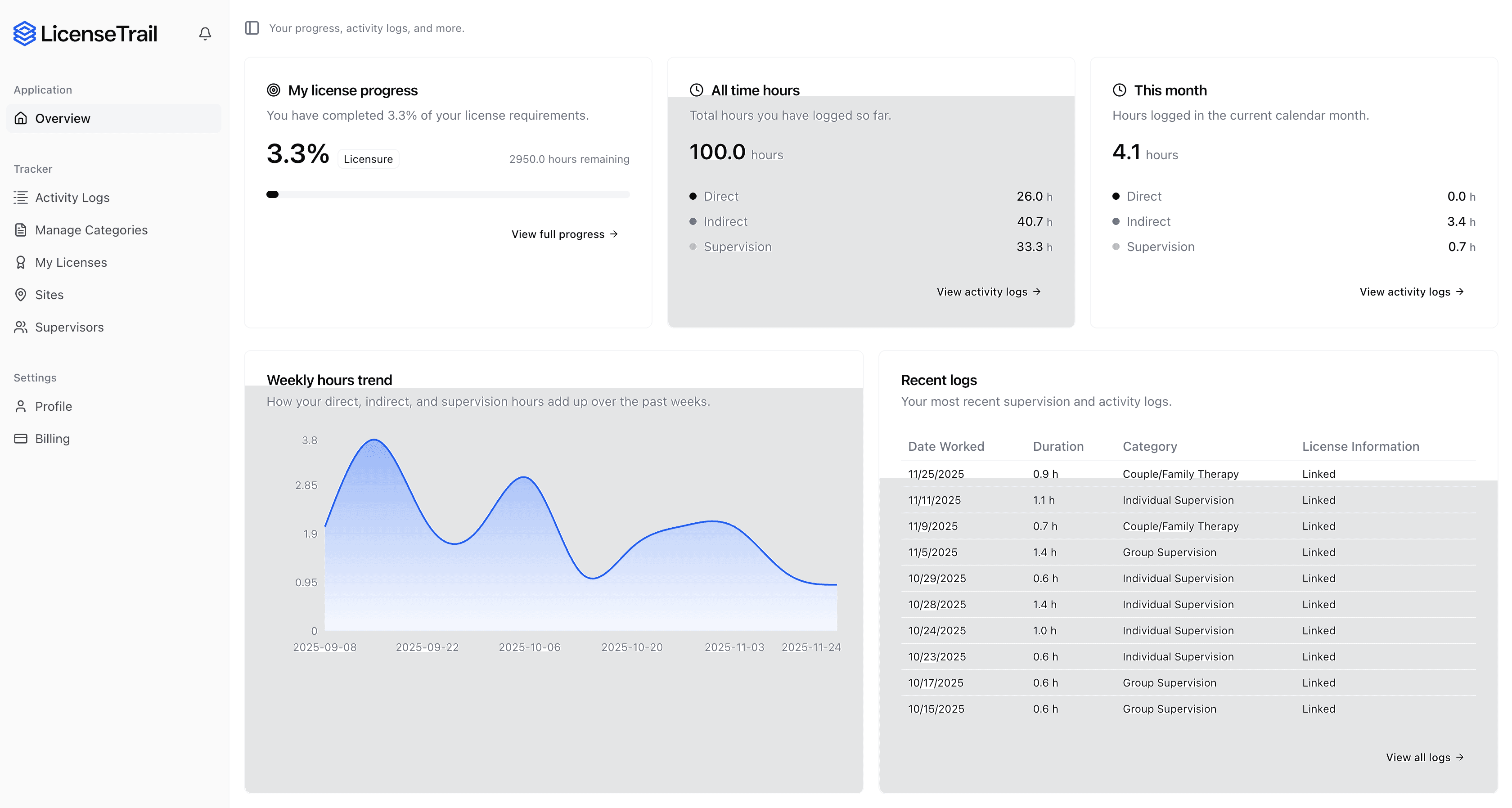
Track your Psychologist hours with confidence
License Trail checks your direct, indirect, and supervision hours against Kansas Psychologist requirements continuously and flags mismatches before you submit.
 Start Tracking for Free
No credit card required · Free plan available
Related Licenses
Is your spreadsheet hiding Kansas Psychologist risks?
Stop guessing if your categories match Arkansas Psychology Board requirements. License Trail checks your direct, indirect, and supervision hours continuously and flags mismatches before you submit.
Import or log
Bring your spreadsheet or start fresh
Upload your existing tracking spreadsheet and we'll map every hour into the right Arkansas Psychology Board categories automatically.
Verify against Kansas
Catch mismatches before the board does
License Trail checks your direct, indirect, and supervision hours against Kansas Psychologist requirements continuously.
Export board-ready
One-click clean reports
Generate professional, board-ready reports for supervision meetings and Arkansas Psychology Board submissions in seconds.
No credit card required · Free plan available