
Kansas PLSW Requirements: Hours, Exams & Step-by-Step Guide
Stop guessing if your categories match Kansas requirements. License Trail checks your direct, indirect, and supervision hours against PLSW requirements continuously and flags mismatches before you submit.
No credit card required · Free plan available
Quick Requirements Overview
- Provided text describes Arkansas PLSW requirements; it does not state Kansas (KS) licensing rules for PLSW.
- PLSW described as a one-time, 1-year, non-renewable provisional license to practice at the LSW level while working toward the exam.
- Eligibility described: CSWE-accredited BSW (or equivalent), application, and state + national criminal background check.
- Exam described: Board-approved bachelor-level exam; must attempt at least once in each 6-month period, max 3 attempts total during the year.
- Hours described: no set pre-licensure practice-hour requirement for PLSW/LSW; supervision required but no cumulative hour total specified.
- Supervision described: weekly minimum supervision expectation by LMSW/LCSW or other qualified professional; in non-clinical roles, must at least report to a supervisor.
License Details
Procedures
In Arkansas, the Provisional Licensed Social Worker (PLSW) credential is a one‑year, non‑renewable license that allows a new BSW‑level applicant to practice at the Licensed Social Worker (LSW) level while working toward passing the required exam. It is created and regulated by the Arkansas Social Work Licensing Board under Arkansas Code § 17‑103‑306 and the Board’s rules. (law.justia.com)
Below is a concise, requirement‑focused guide emphasizing what the Arkansas Board actually says about hours, supervision, and exam timing.
1. What the PLSW credential is
- The Board’s roster identifies PLSW as “Provisional Licensed Social Worker” and lists it as a distinct licensure level alongside LSW, LMSW, LCSW, and PLMSW. (healthy.arkansas.gov)
- By statute, the Board “shall issue a Provisional Licensed Social Worker license one (1) time only” to an otherwise qualified LSW applicant. (law.justia.com)
- The provisional license is valid for one year and attached to the LSW level of practice. (law.justia.com)
Functionally, a PLSW is a transitional LSW: you meet all LSW qualifications except that you have not yet passed the exam.
2. Baseline qualifications you must meet (LSW level)
To be eligible for a PLSW, you must first qualify as an LSW‑level applicant under Arkansas Code § 17‑103‑306(a). In Board and statutory language, that means: (law.justia.com)
-
Education
- Hold a baccalaureate degree in social work from a program accredited by the Council on Social Work Education (CSWE) or the Canadian Association for Social Work Education, or an older qualifying social work degree issued before June 17, 1986.
-
Examination (content requirement, even though you haven’t passed yet)
- You must take an examination approved by the Board “for this purpose and level of practice.” For LSW/PLSW, that is the bachelor’s‑level ASWB exam, though the statute itself just calls it an examination approved by the Board. (law.justia.com)
-
Criminal background check
- You must apply for a state and national criminal background check and meet the Board’s criminal‑history standards under Ark. Code § 17‑103‑307. (law.justia.com)
-
Fitness and character
- You must be physically and mentally competent to provide social work services with reasonable skill and safety.
- You must not have a mental or physical condition that would impair your competence.
- You must not have pleaded guilty, nolo contendere, or been found guilty of specified felonies or offenses involving violence, dishonesty, fraud, breach of client trust, or abuse of the vulnerable.
- You must not use drugs or alcohol in a way that affects your professional competency.
- You must not have engaged in fraud or deceit in making your application. (law.justia.com)
All of those are LSW‑level qualifications; the PLSW simply lets you practice while you are still working on passing the exam.
3. Provisional license specifics (PLSW)
3.1 One‑time, one‑year license
Board rules on provisional licenses say: (law.cornell.edu)
- The bachelor’s‑level provisional license is issued only once per person and cannot be renewed.
- It becomes effective on the date of issuance and expires exactly one year from that date.
Arkansas Code § 17‑103‑306(a)(2) matches this, stating that a Provisional Licensed Social Worker license is good for one year and can be issued “one (1) time only.” (law.justia.com)
3.2 Examination timing and number of attempts
Two sets of rules apply to exam timing:
-
Number of attempts (statute):
- The statute states the PLSW license is valid for “up to three (3) attempts” to pass the approved exam during that year. (law.justia.com)
-
Frequency of attempts (Board rule):
- The provisional‑license rule requires that a provisional licensee must take the social work examination at least once during the first six months of provisional licensure and once during the second six months. (regulations.justia.com)
These two requirements are compatible in practice:
- Minimum: you must sit for the exam at least twice (once in each half of the year).
- Maximum: you may attempt the exam up to three times during the one‑year provisional period.
4. Supervision and “hours” for a PLSW
4.1 What is not required: No set pre‑licensure practice‑hours for PLSW
Neither Arkansas Code § 17‑103‑306 nor the Board’s rules set any numeric practice‑hour requirement (for example, “1,500 hours direct experience” or “1,500 hours supervised experience”) for obtaining a PLSW or a standard LSW license. (law.justia.com)
Those types of hour requirements exist only for the Licensed Certified Social Worker (LCSW) level, discussed briefly below.
Key point:
For the PLSW in Arkansas, there is no requirement that you complete a fixed number of practice hours (direct or supervised) before you can be granted the provisional license.
4.2 Supervision expectations once you hold a PLSW
Once you are licensed as an LSW or LMSW — including on a provisional license — Board rules require ongoing supervision of your practice: (law.cornell.edu)
- The Board defines supervision as a professional relationship designed to promote responsibility, competency, and accountability.
- All LSWs and LMSWs, including provisional licensees, must obtain supervision from a licensed social worker or other qualified professional; the supervision may be within or outside the agency.
- Under an updated 2025 supervision rule (120.00.06‑001):
- The practice of an LSW should be supervised by an LMSW, an LCSW, or another qualified professional from a related field.
- For both LSWs and LMSWs, supervision “should be provided at a minimum on a weekly basis.” (regulations.justia.com)
- For LSWs or LMSWs working in non‑clinical positions, the rules state that direct supervision is not required, but they must report to a supervisor. (law.cornell.edu)
Crucially, none of these supervision rules for LSW/PLSW specify a total number of supervised hours you must accrue; they specify who must supervise you and how often, not cumulative hour counts.
5. Where hour counts do appear (for context)
Because you asked specifically about “type of hours required,” it is useful to note that Arkansas does impose explicit hour requirements at the LCSW level — but not for the PLSW.
Board rules on LCSW licensure state that an applicant must: (law.cornell.edu)
- Complete two years of post‑master’s social work experience under LCSW supervision, and
- The rule equates those two years with 4,000 hours of supervised master’s‑level social work.
- During that period, the applicant must receive ongoing face‑to‑face supervision, and other Board rules (older code version and newer supervision rule) elaborate that this includes at least 100 hours of direct supervision, with limits on how many supervision hours can occur in any one week and how much may be done in groups. (law.cornell.edu)
Those hour‑based requirements do not apply to the PLSW or LSW licenses. They become relevant only if you later pursue independent clinical licensure as an LCSW.
6. Step‑by‑step path to a PLSW in Arkansas
Putting the requirements together, the path to PLSW looks like this:
-
Earn a qualifying social work degree
- Complete a BSW (or equivalent qualifying baccalaureate social work degree) from a CSWE‑ or CASWE‑accredited program. (law.justia.com)
-
Prepare your application to the Arkansas Social Work Licensing Board
- Complete the Board’s application for licensure at the LSW level (online or paper, as permitted).
- Pay the application fee (Board rules list a filing fee of $100 for an application). (law.cornell.edu)
- Arrange for official transcripts to be sent directly to the Board.
- Complete any jurisprudence or Board‑specific forms referenced in its application checklist (these details are in Board forms not accessible via the public law compilations but referenced on the Board’s site). (healthy.arkansas.gov)
-
Submit to background checks
- Apply for the required state and FBI criminal background checks through the Arkansas State Police, as mandated by Ark. Code § 17‑103‑307 and repeated in the provisional license rule. (law.justia.com)
-
Request a provisional license as an LSW applicant
- When you have documented all LSW‑level requirements except passing the exam, you may request a bachelor’s‑level provisional license (PLSW).
- The Board may then issue a PLSW that is:
- Issued only once;
- Valid for one year from the date of issuance;
- Non‑renewable. (law.justia.com)
-
Practice under supervision as a PLSW
- Once the PLSW is issued, you may practice at the LSW level, subject to supervision requirements:
- Weekly supervision from an LMSW, LCSW, or other qualified professional is the Board’s stated minimum expectation for LSW‑level practice.
- In non‑clinical roles, you must at least report to a supervisor, even if direct clinical supervision is not required. (law.cornell.edu)
- Once the PLSW is issued, you may practice at the LSW level, subject to supervision requirements:
-
Sit for the required exam during the provisional period
- The Board must approve you to sit for the bachelor’s‑level licensure examination through its chosen exam service (ASWB).
- While holding a PLSW:
- You must take the exam at least once in the first six months and once in the second six months; and
- You have no more than three total attempts before the PLSW expires. (law.justia.com)
-
Convert to full LSW or lose the provisional license
- If you pass the exam within the one‑year PLSW period, the Board can issue a regular LSW license (assuming all other conditions remain met).
- If you do not pass within three attempts or within the one‑year window, the PLSW expires and cannot be renewed. At that point you cannot legally practice as a social worker in Arkansas until you meet current licensing requirements and re‑apply. (law.justia.com)
7. Summary focused on “hours”
For a Provisional Licensed Social Worker (PLSW) in Arkansas, as of late 2025:
- No fixed pre‑licensure practice‑hours (direct or supervised) are required by statute or Board rule to obtain the PLSW.
- Supervision while you hold the PLSW is required at a minimum weekly frequency, but the Board does not set a cumulative hour total for that supervision.
- Hour‑based requirements (two years / 4,000 hours / minimum 100 hours of direct supervision) appear only for LCSW licensure and do not apply to the PLSW itself. (law.cornell.edu)
For precise procedural details (current forms, any jurisprudence exam instructions, and fee updates), the Arkansas Social Work Licensing Board’s own site and staff remain the controlling authority, but the core legal requirements above come directly from Arkansas law and the Board’s published rules.
Track your PLSW hours with confidence
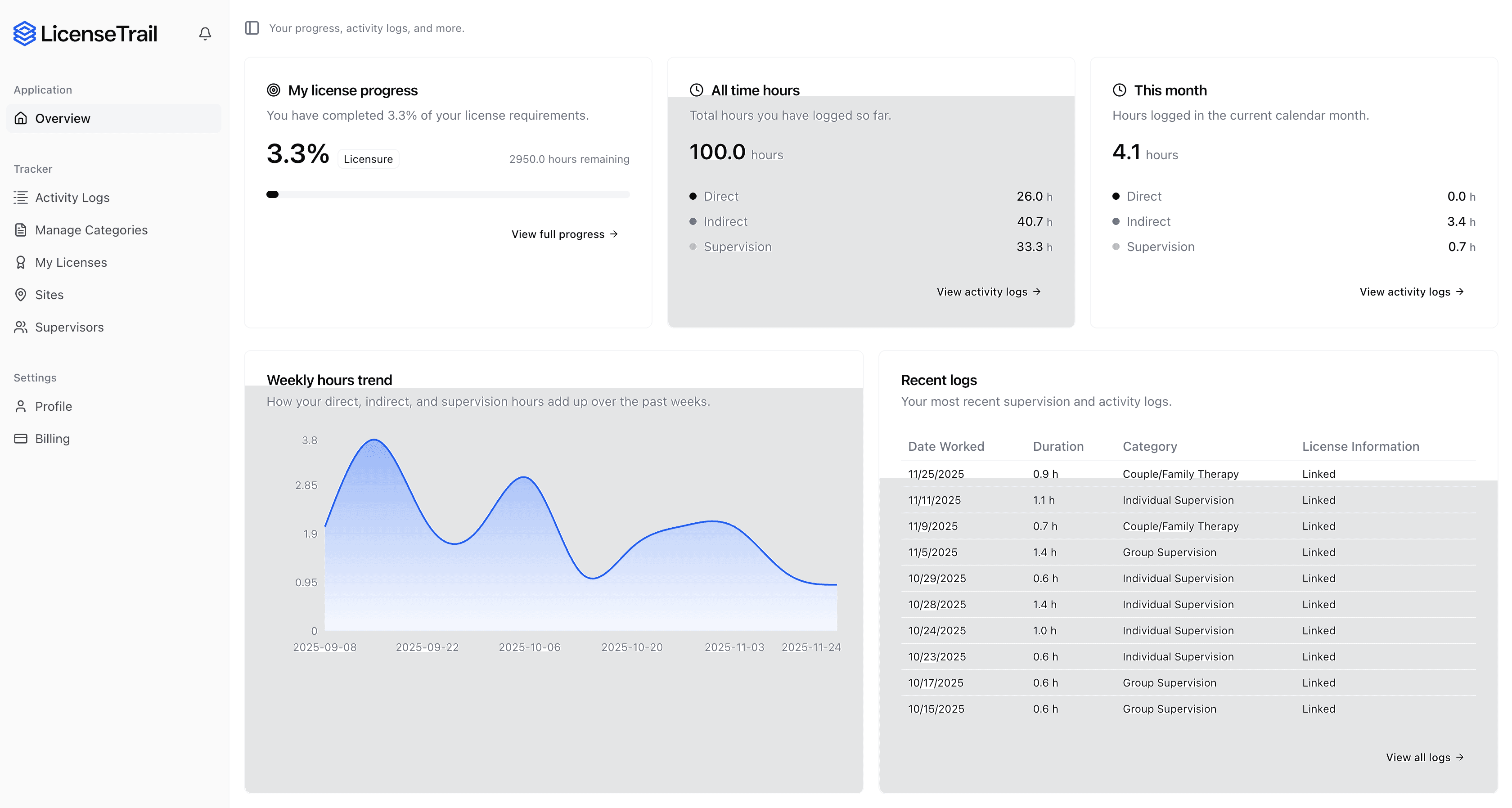
License Trail checks your direct, indirect, and supervision hours against Kansas PLSW requirements continuously and flags mismatches before you submit.
 Start Tracking for Free
No credit card required · Free plan available
Related Licenses
Is your spreadsheet hiding Kansas PLSW risks?
Stop guessing if your categories match Arkansas Social Work Licensing Board requirements. License Trail checks your direct, indirect, and supervision hours continuously and flags mismatches before you submit.
Import or log
Bring your spreadsheet or start fresh
Upload your existing tracking spreadsheet and we'll map every hour into the right Arkansas Social Work Licensing Board categories automatically.
Verify against Kansas
Catch mismatches before the board does
License Trail checks your direct, indirect, and supervision hours against Kansas PLSW requirements continuously.
Export board-ready
One-click clean reports
Generate professional, board-ready reports for supervision meetings and Arkansas Social Work Licensing Board submissions in seconds.
No credit card required · Free plan available