
Kentucky LPA Requirements: Hours, Exams & Step-by-Step Guide
Stop guessing if your categories match Kentucky requirements. License Trail checks your direct, indirect, and supervision hours against LPA requirements continuously and flags mismatches before you submit.
No credit card required · Free plan available
Quick Requirements Overview
- Master’s degree in psychology from a recognized institution/program meeting KY Board standards (201 KAR 26:200)
- Minimum 45 graduate semester hours in psychology
- Within the degree: 600 supervised hours (field experience/practica/internship) in an organized training program
- Of the 600 hours, ≥25% direct client contact (≥150 hours) providing diagnostic/treatment services; weekly supervision with ≥50% by licensed doctoral psychologists
- Exams: EPPP scaled score ≥400 (or previously accepted master’s-level passing score)
- KY exams: Jurisprudence ≥80% and Competency = 100%
- Application: fee, official transcripts, and 3 references (incl. 2 doctoral psychologists)
- Practice is not independent: requires Board-approved ongoing clinical supervision; first 2 full-time years require 1 hour individual face-to-face weekly (later reductions require Board approval; minimum 4 hrs/4 weeks)
License Details
Procedures
In Kentucky, the Licensed Psychological Associate (LPA) is a master’s‑level psychology license that allows you to practice only under ongoing clinical supervision. The requirements are laid out primarily in KRS Chapter 319 and in the Kentucky Administrative Regulations (KAR), especially 201 KAR 26:200 (education), 201 KAR 26:190 (supervised experience), 201 KAR 26:171 (clinical supervision), 201 KAR 26:230 (examinations), and 201 KAR 26:280 (LPA application and temporary license). (apps.legislature.ky.gov)
Below is a step‑by‑step outline of what the Board actually requires, with the state’s own wording and hour counts highlighted.
1. Educational requirement for the LPA
Your degree must be a psychology degree that meets the Board’s standards in 201 KAR 26:200. For LPA (master’s‑level) licensure, that means:
1.1. Master’s degree in psychology
The Board requires that a master’s degree in psychology:
- Be from a “recognized institution of higher learning” and be clearly identified as a psychology program intended “to educate and train professional psychologists.” (apps.legislature.ky.gov)
- Be an integrated, organized psychology program with an identifiable psychology faculty and a psychologist responsible for the program. (apps.legislature.ky.gov)
1.2. Minimum semester hours
For a master’s degree, the curriculum must include:
- “A minimum of forty‑five (45) semester hours” of graduate study. (apps.legislature.ky.gov)
This is the core credit‑hour threshold the Board uses for a master’s program accepted for licensure.
1.3. Required practicum / internship hours built into the degree
For a master’s degree in psychology, the regulation requires:
- “For a master’s degree, a minimum of 600 supervised hours in course‑related field experience, practica, and formal internship, as part of the degree program.” (apps.legislature.ky.gov)
This is the key pre‑licensure hour requirement: 600 supervised hours embedded in your graduate program.
2. Breakdown of the 600 supervised hours (pre‑licensure training)
The Board further defines those 600 hours in 201 KAR 26:190, Section 4, under “An applicant for licensure as a psychological associate shall complete supervised experience…”. (apps.legislature.ky.gov)
The regulation states that your supervised experience must:
-
Total at least 600 supervised hours of:
- “course‑related field experience, practica, and formal [pre‑doctoral] internships” (for the master’s level they function as your practicum/internship placements). (apps.legislature.ky.gov)
-
Occur “within an organized training program” and be “a planned, programmed sequence of training experiences.” (apps.legislature.ky.gov)
-
Be overseen by a placement director in the university’s psychology training program who is “responsible for the integrity and quality of the experiential component.” (apps.legislature.ky.gov)
-
Include weekly practicum / internship supervision, provided:
- By staff of the placement agency, an affiliate, or a university faculty member; and
- With “at least half of the supervision” given by “one (1) or more psychologists with an appropriate doctorate degree and license.” (apps.legislature.ky.gov)
-
Involve direct clinical work:
- Field experiences, practica, and internships “shall provide training in a range of diagnostic and treatment activities conducted directly with clients seeking psychological services.” (apps.legislature.ky.gov)
-
Include a required proportion of direct client time:
- “At least twenty‑five (25) percent of the trainee’s time shall be in direct client contact.” (apps.legislature.ky.gov)
Since you must accumulate 600 supervised hours, this means at least 150 of those hours must be in “direct client contact” (face‑to‑face work delivering psychological services such as assessment and treatment) and the remainder may be indirect activities (documentation, case conferences, supervision, etc.), as long as they fit within the required training context.
-
Ensure trainees are clearly identified:
- “Students participating in university‑sanctioned supervised experience shall be clearly identified to clients and payers as trainees.” (apps.legislature.ky.gov)
In other words, the Kentucky Board does not split these pre‑licensure hours into separate “direct vs. supervised” totals the way some states do (e.g., 1,500 + 1,500). Instead, it requires 600 supervised hours, at least 25% of which must be direct client contact.
3. Examination requirements for the LPA
All applicants must meet exam requirements set out in 201 KAR 26:230.
3.1. National examination (EPPP)
The Board designates the Examination for Professional Practice in Psychology (EPPP) as the national exam. (apps.legislature.ky.gov)
For licensure as a psychological associate, Section 5 of 201 KAR 26:230 requires that the applicant:
- “Obtain a national (EPPP) scaled score of 400 or greater; or
- Have obtained an EPPP passing score for licensure at the master’s level in effect at the time of the applicant’s previous national (EPPP) examination; and
- Be notified by the board of the score, as well as of passing or failing the examination.” (apps.legislature.ky.gov)
So the minimum EPPP requirement for an LPA is a scaled score of 400 (or a previously recognized master’s‑level passing score).
If you fail the EPPP at the associate level:
- You must file “a detailed remediation plan, cosigned by the supervisor within thirty (30) days of notice of failure,” and
- You are “eligible to retake the national (EPPP) examination upon approval of the plan by the board.” (apps.legislature.ky.gov)
3.2. Kentucky jurisprudence and competency exams
201 KAR 26:230 also provides that Kentucky has its own examinations: (apps.legislature.ky.gov)
- “The Kentucky examinations shall consist of a jurisprudence examination of Kentucky mental health law, and a **competency examination of ethical principles and professional practice.”
- To pass, a candidate must score:
- At least 80% on the jurisprudence examination, and
- 100% on the competency examination.
Section 2 applies these examination requirements to “an applicant for licensure,” which includes applicants for the LPA, so an LPA candidate must satisfy the Board’s Kentucky‑specific exam requirements in addition to the EPPP. (apps.legislature.ky.gov)
4. Application and temporary LPA status
The application process specific to LPAs is set out in 201 KAR 26:280 (Licensed psychological associate: application procedures and temporary license) and is tied to KRS 319.064.
4.1. When you can apply
Section 1(1) states:
- “After the requirements established in KRS 319.064(2) are met, an application for a credential to perform certain functions as a licensed psychological associate may be submitted to the board…” (apps.legislature.ky.gov)
In practice, this means that once you have:
- Completed an approved psychology degree (meeting 201 KAR 26:200, including the 600 supervised hours), and
- Met any other statutory requirements in KRS 319.064 (e.g., good moral character, etc.),
you may submit the LPA application.
4.2. What the application must include
Under 201 KAR 26:280, the LPA application must: (apps.legislature.ky.gov)
- Be filed with the Board (or its online application management system).
- Include:
- A certification that the information is true and that you understand misrepresentation can lead to discipline.
- Payment of the application fee (see 201 KAR 26:160 for fee amounts).
- Three (3) letters of reference or Recommendation Forms, including:
- “two (2) persons who have received a doctorate in psychology (Ph.D., Psy.D., or Ed.D.).”
- Official transcripts for all levels of education required for licensure, sent directly from the school or through an approved clearinghouse.
Incomplete applications expire after one year and may be destroyed.
4.3. Temporary LPA status while you finish exams
The Board allows you to function under temporary authority while you complete the EPPP:
-
201 KAR 26:230, Section 5(2), provides that:
“Pursuant to KRS 319.064(3), an applicant for licensure as a licensed psychological associate who has been approved to sit for the national (EPPP) examination and whose supervisory arrangement has been approved by the board shall be considered to be functioning under a temporary license.” (apps.legislature.ky.gov) -
201 KAR 26:280 further states that:
- An applicant may request permission “to perform functions as a licensed psychological associate on a temporary basis pursuant to KRS 319.064(3).”
- The request must be co‑signed by a proposed supervisor, “a licensed psychologist approved by the board and who holds the health services provider designation.” (apps.legislature.ky.gov)
-
A temporary LPA license is initially valid for one year from the Board’s approval notice, during which time you must:
- “Successfully complete all credentials and examination procedures,” and
- “Pass the Examination for Professional Practice in Psychology (EPPP).” (apps.legislature.ky.gov)
Extensions beyond one year are possible under specific conditions, but the total time you may hold temporary LPA status is capped (the current regulation limits total extensions across all temporary licenses; the details are in Section 2(4)–(g) of 201 KAR 26:280). (apps.legislature.ky.gov)
5. Post‑licensure supervision: how LPA practice is supervised
Once licensed, an LPA cannot practice independently. Supervision requirements are governed by 201 KAR 26:171.
5.1. Board‑approved supervisory arrangement
-
“A supervisory arrangement shall have the prior approval of the board, with both clinical supervisor and supervisee petitioning the board in writing.” (apps.legislature.ky.gov)
-
LPAs are specifically included in the regulation’s scope: it governs “a certified psychologist, licensed psychological associate, candidate for licensure, or a credential holder sanctioned by the board.” (apps.legislature.ky.gov)
5.2. Definition of “full‑time” practice and supervised hours
For supervision tracking, the Board defines a full‑time year:
- “In calculating the amount of time spent in full‑time practice while under clinical supervision, 1,800 hours of supervised practice shall be equivalent to one (1) year of experience.” (apps.legislature.ky.gov)
This 1,800‑hour measure is important later if the LPA wants to qualify for the higher‑level Licensed Psychological Practitioner credential, which requires five full‑time years (5 × 1,800 = 9,000 hours) of supervised professional experience as an LPA. (apps.legislature.ky.gov)
5.3. Minimum supervision frequency for LPAs
For licensed psychological associates and certified psychologists, 201 KAR 26:171, Section 11, sets specific supervision time requirements: (apps.legislature.ky.gov)
-
First two years of full‑time, post‑licensure practice (or equivalent):
- “A licensed psychological associate or certified psychologist shall have a minimum of one (1) hour of individual face‑to‑face clinical supervision on a weekly basis…”
-
After two years of full‑time practice (or equivalent):
- Supervisor and supervisee may petition the Board to alter the format/frequency, but the plan must still include:
- At least “two (2) one (1) hour individual face‑to‑face meetings every four (4) weeks,” and
- “The total amount of clinical supervision [must be] not less than four (4) hours per four (4) week period.”
- Supervisor and supervisee may petition the Board to alter the format/frequency, but the plan must still include:
The regulation also sets reporting schedules (e.g., yearly supervisory reports for LPAs with fewer than four years of practice) and clarifies that 1,800 supervised practice hours = one year when the Board calculates supervised experience. (apps.legislature.ky.gov)
6. Summary of the hour requirements specific to Kentucky LPAs
Putting the state’s requirements into quantitative form:
-
Graduate training hours (pre‑licensure):
- Minimum 45 graduate semester hours in psychology for a master’s degree accepted for licensure. (apps.legislature.ky.gov)
- Minimum 600 supervised hours of “course‑related field experience, practica, and formal internship” built into the degree, at least 25% of which (≥150 hours) must be “direct client contact” providing diagnostic and treatment services to clients seeking psychological services. (apps.legislature.ky.gov)
-
Examination thresholds:
- EPPP: scaled score ≥ 400 (or previously recognized master’s‑level passing score). (apps.legislature.ky.gov)
- Kentucky exams: jurisprudence (≥ 80%) and competency (100%). (apps.legislature.ky.gov)
-
Post‑licensure supervised practice (as an LPA):
- Supervision must be Board‑approved, under 201 KAR 26:171. (apps.legislature.ky.gov)
- Full‑time supervised practice is defined as 1,800 hours per year for the Board’s experience calculations. (apps.legislature.ky.gov)
- First two years post‑licensure: at least 1 hour of individual clinical supervision every week.
- After two years, minimum of 4 hours of supervision per 4‑week period, including at least two 1‑hour individual meetings in that 4‑week span, if the Board approves a reduced frequency. (apps.legislature.ky.gov)
-
For future upgrade to Licensed Psychological Practitioner (optional but often relevant):
- Must complete “the equivalent of five (5) full‑time years of psychological practice under the direct supervision of a licensed psychologist approved by the board.”
- “A full‑time year comprises at least 1,800 hours of supervised professional experience.” (apps.legislature.ky.gov)
Taken together, Kentucky’s LPA pathway centers on:
- An approved master’s degree in psychology (≥45 credits)
- 600 supervised practicum/internship hours, of which at least 150 hours must be direct client contact
- Passing the EPPP with a scaled score ≥400, plus Kentucky’s jurisprudence and competency exams
- Maintaining a Board‑approved supervisory relationship with specified minimum supervision hours once licensed.
Track your LPA hours with confidence
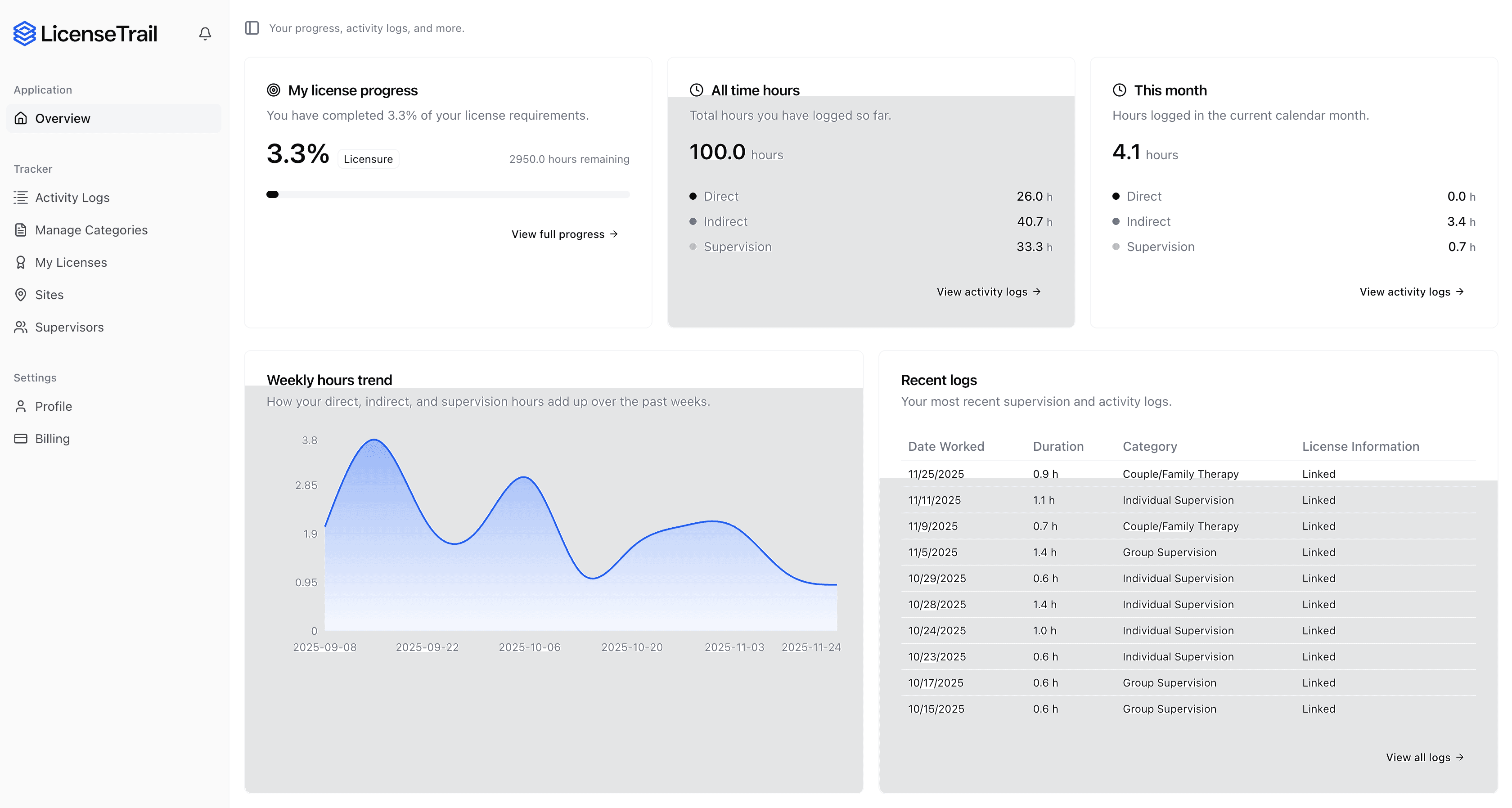
License Trail checks your direct, indirect, and supervision hours against Kentucky LPA requirements continuously and flags mismatches before you submit.
 Start Tracking for Free
No credit card required · Free plan available
Is your spreadsheet hiding Kentucky LPA risks?
Stop guessing if your categories match Kentucky Board of Examiners of Psychology requirements. License Trail checks your direct, indirect, and supervision hours continuously and flags mismatches before you submit.
Import or log
Bring your spreadsheet or start fresh
Upload your existing tracking spreadsheet and we'll map every hour into the right Kentucky Board of Examiners of Psychology categories automatically.
Verify against Kentucky
Catch mismatches before the board does
License Trail checks your direct, indirect, and supervision hours against Kentucky LPA requirements continuously.
Export board-ready
One-click clean reports
Generate professional, board-ready reports for supervision meetings and Kentucky Board of Examiners of Psychology submissions in seconds.
No credit card required · Free plan available