
Louisiana LMFT Requirements: Hours, Exams & Step-by-Step Guide
Stop guessing if your categories match Louisiana requirements. License Trail checks your direct, indirect, and supervision hours against LMFT requirements continuously and flags mismatches before you submit.
No credit card required · Free plan available
Quick Requirements Overview
- Regulator: Louisiana Licensed Professional Counselors Board of Examiners (LPC Board)
- Pathway: PLMFT (provisional) → LMFT; hours only count after official PLMFT approval (no retroactive hours)
- Education: Qualifying MFT degree/certificate (typically 60 graduate semester hours + practicum/internship); 6 credits diagnostic psychopathology required for many applicants (post‑1/1/2018)
- Supervised experience (for LMFT): 3,000 post‑master hours completed in 2–6 years while PLMFT
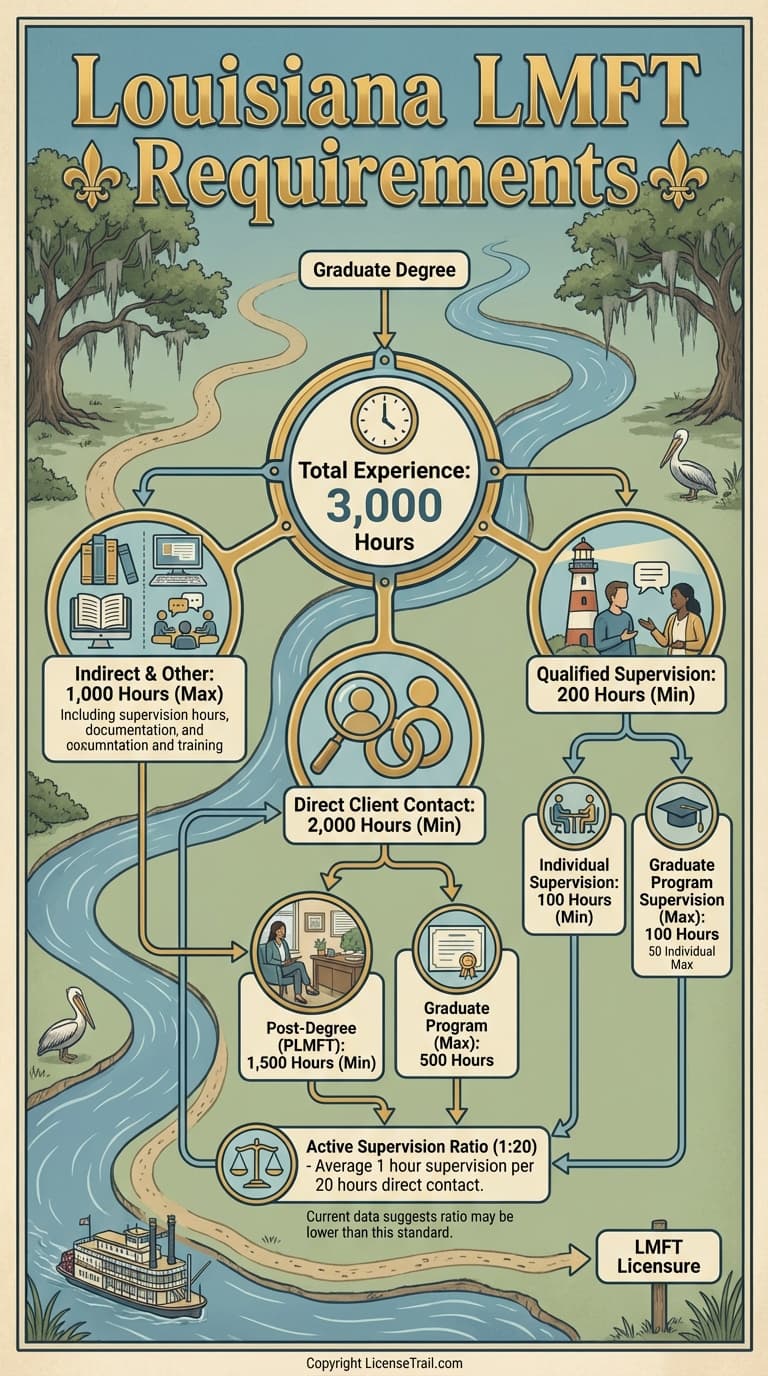
- Hour breakdown: 2,000 direct client contact + 1,000 indirect/other professional activities
- Supervision (within 3,000): 200 hours qualified, face‑to‑face supervision (HIPAA‑compliant video allowed); ≥100 individual (rest may be group)
- Graduate-hour credits allowed: Up to 500 direct hours + up to 100 supervision hours (max 50 individual) from qualifying graduate program may count
- Exam: Pass the National Marriage & Family Therapy Examination (NMFTE) (must be approved to sit)
License Details
Procedures
Louisiana regulates Marriage and Family Therapists through the Louisiana Licensed Professional Counselors Board of Examiners (often called the LPC Board). Licensure is a two‑stage process: first as a Provisional Licensed Marriage and Family Therapist (PLMFT), then as a Licensed Marriage and Family Therapist (LMFT). The supervised‑experience hours that matter for full licensure are accumulated while you hold the PLMFT.
Below is a step‑by‑step outline with the key hour requirements and the Board’s own terminology.
1. Licensure structure in Louisiana
- Regulator: Louisiana Licensed Professional Counselors Board of Examiners (LPC Board). (law.cornell.edu)
- Levels:
- PLMFT – Provisional Licensed Marriage and Family Therapist: post‑master, supervised status.
- LMFT – Licensed Marriage and Family Therapist: independent practice license.
To become an LMFT, you must:
- Meet the academic requirements for MFT licensure or provisional licensure. (regulations.justia.com)
- Obtain PLMFT status.
- Complete 3,000 hours of post‑master supervised experience in marriage and family therapy under a Board‑approved supervisor. (lpcboard.org)
- Pass the National Marriage and Family Therapy Examination (the national MFT exam). (law.cornell.edu)
- Apply to the LPC Board for full LMFT licensure and meet all general licensing requirements.
2. Academic requirements (“qualifying degree”)
Louisiana’s rules describe “Academic Requirements for MFT Licensure or Provisional Licensure” in the Administrative Code. (regulations.justia.com)
2.1 Degree type
You must have either:
- A master’s or doctoral degree in marriage and family therapy from a COAMFTE‑accredited program at a regionally‑accredited institution, or
- A COAMFTE‑accredited post‑graduate certificate in MFT, or
- Other options the Board approves (e.g., certain CACREP or Board‑approved MFT programs meeting detailed coursework requirements). (regulations.justia.com)
The qualifying degree must include:
- At least 60 graduate semester hours of coursework. (regulations.justia.com)
- A practicum and/or internship equivalent to COAMFTE standards.
2.2 Diagnostic psychopathology requirement
For applicants not previously Board‑approved as of January 1, 2018, the rules require a minimum of six graduate credits in diagnostic psychopathology, taught from a systemic/relational perspective and covering: psychopharmacology, health and illness, DSM‑5 and/or ICD‑10 diagnostic categories, and assessment/treatment planning within marriage and family systems. (regulations.justia.com)
3. Becoming a PLMFT (Provisional Licensed Marriage and Family Therapist)
You cannot start accruing Louisiana‑approved post‑master MFT hours until you are a PLMFT.
3.1 Apply for PLMFT
To be provisionally licensed, you must:
- Meet the academic requirements above.
- Submit the Board’s PLMFT application and fee.
- Submit a plan of supervision for approval by the Marriage and Family Therapy Advisory Committee.
- Receive an official letter from the Board approving you as a PLMFT before you begin counting supervised hours. (regulations.justia.com)
Louisiana’s rules emphasize that you may begin accruing client‑ and supervisor‑contact hours only after you have received that official PLMFT approval letter. (regulations.justia.com)
3.2 Time limits as a PLMFT
- PLMFTs must remain under active Board‑approved supervision for at least two years, but no more than six years. (lpcboard.org)
- You must apply for and be approved for full LMFT licensure within six years from the date of PLMFT approval, or you forfeit all supervised experience hours and must reapply under current requirements. (regulations.justia.com)
4. Supervised post‑master experience: the hour requirements
The LPC Board and Administrative Code both spell out the supervised‑experience requirements in quantitative terms.
4.1 Overall supervised‑experience requirement
To qualify for LMFT, you must:
“Document a minimum of 3000 hours of post‑masters supervised experience in marriage and family therapy under the clinical supervision of a Board‑Approved Supervisor” (lpcboard.org)
This 3,000‑hour total must be accumulated over at least two years and no more than six years from the original date your supervision is approved. (lpcboard.org)
Louisiana’s Administrative Code further describes this as “work experience in marriage and family therapy … [that] includes at least 3,000 hours of clinical services to individuals, couples, families, or groups.” (law.cornell.edu)
4.2 Breakdown of 3,000 hours
The Board’s application and the Administrative Code together make the breakdown explicit: (lpcboard.org)
Within the 3,000 post‑master hours you must have:
- 2,000 hours of direct client contact in marriage and family therapy.
- 1,000 hours of indirect work experience / indirect client contact and other professional activities.
- 200 hours of “qualified supervision” (face‑to‑face supervision), with at least 100 hours of individual supervision.
4.2.1 Direct client contact hours (2,000 hours)
Board language:
- A “Client Contact Hour” is a 50‑minute period a therapist spends working face‑to‑face with an individual, couple, family, or group. (regulations.justia.com)
- “Direct client contact” means face‑to‑face therapy with individuals, couples, families, and/or groups from a relational perspective; activities like phone calls, treatment planning, charting, travel, administration, consultation, or supervision do not count as direct. (regulations.justia.com)
The supervised‑experience section of the rules says that at least 1,500 hours must be direct work experience, and that up to 500 hours of direct work experience earned during a qualifying, systemically‑oriented graduate program may be counted toward the required 2,000 direct hours. (law.cornell.edu)
In practical terms:
- Total required direct hours:
- 2,000 direct client contact hours in marriage and family therapy.
- Source of those hours:
- At least 1,500 must be post‑master, supervised direct work as a PLMFT.
- Up to 500 may be credited from your qualifying graduate practicum/internship, if that program is systemically oriented and approved by the Advisory Committee.
Direct hours must be psychotherapy services with individuals, couples, or families where you are explicitly applying marriage and family systems theory, not generic counseling tasks.
4.2.2 Indirect work experience / indirect client contact hours (1,000 hours)
The same rule states that:
- The remaining 1,000 hours may be “indirect work experience or other professional activities” approved by the Advisory Committee. (law.cornell.edu)
Examples (per the rule’s wording) include:
- Qualified supervision
- Workshops / continuing education
- Public relations
- Administrative tasks
- Consulting with referral sources
and similar professional activities tied to your role as an MFT. (regulations.justia.com)
The LPC Board’s application page calls these “indirect client contact hours.” (lpcboard.org)
4.2.3 Qualified supervision hours (200 hours, within the 3,000)
Louisiana defines “qualified supervision” as supervision of the clinical services of a PLMFT by a Board‑approved supervisor or registered supervisor candidate under an approved plan of supervision, for the purpose of qualifying the PLMFT for licensure as an LMFT. (regulations.justia.com)
Key points:
- You must complete at least 200 hours of qualified supervision, of which:
- At least 100 hours must be individual supervision (one‑on‑one).
- The other 100 hours may be group supervision. (regulations.justia.com)
- Up to 100 face‑to‑face supervision hours earned during your qualifying graduate program may be counted toward this 200‑hour requirement, but no more than 50 of those may count as individual supervision. (regulations.justia.com)
- All qualified supervision must be “face‑to‑face” contact between you and the supervisor. The rules allow up to 100% of those face‑to‑face hours via HIPAA‑compliant synchronous videoconferencing. (regulations.justia.com)
- Supervision that is purely administrative performance review, or typical didactic classroom/CE training does not normally count as qualified supervision unless specifically included and approved in your plan of supervision. (regulations.justia.com)
The Board’s own application summary mirrors this, requiring:
“a minimum of 200 face-to-face supervision hours” (as part of the 3,000) under a Board‑Approved Supervisor. (lpcboard.org)
5. Supervision conditions and who may supervise
- Supervision must be provided by a Board‑approved LMFT supervisor or registered supervisor candidate meeting the qualifications in §3317 (LMFT‑Approved Supervisor / LMFT‑Registered Supervisor Candidate). (law.cornell.edu)
- Your plan of supervision must reflect that you are being supervised in “the application of systemically based approaches to therapy with all clients.” (regulations.justia.com)
- You cannot count supervision or client‑contact hours that occur before your PLMFT is officially approved, nor can you count “retroactive” hours. (regulations.justia.com)
6. Examination requirements
The examination rules are concise:
- Required exam: the National Marriage and Family Therapy Examination (NMFTE) – described in rule as “the national marriage and family therapy examination as determined by the advisory committee. No other examination will be accepted.” (law.cornell.edu)
- You cannot sit for the exam until the Advisory Committee has approved you as an exam candidate. (law.cornell.edu)
The LPC Board’s FAQ clarifies that PLMFTs must both pass the NMFTE and document the full 3,000 hours of post‑master supervised experience to be eligible for LMFT licensure. (lpcboard.org)
(Some secondary sources mention a separate Louisiana jurisprudence exam; if required, its details will be in the LMFT application packet. The controlling regulation, however, only mandates the national MFT exam.)
7. Applying for full LMFT licensure
Once you have:
- Held PLMFT status for at least two years (but not more than six), (lpcboard.org)
- Completed and documented the required 3,000 supervised hours (2,000 direct; 1,000 indirect; 200 qualified supervision), (lpcboard.org)
- And passed the National MFT Exam, (law.cornell.edu)
you submit an LMFT licensure application to the LPC Board. The Board’s site and forms (which change periodically) specify:
- A non‑refundable application fee (amount set by the Board),
- Official graduate transcripts,
- Verification forms for all supervised hours signed by your Board‑approved supervisor(s),
- A criminal records check and privacy statement,
- A Statement of Practices and Procedures, and
- Any additional documentation the Board prescribes. (lpcboard.org)
Once approved, you are granted the LMFT license and may independently provide marriage and family therapy services to the public for a fee within Louisiana. (lpcboard.org)
8. Summary of hour requirements in Louisiana language
Putting the numbers together in the style you requested:
-
Total supervised post‑master experience:
- 3,000 hours of post‑masters supervised experience in marriage and family therapy (clinical services to individuals, couples, families, or groups). (lpcboard.org)
-
Direct experience requirement:
- 2,000 hours of direct client contact, defined as 50‑minute, face‑to‑face psychotherapy sessions with individuals, couples, families, or groups from a relational perspective (client contact hours). (lpcboard.org)
- Of these, at least 1,500 hours must be post‑master direct work under supervision as a PLMFT; up to 500 direct hours from a qualifying, systemically‑oriented graduate practicum may be counted toward the 2,000. (law.cornell.edu)
-
Indirect / other professional experience requirement:
- 1,000 hours of indirect work experience or other professional activities, which may include qualified supervision, documentation, administrative tasks, consultation, workshops, and related activities approved in your supervision plan. (lpcboard.org)
-
Supervision requirement (within the 3,000 hours):
- At least 200 hours of “qualified supervision,” provided by a Board‑approved supervisor or registered supervisor candidate under an approved plan of supervision.
- At least 100 of those 200 hours must be individual supervision; the remainder may be group supervision.
- Up to 100 supervision hours from your qualifying graduate program may apply, with no more than 50 counted as individual supervision. (regulations.justia.com)
All of these hours must be accrued after formal PLMFT approval, within a supervision period lasting no fewer than two and no more than six years. (lpcboard.org)
This reflects the LPC Board’s current rules and website as of late 2025. For any application, always cross‑check the latest Board Rules (Title 46, Part LX, Subpart 2, Chapter 33) and the LPC Board application forms, as the Board periodically updates procedures, but the core hour structure summarized above is what the Board itself requires.
Track your LMFT hours with confidence
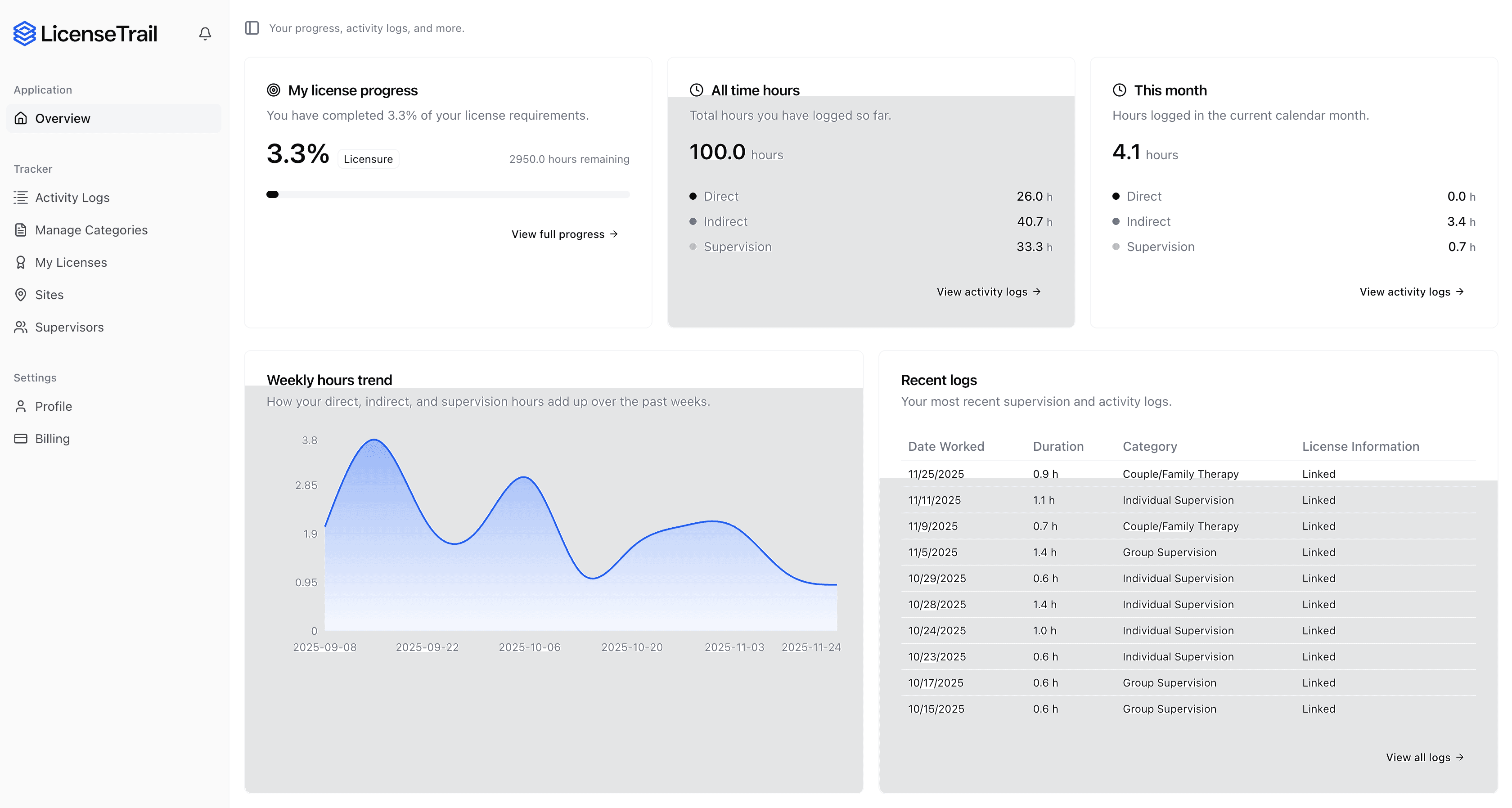
License Trail checks your direct, indirect, and supervision hours against Louisiana LMFT requirements continuously and flags mismatches before you submit.
 Start Tracking for Free
No credit card required · Free plan available
Related Licenses
Is your spreadsheet hiding Louisiana LMFT risks?
Stop guessing if your categories match Louisiana Licensed Professional Counselors Board of Examiners requirements. License Trail checks your direct, indirect, and supervision hours continuously and flags mismatches before you submit.
Import or log
Bring your spreadsheet or start fresh
Upload your existing tracking spreadsheet and we'll map every hour into the right Louisiana Licensed Professional Counselors Board of Examiners categories automatically.
Verify against Louisiana
Catch mismatches before the board does
License Trail checks your direct, indirect, and supervision hours against Louisiana LMFT requirements continuously.
Export board-ready
One-click clean reports
Generate professional, board-ready reports for supervision meetings and Louisiana Licensed Professional Counselors Board of Examiners submissions in seconds.
No credit card required · Free plan available