
Louisiana LPC Requirements: Hours, Exams & Step-by-Step Guide
Stop guessing if your categories match Louisiana requirements. License Trail checks your direct, indirect, and supervision hours against LPC requirements continuously and flags mismatches before you submit.
No credit card required · Free plan available
Quick Requirements Overview
- Eligibility: Age 21+, good moral character, and no practice act/Board rule violations
- Education: 60 semester-hour graduate degree in professional mental health counseling (or counseling “in substance”) from a regionally accredited university
- Provisional stage required: Must hold PLPC and have Board-approved supervision before hours count; no independent practice and no direct client payment
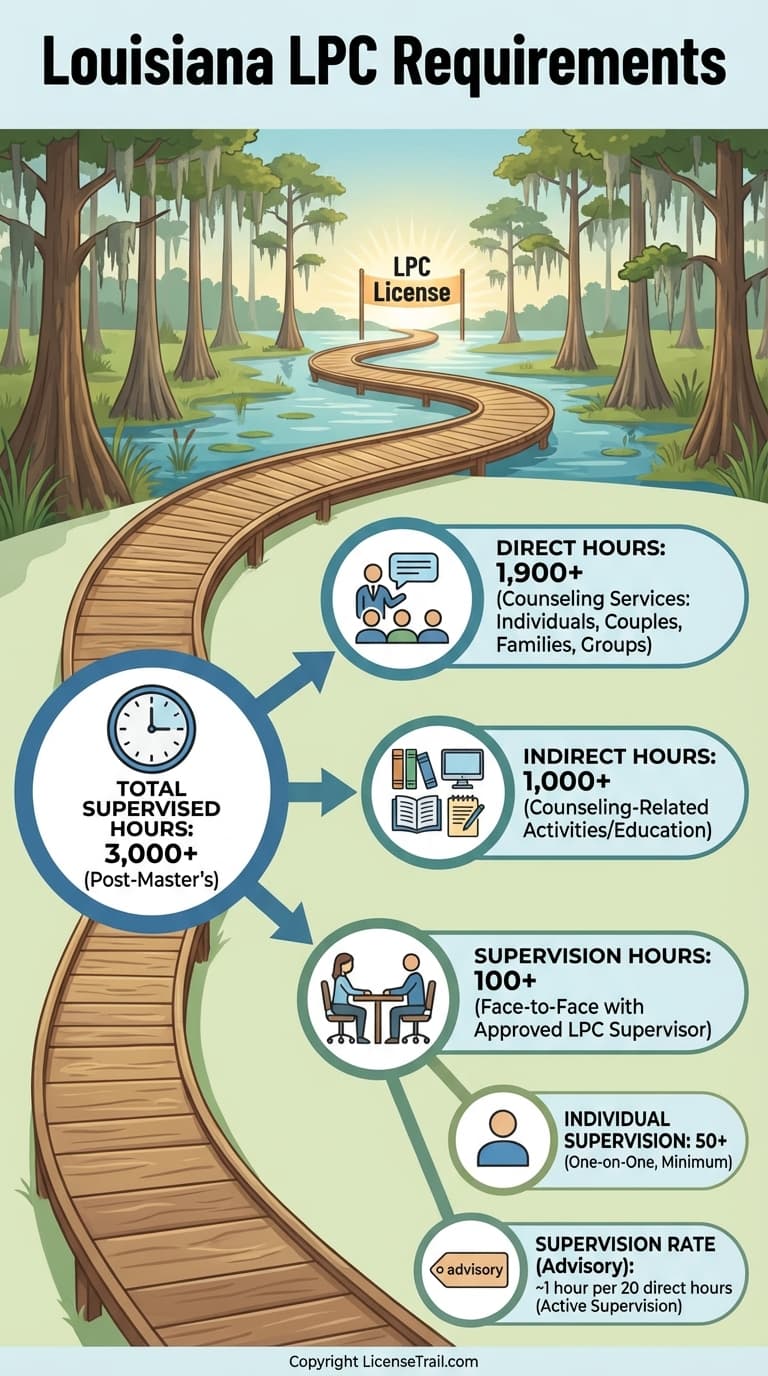
- Supervised experience: 3,000 post-master’s hours under a Board-Approved Supervisor, completed in 2–6 years from supervision approval
- Hour breakdown minimums: 1,900 direct client-contact hours + 1,000 indirect hours + 100 face-to-face supervision hours (≥50 individual; remainder individual/group with 2–10 supervisees)
- Supervision cadence (“active supervision”): 1 hour supervision per 20 direct client hours (or at least once every 3 months)
- Exam: Pass NCE or NCMHCE (Board may require additional/oral exam; PLPC must attempt each renewal until passed)
- Coursework substitution (limited): 500 indirect hours credit per 30 post-master’s graduate semester hours (Board-approved), but total supervised experience cannot drop below 2,000 hours
License Details
Procedures
Becoming a Licensed Professional Counselor (LPC) in Louisiana is a two‑stage process overseen by the Louisiana Licensed Professional Counselors Board of Examiners. You first practice as a Provisional Licensed Professional Counselor (PLPC) under supervision, then upgrade to full LPC once all supervised hours and exam requirements are complete. The details below use the Board’s own categories and terminology.
1. Statutory and Board-Level Basics
The Board issues LPC licenses under Louisiana Revised Statutes 37:1101–1123 and the Louisiana Administrative Code, Title 46, Part LX. To receive an LPC license, an applicant must: (law.cornell.edu)
- Be at least 21 years old.
- Be of good moral character.
- Not be in violation of any provisions of the practice act or Board rules.
- Hold an approved graduate degree in counseling (see below).
- Document the required supervised post‑master’s experience.
- Pass a Board‑approved national examination.
2. Educational Prerequisite
The Board requires a graduate degree in counseling or a closely related field that is counseling in substance:
- Degree level and length: A “60 semester hour graduate degree the substance of which is professional mental health counseling from a regionally‑accredited university”. (lpcboard.org)
- The degree must be from a regionally accredited institution and meet the Board’s academic content requirements in Chapter 6 of its rules. (law.cornell.edu)
(Individual programs typically include a supervised practicum and internship, but the LPC license itself hinges on the 60‑hour counseling degree plus the post‑master’s supervised experience described below.)
3. Stage One: Provisional Licensed Professional Counselor (PLPC)
You cannot start accruing LPC supervision hours until you are provisionally licensed as a PLPC and have an approved supervision arrangement.
3.1 PLPC Scope of Practice
The Board defines a PLPC as someone who, under board‑approved supervision, provides professional mental health counseling/psychotherapy services and “may not practice independently”. (lpcboard.org)
Additional Board language and limits:
- PLPCs must be under active supervision of a Board‑Approved Supervisor and “may not practice independently or receive direct payment for services rendered.” (lpcboard.org)
- PLPCs are working toward independent licensure and must accrue a minimum of 3,000 hours of supervised experience in a minimum timeframe of two years before they may be considered for LPC licensure. (lpcboard.org)
3.2 Active Supervision (PLPC Level)
On its PLPC information page, the Board defines Active Supervision as:
A process by which a supervisee receives **one hour of face‑to‑face supervision with his/her board‑approved supervisor for every 20 hours of direct client contact or at least once every three‑month period. (lpcboard.org)
PLPCs must remain under this “active supervision” until they become fully licensed LPCs. (law.cornell.edu)
4. Core LPC Supervised Experience Requirements
4.1 Total Hours and Timeframe
Both the statute and Board rules require: (law.cornell.edu)
-
Total hours:
A minimum of 3,000 hours of post‑master’s experience in professional mental health counseling, under the clinical supervision of a Board‑Approved Supervisor. -
Timeframe:
These supervised hours must occur over “a period of no less than two years and not more than six years from the original date such supervision was approved.”
The Board’s application page restates this as a requirement to:
“Document a minimum of 3,000 hours of post‑masters supervised experience in professional mental health counseling under the clinical supervision of a Board‑Approved Supervisor…” (lpcboard.org)
The 3,000 hours are then broken down into direct client contact hours, indirect hours, and supervision hours.
5. Hour Types as Defined by the Board
The Louisiana Administrative Code, Title 46, § LX‑605 (“Supervised Practice Requirements”), spells out the minimum standards for PLPC supervised practice and how the 3,000 hours must be accrued. (law.cornell.edu)
5.1 Direct Client Contact Hours
The Board’s rules specify:
- Minimum direct hours
“A minimum of 1,900 hours in direct counseling/psychotherapeutic services involving individuals, couples, families, or groups.” (law.cornell.edu)
In Board language, Direct Hours are:
- Counseling/psychotherapy services provided directly to clients (individuals, couples, families, or groups). (law.cornell.edu)
Important details:
-
Counting practicum/internship direct hours:
The Board allows an applicant to count supervised direct hours earned in post‑master’s degree practicum and internship courses toward the 1,900 direct hours, but only if: (law.cornell.edu)- The practicum/internship is part of a post‑master’s counseling degree program from a regionally accredited university;
- The hours occurred after the applicant had been approved for provisional licensure; and
- The applicant was under the supervision of a Board‑Approved Supervisor at the time.
-
What cannot count as direct hours:
Hours spent supervising others (for example, in supervision courses or doctoral students supervising master’s students) may not be counted toward an applicant’s direct hours. (law.cornell.edu)
In practice, this means you must personally deliver at least 1,900 hours of counseling/psychotherapy to clients, even if some of those hours overlap with approved post‑master’s practicum or internship experiences.
5.2 Indirect Hours
The Board defines Indirect Hours and the minimum number required:
- Minimum indirect hours
The rules require “a minimum of 1,000 indirect hours in counseling‑related activities or education at the graduate level in the field of mental health counseling.” (law.cornell.edu)
Indirect hours may include, but are not limited to: (law.cornell.edu)
- Client‑related contact that is not face‑to‑face therapy (e.g., phone calls for coordination of care);
- Case notes and record‑keeping;
- Staffings and team meetings;
- Case consultation;
- Testing/assessment of clients;
- Certain graduate‑level coursework in mental health counseling (discussed more below).
The Board’s statute section on licensing requirements also allows “Five hundred indirect hours of supervised experience [to] be gained for each 30 graduate semester hours earned beyond the required master’s degree”, subject to conditions and an absolute minimum of 2,000 supervised hours total (see 5.4). (law.cornell.edu)
5.3 Supervision Hours
The Board treats supervision as its own category of required hours.
-
Minimum supervision hours
The rules require:“A minimum of 100 hours of face‑to‑face supervision by a LPC Supervisor.” (law.cornell.edu)
-
Format of supervision:
- Face‑to‑face includes in‑person or synchronous videoconferencing on a HIPAA‑compliant platform; up to 100% of the 100 hours may be done via such videoconferencing. (law.cornell.edu)
- Supervision may not take place via mail, email, or telephone. Contacts by phone, mail, or email can count as indirect hours (consultation), but cannot be counted as “face‑to‑face supervision.” (law.cornell.edu)
-
Individual vs. group supervision requirements:
- At least 50 of the 100 hours must be individual supervision (one PLPC with the LPC Supervisor). (law.cornell.edu)
- The remaining up to 50 hours may be either individual or group supervision. In group supervision, the session is conducted by the supervisor with 2 to no more than 10 PLPCs present. (law.cornell.edu)
These supervision hours are in addition to the direct and indirect hours; they are not a subset of them.
5.4 Using Additional Graduate Coursework to Substitute Some Indirect Hours
Louisiana allows limited substitution of supervised indirect hours with additional graduate coursework:
-
The statute and rules state that “Five hundred indirect hours of supervised experience may be gained for each 30 graduate semester hours earned beyond the required master’s degree” as long as: (law.cornell.edu)
- The coursework is clearly related to the field of mental health counseling;
- It is earned from a regionally accredited institution; and
- It is acceptable to the Board.
-
Courses used to substitute for indirect hours cannot also be counted as direct hours. For example, practicum or internship courses may not be included in the 30 extra semester hours if they are already being counted toward your direct hours. (law.cornell.edu)
-
Even with substitution, the Board requires that an applicant must still have “no less than 2,000 hours of board‑approved supervised experience” overall. (law.cornell.edu)
In effect, advanced post‑master’s study can reduce the number of indirect hours you must accrue on the job, but cannot reduce your total supervised experience below 2,000 hours, nor can it replace the 1,900 direct or 100 supervision minimums.
5.5 Concurrent Hours with LMFT (if applicable)
For applicants who also hold Provisional Licensed Marriage and Family Therapist (PLMFT) status, the Board allows some coordination:
- “Supervised experience hours for PLPC and PLMFT may be accrued concurrently,” but only after you have been approved for both provisional licenses and only prospectively (retroactive hours are not permitted). (law.cornell.edu)
This is mainly relevant if you are pursuing both LPC and LMFT licensure in Louisiana.
5.6 Documentation Responsibilities
The Board places responsibility on the supervisee to track hours:
- The rules state that “The supervisee must maintain documentation of all supervised experience hours by employment location and type of hour (indirect, direct, and face to face supervision).” It is recommended that supervisees obtain their supervisor’s signature on documentation at regular intervals. (law.cornell.edu)
Accurate logs, broken down by site and by hour type, are essential when you later apply for full LPC licensure.
6. National Examination Requirement
To demonstrate professional competence, Louisiana requires passage of a Board‑approved national counseling exam:
-
The Board’s licensing rule requires that an LPC applicant “has declared special competencies and demonstrated professional competence therein by passing a written exam (NCE or NCMHCE)”, and the Board reserves discretion to require an oral exam as well. (law.cornell.edu)
-
On its application page, the Board specifies:
“Passing the National Counselor Examination (NCE) or the National Clinical Mental Health Counseling Examination (NCMHCE).” (lpcboard.org)
PLPCs must also attempt one of these exams each renewal period until they pass. (lpcboard.org)
7. Final LPC Application and Licensure
Once you have completed all prerequisites, the final steps are:
-
Meet all supervised experience requirements
- At least 3,000 post‑master’s hours under Board‑Approved supervision.
- Including ≥ 1,900 direct client contact hours, ≥ 1,000 indirect hours, and ≥ 100 face‑to‑face supervision hours, accrued in 2–6 years from the date your supervision plan was approved. (lpcboard.org)
-
Ensure statutory conditions are satisfied
- Age ≥ 21, good moral character, no violations of the practice act or Board rules. (law.cornell.edu)
-
Pass the NCE or NCMHCE (and any additional exam the Board may require). (law.cornell.edu)
-
Submit the LPC application through the Board’s online system
- Choose the “Licensed Professional Counselor (LPC)” application track.
- Provide verification of your 60‑hour counseling degree, supervisee logs and supervisor attestations, and exam scores, in the format required by the Board. (lpcboard.org)
-
Await Board review and issuance of license
- The Board will review your education, supervised experience, and exam results under the criteria in Title 46, Part LX and, if satisfied, issue your LPC license. (law.cornell.edu)
8. Quick Hour-Breakdown Snapshot (Board Language)
Using the Louisiana LPC Board’s own categories and numbers, the supervised experience requirement for LPC licensure is:
-
Total supervised experience:
3,000 hours of post‑master’s experience in professional mental health counseling under a Board‑Approved Supervisor, over 2–6 years. (law.cornell.edu) -
Direct client contact (“direct hours”):
Minimum 1,900 hours of direct counseling/psychotherapeutic services with individuals, couples, families, or groups. (law.cornell.edu) -
Indirect hours:
Minimum 1,000 hours in counseling‑related activities (e.g., case notes, staffing, consultation, testing/assessment) or qualifying graduate‑level education in mental health counseling, with limited substitution permitted for additional coursework. (law.cornell.edu) -
Supervision hours:
Minimum 100 hours of face‑to‑face supervision by an LPC Supervisor, of which at least 50 must be individual; up to 100% may occur via synchronous HIPAA‑compliant videoconferencing. (law.cornell.edu)
All of these requirements must be met while you hold PLPC status and remain under active supervision, before the Board will issue you a full LPC license.
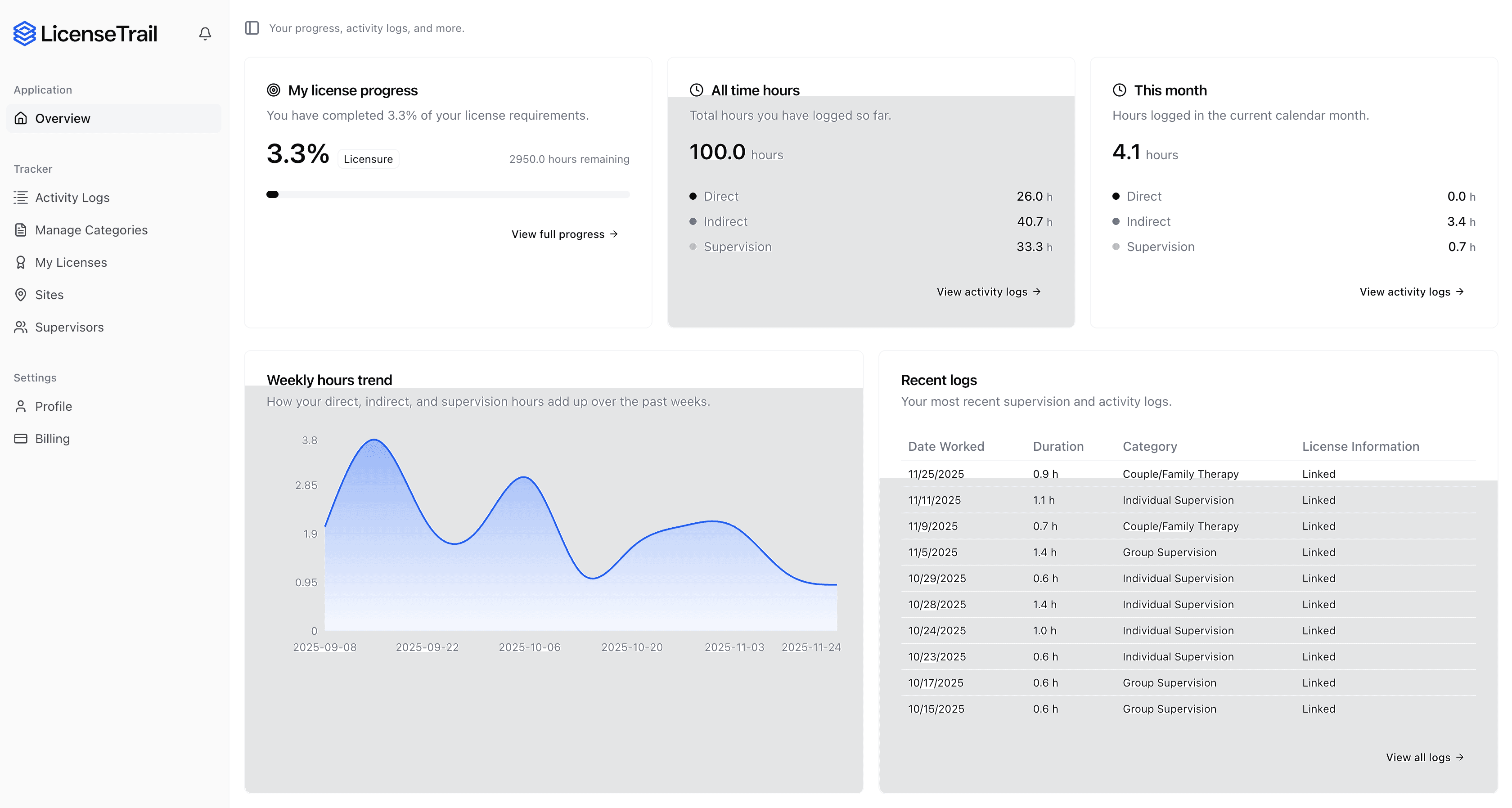
Track your LPC hours with confidence
License Trail checks your direct, indirect, and supervision hours against Louisiana LPC requirements continuously and flags mismatches before you submit.
 Start Tracking for Free
No credit card required · Free plan available
Related Licenses
Is your spreadsheet hiding Louisiana LPC risks?
Stop guessing if your categories match Louisiana Licensed Professional Counselors Board of Examiners requirements. License Trail checks your direct, indirect, and supervision hours continuously and flags mismatches before you submit.
Import or log
Bring your spreadsheet or start fresh
Upload your existing tracking spreadsheet and we'll map every hour into the right Louisiana Licensed Professional Counselors Board of Examiners categories automatically.
Verify against Louisiana
Catch mismatches before the board does
License Trail checks your direct, indirect, and supervision hours against Louisiana LPC requirements continuously.
Export board-ready
One-click clean reports
Generate professional, board-ready reports for supervision meetings and Louisiana Licensed Professional Counselors Board of Examiners submissions in seconds.
No credit card required · Free plan available