
Louisiana LMSW Requirements: Hours, Exams & Step-by-Step Guide
Stop guessing if your categories match Louisiana requirements. License Trail checks your direct, indirect, and supervision hours against LMSW requirements continuously and flags mismatches before you submit.
No credit card required · Free plan available
Quick Requirements Overview
- Regulator: Louisiana State Board of Social Work Examiners (LABSWE) under La. R.S. 37:2701–2720 and LAC Title 46, Part XXV
- Education: MSW from a CSWE-accredited program; official transcript sent directly to LABSWE
- Screening: Good moral character + fingerprint-based state & federal criminal background check
- Exam: Pass board-approved exam (ASWB Master’s exam)
- Application: Submit complete application + nonrefundable fee; incomplete applications not reviewed; approval at board meeting
- Practice limits: No independent/private practice; restrictions on direct contracting, billing/receiving direct payment (except via governmental contract), and claiming private practice
- Clinical supervision (if providing psychotherapy): Must be supervised by an LCSW with ≥2 hours/month ongoing (records required)
- Renewal/CE: 20 CE hours annually (July 1–June 30); ethics: 3 hours every 2 years; ≤10 hours/year via distance learning unless exception granted
License Details
Procedures
Louisiana’s Licensed Master’s Social Worker (LMSW) credential sits at the center of the state’s social work licensing system. It is the master’s‑level license for non‑clinical and supervised clinical practice, regulated by the Louisiana State Board of Social Work Examiners (LABSWE) under the Louisiana Social Work Practice Act (La. R.S. 37:2701–2720) and the Louisiana Administrative Code, Title 46, Part XXV.(law.justia.com)
This guide walks through:
- What “LMSW” means in Louisiana law
- The exact requirements to obtain the LMSW
- The hours and supervision rules that apply once you are an LMSW, especially if you plan to become an LCSW
- Ongoing continuing‑education requirements
1. How Louisiana defines an LMSW and other credentials
Louisiana law defines a:
- Licensed master’s social worker (LMSW) as a person “duly registered to practice master’s social work” under the Social Work Practice Act.(law.justia.com)
- Certified social worker (CSW) as a temporary certification that lets an MSW graduate perform the duties of an LMSW for up to three years while pursuing licensure.(law.justia.com)
- Licensed clinical social worker (LCSW) as the only social work credential permitted to engage in independent and private practice of social work.(regulations.justia.com)
The LMSW is therefore the standard licensed master’s‑level credential; CSW is a bridge status used while the new graduate passes the exam, and LCSW is the independent clinical license.
2. Core qualifications to become an LMSW (initial licensure)
The authoritative requirements are in Louisiana Administrative Code (LAC) Title 46, Part XXV, §305(B). In plain language, to qualify for Licensed Master Social Worker (LMSW) you must meet three conditions:(regulations.justia.com)
2.1. Good moral character and criminal background check
The Board explicitly requires that an LMSW applicant:
- Be “of good moral character”, and
- Submit a full set of fingerprints for state and federal criminal records checks.
The rule states that criminal‑record information is one element of determining good moral character, and that all such information is considered in licensing decisions to the extent allowed by law.(regulations.justia.com)
2.2. Master’s degree in social work (MSW)
You must have the university send official transcripts directly to the Board showing:
- A master’s degree in social work from a graduate program accredited by the Council on Social Work Education (CSWE).(regulations.justia.com)
No alternative degree (e.g., counseling, psychology) substitutes for the MSW for LMSW licensure in Louisiana.
2.3. Passing the licensing examination
The rule requires that:
- The applicant “obtain a passing score on an examination approved by the board.”(regulations.justia.com)
Louisiana uses the Association of Social Work Boards (ASWB) Master’s‑level examination as the exam “approved by the board” for LMSW.(online.simmons.edu)
3. Application process and the CSW “bridge” status
3.1. Submitting the application
Under LAC §309 (Application Procedure), the process is:(regulations.justia.com)
- Obtain forms: Applications and instructions are downloaded from the Board’s website or requested from the Board office.
- Submit a complete application for licensure, including:
- Completed forms
- Applicable non‑refundable application fee (money order, certified check, or credit card)
- Official transcripts sent by the university
- Fingerprints for the criminal background check
- Board review: Applications are reviewed and approved at regularly scheduled Board meetings. Incomplete applications are not considered.
3.2. Certified Social Worker (CSW) as temporary status
If you have completed the degree and background check but have not yet passed the LMSW exam, the Board may grant you the Certified Social Worker (CSW) credential:(regulations.justia.com)
- A CSW meets all LMSW requirements except passing the exam.
- CSW status can last up to three years from the original issuance date.
- You must take the LMSW examination:
- Within the first six months after certification, and
- At least annually for the next 2½ years if you have not yet passed.
- If you still have not passed after three years, the rule allows you to apply instead for the Registered Social Worker (RSW) credential.
Importantly, the statute states that the CSW credential “entitles the master of social work graduate to perform the duties and responsibilities within the scope of practice of the licensed master social worker” while pursuing full licensure.(law.justia.com)
4. Practice restrictions and supervision rules once you are an LMSW
The Board’s practice rules for LMSWs appear mainly in LAC §303 (Practice) and Chapter 5 (Minimum Supervision Requirements).(regulations.justia.com)
4.1. LMSWs are not allowed independent or private practice
Section 303 states that only an LCSW may engage in the independent and private practice of social work.(regulations.justia.com)
For licensed master social workers and certified social workers, §303(D) specifically prohibits them from:(regulations.justia.com)
- Contracting directly with individuals, couples, families, or non‑governmental agencies for clinical services, consultation, supervision, or educational services;
- Billing for services except through a governmental agency contract;
- Receiving direct payment for services except through a governmental contract;
- Claiming to be in private practice.
In other words, as an LMSW you must work within an agency or organization, not as an independent provider, unless and until you become an LCSW.
4.2. Supervision for LMSWs doing clinical work but not seeking the LCSW
If you are an LMSW (or CSW) who is providing psychotherapy/clinical services but not in a Board‑approved LCSW‑track supervision arrangement, you fall under LAC §505:(regulations.justia.com)
- You may deliver psychotherapy only under supervision of an LCSW (this LCSW does not have to be a Board‑Approved Clinical Supervisor/BACS).
- Supervision must total at least two hours per month, in increments of at least 30 minutes, for as long as you are providing psychotherapy.
- Supervision can be individual, group, by phone, or via secure electronic media.
- Both supervisor and supervisee must keep accurate records of dates and hours of supervision for potential Board audit.
These are ongoing supervision requirements, not a finite total of hours. The regulation does not specify a set number of clinical or supervised hours you must complete solely to keep the LMSW license.
5. Hour requirements that apply to LMSWs who are seeking the LCSW
The only concrete hour requirements in Louisiana law relate to LCSW licensure, not to initial LMSW licensure. However, they are directly relevant to LMSWs because only an LMSW (not a CSW or RSW) can begin accruing Board‑approved supervision for LCSW.(mswguide.org)
5.1. Total practice and supervised hours for LCSW
Two sections govern the LCSW hour requirements:
- LAC §305(D) (qualifications for LCSW), and
- LAC §503 (LMSWs Seeking the LCSW Credential).(regulations.justia.com)
Together, they require an LMSW who wants to become an LCSW to complete:
- 5,760 hours of postgraduate social work practice after the MSW; and
- At least 3,840 of those hours under supervision by a Board‑Approved Clinical Supervisor (BACS), documented on Board forms.(regulations.justia.com)
So, if you are looking for a numerical breakdown of hours, Louisiana’s language is:
- 5,760 hours – total post‑MSW social work practice, and
- 3,840 hours – of that total must be supervised by a BACS.
There is no separate requirement like “X hours of direct client contact and Y hours of general practice” written into the regulations; the division is simply “total practice” vs. “practice under BACS supervision.”
5.2. Required supervision sessions (96 hours face‑to‑face)
Within the 3,840 supervised hours, LAC §503(E) adds a further requirement:
- You must complete 96 hours of face‑to‑face supervision between supervisor and supervisee.
- Each supervision session must be at least 30 minutes and no longer than two hours.
- No more than 80 hours of practice may occur between supervisory meetings. If that rule is violated, supervision credit is reduced and not all hours may count.(regulations.justia.com)
5.3. Group supervision limits
Louisiana allows some supervision to be in groups, but with strict caps:(regulations.justia.com)
- At most one‑half of the 96 supervision hours (i.e., up to 48 hours) may be group supervision.
- Group sessions must be in blocks of no more than two hours.
- No more than five supervisees may be in a supervision group.
- A supervisor may request Board approval to use up to 72 hours of group supervision in some cases, but must provide written rationale; the Board acts on such requests at regular meetings.
5.4. Monitoring and documentation
To protect the integrity of supervised hours, LAC §503(I)–(N) requires:(regulations.justia.com)
- Both supervisor and supervisee keep detailed records (dates, times, duration, and content summary) for each supervisory session.
- Both must sign for each session on the Board’s Record of Supervision form.
- At the end of supervision, the LMSW submits:
- The Record of Supervision, and
- A Professional Experience Verification form from each employer verifying the hours of social work practice.
- The Board may audit records and reduce supervision credit if irregularities are found.
These hour requirements are only for upgrading from LMSW to LCSW. You can be and remain an LMSW without ever completing the 5,760/3,840 hour package, as long as you work in appropriate settings and under required supervision when doing clinical work.
6. Continuing education and renewal for an LMSW
Once licensed, an LMSW must comply with the continuing‑education (CE) rules in LAC §317(K):(regulations.justia.com)
- 20 clock hours of CE every year (collection period July 1 – June 30).
- Of those hours, three clock hours in social work ethics are required once every two years.
- No more than 10 of the 20 hours may be completed via distance learning (online, home‑study, telecourse, etc.) unless the Board grants a specific exception.(regulations.justia.com)
CE must come from:
- Social work licensing bodies, professional social work organizations, or CSWE‑accredited schools, or
- Providers approved by the Association of Social Work Boards (ASWB), or
- Other offerings that the social worker can justify as related to social work practice (using the Board’s CE assessment guide).(regulations.justia.com)
7. Summary of key quantitative requirements for an LMSW in Louisiana
Putting the Board’s language into a concise checklist:
To obtain the LMSW license (initial licensure)
- Education: MSW from a CSWE‑accredited graduate social work program (transcript sent directly to LABSWE).(regulations.justia.com)
- Character & background: Of “good moral character,” demonstrated in part through a fingerprint‑based state and federal criminal records check.(regulations.justia.com)
- Exam: Passing score on the Board‑approved exam (ASWB Master’s‑level).(regulations.justia.com)
- Application: Completed application, fee, and supporting documents, reviewed and approved at a Board meeting.(regulations.justia.com)
Hours specifically tied to the LMSW credential itself
- There is no set number of post‑degree practice hours required just to become or remain an LMSW.
- Instead, hour requirements appear:
- As ongoing minimum supervision (2 hours/month) when an LMSW or CSW is providing psychotherapy but not in a BACS‑supervised LCSW track.(regulations.justia.com)
- As LCSW‑track requirements: 5,760 total hours of post‑MSW social work practice, including 3,840 BACS‑supervised hours and 96 hours of face‑to‑face supervision, for those LMSWs who seek to become LCSWs.(regulations.justia.com)
Ongoing requirements once licensed as an LMSW
- Practice context: May not engage in independent or private practice; must work within agencies or organizations and follow supervision rules for any clinical/psychotherapeutic services.(regulations.justia.com)
- Continuing education: 20 hours of Board‑approved CE every year, including 3 hours in ethics every two years; no more than 10 hours per year via distance learning without special approval.(regulations.justia.com)
Taken together, Louisiana’s framework makes LMSW licensure primarily about education, examination, and ethical screening, while intensive hour‑based requirements are reserved for LMSWs progressing to independent clinical practice as LCSWs.
Track your LMSW hours with confidence
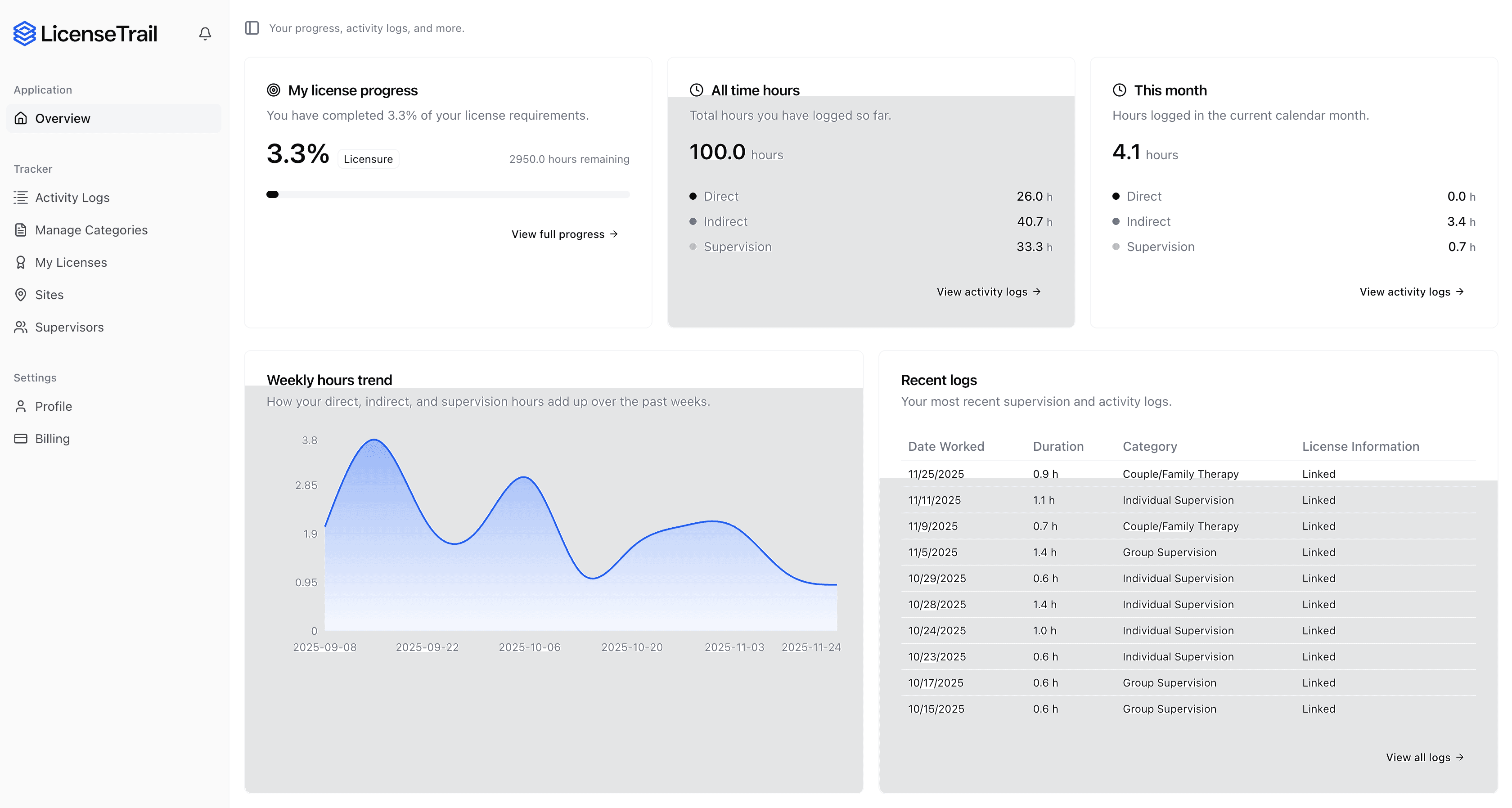
License Trail checks your direct, indirect, and supervision hours against Louisiana LMSW requirements continuously and flags mismatches before you submit.
 Start Tracking for Free
No credit card required · Free plan available
Related Licenses
Is your spreadsheet hiding Louisiana LMSW risks?
Stop guessing if your categories match Louisiana State Board of Social Work Examiners requirements. License Trail checks your direct, indirect, and supervision hours continuously and flags mismatches before you submit.
Import or log
Bring your spreadsheet or start fresh
Upload your existing tracking spreadsheet and we'll map every hour into the right Louisiana State Board of Social Work Examiners categories automatically.
Verify against Louisiana
Catch mismatches before the board does
License Trail checks your direct, indirect, and supervision hours against Louisiana LMSW requirements continuously.
Export board-ready
One-click clean reports
Generate professional, board-ready reports for supervision meetings and Louisiana State Board of Social Work Examiners submissions in seconds.
No credit card required · Free plan available