
Louisiana LP Requirements: Hours, Exams & Step-by-Step Guide
Stop guessing if your categories match Louisiana requirements. License Trail checks your direct, indirect, and supervision hours against LP requirements continuously and flags mismatches before you submit.
No credit card required · Free plan available
Quick Requirements Overview
- Eligibility: Age 21+, good moral character, U.S. citizen or declared intent, doctoral degree (major in psychology) meeting LSBEP standards (APA-accredited or “designated doctoral program”).
- Supervised experience: 4,000 hours (2 years) supervised & documented required.
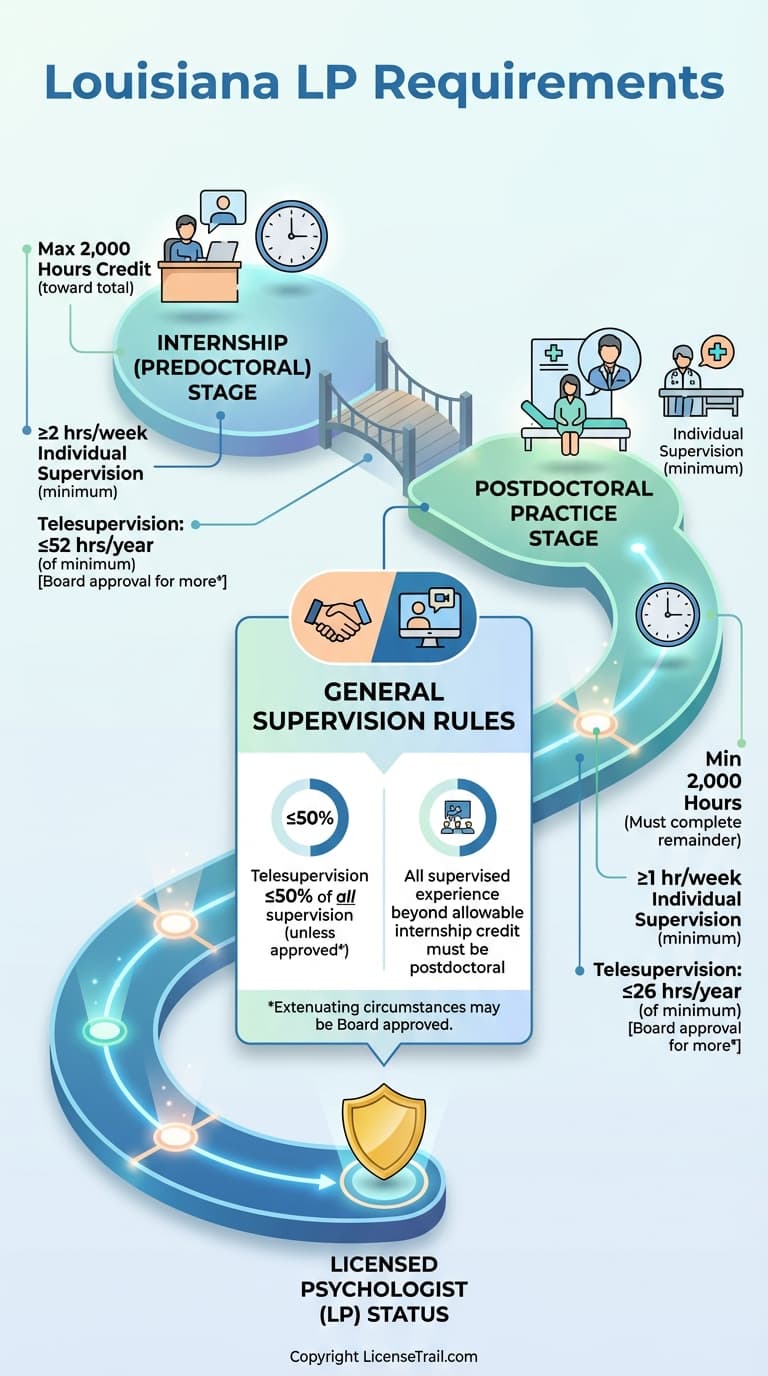
- Internship credit: Up to 2,000 hours (1 year) of acceptable predoctoral internship may count; all remaining hours must be postdoctoral.
- Supervision structure: Must be Direct Supervision (supervisor has legal + functional authority; not consultation); Supervised Practice Plan required/expected before postdoc supervision begins.
- Hour-counting rules: Each supervised assignment credited must be ≥500 hours and at least half-time; all hours must be completed within 5 calendar years (extensions possible).
- Exams: EPPP (pass score 500), LA Jurisprudence Exam, and Board oral exam (after other requirements met).
- PLP pathway: Common route to earn postdoc hours—requires doctoral degree + 2,000-hour internship, LA residency, criminal background check, jurisprudence exam, and direct supervision; PLP cannot practice independently.
- Application/admin: Apply via LSBEP portal; $200 nonrefundable application fee; submit primary-source verification (transcripts, internship/postdoc supervision forms) and complete criminal background check.
License Details
Procedures
Licensure as a Licensed Psychologist (LP) in Louisiana is governed by the Louisiana State Board of Examiners of Psychologists (LSBEP) under Louisiana Revised Statutes Title 37 and the Louisiana Administrative Code, Title 46, Part LXIII. The Board’s own rules and “Steps Toward Licensure” guide, updated in 2025, are the controlling references for requirements. (lsbep.org)
Below is a structured guide focused on the supervised-experience hours and how Louisiana defines them, followed by the other major steps (degree, exams, application).
1. Basic Eligibility for LP Licensure
Under LAC 46:LXIII-103 and La. R.S. 37:2356, an applicant for licensure as a psychologist must provide evidence that they: (law.cornell.edu)
- Are at least 21 years of age.
- Are of good moral character.
- Are a U.S. citizen or have declared intent to become a citizen (with an oath statement accepted as proof).
- Hold a doctoral degree with a major in psychology from a university and program that meet the Board’s standards (APA-accredited or meeting detailed “designated doctoral program” criteria under LAC 46:LXIII-303). (law.cornell.edu)
- Have the required supervised experience (detailed in Section 2 below).
The doctoral program must be a coherent psychology program, with an identifiable psychology faculty and students, and must include practicum/internship training appropriate to the practice of psychology. (law.cornell.edu)
2. Supervised Experience: Exact Hours and Official Wording
Louisiana law and rules describe supervised experience in two complementary ways:
- A time-based requirement in years (LAC 46:LXIII-103).
- A precise hour requirement in LAC 46:LXIII-703.
2.1 Core Requirement in Law (Years)
LAC 46:LXIII‑103 states that an applicant must have a minimum of two years of experience practicing psychology under supervision, with one of those years allowed to be a predoctoral internship and the rest postdoctoral. The rule specifies that: (law.cornell.edu)
- The person
“has a minimum of two years of experience practicing psychology under the supervision of a psychologist, one year of which may be a predoctoral internship … and all other experience being postdoctoral.”
So, at the level of years, Louisiana requires:
- 2 years total supervised experience,
- Up to 1 year may be predoctoral internship (as long as it meets Board standards).
- The remaining experience must be postdoctoral.
2.2 Hour Requirement in Regulation (LAC 46:LXIII‑703)
LAC 46:LXIII‑703 is where the Board translates years into hours, and the exact wording is important. It states: (law.cornell.edu)
“Two years of full-time (4,000 hours) supervised and documented experience shall be required for licensure. Up to one year full-time (2,000 hours) of an acceptable internship may be applied to this requirement, however all remaining supervision must be post-doctoral.”
Key points:
- Total supervised experience required for LP licensure: 4,000 hours.
- Of those 4,000 hours:
- Up to 2,000 hours (one full-time year) can be predoctoral internship.
- The balance must be postdoctoral supervised experience.
- This requirement is “supervised and documented” experience; you must be able to document hours to the Board’s satisfaction.
The rule further specifies: (law.cornell.edu)
- Each supervised assignment that is to be credited
“shall be of at least 500 hours in duration and at least half-time for that setting or integrated program.”
- All supervised practice must be completed within five calendar years, though the Board may grant extensions for cause.
Important clarification:
Some secondary sources describe Louisiana as requiring “3,000 hours (1,500 internship + 1,500 postdoc).” That is not what the current Louisiana regulations and the Board’s own materials say. The controlling language is the 4,000-hour requirement above, with up to 2,000 hours internship + 2,000 hours postdoc.
3. What Counts Within Those 4,000 Supervised Hours?
Louisiana does not break the 4,000 hours into fixed quotas of “direct service hours vs. supervision hours vs. other” in the way some other states do. Instead:
- The regulation focuses on total supervised time, the internship vs. postdoc split, and the structure of supervision.
- The Board’s Postdoctoral Supervision Documentation form shows how they conceptualize and track the content of those hours. Supervisors must report, for the period covered: (lsbep.org)
- “Total number of supervised hours of practice during dates covered in this report”
- “Number of one-to-one general/professional supervision hours per week”
- “Number of case discussion/skill training per week”
- “Number of direct client contact per week”
This tells you the types of activities they expect to see within supervised practice:
- Direct client contact (assessment, intervention, etc.)
- General/professional supervision (one-to-one with supervisor)
- Case discussion and skills training
- Other duties/responsibilities related to practice
However, there is no Louisiana rule that says, for example, “you must have 1,500 hours of direct experience and 1,500 hours of supervised experience.” Instead, Louisiana requires 4,000 supervised hours total, with content appropriate to the practice of psychology and structured under Board-approved supervision.
4. Definition and Structure of Supervision in Louisiana
4.1 Direct Supervision vs. Consultation (Board Guide)
The 2025 “Steps Toward Licensure – Licensed Psychologist” guide defines Direct Supervision as: (lsbep.org)
“Direct Supervision means the supervising psychologist has both legal and functional authority over the supervisee’s practice.”
And clarifies:
- This generally requires the supervisor and supervisee to work under the same employer or department, or that the supervisee is directly employed by the supervising psychologist.
- It notes that “Supervision is distinct from consultation” and must meet the Board’s regulatory definition.
4.2 Conduct of Supervision (LAC 46:LXIII‑709)
LAC 46:LXIII‑709 provides core requirements for supervision of a candidate for licensure: (regulations.justia.com)
- The Board acknowledges that supervision must be “individually tailored”; the specific content is worked out between supervisor and supervisee.
- The supervisor must have “legal functioning authority over and professional responsibility for the work of the supervisee”, and must be available at the point of decision-making.
- The supervisor’s role is explicitly distinguished from consultation, where the consultant has no functional authority or legal accountability for services.
For provisionally licensed psychologists, termination of supervision must be reported in writing to the board by both supervisor and supervisee within seven calendar days, and practice cannot continue without Board-approved supervision. (regulations.justia.com)
5. Predoctoral Internship Requirements (How the First 2,000 Hours May Be Earned)
LAC 46:LXIII‑703 states that a predoctoral internship can be credited to the 4,000 hours if: (law.cornell.edu)
- It was required as part of the doctoral degree, and
- It meets the Board’s internship requirements under LAC 46:LXIII‑305.
The Board’s “Steps Toward Licensure” guide also ties eligibility for Provisional Licensed Psychologist (PLP) status to having completed: (lsbep.org)
- “one year (2,000 hours) of internship training”
in addition to an acceptable doctoral degree, residency in Louisiana, a clean criminal background check, passing the jurisprudence exam, and securing direct supervision from a Louisiana-licensed psychologist.
So, in practice:
- A standard APA‑accredited full-time internship year (≈2,000 hours) becomes your first year of the required two years / 4,000 hours.
- Your postdoctoral supervised year (≈2,000 hours) completes the requirement.
6. Postdoctoral Supervised Practice (The Remaining 2,000 Hours)
6.1 When Postdoc Hours Can Begin
LAC 46:LXIII‑703(A)(1) states that postdoctoral supervised practice hours can only start after: (law.cornell.edu)
- All requirements for the doctoral degree have been met,
- There are no outstanding points of evaluation, and
- This is verified by the degree‑granting institution using Board-specified forms.
Credit cannot be granted for practice that is essentially tied to predoctoral coursework practicum experiences for which graduate credit is granted.
6.2 Supervised Practice Plan and Documentation
The Board requires or strongly encourages a Supervised Practice Plan (SPP) for postdoctoral fellows; for provisional licensure it is mandatory. The Steps guide states that applicants completing postdoctoral training must submit an SPP “for Board approval before supervision begins”, and that all supervision must comply with licensing law and Board regulations. (lsbep.org)
For postdoc supervision, supervisors must complete the Postdoctoral Supervision Documentation form, which reports: (lsbep.org)
- Total supervised hours in the reporting period
- Weekly hours of one‑to‑one supervision
- Weekly hours of case discussion/skills training
- Weekly hours of direct client contact
- The supervisee’s duties and the supervisor’s assessment of competence
These documents are how the Board verifies your 2,000 postdoctoral supervised hours (or more) that complete the required 4,000.
7. Provisional Licensed Psychologist (PLP) Pathway
Most new graduates practice in Louisiana first as a Provisional Licensed Psychologist, then complete postdoctoral supervision before full licensure.
According to the 2025 Steps guide, an applicant is eligible for Provisional Licensure if they: (lsbep.org)
- Have earned an acceptable doctoral degree in psychology.
- Have completed one year (2,000 hours) of internship training.
- Have established residency in Louisiana.
- Have completed a state and federal criminal background check.
- Have passed the Louisiana jurisprudence exam.
- Have secured direct supervision from a Louisiana-licensed psychologist, meeting the Board’s definition of direct supervision (legal and functional authority over the supervisee’s practice).
Key PLP points:
- PLPs must practice under continuing professional supervision of a licensed psychologist and must use the title “provisional licensed psychologist.” (law.cornell.edu)
- PLPs may not supervise other mental health professionals or practice independently. (law.cornell.edu)
- Termination of supervision must be immediately reported, and the provisional license effectively lapses until a new supervisory relationship is approved. (law.cornell.edu)
- A provisional license may generally be renewed up to three years while you complete all remaining licensing requirements (including postdoc hours and exams). (lsbep.org)
In other words, most or all of your 2,000 postdoctoral supervised hours in Louisiana will be accrued while you hold PLP status.
8. Examination Requirements
To transition from applicant/PLP to fully licensed LP, Louisiana requires three major examinations, as summarized in the Steps guide: (lsbep.org)
-
Examination for Professional Practice in Psychology (EPPP)
- Minimum passing score accepted by LSBEP: 500 (current rule cited in the Steps guide). (lsbep.org)
- Scores must be transferred to the Board from ASPPB.
-
Louisiana Jurisprudence Examination
- Online exam covering Louisiana psychology law and rules, administered via Canvas.
- $75 non‑refundable fee, paid when the Board sends the link after your application and notarized statement are received. (lsbep.org)
-
Oral Examination before the Board
- Scheduled after you have met all other requirements (doctoral degree, 4,000 supervised hours, EPPP, jurisprudence exam, background check, etc.).
- Passing the oral exam is the final step; upon success, the Board “will grant a license for the independent practice of psychology in the State of Louisiana.” (lsbep.org)
There are modified procedures and possible waivers for applicants via reciprocity, endorsement, or the 5‑year exemption, but the standard pathway for new graduates assumes completion of all three exams in Louisiana.
9. Criminal Background Check and Application Process
The application and documentation process is outlined in the LSBEP’s 2025 “Steps Toward Licensure – Licensed Psychologist” document: (lsbep.org)
- Create an online account in the LSBEP Licensing Portal and choose “Licensed Psychologist” (with the option to apply simultaneously or sequentially for a Provisional License).
- Complete the online application and pay the $200 non‑refundable application fee. (lsbep.org)
- Upload applicant‑supplied documents (photo, notarized Engagement Agreement, Supervised Practice Plan if applicable, etc.).
- Arrange for primary-source documents to be sent directly to LSBEP:
- Official doctoral transcripts.
- Doctoral Program Training Form for non‑APA programs.
- Internship Documentation form, completed and signed by the Director of Internship Training.
- Postdoctoral Supervision Documentation from supervisors.
- Verification of Licensure from other jurisdictions (if applicable). (lsbep.org)
- Complete the Criminal Background Check, following instructions sent after the Board receives your application and CHRI/Privacy Act Statement. (lsbep.org)
Only after all supporting documents are in and reviewed, and required exams are passed, will you be invited for the oral examination and considered for full licensure.
10. Alternative Pathways and Reductions in Documentation
The LSBEP recognizes several special application pathways in its 2025 guide: (lsbep.org)
- Endorsement License / Reciprocity – for psychologists licensed in other jurisdictions who meet certain credential standards (e.g., ABPP, CPQ). They may be exempt from some documentation and/or the Louisiana oral exam, depending on prior exams and disciplinary history.
- 5‑Year Exemption – the Board may waive documentation of one year (2,000 hours) of the 4,000 required postdoctoral supervision if you have been licensed as a doctoral-level psychologist in another jurisdiction for at least five years with a clean record and completed an acceptable internship as part of your doctoral training. (lsbep.org)
- Military Applicants – expedited processing and eligibility for Temporary Registration while licensure is being completed. (lsbep.org)
These pathways do not change the underlying statutory requirement that Louisiana licensure is based on two years / 4,000 hours of supervised experience, but they can reduce the amount of documentation you must provide or the amount of Louisiana‑based postdoc supervision you need to show.
11. Practical Summary of Hour and Supervision Requirements (Standard New‑Grad Route)
For a typical new doctoral graduate seeking LP licensure in Louisiana through the standard pathway:
-
Doctoral Degree
- APA-accredited or otherwise recognized doctoral program in psychology that meets LAC 46:LXIII‑303.
-
Supervised Experience
- Total required:
- 4,000 hours of “supervised and documented experience” in the practice of psychology. (law.cornell.edu)
- Breakdown by source (as allowed, not rigidly fixed):
- Up to 2,000 hours from a full-time predoctoral internship that is required for the doctoral degree and meets LSBEP standards.
- Remaining 2,000 hours (or more if internship was less than 2,000 hours) from postdoctoral supervised practice under a licensed psychologist.
- No fixed quota is specified in Louisiana law for “direct client” vs. “indirect” hours within those 4,000, but the Board expects a mix of:
- Direct client contact,
- One‑to‑one supervision, and
- Case discussion/skills training,
as documented on supervision forms. (lsbep.org)
- Total required:
-
Supervision Structure
- Must occur under Direct Supervision: the supervisor holds legal and functional authority over your practice and is responsible for your work. (lsbep.org)
- Supervision must be distinguished from consultation and conducted under an approved Supervised Practice Plan for postdoc/PLP practice. (lsbep.org)
- Each supervised assignment counted toward the 4,000 hours must be ≥ 500 hours and at least half-time. (law.cornell.edu)
- All supervised practice for licensure must be completed within five calendar years, absent an extension. (law.cornell.edu)
-
Exams
- EPPP (minimum score 500).
- Louisiana Jurisprudence Exam.
- Oral exam before the Board. (lsbep.org)
-
Licensure
- After all of the above are met and approved, LSBEP issues the Licensed Psychologist (LP) license authorizing independent practice in Louisiana. (lsbep.org)
This framework reflects the Board’s current rules and guidance as of mid‑2025 and should be read together with the official LSBEP site, the “Steps Toward Licensure – Licensed Psychologist” document, and Title 46, Part LXIII of the Louisiana Administrative Code.
Track your LP hours with confidence
License Trail checks your direct, indirect, and supervision hours against Louisiana LP requirements continuously and flags mismatches before you submit.
 Start Tracking for Free
No credit card required · Free plan available
Related Licenses
Is your spreadsheet hiding Louisiana LP risks?
Stop guessing if your categories match Louisiana State Board of Examiners of Psychologists requirements. License Trail checks your direct, indirect, and supervision hours continuously and flags mismatches before you submit.
Import or log
Bring your spreadsheet or start fresh
Upload your existing tracking spreadsheet and we'll map every hour into the right Louisiana State Board of Examiners of Psychologists categories automatically.
Verify against Louisiana
Catch mismatches before the board does
License Trail checks your direct, indirect, and supervision hours against Louisiana LP requirements continuously.
Export board-ready
One-click clean reports
Generate professional, board-ready reports for supervision meetings and Louisiana State Board of Examiners of Psychologists submissions in seconds.
No credit card required · Free plan available