
Louisiana LSSP Requirements: Hours, Exams & Step-by-Step Guide
Stop guessing if your categories match Louisiana requirements. License Trail checks your direct, indirect, and supervision hours against LSSP requirements continuously and flags mismatches before you submit.
No credit card required · Free plan available
Quick Requirements Overview
- Regulator: Louisiana State Board of Examiners of Psychologists (LSBEP); rules in LAC Title 46, Part LXIII (major update effective 2025)
- Applicant basics: age ≥21; good moral character; U.S. citizen or declared intent; acceptable criminal background/fingerprints; no disqualifying discipline/complaints
- Education: graduate/specialist degree from NASP-approved/accredited (or equivalent) school psychology program; for non-NASP programs must meet specialist-level standards incl. practicum + 1-year internship; 1 continuous academic year full-time campus residency
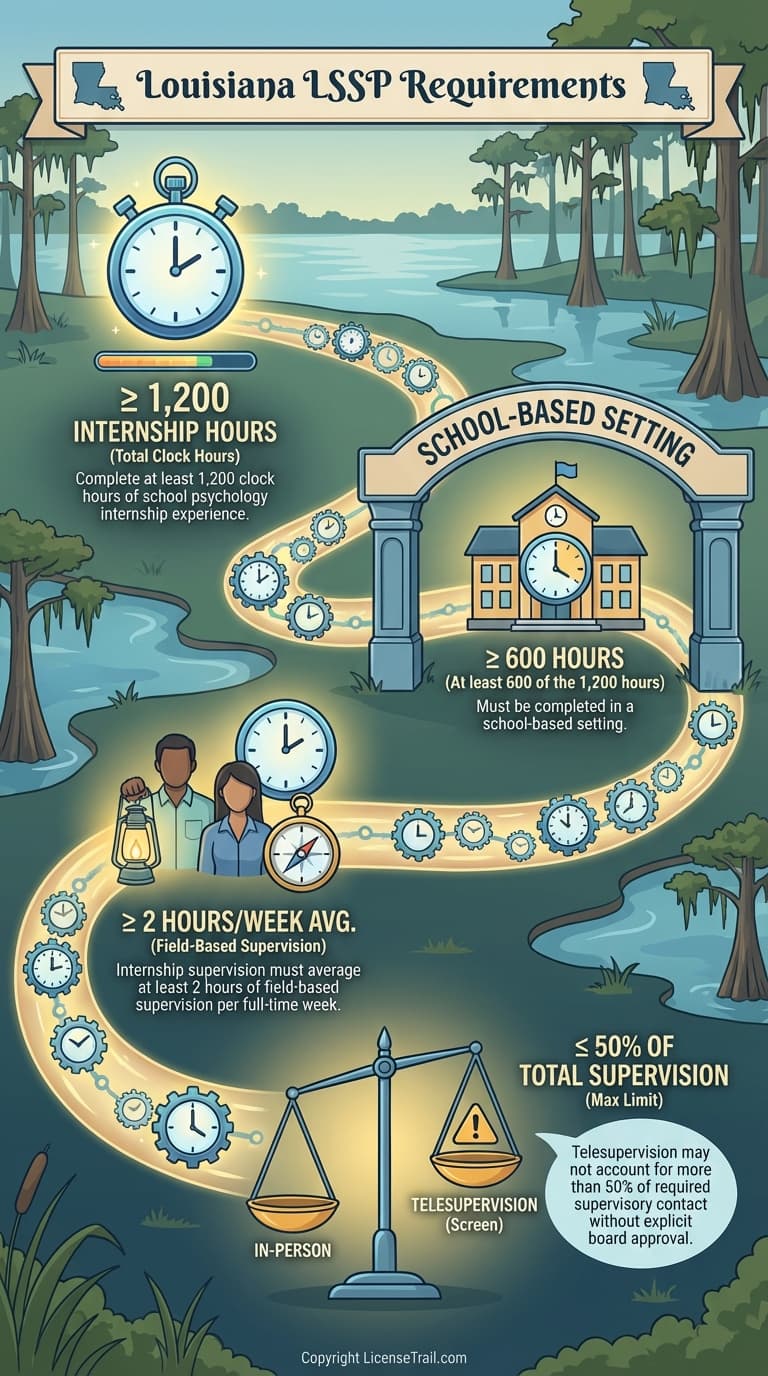
- Internship: minimum 1,200 clock hours over ≥9 months; at least 600 hours in a school-based setting
- Internship supervision: avg ≥2 hours/week field-based supervision (certified school psychologist in schools; licensed psychologist in other approved settings)
- Post-internship experience (non-NCSP): 3 years supervised experience as a certified school psychologist in a public school system; up to 1 year may be credited from a full-time public-school internship year
- Exams: pass Praxis School Psychology (or EPPP substitute at required score) and Louisiana Jurisprudence Exam before licensure is issued
- Ongoing supervision standard: minimum 1 hour/week one-on-one, face-to-face general professional supervision during supervised practice; LSSP supervisor must be licensed ≥1 year and supervise ≤2 at a time
License Details
Procedures
In Louisiana, the Licensed Specialist in School Psychology (LSSP) credential is regulated by the Louisiana State Board of Examiners of Psychologists (LSBEP) under Title 46, Part LXIII, Subpart 2 of the Louisiana Administrative Code, with a major update effective in 2025.(law.cornell.edu)
The following guide walks through what the Board itself requires and how it describes those requirements, with special attention to hours and supervised experience.
1. Basic eligibility for all LSSP applicants
Under La. Admin. Code § LXIII‑3300(B), every applicant (regardless of pathway) must:(regulations.justia.com)
- Be at least 21 years of age.
- Be of good moral character.
- Be a U.S. citizen or have formally declared intent to become a citizen (an oath statement is sufficient).
- Hold a graduate or specialist degree from a National Association of School Psychologists (NASP)–approved or equivalent school psychology program (details in Section 2).
- Pass the Louisiana Jurisprudence Examination on state laws and rules before a license is issued.
- Complete a criminal background check, including fingerprints, with results “reviewed and considered acceptable by the board” before licensure.
- Have no disqualifying disciplinary history, pending complaints, current investigations, or malpractice findings related to school psychology.
These are prerequisites on top of the training and experience requirements described below.
2. Required degree and program type
2.1 Type of degree and program
The Board requires that you:
- “Hold a graduate degree or specialist degree from a NASP‑approved or accredited program, or an equivalent certificate from a university offering a full‑time graduate course of study in school psychology” (summarizing § LXIII‑3300(B)(4)).(regulations.justia.com)
For programs not NASP‑approved, § LXIII‑3401 lays out minimum standards. In plain terms, the program must:(law.cornell.edu)
- Be specialist‑level in school psychology at a regionally accredited institution.
- Be clearly identified as a specialist in school psychology program.
- Include supervised practicum and internship consistent with NASP standards.
- Require at least two academic years of full‑time graduate study and an approved one‑year internship.
2.2 Residency requirement
The Board requires “at least one continuous academic year of full‑time residency on the campus of the institution at which the degree is granted.”(law.cornell.edu)
3. Internship requirements (hours and supervision)
Internship requirements are spelled out both as a program requirement (Chapter 34) and as part of the licensure pathway for non‑NCSP applicants (Chapter 33).
3.1 Total internship hours and setting
Under La. Admin. Code § LXIII‑3403, a qualifying internship must include:(law.cornell.edu)
- “A minimum of 1200 clock hours, including a minimum of 600 hours of the internship completed in a school‑based setting.”
- An internship of at least nine months duration.
- A culminating experience in the program’s course of study, taken for academic credit or otherwise formally documented.
- A primary emphasis on breadth and quality of experience across the domains of school psychology, including work with diverse populations.
So, in terms of hours:
- Total internship hours required: 1,200 clock hours minimum
- Of those, hours that must be in a school setting: at least 600 clock hours
The remaining hours (up to 600) may be in other approved, program‑relevant settings (e.g., community agencies) as long as they meet program and Board requirements.
3.2 Internship supervision requirements
The same regulation sets out detailed supervision expectations:(law.cornell.edu)
- Supervision must be provided by:
- A certified school psychologist (holding the appropriate state school psychologist credential) when the internship is in a school setting, or
- A licensed psychologist when in an alternative community or other approved setting.
- There must be “an average of at least two hours of field‑based supervision per full‑time week or the equivalent for part‑time placements.”
- The program must maintain a written plan specifying joint responsibilities of the university and the internship site for supervision and support.
These hours are supervisory contact hours, not additional service hours; the 2 hours/week of supervision occur within the 1,200 internship clock hours.
4. Practica (pre‑internship) expectations
Before internship, the Board expects supervised practica that:(law.cornell.edu)
- Are completed for academic credit,
- Are distinct from, precede, and prepare students for the internship,
- Include specific required activities and systematic evaluation of skills,
- Emphasize human diversity and are in settings aligned with program objectives, and
- Involve close supervision by program faculty and qualified site supervisors with performance‑based evaluation.
The Board does not specify a fixed number of practicum hours in the regulation; it ties practica instead to NASP standards and program goals.
5. Post‑internship supervised experience (years vs. hours)
Louisiana uses years of supervised experience as a certified school psychologist, rather than a specific clock‑hour count, for the post‑internship requirement when you do not already hold the National Certification in School Psychology (NCSP).
5.1 New “full application” pathway (non‑legacy)
Under § LXIII‑3300(D)(1), a new applicant can qualify in one of two ways:(regulations.justia.com)
-
NCSP route
- You hold a current National Certification in School Psychology (NCSP) from NASP.
- The Board accepts this credential in lieu of separately documenting the 1,200‑hour internship and multi‑year supervised practice, as long as all other requirements (degree, background check, jurisprudence exam, etc.) are met.
-
Non‑NCSP route (board‑documented experience)
You must show all of the following:- Internship:
- “An acceptable internship of at least 1200 hours and nine months in duration, conducted under the supervision of a certified school psychologist in a school setting or by a licensed psychologist in a community setting. Of the 1200 hours, 600 hours shall be completed in a school setting.” (summarizing § LXIII‑3300(D)(1)(b)(i), which mirrors § LXIII‑3403).(regulations.justia.com)
- Supervised professional experience after certification:
- “Three years of supervised experience as a certified school psychologist within the public school system.”
- The Board allows “one year of full‑time employment or experience, obtained as part of an acceptable internship… in a public school system” to be applied toward the three years. This year must be obtained in one academic year.(regulations.justia.com)
- National exam:
- Passing scores on the Nationally Certified School Psychologist Examination, which the Board defines as the Praxis School Psychology Examination (or the EPPP at a specified cut score, if used as a substitute).(law.cornell.edu)
- Internship:
How this translates in practice
For a non‑NCSP new applicant, the experience requirement effectively means:
- Internship:
- 1,200 clock hours, of which 600 must be in schools, over at least nine months, with 2 hours/week of field‑based supervision.
- Post‑internship supervised work:
- At least two additional academic years of supervised, full‑time work as a certified school psychologist in a public school system, because:
- Total required supervised experience as a certified school psychologist = 3 academic years,
- Up to 1 of those years may be satisfied by your internship year, if that internship was full‑time in a public school and completed within one academic year.
- At least two additional academic years of supervised, full‑time work as a certified school psychologist in a public school system, because:
The Board does not convert those three years into a specific number of clock hours in rule; the metric is years of supervised employment/experience, not a fixed 1,500/3,000‑hour post‑degree tally.
6. Ongoing supervision standards during supervised practice
Beyond internship, Chapter 36 governs how supervision is structured for graduate students and graduates working under an LSSP.
6.1 Minimum weekly supervision
La. Admin. Code § LXIII‑3603 sets a global minimum:
- “The minimum standard of one hour per week for general professional supervision”, conducted one‑on‑one, face‑to‑face.(law.cornell.edu)
This standard underpins supervision during supervised practice years (e.g., early employment as a certified school psychologist under a supervising LSSP or psychologist).
6.2 Limits on supervisees and responsibility
Under § LXIII‑3604:(law.cornell.edu)
- An LSSP must be licensed at least one year before supervising and may supervise no more than two graduate students or graduates at the same time.
- All services by graduate students or graduates must be under “direct and continuing professional supervision” of the LSSP.
- The LSSP retains “ultimate legal and professional responsibility for the welfare of every client” and must have sufficient contact with clients to plan and oversee services, including emergency availability.
These rules shape the environment in which your supervised experience is accrued, even though the regulation itself does not assign additional hour totals beyond the 1‑hour/week minimum.
7. Certification as a “Certified School Psychologist” (DOEd ancillary certificate)
The Board’s rules assume or require that you hold, or have held, Louisiana Department of Education (LDOE) recognition as a “certified school psychologist” (an ancillary school credential).
In § LXIII‑3100(D), the Board defines a certified school psychologist as someone who:(law.cornell.edu)
- Completed a school psychology training program meeting NASP requirements,
- Holds a graduate or specialist degree from a regionally accredited institution, and
- Holds (or held, within a defined 2015–2025 window for certain legacy routes) an ancillary certificate in school psychology from the LDOE.
This credential is central because:
- The three years of supervised experience required in § LXIII‑3300(D)(1)(b)(ii) must be as a certified school psychologist in a public school system.(regulations.justia.com)
8. Examination requirements
8.1 National exam
The Board designates the “Nationally Certified School Psychologist Examination” as:(law.cornell.edu)
- The Praxis School Psychology Examination (Educational Testing Service), with the passing score set at the ETS‑recommended cut score, or
- The EPPP (Examination for Professional Practice in Psychology) as a substitute, with a specified passing score of 450 for specialist‑level independent practice.
Applicants on the non‑NCSP route must show a passing Praxis (or EPPP) score. Many NCSP holders will already have passed the Praxis at or above the national standard.
8.2 Louisiana Jurisprudence Examination
All applicants must demonstrate knowledge of Louisiana laws and rules by passing the Louisiana Jurisprudence Examination before a license is issued. This is explicitly required in § LXIII‑3300(B)(5) and reflected in the Board’s “LSSP Steps Toward Licensure” and application instructions.(regulations.justia.com)
9. Application mechanics and documentation
The Board requires applications to be submitted through its online licensing portal. For LSSP applicants, the Board’s official “Applications” page and “LSSP Steps Toward Licensure” specify the documentation you must provide.(lsbep.org)
9.1 Core documentation
For a new LSSP applicant, expect to submit:
- Online application and application fee (Board provides current amounts; e.g., an LSSP application fee separate from renewal fees).(lsbep.org)
- Online Application Engagement Agreement (notarized statement).
- Criminal background check forms and fingerprints.
- Official transcripts showing your graduate/specialist degree and program.
- Verification of Graduate Program of Study (required if your program was not NASP‑accredited).
- Verification of Professional License/Certification, if you hold or have held other professional credentials.
9.2 Experience and exam documentation (non‑NCSP)
If you do not hold NCSP, you must also provide:(lsbep.org)
- PRAXIS Examination Score Report Request (or EPPP documentation, if used).
- Internship Experience Documentation – showing that the internship met the 1,200‑hour / 600‑hour‑in‑schools / 9‑month minimum and supervision requirements.
- School Supervised Experience Documentation – to document the required three years of supervised experience as a certified school psychologist (showing which portion, if any, is satisfied by the internship year).
Legacy applicants (those certified and employed in Louisiana schools between July 1, 2015 and June 30, 2025) and reciprocity/military applicants have alternative documentation paths spelled out in § LXIII‑3300(D)(2)–(4), but the hours and supervision structure of training are essentially the same; what changes is how you prove it and which parts may be waived or credited.(regulations.justia.com)
10. Scope and limits of LSSP practice (why the Board is so specific)
Louisiana statute defines “licensed specialist in school psychology” and the “practice of licensed specialist in school psychology” as applying psychological principles to help children and youth succeed academically, socially, behaviorally, and emotionally in collaboration with schools and families.(codes.findlaw.com)
Crucially, the law also states that nothing in the LSSP chapter permits an LSSP to diagnose mental disorders or diseases as defined by the DSM or ICD. That limitation explains why the Board’s training standards emphasize school‑based assessment, intervention, and consultation rather than the broader diagnostic authority granted to doctoral‑level licensed psychologists.(codes.findlaw.com)
11. Summary of key hour and experience requirements
Putting the Board’s own language into a single snapshot for a new, non‑NCSP applicant:
-
Graduate/Specialist Program
- Specialist‑level school psychology degree from a NASP‑approved or equivalent program, including:
- At least two academic years of full‑time graduate study plus one year of internship.(law.cornell.edu)
- Specialist‑level school psychology degree from a NASP‑approved or equivalent program, including:
-
Internship
- 1,200 clock hours minimum, at least 600 hours in a school‑based setting.
- At least nine months in duration.
- Average of at least two hours of field‑based supervision per full‑time week by a certified school psychologist or licensed psychologist, depending on setting.(law.cornell.edu)
-
Post‑internship supervised practice
- Three academic years of supervised experience as a certified school psychologist in a public school system.
- Up to one year of that may be satisfied by a full‑time internship year in a public school, completed within one academic year.
- Practically, this usually means one internship year plus two additional supervised years in school psychology practice.(regulations.justia.com)
-
Weekly supervision during supervised practice
- At least one hour per week of one‑on‑one, face‑to‑face general professional supervision.(law.cornell.edu)
-
Exams
- National exam: Praxis School Psychology (or EPPP substitute) at required cut score.
- State exam: Louisiana Jurisprudence Examination.
-
Other conditions
- Age ≥ 21, good moral character, U.S. citizenship/intent, acceptable criminal background, and no disqualifying professional discipline or malpractice findings.
All of these requirements come directly from current Louisiana statutes and the Louisiana Administrative Code as administered by the Louisiana State Board of Examiners of Psychologists as of mid‑2025. Always verify with the Board or the current LAC version before making final program or employment decisions, since rules can change by future legislative or Board action.
Track your LSSP hours with confidence
License Trail checks your direct, indirect, and supervision hours against Louisiana LSSP requirements continuously and flags mismatches before you submit.
 Start Tracking for Free
No credit card required · Free plan available
Related Licenses
Is your spreadsheet hiding Louisiana LSSP risks?
Stop guessing if your categories match Louisiana State Board of Examiners of Psychologists requirements. License Trail checks your direct, indirect, and supervision hours continuously and flags mismatches before you submit.
Import or log
Bring your spreadsheet or start fresh
Upload your existing tracking spreadsheet and we'll map every hour into the right Louisiana State Board of Examiners of Psychologists categories automatically.
Verify against Louisiana
Catch mismatches before the board does
License Trail checks your direct, indirect, and supervision hours against Louisiana LSSP requirements continuously.
Export board-ready
One-click clean reports
Generate professional, board-ready reports for supervision meetings and Louisiana State Board of Examiners of Psychologists submissions in seconds.
No credit card required · Free plan available