
Maine CPE Requirements: Hours, Exams & Step-by-Step Guide
Stop guessing if your categories match Maine requirements. License Trail checks your direct, indirect, and supervision hours against CPE requirements continuously and flags mismatches before you submit.
No credit card required · Free plan available
Quick Requirements Overview
- License type: Conditional Psychological Examiner (CPE1421) issued by the ME Board of Examiners of Psychologists
- Term/renewal: Valid 1 year from issue; non-renewable / non-extendable
- Practice limitation: May practice only under supervision during the conditional period
- Education (underlying PE eligibility): Master’s degree in psychology (comprehensive training) from an accredited institution
- Supervised experience (underlying PE eligibility): 1,500 hours actual work experience completed in 48–104 weeks, averaging 16–40 hrs/week; excludes absences and credit-bearing practica
- Supervision during experience (underlying PE eligibility): 3 hrs/week supervision (incl. 1 hr/week formal face-to-face individual; remaining via approved learning/supervision activities)
- Exams (underlying PE + conditional completion): EPPP (PE level; 65% passing per board) and ME Jurisprudence Exam (80%); jurisprudence must be passed within the 1-year CPE term
- CPE supervision agreement: Board-accepted Letter of Agreement required; while licensed, minimum 1 hr/week one-to-one, face-to-face supervision (unless pre-approved alternative); supervisor responsible and must keep supervision records
License Details
Procedures
In Maine, a “CPE” is a Conditional Psychological Examiner license issued by the State Board of Examiners of Psychologists (license type code CPE1421). It is a one‑year, non‑renewable license that lets you practice as a psychological examiner only under supervision while you complete Maine’s final requirements (typically the jurisprudence exam) or transition from another state. (mainelegislature.org)
Becoming a CPE involves two layers of requirements:
- Meeting all the underlying requirements to be a Psychological Examiner in Maine (education, supervised experience, exams); and
- Meeting the extra conditions specific to a conditional license (supervision agreement, supervision schedule, time limits).
Below is a step‑by‑step outline, with emphasis on hours and the board’s own language.
1. Understand the underlying license: Psychological Examiner
Maine law and rules treat the CPE as a conditional version of the full Psychological Examiner license. You must qualify for licensure at that level.
1.1. Education
State law requires that a Psychological Examiner candidate:
- “has had a master’s degree reflecting comprehensive training in psychology from an accredited educational institution” recognized by the board. (legislature.maine.gov)
The board’s licensing page restates this as having “Received a masters degree from an accredited institution.” (maine.gov)
1.2. One year of supervised experience – how the hours are defined
Statute:
- You must have “at least one year of full‑time supervised experience in psychology of a type considered by the board to be qualifying in nature.” (legislature.maine.gov)
Board rule (Chapter 5, § 5‑2) turns that into specific hours and structure:
-
Minimum total hours:
- “a minimum of 1,500 hours of actual work experience (exclusive of holidays, sick leave, vacations or other such absences).” (regulations.justia.com)
-
Time frame:
- Those 1,500 hours must be completed “in not less than 48 weeks nor more than 104 weeks.” (regulations.justia.com)
-
Weekly workload:
- The experience must “average at least 16 hours but not more than 40 hours per week.” (regulations.justia.com)
-
When the hours can count:
- Supervised experience “may be credited only after the applicant has completed the equivalent of one year of full‑time graduate study” in psychology.
- “Supervised experience does not include work experience earned in connection with practica for which academic credit has been awarded.” (regulations.justia.com)
-
Supervision time within that year:
- During the supervised experience, “the supervisor shall provide a minimum of 3 hours of supervision per week, one of which shall be regularly‑scheduled formal face‑to‑face individual supervision.” (regulations.justia.com)
- The other 2 hours per week must be “learning activities such as case conferences… seminars dealing with clinical issues; co‑therapy with a staff person… group supervision; and additional individual supervision.” (regulations.justia.com)
-
Setting requirements:
- The 1,500 hours must be in an organized public or private agency, school, institution, private practice or similar setting that offers “contact with other professional disciplines and work experience with a broad range of clients.” (regulations.justia.com)
Notice that, unlike some states, Maine’s rule for Psychological Examiners does not split these 1,500 hours into “direct client contact” vs. “other” hours. The rule speaks broadly of “actual work experience” under the above supervision structure.
1.3. Examinations
To be licensed at the Psychological Examiner level (and therefore to qualify for a CPE), you must:
- Pass the EPPP (Examination for Professional Practice in Psychology) with at least a 65% passing score at the Psychological Examiner level; and
- Pass the Maine Jurisprudence Examination. (maine.gov)
The board’s examination rule clarifies that:
- The written examination is the EPPP, and
- The jurisprudence exam is a separate test on Maine law and rules with a passing score of 80%. (law.cornell.edu)
2. What makes the license “Conditional” (CPE)?
Under Maine law, a conditional license is an endorsement/transition license that:
- May be granted to someone who “is licensed or certified by a similar board of another state whose standards… are equivalent” to Maine’s;
- Is issued “at the appropriate level” (in this case, Psychological Examiner);
- Is “effective for one year and requires that the licensee practice only under supervision”; and
- May be conditioned on passing an examination approved by the board (such as the Maine jurisprudence exam) during that one‑year term. (mainelegislature.org)
The board’s licensing page reinforces that the Conditional License fee is $200 and notes that it “cannot renew”, and that conditional licenses run for “1 year from date of issue.” (maine.gov)
On the application itself, the license type is explicitly identified as:
- “Conditional Psychological Examiner (CPE1421).” (maine.gov)
And the form states:
- “This application must accompany the Psychological Examiner license application.” (maine.gov)
So, in practice, when you apply for a CPE you are also applying for, or documenting eligibility for, full Psychological Examiner licensure.
3. Supervision requirements specific to a CPE
Once you hold a Conditional Psychological Examiner license, your ongoing supervision is governed by both the rules and the required Letter of Agreement between you and a Maine‑licensed psychologist.
3.1. Minimum weekly supervision while you are a CPE
Board rule, Chapter 3, § 3‑6 (Supervision of Conditional and Temporary Licensees) sets the basic standard:
- A conditional licensee “may practice only under the supervision of a psychologist” who meets the board’s Chapter 7 qualifications. (regulations.justia.com)
- The supervising psychologist is “responsible for the work of the supervisee.” (regulations.justia.com)
- The supervisor “shall provide supervision on a schedule appropriate to the nature and extent” of your practice and “shall provide a minimum of one hour per week of one‑to‑one, face‑to‑face supervision unless other arrangements are approved in advance by the board.” (regulations.justia.com)
The CPE application’s Letter of Agreement reiterates this requirement in nearly identical wording:
- “I understand that a minimum of one (1) hour per week of one‑on‑one supervision is required and that additional supervisory time may be required to meet individual needs.” (maine.gov)
There is no separate requirement in rule that you accumulate a new, fixed number (e.g., 1,500 or 3,000) of supervised hours while holding the conditional license. Instead, the focus is on:
- Maintaining continuous, appropriate supervision (at least 1 hr/week one‑to‑one, face‑to‑face); and
- Practicing only under an accepted Letter of Agreement with a qualified supervising psychologist.
3.2. Letter of Agreement and supervisory responsibilities
Before you can practice under a CPE:
- You may not practice until the board has accepted a letter of agreement signed by both you and your supervising psychologist, on the board’s form. (regulations.justia.com)
That letter (included in the CPE application) requires the supervisor to attest that:
- They will be “responsible for the professional work” of the CPE;
- They are “knowledgeable of the Maine laws and rules as it applies to psychologists who practice in Maine”;
- They have reviewed the board’s rules on conditional and temporary licensees; and
- They will notify the board of any significant interruption or termination of supervision and ensure transfer of supervision to another qualified psychologist if needed. (maine.gov)
The supervision rule also requires that:
- The supervisor maintain records of supervision (frequency, duration, content, progress, concerns) and provide them to the board upon request;
- The supervisor restrict your practice to areas you are competent to perform under supervision and develop a corrective action plan, if deficiencies are identified;
- Both supervisor and conditional licensee communicate clearly to the public that services are time‑limited and supervised. (regulations.justia.com)
4. Exams and time‑limited status during the CPE year
The board’s examination rule specifies what must be completed during the one‑year conditional period:
- A conditional license “may not be renewed or extended.” (law.cornell.edu)
- The holder “shall pass the jurisprudence examination during the 1‑year term of the license.” (law.cornell.edu)
The board may also require a conditional licensee to pass any other examination it approves (for examiners, this will typically be the EPPP if it has not already been passed at the required level). (mainelegislature.org)
Once you have:
- Documented your 1,500‑hour supervised experience (or its accepted equivalent);
- Met the education requirement;
- Passed the EPPP (at 65% or better) and the Maine jurisprudence exam; and
- Satisfied any additional board requirements,
you may be granted full Psychological Examiner licensure, after which you no longer practice under the conditional supervision rule.
5. Summary of hour‑related requirements for a CPE in Maine
Putting it all together for a Conditional Psychological Examiner (CPE):
-
Pre‑licensure supervised experience (to qualify as a Psychological Examiner):
- At least 1,500 hours of actual work experience in psychology,
- Completed over 48–104 weeks, averaging 16–40 hours/week,
- Under 3 hours/week of supervision (1 hour formal face‑to‑face individual; 2 hours of structured learning/supervision activities),
- In an approved practice setting,
- After at least one year of full‑time graduate study, and not including credit‑bearing practica. (regulations.justia.com)
-
Supervision while holding the Conditional Psychological Examiner license:
- No new fixed number of total hours is specified; instead, you must:
- Practice only under supervision, and
- Receive at least 1 hour per week of one‑to‑one, face‑to‑face supervision, with additional time as needed. (regulations.justia.com)
- No new fixed number of total hours is specified; instead, you must:
-
Time limit:
- The CPE license is one year only from the date of issue and cannot be renewed. (maine.gov)
Maine therefore does not use a “1,500 hours of direct experience + 1,500 hours of supervised experience” model for Conditional Psychological Examiners. Instead, it requires a single 1,500‑hour year of supervised work to qualify as a Psychological Examiner, plus a supervision‑intensive, time‑limited conditional year under at least one hour per week of direct supervision while you complete Maine‑specific licensure conditions.
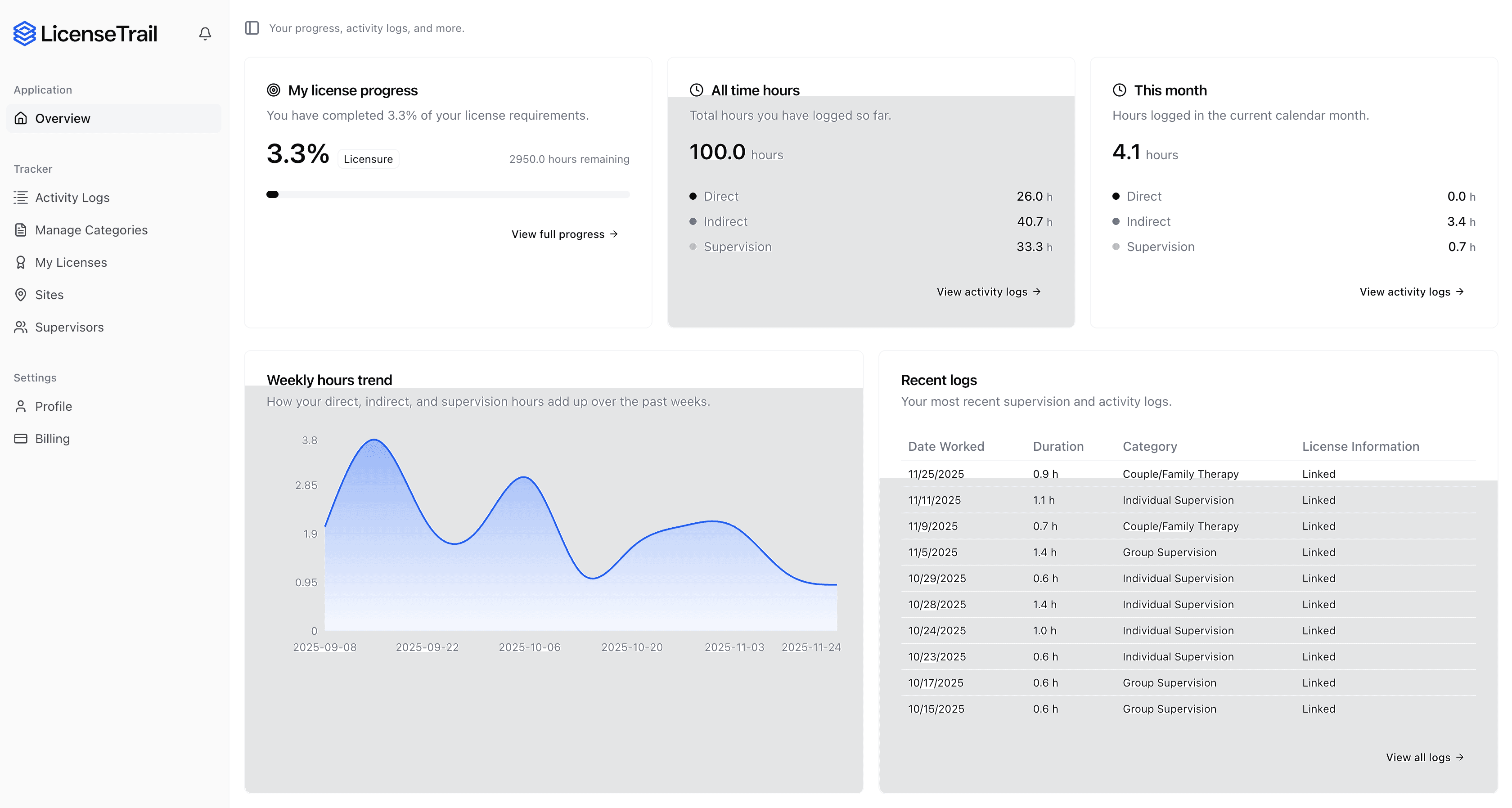
Track your CPE hours with confidence
License Trail checks your direct, indirect, and supervision hours against Maine CPE requirements continuously and flags mismatches before you submit.
 Start Tracking for Free
No credit card required · Free plan available
Related Licenses
Is your spreadsheet hiding Maine CPE risks?
Stop guessing if your categories match Maine Board of Examiners of Psychologists requirements. License Trail checks your direct, indirect, and supervision hours continuously and flags mismatches before you submit.
Import or log
Bring your spreadsheet or start fresh
Upload your existing tracking spreadsheet and we'll map every hour into the right Maine Board of Examiners of Psychologists categories automatically.
Verify against Maine
Catch mismatches before the board does
License Trail checks your direct, indirect, and supervision hours against Maine CPE requirements continuously.
Export board-ready
One-click clean reports
Generate professional, board-ready reports for supervision meetings and Maine Board of Examiners of Psychologists submissions in seconds.
No credit card required · Free plan available