
Maine CPSY Requirements: Hours, Exams & Step-by-Step Guide
Stop guessing if your categories match Maine requirements. License Trail checks your direct, indirect, and supervision hours against CPSY requirements continuously and flags mismatches before you submit.
No credit card required · Free plan available
Quick Requirements Overview
- Doctorate in psychology from an institution/program recognized by the Maine Board; must be trustworthy/competent
- Supervised experience for full psychologist licensure (total 3,000 hrs): 1,500 predoctoral + 1,500 postdoctoral
- Predoctoral year: 1,500 hrs over 48–104 weeks (avg 16–40 hrs/wk); ≥50% service-related; ≥25% of service time in face-to-face client contact; ≤25% research; no academic-credit practica
- Predoctoral supervision: ≥2 hrs/wk face-to-face supervision + 2 hrs/wk learning activities
- Postdoctoral year: 1,500 hrs over 48–104 weeks (avg 16–40 hrs/wk); 25–60% of time in direct service; no academic-credit practica
- Postdoctoral supervision: ≥1 hr/wk individual supervision + 1 hr/wk learning activities
- Exams/education add-ons for full licensure: EPPP (70% pass standard) + Maine jurisprudence exam; 3-hr IPV screening/referral/intervention coursework (if applying on/after 1/1/2020)
- CPSY (Conditional) license: 1 year, nonrenewable, $200 fee; must be filed with psychologist application; requires Letter of Agreement with a Maine-licensed psychologist; practice only under supervision with ≥1 hr/wk one-to-one face-to-face supervision (records required)
License Details
Procedures
Becoming a Conditional Psychologist (CPSY) in Maine involves meeting the state’s doctoral‑level psychologist standards for education and supervised experience, then practicing under a time‑limited, closely supervised license while your full psychologist license is finalized.
Below is an article‑style, step‑by‑step explanation focused on the specific hours and supervision requirements the Maine Board of Examiners of Psychologists has written into law and rule.
1. What the Conditional Psychologist license is
Under Maine law, the Board may issue a conditional license “at the appropriate level, to applicants for a permanent license” or to psychologists already licensed in another state whose standards the Board deems equivalent. The conditional license: (legislature.maine.gov)
- Is effective for one year.
- Requires that the licensee practice only under supervision.
- May be issued with or without examination at the Board’s discretion, but the Board may require the conditional licensee to pass an examination during the term of the conditional license (typically the EPPP and Maine jurisprudence exam). (legislature.maine.gov)
The Board’s licensing page specifies that for psychologists, conditional licenses: (maine.gov)
- Carry a separate fee of $200 and cannot be renewed.
- Are issued for 1 year from the date of issue.
- Require a letter of agreement signed by the applicant and a licensed Maine psychologist who will supervise the conditional licensee.
The conditional application form itself labels this license as “Conditional Psychologist (CP1421)” and explicitly states that the conditional application must accompany the Psychological License application. (maine.gov)
2. Baseline eligibility: education and general requirements
To be eligible for a psychologist license (which is what your conditional license is tied to), Maine statute requires that a psychologist candidate: (legislature.maine.gov)
- Be trustworthy and competent to safeguard the public.
- Have a doctorate in psychology “reflecting comprehensive training in psychology” from an accredited institution recognized by the Board.
- Have at least 2 years of experience in psychology “of a type considered by the board to be qualifying in nature.”
- Pass examinations “as the board determines necessary” – currently:
- The Examination for Professional Practice in Psychology (EPPP) with a passing score of 70% (or the equivalent scaled score), and
- The Maine jurisprudence examination. (maine.gov)
- Not have failed an examination within the previous 6 months.
- Complete at least 3 hours of coursework in family or intimate partner violence screening, referral, and intervention strategies (if applying for initial licensure on or after January 1, 2020). (legislature.maine.gov)
The “2 years of experience in psychology” requirement for psychologists is operationalized in Board rules as two distinct years of supervised experience: one predoctoral and one postdoctoral, each with specific hour and content requirements (detailed next). (regulations.justia.com)
3. Required supervised experience hours for psychologist licensure
3.1 Overall structure
Board rules for psychologists (Chapter 4, §415‑4‑2) require: (regulations.justia.com)
- One year of predoctoral supervised experience, and
- One year of postdoctoral supervised experience,
both under supervisors meeting the qualifications in Chapter 7 of the rules.
Each “year” is defined not by calendar years, but by hours and weeks.
3.2 Predoctoral supervised experience (internship year)
The Board defines the predoctoral supervised experience as: (regulations.justia.com)
- A minimum of 1,500 hours of actual work experience,
- Completed in no fewer than 48 weeks and no more than 104 weeks.
- Averaging at least 16 hours and not more than 40 hours per week.
- Supervision requirements during this year:
- At least 2 hours per week of face‑to‑face supervision, and
- An additional 2 hours per week of “learning activities” (such as group supervision, seminars, and case conferences), regardless of whether the internship is completed in one or two years.
The content of those 1,500 hours is also regulated:
- At least 50% of the predoctoral supervised experience must be in service‑related activities such as assessment, interviews, report writing, case presentations, treatment, and consultation.
- Of that service‑related time, at least 25% must be devoted to face‑to‑face direct patient/client contact.
- In practice, this means:
- Minimum service‑related activities: 50% of 1,500 = 750 hours.
- Minimum direct face‑to‑face contact: 25% of those 750 service‑related hours ≈ 188 hours of direct client contact.
- In practice, this means:
- No more than 25% of total time may be allocated to research.
- Practica that carried academic credit may not be counted toward these supervised experience hours.
All of these requirements come directly from the Board’s supervision rule for psychologists, which states that the predoctoral supervised experience “consists of a minimum of 1,500 hours of actual work experience” with the above distribution. (regulations.justia.com)
3.3 Postdoctoral supervised experience (postdoc year)
The postdoctoral supervised experience is structured similarly: (regulations.justia.com)
- A minimum of 1,500 hours of actual work experience,
- Completed in not less than 48 weeks and not more than 104 weeks.
- Averaging at least 16 hours and not more than 40 hours per week.
Supervision and content:
- The supervisor must provide at least:
- 1 hour per week of individual supervision, and
- 1 additional hour per week of learning activities (e.g., seminars, case conferences, group supervision).
- The postdoctoral supervised experience must consist of at least 25% and not more than 60% of time devoted to direct service per week, with the majority of work in the intended area of practice.
- Minimum direct service hours, by rule: 25% of 1,500 = 375 hours of direct service across the postdoc year.
- As with the predoctoral year, practicum hours that carried academic credit cannot be counted as postdoctoral supervised experience.
Together, the minimum supervised experience for psychologist licensure in Maine is 3,000 hours, broken down as:
- 1,500 hours predoctoral supervised experience, with:
- ≥ 750 hours in service‑related activities,
- ≥ ~188 hours in face‑to‑face direct client contact,
- ≤ 375 hours in research.
- 1,500 hours postdoctoral supervised experience, with:
- ≥ 375 hours and ≤ 900 hours devoted to direct service.
These hours, documented on Board‑supplied forms or via ASPPB/NR credentials, are what satisfy the statutory requirement of “at least 2 years of experience in psychology.” (regulations.justia.com)
4. Supervision requirements while you hold a Conditional Psychologist license
The conditional license is about how you may practice while your permanent psychologist license is pending or while you transition from another state. During this period, supervision is governed by Chapter 3, §415‑3‑6 and the Letter of Agreement attached to the conditional application. (regulations.justia.com)
4.1 Who must supervise you
Under Board rule:
- “The holder of a conditional or temporary license may practice only under the supervision of a psychologist with the qualifications described in Chapter 7.”
- The supervising psychologist is responsible for the work of the supervisee. (regulations.justia.com)
The Letter of Agreement you and your supervisor sign states that the supervisor:
- Agrees to be responsible for your professional work.
- Confirms being knowledgeable of Maine laws and rules governing psychologists.
- Has reviewed the terms of supervision in Chapter 3, §2(3) and §6.
- Understands that “a minimum of one (1) hour per week of one‑on‑one supervision is required” and that additional supervision may be required to meet individual needs.
- Will notify the Board of any significant interruption or termination of supervision and will ensure transfer of supervision to another licensed psychologist if needed. (maine.gov)
4.2 Required frequency and documentation of supervision
Chapter 3, §415‑3‑6 sets the minimum ongoing supervision standard for conditional (and temporary) licensees: (regulations.justia.com)
- The supervisor must provide supervision on a schedule appropriate to the nature and extent of the supervisee’s practice.
- The supervisor must provide at least one hour per week of one‑to‑one, face‑to‑face supervision, unless the Board has approved other arrangements in advance.
- The supervisor must maintain a written record of supervision, including frequency, duration, content, and an assessment of your progress and performance, and must furnish it to the Board on request.
- The supervisor must:
- Restrict your practice to areas where you are competent under supervision.
- Develop and send the Board a corrective action plan if deficiencies are identified.
- Interrupt or terminate your practice if necessary to protect the public and notify the Board.
Both the supervising psychologist and the conditional licensee share responsibility for making clear to the public that your license is time‑limited and supervised. (regulations.justia.com)
Crucially, you cannot practice at all under the conditional license until the Board has:
- Received and accepted a Letter of Agreement signed by both you and your supervising psychologist.
- Confirmed that the letter is in effect; the conditional license is “expressly conditioned” on keeping this agreement active. (regulations.justia.com)
5. How the hours and supervision fit together in practice
Putting statutory and rule language together, the path to a CPSY Conditional Psychologist license in Maine typically looks like this:
-
Complete your doctoral education in psychology
- From an accredited institution in a program recognized by the Board. (legislature.maine.gov)
-
Complete at least 1,500 hours of predoctoral supervised experience
- 48–104 weeks, 16–40 hrs/week.
- With the required balance of service‑related activities, face‑to‑face direct client contact, supervision, and learning activities. (regulations.justia.com)
-
Complete at least 1,500 hours of postdoctoral supervised experience
- 48–104 weeks, 16–40 hrs/week.
- With 25–60% of time each week in direct service and at least 2 hours/week of supervision/learning activities. (regulations.justia.com)
-
Document those supervised hours to the Board’s standards
- Using official supervisory forms or through ASPPB credentials, as allowed in Chapter 3, §415‑3‑1. (regulations.justia.com)
-
Apply for psychologist licensure and, simultaneously, for the Conditional Psychologist license
- Submit the standard psychologist application, supporting materials (transcripts, supervised experience documentation, exam scores if available, recommendations, license verifications), and fees. (maine.gov)
- Attach the Conditional Psychologist (CP1421) application and pay the $200 conditional license fee. (maine.gov)
-
Secure a supervising Maine psychologist and submit the Letter of Agreement
- Both you and your supervisor sign the Board’s Letter of Agreement form acknowledging responsibility, familiarity with Board rules, and the weekly supervision commitment. (maine.gov)
-
Once the Board approves the conditional license and Letter of Agreement, practice under supervision for up to one year
- Provide psychological services as permitted under the psychologist scope of practice, but only under the supervision of your designated Maine psychologist, with at least one hour/week of one‑to‑one, face‑to‑face supervision and additional supervision as required. (regulations.justia.com)
-
During the conditional year, complete any remaining requirements for full licensure
- Pass (or have passed) the EPPP and Maine jurisprudence exam (if the Board has not already required these before issuing the conditional license). (legislature.maine.gov)
-
Transition to full psychologist licensure
- Once all education, experience, and examination requirements are satisfied and the Board approves your permanent license, the conditional license expires, and you may practice independently under the full psychologist license.
Key hour‑related takeaways
- Total supervised experience required for psychologist licensure:
- 3,000 hours minimum (1,500 predoctoral + 1,500 postdoctoral).
- Predoctoral year:
- At least 1,500 hours; ≥ 750 service‑related; ≥ ~188 face‑to‑face direct client hours.
- 2 hours/week face‑to‑face supervision + 2 hours/week additional learning activities. (regulations.justia.com)
- Postdoctoral year:
- At least 1,500 hours; 25–60% of time in direct service (≥ ~375 hours direct service).
- 1 hour/week individual supervision + 1 additional hour/week learning activities. (regulations.justia.com)
- While holding a Conditional Psychologist license:
- You are not accumulating a separate, special “conditional” hour requirement; instead, you are practicing under supervision while your qualifications for full licensure are being processed or finalized.
- You must receive at least one hour per week of one‑to‑one, face‑to‑face supervision, with the supervisor legally responsible for your work and required to maintain supervision records and protect the public. (regulations.justia.com)
These are the Board’s own structural requirements and hour definitions for becoming a CPSY Conditional Psychologist and ultimately a fully licensed psychologist in Maine.
Track your CPSY hours with confidence
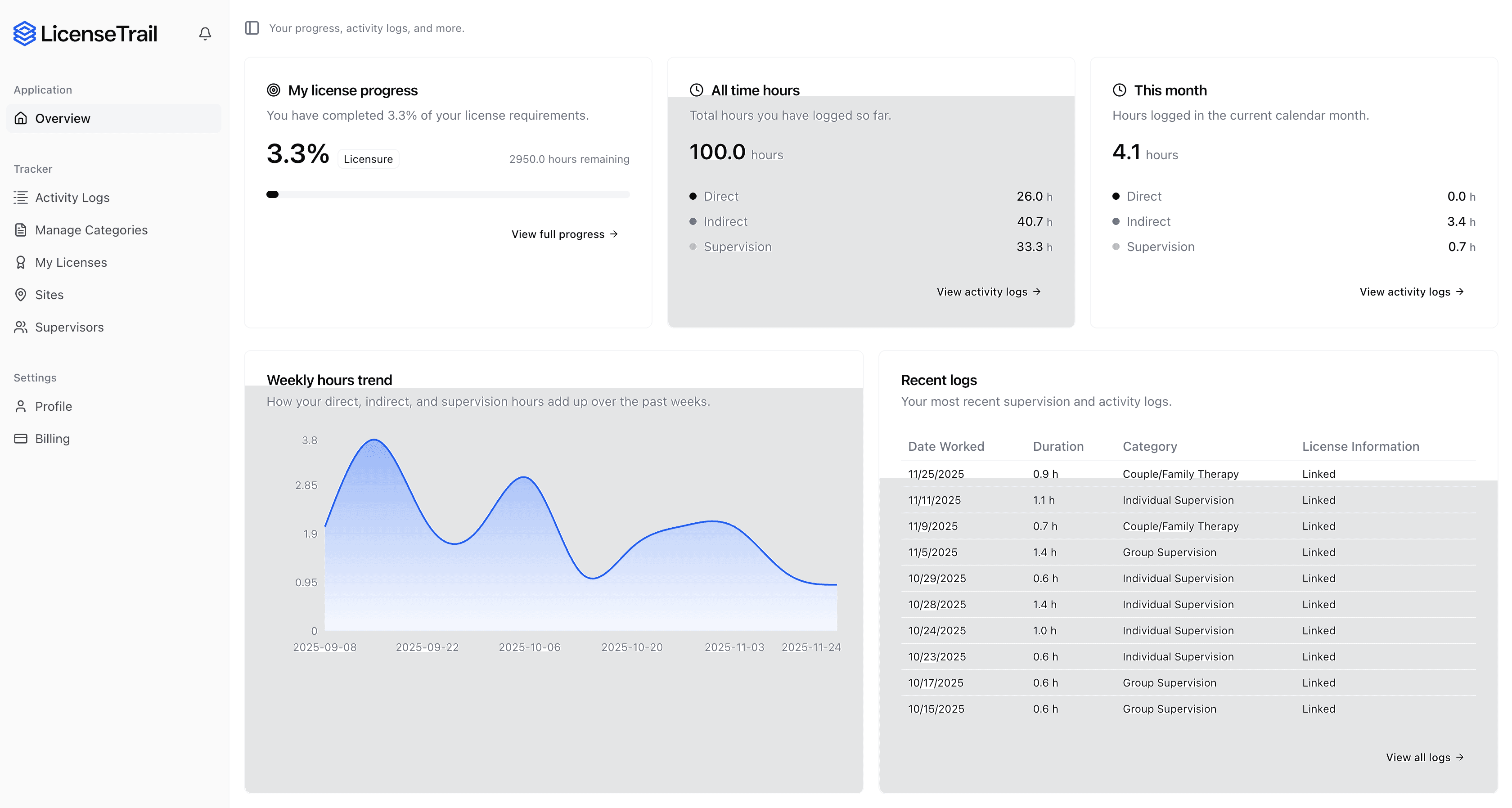
License Trail checks your direct, indirect, and supervision hours against Maine CPSY requirements continuously and flags mismatches before you submit.
 Start Tracking for Free
No credit card required · Free plan available
Related Licenses
Is your spreadsheet hiding Maine CPSY risks?
Stop guessing if your categories match Maine Board of Examiners of Psychologists requirements. License Trail checks your direct, indirect, and supervision hours continuously and flags mismatches before you submit.
Import or log
Bring your spreadsheet or start fresh
Upload your existing tracking spreadsheet and we'll map every hour into the right Maine Board of Examiners of Psychologists categories automatically.
Verify against Maine
Catch mismatches before the board does
License Trail checks your direct, indirect, and supervision hours against Maine CPSY requirements continuously.
Export board-ready
One-click clean reports
Generate professional, board-ready reports for supervision meetings and Maine Board of Examiners of Psychologists submissions in seconds.
No credit card required · Free plan available