
Maine MC Requirements: Hours, Exams & Step-by-Step Guide
Stop guessing if your categories match Maine requirements. License Trail checks your direct, indirect, and supervision hours against MC requirements continuously and flags mismatches before you submit.
No credit card required · Free plan available
Quick Requirements Overview
- MSW/DSW/PhD in social work/social welfare from an accredited program (official transcript required)
- Pass ASWB Masters exam (required for MC issuance)
- Must have a qualified consultant and an active Consultation Agreement on file; cannot practice without it
- Submit Clinical Concentration Worksheet (determines clinical vs non-clinical track)
- No pre-licensure hours required to obtain MC; hours accrue after MC toward LC
- MC is conditional and cannot engage in private practice
- Toward LC while MC (paid clinical employment + consultation, concurrent): Clinical MSW: 3,200 hrs + 96 consult (72 ind/24 grp) over ≥2 yrs; Non-clinical MSW: 6,400 hrs + 192 consult (144 ind/48 grp) over ≥4 yrs
- Consultation must be documented; live in-person or synchronous video only (no audio-only); renewal expects 4 consultation hrs/month of clinical practice
License Details
Procedures
Licensing as a Master Social Worker, Conditional Clinical (MC / LMSW‑CC) in Maine centers on three things: graduate education, the ASWB Masters exam, and a structured period of paid clinical practice under “consultation” (Maine’s term for clinical supervision).
Below is a structured overview using the Maine State Board of Social Worker Licensure’s own categories and wording.
1. What the MC license is in Maine
Maine formally calls this license:
“Licensed Master Social Worker, Conditional Clinical (MC)” (maine.gov)
Key points from the Board’s description:
- It is a “clinical, master level, conditional license” that:
- A “conditional license” means the licensee:
- Has entered an arrangement of consultation under Chapter 13 of the Board’s rules.
- “May not practice social work without an active consultation agreement on record with the Board.” (maine.gov)
This is the license you hold while accruing the supervised clinical experience needed to become a Licensed Clinical Social Worker (LC / LCSW).
2. Baseline eligibility to be licensed as MC
To apply for an MC license, the Board requires the following, in its own terms.
2.1 Education
You must provide:
“Documented proof of a master’s or doctoral degree in social work or social welfare from an accredited program.” (law.cornell.edu)
In practice this means an MSW (or DSW/PhD in social work) from a CSWE‑accredited program, documented via official transcript. (maine.gov)
2.2 ASWB Masters examination
You must show:
“Proof of a passing score on the ASWB Master examination.” (law.cornell.edu)
The Board’s licensing page repeats this: MC licensure “requires… a passing score on the ASWB Masters examination.” (maine.gov)
2.3 Consultation (supervision) arrangement
You must already have a consultant lined up and document this when you apply.
The rule for initial issuance of the MC license requires:
“Documentation of intent to provide the clinical social work experience described in section 5(1)(D) of this chapter, signed by”
a licensed clinical social worker, certified social worker‑independent practice, LCPC, LMFT, licensed psychologist, licensed psychiatrist, or similarly credentialed licensee in those professions. (law.cornell.edu)
On the Board’s licensing page this is implemented as an “Agreement to Provide Consultation” form, which must be “signed by a qualified consultant” and kept on file; the MC “may not practice social work without an active consultation agreement on record with the Board.” (maine.gov)
2.4 Clinical Concentration Worksheet
The Board also requires:
- A “Clinical Concentration Worksheet” with the MC application. (maine.gov)
This is how the Board verifies whether your MSW is a clinical concentration or non‑clinical concentration, because that affects the number of hours you must complete (see below).
3. Hour requirements while you hold the MC license
There are two separate questions:
- Hours required to obtain the MC license itself
- Hours you must complete while licensed as MC to qualify later for LC (LCSW)
3.1 Hours required to obtain the MC license
The Board does not require prior post‑graduate experience hours (like “1,500 hours direct practice”) to issue the MC license.
Instead, to be granted MC you must show:
- Graduate degree (MSW / DSW in social work)
- Passing ASWB Masters exam
- A signed consultation agreement documenting intent to complete the clinical social work experience described in section 5(1)(D). (law.cornell.edu)
There is no fixed number of completed clinical hours required before MC is issued. The hours come into play after you are licensed as MC, on the path to LC.
3.2 Hours required while MC to become LC (LCSW)
All of the experience and consultation hours that lead to LC must be accrued while you hold the MC license. The Board’s rule for LC (Licensed Clinical Social Worker) is where the hours are spelled out in detail. (law.cornell.edu)
The Board refers to this combination of practice and consultation as “clinical social work experience.” It must be:
“clinical social work practice which encompasses interventions directed to interpersonal interactions, intrapsychic dynamics and life‑support and management issues, including but not limited to individual, couples, family and group psychotherapy.” (law.cornell.edu)
The hour requirements depend on whether your MSW is clinical or non‑clinical:
A. If your MSW is a clinical concentration
You must complete:
- 3,200 hours of social work employment in a clinical setting, and
- 96 hours of consultation
The regulation states:
“For applicants whose master’s degrees in social work are in clinical concentrations, 96 hours of consultation concurrent with 3,200 hours of social work employment occurring within a period of not less than 2 years.” (law.cornell.edu)
Key details:
- “Social work employment” at this level is defined as paid work only:
“For purposes of this level of licensure, ‘social work employment’ consists entirely of work that is compensated financially.” (law.cornell.edu)
- The 3,200 hours must be in clinical settings (public or private agencies, schools, institutions, etc.) that offer “opportunities for contact with other professional disciplines and work experience with broad ranges of clients.” Private/self‑employed practice does not count. (law.cornell.edu)
- Of the 96 consultation hours:
- 72 hours must be individual consultation
- 24 hours may be in a group of not more than 8 members (law.cornell.edu)
- Consultation may be in person or via live, synchronous video; audio‑only is not permitted. (law.cornell.edu)
In other words, Maine’s clinical‑track formula is:
**3,200 hours of paid clinical social work employment
- 96 hours of documented consultation (72 individual, 24 allowed group)**
B. If your MSW is a non‑clinical concentration
You must complete:
- 6,400 hours of social work employment in a clinical setting, and
- 192 hours of consultation
The rule states:
“For applicants whose master’s degrees in social work are in nonclinical concentrations, 192 hours of consultation… concurrent with 6,400 hours of social work employment occurring within a period of not less than 4 years.” (law.cornell.edu)
Key details:
- Again, “social work employment” here must be paid clinical work; private/self‑employed practice is not creditable. (law.cornell.edu)
- Of the 192 consultation hours:
- 144 hours must be individual consultation
- 48 hours may be in a group of not more than 8 members (law.cornell.edu)
- Same rules on in‑person vs live video; audio‑only is not acceptable. (law.cornell.edu)
So the non‑clinical‑track formula is:
**6,400 hours of paid clinical social work employment
- 192 hours of documented consultation (144 individual, 48 allowed group)**
C. Timeframe and recency requirements
For both tracks:
- The hours must be concurrent (you can’t pile up consultation later, disconnected from your clinical practice). (law.cornell.edu)
- No less than 50% of both your consultation hours and your social work employment hours must be completed within the 4 years immediately before you apply for LC. (law.cornell.edu)
4. What “consultation” means in Maine’s language
Maine uses “consultation” where many states would say “clinical supervision.”
Statute defines “consultation” as:
“regularly scheduled face‑to‑face case discussion and evaluation focusing on raw data, goals and objectives from the social worker’s practice.” (legislature.maine.gov)
Additional elements in the LC rule:
- It must include “regular, systematic discussion and evaluation of cases, focusing on data, goals, ethics, and objectives of specific social work practice” and
- “Documentation of the clinical supervision provided.” (law.cornell.edu)
For MC renewal, the Board also requires:
“Evidence of successful completion of 4 consultation hours… for each month of actual clinical practice or part thereof engaged in by the licensee during the preceding license term,” signed by the consultant. (law.cornell.edu)
That effectively sets the ongoing supervision rate at about 1 hour of consultation per week of full‑time clinical practice, which will, over time, add up to the 96 or 192‑hour total depending on your track.
5. How the pieces fit together (practical sequence)
Putting the Board’s requirements into a chronological path:
-
Complete your MSW (or doctoral social work degree)
- Ensure you can document whether your program is clinical or non‑clinical—this affects whether your target is 3,200/96 or 6,400/192. (law.cornell.edu)
-
Pass the ASWB Masters examination
- You need proof of a passing score to apply for MC. (law.cornell.edu)
-
Line up a qualified consultant and sign a consultation agreement
- Must be an LC (LCSW), CSW‑IP, LCPC, LMFT, licensed psychologist, psychiatrist, or similarly‑credentialed professional. (law.cornell.edu)
- File the Board’s “Agreement to Provide Consultation” form; you may not practice without this on file. (maine.gov)
-
Apply for the MC license (Master Social Worker – Conditional Clinical)
- Submit online application, exam result, transcript, consultation agreement, and Clinical Concentration Worksheet, plus required fees and background check. (maine.gov)
-
Work in an approved clinical setting while MC and accrue hours
- Make sure all counted hours are paid “social work employment” in clinical settings with broad client populations and interdisciplinary contact. (law.cornell.edu)
- Maintain 4 hours of consultation per month of clinical practice, documented by your consultant. (law.cornell.edu)
-
Accumulate the required totals, depending on your degree track
-
Clinical MSW:
- 3,200 hours paid clinical social work employment
- 96 hours consultation (72 individual, 24 group allowed)
-
Non‑clinical MSW:
- 6,400 hours paid clinical social work employment
- 192 hours consultation (144 individual, 48 group allowed) (law.cornell.edu)
-
-
Apply for LC (Licensed Clinical Social Worker)
- Submit documentation of:
- Your clinical social work employment hours
- Your consultation hours and structure (individual vs group, dates, etc.)
- Pass the ASWB Clinical examination
- Once the Board approves, you move from MC to LC, gaining independent clinical practice authority. (maine.gov)
- Submit documentation of:
6. Summary of hour requirements in Maine’s own terms
For a Licensed Master Social Worker, Conditional Clinical (MC) in Maine, the hours that matter are those you complete after licensure in order to qualify for LC:
-
If you have a clinical‑concentration MSW:
- 3,200 hours of compensated “social work employment” in clinical settings
- 96 hours of “consultation” (clinical supervision), at least 72 individual and up to 24 in group, all concurrent with your employment and within required timeframes. (law.cornell.edu)
-
If you have a non‑clinical‑concentration MSW:
- 6,400 hours of compensated clinical social work employment
- 192 hours of consultation, at least 144 individual and up to 48 in group, again concurrent with employment and within the required timeframes. (law.cornell.edu)
The Board does not split these into separate “direct client hours vs supervised hours” the way some other states do. Instead, it requires:
a specific number of hours of paid clinical social work employment plus a specified number of hours of “consultation” (structured, documented clinical supervision) completed simultaneously over defined minimum periods. (law.cornell.edu)
Track your MC hours with confidence
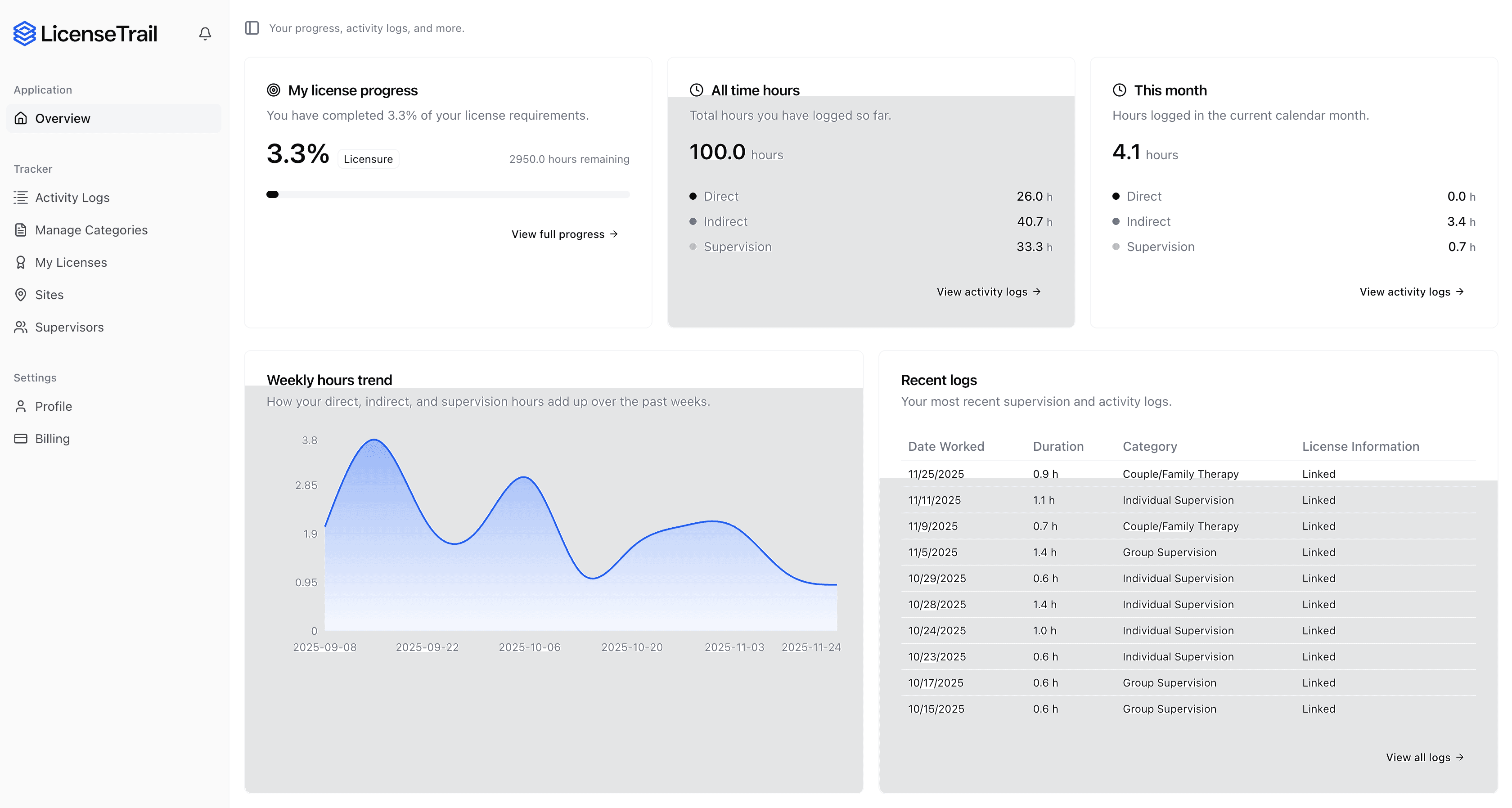
License Trail checks your direct, indirect, and supervision hours against Maine MC requirements continuously and flags mismatches before you submit.
 Start Tracking for Free
No credit card required · Free plan available
Related Licenses
Is your spreadsheet hiding Maine MC risks?
Stop guessing if your categories match Maine State Board of Social Worker Licensure requirements. License Trail checks your direct, indirect, and supervision hours continuously and flags mismatches before you submit.
Import or log
Bring your spreadsheet or start fresh
Upload your existing tracking spreadsheet and we'll map every hour into the right Maine State Board of Social Worker Licensure categories automatically.
Verify against Maine
Catch mismatches before the board does
License Trail checks your direct, indirect, and supervision hours against Maine MC requirements continuously.
Export board-ready
One-click clean reports
Generate professional, board-ready reports for supervision meetings and Maine State Board of Social Worker Licensure submissions in seconds.
No credit card required · Free plan available