
Maine LSX Requirements: Hours, Exams & Step-by-Step Guide
Stop guessing if your categories match Maine requirements. License Trail checks your direct, indirect, and supervision hours against LSX requirements continuously and flags mismatches before you submit.
No credit card required · Free plan available
Quick Requirements Overview
- Purpose/limits: Entry-level, non-clinical “conditional” license; no private practice
- Education: Bachelor’s degree sufficiently related to social work/social welfare (Educational Worksheet if degree not on Board list)
- Employment: Must show employment in a social service delivery field (paid role)
- Supervision required to practice: Board-approved consultation agreement must be on file and active at all times; cannot practice without it
- Experience to upgrade (LS): 3,200 hours paid social work employment + 96 hours consultation, concurrent, completed in 2–4 years while holding LSX
- Consultation format: Individual or group (max 8); in-person or live video (no audio-only)
- Renewal/term: 2-year license; one renewal only (max 4 years)
- CE for renewal: 25 contact hours/2-year term incl. 6 ethics + 6 psychosocial assessment; one-time 12 hours family/intimate partner violence; ASWB Bachelor exam required to move to LS
License Details
Procedures
Maine’s LSX (Licensed Social Worker, Conditional) is the state’s entry‑level, non‑clinical social work license. It is designed as a structured, supervised “internship” period that leads to full LSW licensure. The Maine State Board of Social Worker Licensure and its rules in 02‑416 C.M.R. ch. 13, together with the Board’s licensing page, spell out the exact education, application, and hour requirements.
Below is a step‑by‑step breakdown, with emphasis on the types and amounts of hours Maine requires.
1. What the LSX license is for
The Board describes the LSX as a non‑clinical, entry level license that requires a bachelor’s degree in a field “sufficiently related to social work or social welfare.” (law.cornell.edu)
A “conditional” license means:
- You must have an approved consultation (supervision) agreement on file with the Board and
- You may not practice social work at all without that active agreement. (law.cornell.edu)
LSX holders are not allowed to engage in private practice. (maine.gov)
Separate Department of Education regulations (for school social workers) explicitly note that an LSX indicates the licensee is completing a required internship period to progress to another level of licensure, and that an LSX “must obtain four hours per month of supervision” if working in a school setting. (regulations.justia.com)
2. Educational and employment prerequisites
To qualify for initial issuance of an LSX, Board rule 02‑416 C.M.R. ch. 13, § 1 and the Board’s licensing page require:
2.1. Education
You must have:
- A bachelor’s degree in a field sufficiently related to social work or social welfare. (law.cornell.edu)
The Board’s LSX application guidance lists examples of acceptable related degrees, including Behavioral Science, Social and Behavioral Sciences, Child Development, Psychology, Education or Human Development, Mental Health and Human Services, Educational Psychology, Rehabilitation Services, and Sociology. (maine.gov)
If your degree title is not on that list, you must submit an Educational Worksheet to show how your coursework is sufficiently related to social work. (maine.gov)
2.2. Employment in social services
Board rule requires “evidence of employment in a social service delivery field” when the LSX is first issued. (law.cornell.edu)
In practice, that means you either:
- Already work in a social services job, or
- Have a bona fide job offer in a qualifying social service delivery setting.
This employment will later count toward your required 3,200 hours of “social work employment” (explained in Section 5).
3. Consultation (supervision) arrangement required before you can practice
The LSX cannot be issued without a specific, Board‑defined consultation arrangement.
3.1. Who can be your consultant
Under 02‑416 C.M.R. ch. 13, § 1(1)(C): (law.cornell.edu)
-
If you are not a Maine DHHS employee:
Your consultant must be one of:- A Licensed Social Worker (LS) with a bachelor’s in social work or social welfare and at least 2 years as an LSW; or
- A Licensed Master Social Worker (LM); or
- A Licensed Clinical Social Worker (LCSW); or
- A Certified Social Worker – Independent Practice (CSW‑IP).
-
If you are a DHHS employee:
Your consultant must be:- An LSW licensed at least 4 years; or
- An LM. (law.cornell.edu)
On the Board’s LSX licensing page, you must file an “Agreement to Provide Consultation” form signed by that qualified consultant as part of your application. (maine.gov)
3.2. You must always have an active consultation agreement
The Board states that an LSX “may not practice social work without an active consultation agreement on record with the Board.” If the agreement ends, you must notify the Board and submit a new one. (maine.gov)
This is in addition to the total consultation hours you must accumulate (see Section 5).
4. Applying for the LSX license
According to the Board’s LSX application section, applicants must submit: (maine.gov)
- A completed Online Application for Licensure;
- A completed Agreement to Provide Consultation form, signed by a qualified consultant;
- An official transcript showing the earned bachelor’s degree in a sufficiently related field;
- If the degree title is not on the Board’s list, a completed Educational Worksheet;
- Official license verifications for any professional licenses you hold or have ever held (with specified details such as license number, issue and expiration dates, and any discipline history).
At this LSX stage, no ASWB exam is required. The exam is required later when you upgrade to the full LSW license.
5. Hour requirements while holding an LSX
Maine does not split the internship into, for example, 1,500 hours of direct experience plus 1,500 hours of supervised experience.
Instead, the Maine State Board of Social Worker Licensure requires LSX holders who want to become Licensed Social Workers (LS) to complete:
5.1. 3,200 hours of paid social work employment
- The Board’s LSX page states that LSX licensees must complete 3,200 hours of social work employment to advance to the LS license. (maine.gov)
- The Board’s LSW rule clarifies that “social work employment” consists entirely of paid, compensated work in social work. (law.cornell.edu)
These hours must be:
- Accrued while you hold an active LSX,
- In a period of not less than 2 years and not more than 4 years. (law.cornell.edu)
In practical terms, 3,200 hours is roughly:
- About 40 hours/week for 80 weeks (~2 years); or
- Fewer weekly hours spread over up to 4 years.
5.2. 96 hours of consultation (supervision)
During the same period, Board rule 02‑416 C.M.R. ch. 13, § 2 and the LSX page require 96 hours of consultation with your Board‑approved consultant. (law.cornell.edu)
Key points:
- The 96 consultation hours must be concurrent with the 3,200 hours of employment—you do not do them before or after, but during your LSX practice. (law.cornell.edu)
- Consultation can be provided individually or in groups of up to 8 members, and may be in person or via live, synchronous video (audio‑only is not allowed). (law.cornell.edu)
If you are not a DHHS employee, the consultant must meet the qualifications listed in § 1(1)(C)(1) (LS with required experience, LM, LCSW, or CSW‑IP). If you are a DHHS employee, the consultant must meet the DHHS‑specific requirements (e.g., LSW with at least 4 years’ licensure or LM). (law.cornell.edu)
For school social workers, Department of Education rules add that an LSX “must obtain four hours per month of supervision,” reinforcing the expectation of regular, ongoing supervision during this internship period. (regulations.justia.com)
5.3. Summary of the core “experience” requirement
To move from LSX to LS in Maine, the Board’s own language can be summarized as:
- 3,200 hours of paid social work employment
- 96 hours of consultation (supervision)
- Both completed while holding an active LSX, over 2–4 years, with consultation concurrent with those 3,200 hours. (law.cornell.edu)
This is the critical internship requirement Maine uses instead of a 1,500/1,500 type split.
6. Continuing education (“contact hours”) while you are LSX
In addition to practice and consultation hours, Maine requires continuing professional education (“contact hours”) for LSX renewal.
Under Board rules and the LSX renewal section: (regulations.justia.com)
- You must complete 25 contact hours of continuing education during each 2‑year license term.
- For LSX holders specifically, at least:
- 6 of the 25 hours must be in social work ethics; and
- 6 of the 25 hours must be in psychosocial assessment.
- Additionally, there is a one‑time requirement of 12 contact hours in family or intimate partner violence (Title 32, § 7060).
These contact‑hour requirements are separate from your 3,200 employment hours and 96 consultation hours: they refer to formal education (courses, trainings, etc.), not on‑the‑job practice.
7. LSX license term and renewal limits
The Board’s LSX renewal section sets strict time limits: (maine.gov)
- The LSX is issued for a two‑year term.
- It may be renewed one time only, so you can hold an LSX for a maximum of 4 years.
- You may not practice without an active consultation agreement on file.
- You must:
- Complete your 3,200 hours of social work employment and 96 hours of consultation within that 2–4 year window, and
- Pass the ASWB Bachelor exam and apply for the Licensed Social Worker (LS) license before your LSX’s final expiration.
If you do not complete these requirements within 4 years, your LSX cannot be renewed further, and you risk losing the path to LS through that conditional license. (law.cornell.edu)
8. Moving from LSX to Licensed Social Worker (LS)
Once you have:
- Finished 3,200 hours of paid social work employment;
- Completed 96 hours of approved consultation while LSX; and
- Passed the ASWB Bachelor exam,
you may apply for the LS (Licensed Social Worker) license.
For LS applicants coming from an active LSX license, the Board requires: (maine.gov)
- An online application;
- Proof of a passing score on the ASWB Bachelor exam;
- Official transcript for the bachelor’s degree sufficiently related to social work;
- A Verification of Consultation form (or forms) documenting completion of the 96 consultation hours concurrent with 3,200 hours of social work employment from your consultant(s);
- A new Agreement to Provide Consultation for the early years of your LS license;
- License verifications for any professional licenses you have held.
You must submit this before your LSX’s final expiration, consistent with the 2–4‑year timeline.
9. Key numbers and terms at a glance (Maine LSX)
- Education: Bachelor’s degree “sufficiently related to social work or social welfare” (with an Educational Worksheet if the major is not on the Board’s list). (law.cornell.edu)
- Initial employment: Must show employment in a social service delivery field. (law.cornell.edu)
- Consultation arrangement: Required before practicing; must always be active; consultant must meet specific license and experience criteria. (law.cornell.edu)
- Practice hours to advance:
- 3,200 hours of paid “social work employment”;
- 96 hours of consultation;
- Concurrent; completed within 2–4 years while holding LSX. (law.cornell.edu)
- Monthly supervision expectation (especially in school settings): 4 hours per month of supervision. (regulations.justia.com)
- Continuing education: 25 contact hours per 2‑year LSX term, including 6 hours ethics, 6 hours psychosocial assessment, and a one‑time 12 hours in family or intimate partner violence. (regulations.justia.com)
- License term: 2 years; one renewal only (maximum 4 years on LSX). (maine.gov)
Taken together, these rules define the LSX as a structured, supervised, paid internship period: you must be employed in social work, receiving documented consultation, accruing 3,200 hours of practice and 96 hours of consultation within 2–4 years, and completing substantial continuing education, so that you can qualify for full LSW licensure under Maine law.
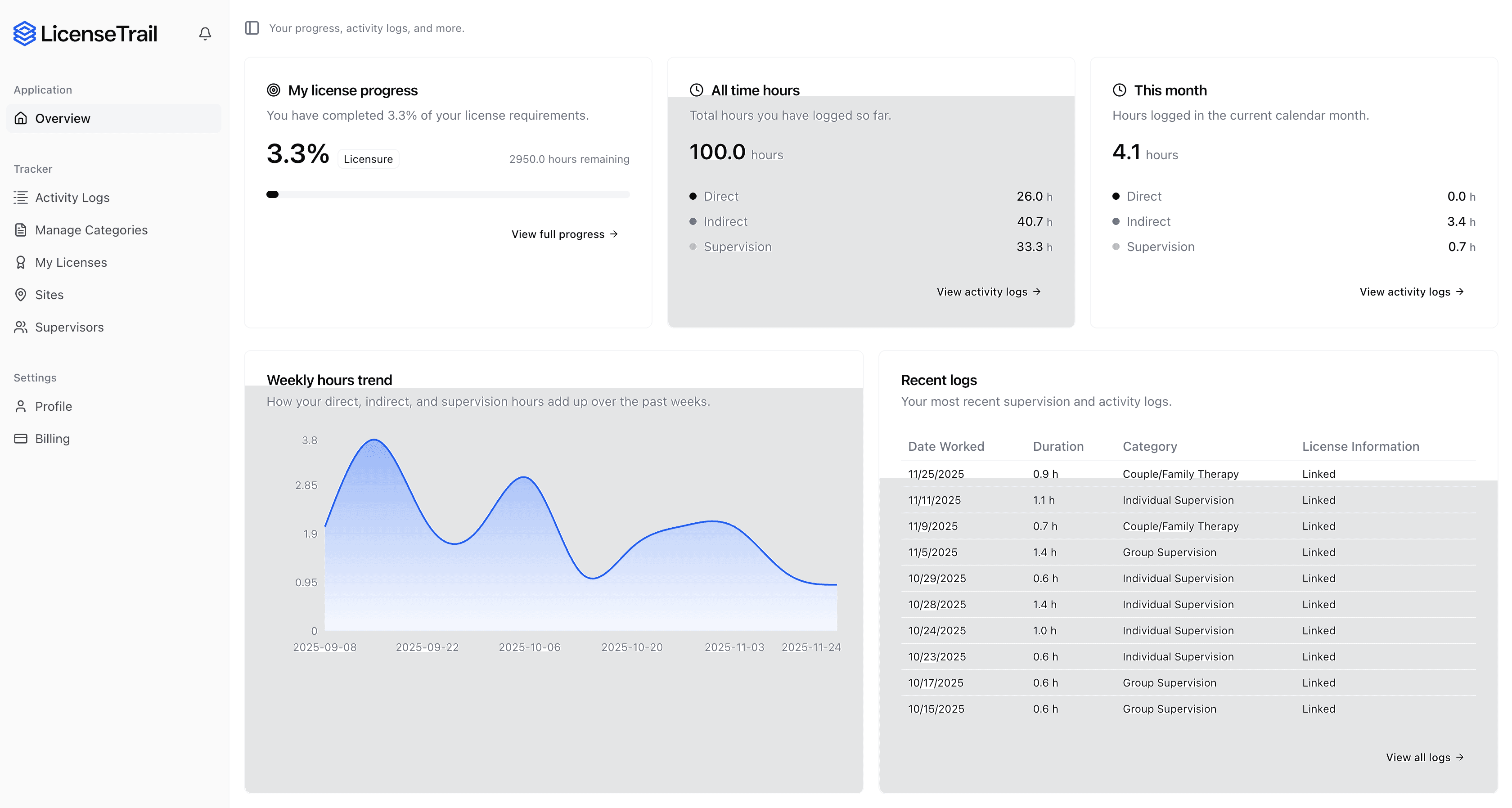
Track your LSX hours with confidence
License Trail checks your direct, indirect, and supervision hours against Maine LSX requirements continuously and flags mismatches before you submit.
 Start Tracking for Free
No credit card required · Free plan available
Related Licenses
Is your spreadsheet hiding Maine LSX risks?
Stop guessing if your categories match Maine State Board of Social Worker Licensure requirements. License Trail checks your direct, indirect, and supervision hours continuously and flags mismatches before you submit.
Import or log
Bring your spreadsheet or start fresh
Upload your existing tracking spreadsheet and we'll map every hour into the right Maine State Board of Social Worker Licensure categories automatically.
Verify against Maine
Catch mismatches before the board does
License Trail checks your direct, indirect, and supervision hours against Maine LSX requirements continuously.
Export board-ready
One-click clean reports
Generate professional, board-ready reports for supervision meetings and Maine State Board of Social Worker Licensure submissions in seconds.
No credit card required · Free plan available