
Maine PE Requirements: Hours, Exams & Step-by-Step Guide
Stop guessing if your categories match Maine requirements. License Trail checks your direct, indirect, and supervision hours against PE requirements continuously and flags mismatches before you submit.
No credit card required · Free plan available
Quick Requirements Overview
- Degree: Master’s in psychology (comprehensive training) from an accredited institution acceptable to the ME Board
- Supervised experience: 1,500 hours of actual work in psychology completed in 48–104 weeks (avg 16–40 hrs/week); no credit for practicum hours with academic credit; hours count only after 1 full-time graduate year completed
- Supervision: 3 hrs/week minimum, incl. 1 hr/week scheduled face-to-face individual supervision + 2 hrs/week approved learning activities (e.g., case conference, seminars, group supervision)
- Setting/program: Organized service setting with structured training plan, written expectations, 6‑month evaluations, and on-site oversight by a full-time licensed psychologist (supervisor max 4 supervisees)
- Exams: Pass EPPP (≥65%) + Maine jurisprudence exam (typically after education/experience completed)
- Character/fitness: Must be trustworthy/competent; no unethical practice; no failed licensing exam within prior 6 months
- Application/admin: Submit application, photo, transcripts, supervised-experience verification, score reports sent directly, license verifications, background check; fees include $200 license + $21 background check
- Scope limits (PE): Primarily assessment; interventions only under psychologist supervision; psychotherapy prohibited
License Details
Procedures
In Maine, the title “Psychological Examiner (PE)” is a distinct, master’s‑level license regulated by the State Board of Examiners of Psychologists. The requirements are set in statute (32 M.R.S. Chapter 56) and in the Board’s rules (02‑415 CMR, Chapter 5), and are supplemented by the Board’s own licensing guidance.
Below is a step‑by‑step outline of what Maine currently requires, with an emphasis on the hours and types of experience specified by the Board’s rules.
1. Understand the role and legal scope of a Psychological Examiner
Maine law recognizes two levels of psychological practice: “psychological examiner” and “psychologist.” (legislature.maine.gov)
A psychological examiner’s work is limited primarily to assessment, not psychotherapy. By statute, a person practices as a psychological examiner when they use recognized psychological principles and methods, but only to:
- Interview or administer and interpret tests of mental abilities, aptitudes, interests, and personality characteristics, and
- Do so for purposes like psychological evaluation, or for educational or vocational selection, guidance, or placement. (legislature.maine.gov)
Key limitations:
- May provide interventions such as consultation, behavior management, or social skills training only under the supervision of a licensed psychologist or as otherwise allowed by rules. (legislature.maine.gov)
- May not provide psychotherapy services under any circumstances. (legislature.maine.gov)
This is the scope of practice you are being licensed for as a PE.
2. Educational requirement: Master’s degree with “comprehensive training in psychology”
The statute for licensure as a psychological examiner requires that a candidate:
- “Has had a master’s degree reflecting comprehensive training in psychology from an accredited educational institution recognized by the board as maintaining satisfactory standards.” (mainelegislature.org)
The Board’s licensing page restates this as:
- Education: “Received a masters degree from an accredited institution” and “has had at least 1 year of experience in psychology.” (maine.gov)
In practice:
- Your master’s degree must be in psychology (or a very closely related field) and must show comprehensive training in psychology—not a narrow, non‑clinical specialty.
- The institution must be accredited and acceptable to the Board.
3. Supervised experience: 1,500 hours of “actual work experience” over one year
There are two linked requirements:
- A statutory requirement of one year of full‑time supervised experience in psychology, and
- A rule‑based requirement that defines that year as 1,500 hours of actual work experience and sets supervision conditions.
3.1. Statutory supervised‑experience requirement
Under 32 M.R.S. §3831(1), a candidate for PE licensure must have:
“At least one year of full‑time supervised experience in psychology of a type considered by the board to be qualifying in nature.” (mainelegislature.org)
This establishes the minimum duration (one year) and the need for the Board to consider the experience “qualifying.”
3.2. Board rule: 1,500 hours of actual work experience
The Board’s rules for psychological examiners, 02‑415 CMR Chapter 5, Section 415‑5‑2, give the precise hour and structure requirements. Each applicant must show one year of supervised experience as described in that section. (regulations.justia.com)
The rule specifies:
-
Total hours and time frame
- “The supervised experience consists of a minimum of 1,500 hours of actual work experience … completed in not less than 48 weeks nor more than 104 weeks.” (regulations.justia.com)
- Average 16–40 hours per week. (regulations.justia.com)
In practical terms:
- You must complete at least 1,500 total hours of work in psychology under supervision.
- Those hours must span at least 48 weeks and no more than 104 weeks (i.e., 1–2 years), at a part‑time or full‑time schedule between 16 and 40 hours/week.
- Holidays, sick leave, vacations and similar absences do not count toward the hours. (regulations.justia.com)
-
When the hours can count
- Supervised experience “may be credited only after the applicant has completed the equivalent of one year of full-time graduate study in an integrated sequence of course work in psychology.” (regulations.justia.com)
- Hours cannot be practica hours for which academic credit is awarded: “Supervised experience does not include work experience earned in connection with practica for which academic credit has been awarded.” (regulations.justia.com)
This means:
- You can only start counting supervised‑experience hours after you have completed at least one full‑time graduate year in psychology.
- Practicum hours that are part of your degree program do not count toward the 1,500 hours.
-
Weekly supervision requirements
During the supervised year, the rule requires structured, ongoing supervision:
- The supervisor must provide a minimum of 3 hours of supervision per week. (regulations.justia.com)
- At least 1 hour per week must be regularly‑scheduled, formal, face‑to‑face individual supervision. (regulations.justia.com)
- The other 2 hours per week must be made up of “learning activities” such as:
- Case conferences about cases in which you were actively involved
- Seminars on clinical issues
- Co‑therapy with staff, including discussion
- Group supervision
- Additional individual supervision (regulations.justia.com)
These 3 hours are in addition to the 1,500 “actual work experience” hours, not extra work hours. The rule does not break the 1,500 hours into separate “direct” vs “indirect” categories; it simply requires 1,500 hours of actual work experience carried out under the required supervision.
3.3. Nature of the setting and program
The supervised experience must occur in a setting and program that the Board considers appropriate:
-
Must be an organized public or private agency, private practice, school, institution, or similar organization that:
- Provides ongoing psychological services in a well‑defined, established program
- Offers exposure to a broad range of clients and contact with other professional disciplines
- Has the physical infrastructure (offices, support staff, equipment) needed for training and practice (regulations.justia.com)
-
The supervision program must:
- Be an organized education and training program with a planned sequence of supervised experience
- Provide written rules and expectations for both supervisor and supervisee
- Include an individualized written training plan developed at the onset of training
- Include written evaluations at least every six months (regulations.justia.com)
-
A full‑time licensed psychologist on site must be responsible for the integrity and quality of the program; additional psychologists can be involved as needed. (regulations.justia.com)
-
The supervisor is ethically and legally responsible for all of the professional activities of the supervisee and may supervise no more than four supervisees at once. (regulations.justia.com)
If the supervisor deems your performance unacceptable, the Board rule explicitly allows that period of experience not to be credited toward the 1,500 hours. (regulations.justia.com)
4. Character and fitness requirements
The licensure statute also requires that a PE candidate:
- Be “trustworthy and competent to practice as a psychological examiner in such manner as to safeguard the interests of the public”,
- Not be considered by the Board to be engaged in unethical practice, and
- Not have failed a licensing examination within the preceding six months. (mainelegislature.org)
The Board’s website mirrors this requirement, stating that applicants must prove they are “trustworthy and competent to engage in the practice of psychology as to safeguard the interests of the public.” (maine.gov)
5. Examinations: EPPP and Maine jurisprudence exam
To be licensed as a Psychological Examiner, the Board requires:
-
EPPP (Examination for Professional Practice in Psychology)
- This is the national written exam in psychology.
- Maine’s Board guidance specifies: Pass the EPPP with a minimum passing score of 65%. (maine.gov)
-
Maine Jurisprudence Exam
- A state‑specific examination on Maine statutes and rules governing psychological practice. (law.cornell.edu)
The Board’s general examination rule (02‑415 CMR Chapter 3, Section 3‑2) states that an applicant for full licensure as a psychologist or psychological examiner must:
- Provide proof of passing scores on the written examination, and
- Pass the jurisprudence examination. (law.cornell.edu)
You must complete all required education and supervised experience before taking the licensing examination, according to the same rule. (law.cornell.edu)
6. Application package and fees
According to the Board’s licensing page for Psychological Examiners, you must submit: (maine.gov)
General application materials
- Completed application form (either online, or using one of the PDF forms listed for psychological examiners)
- Recent photograph
- Documentation of supervised experience (typically supervisor verification forms and training program description)
- Official transcript(s) showing your qualifying master’s degree
- EPPP score report sent directly to the Board by the testing company
- Official license verifications for any professional license you hold or have held (even if expired), sent from the issuing board
- If applying for a conditional or temporary license: a letter of agreement signed by you and the supervising Maine‑licensed psychologist
Fees (initial PE license)
- License fee: $200
- Criminal background check fee: $21 (maine.gov)
License term
- The PE license renews annually; the Board notes that this license renews on April 30 each year, with a current renewal fee of $125 and a late fee of $50 if renewal is submitted after the expiration date. (maine.gov)
7. Conditional and temporary PE licenses (briefly)
Maine also offers conditional and temporary PE licenses:
- Both are one‑year, non‑renewable licenses that allow practice only under supervision and are usually used when an applicant is transitioning into Maine or is awaiting completion of certain steps (for example, passing the written or jurisprudence exam). (law.cornell.edu)
- A conditional or temporary license requires a formal supervision agreement with a Maine‑licensed psychologist, and passing at least the jurisprudence exam depending on the license type. (law.cornell.edu)
These pathways do not change the ultimate requirement for 1,500 supervised hours of qualifying work experience for full PE licensure.
8. Summary of the hour and experience requirements for a Maine PE
Putting the requirements together:
-
Degree:
- Master’s degree in psychology (or equivalent) with comprehensive training in psychology, from an accredited institution recognized by the Board. (mainelegislature.org)
-
Supervised experience:
- At least one year of full‑time supervised experience in psychology that the Board deems qualifying. (mainelegislature.org)
- Defined by rule as a minimum of 1,500 hours of actual work experience in psychology,
- Completed in 48–104 weeks,
- Averaging 16–40 hours/week,
- After at least one year of full‑time graduate study in psychology,
- Excluding practicum hours taken for academic credit. (regulations.justia.com)
- Supervision must include 3 hours/week, with:
- 1 hour/week of scheduled, formal, face‑to‑face individual supervision, and
- 2 additional hours/week of approved learning activities (case conferences, seminars, co‑therapy, group supervision, etc.). (regulations.justia.com)
Maine does not split this requirement into separate blocks such as “1,500 hours of direct service and 1,500 hours of supervised experience.” Instead, it requires one year of supervised experience totaling at least 1,500 hours of actual work experience, with specified weekly supervision.
-
Examinations:
- Pass the EPPP (national exam) with at least a 65% score.
- Pass the Maine Jurisprudence Exam. (maine.gov)
-
Other conditions:
- Demonstrate trustworthiness and competence, absence of unethical practice, and no failed exam within the previous six months. (mainelegislature.org)
- Submit a complete application, background check, and pay the required fees. (maine.gov)
These are the core, current requirements to become licensed as a Psychological Examiner (PE) with the Maine Board of Examiners of Psychologists, based on the Board’s rules and the 2024–2025 versions of Maine’s statutes and regulations.
Track your PE hours with confidence
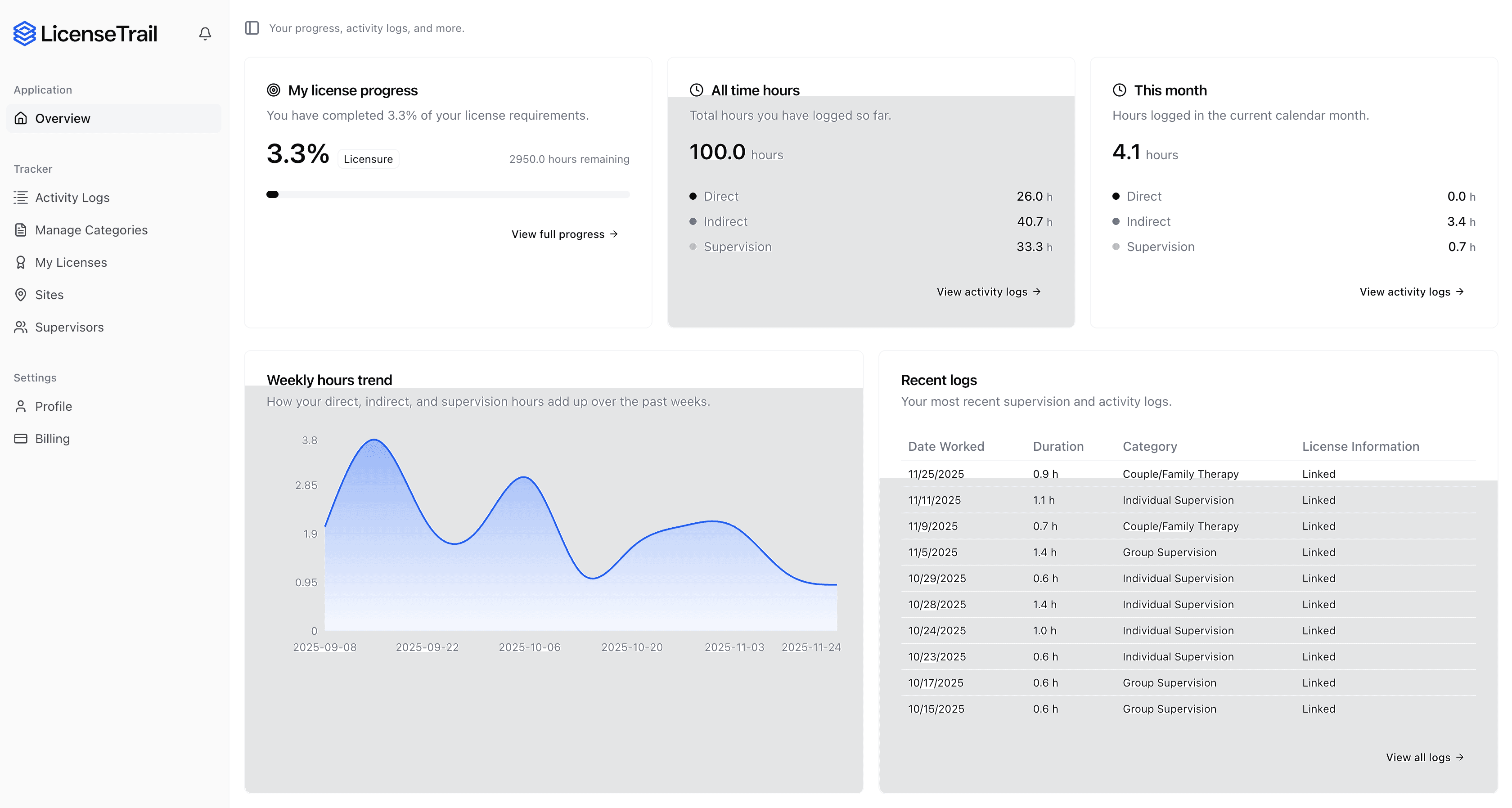
License Trail checks your direct, indirect, and supervision hours against Maine PE requirements continuously and flags mismatches before you submit.
 Start Tracking for Free
No credit card required · Free plan available
Related Licenses
Is your spreadsheet hiding Maine PE risks?
Stop guessing if your categories match Maine Board of Examiners of Psychologists requirements. License Trail checks your direct, indirect, and supervision hours continuously and flags mismatches before you submit.
Import or log
Bring your spreadsheet or start fresh
Upload your existing tracking spreadsheet and we'll map every hour into the right Maine Board of Examiners of Psychologists categories automatically.
Verify against Maine
Catch mismatches before the board does
License Trail checks your direct, indirect, and supervision hours against Maine PE requirements continuously.
Export board-ready
One-click clean reports
Generate professional, board-ready reports for supervision meetings and Maine Board of Examiners of Psychologists submissions in seconds.
No credit card required · Free plan available