
Maine TPE Requirements: Hours, Exams & Step-by-Step Guide
Stop guessing if your categories match Maine requirements. License Trail checks your direct, indirect, and supervision hours against TPE requirements continuously and flags mismatches before you submit.
No credit card required · Free plan available
Quick Requirements Overview
- TPE (Temporary Psychological Examiner) is issued only alongside the full Psychological Examiner application; lets you practice under supervision while completing exams
- Education: Master’s degree with comprehensive psychology training from a board-recognized accredited institution
- Experience (PE prerequisite): 1,500 hours actual work experience completed in 48–104 weeks, averaging 16–40 hrs/week
- Supervision during the 1,500 hrs: 3 hrs/week minimum (1 hr formal 1:1 face-to-face + 2 hrs learning activities/group/other supervision)
- TPE supervision: supervising Maine-licensed psychologist required; ≥1 hr/week 1:1 supervision (per Letter of Agreement), more as needed
- Exams: must pass Maine jurisprudence exam before TPE issuance; must pass EPPP (master’s level; 65%) during the TPE term
- Term/renewal: valid 1 year; non-renewable
- Scope limits: psychological examiner services only; no psychotherapy (interventions only as allowed and under psychologist supervision)
License Details
Procedures
In Maine, a Temporary Psychological Examiner (TPE) license is a short‑term credential that allows a master’s‑level psychological examiner applicant to practice under supervision while completing the examination requirements for full Psychological Examiner licensure.
Below is a step‑by‑step guide, with emphasis on the exact hour requirements and key state‑board language.
1. What a Temporary Psychological Examiner (TPE) license is
The Maine State Board of Examiners of Psychologists issues a temporary license specifically labeled on the application as:
“Temporary Psychological Examiner (TPE1421)” (maine.gov)
The application form states that:
“This application must accompany the Psychological Examiner license application.” (maine.gov)
So, you are not applying for a stand‑alone credential; you are applying for full Psychological Examiner licensure and, at the same time, for a temporary authorization to practice under supervision while your full license requirements (primarily the written exam) are completed.
The temporary license:
- Is issued for one year and cannot be renewed. (maine.gov)
- Allows you to practice only under supervision of a Maine‑licensed psychologist.
- Exists so that applicants who otherwise meet licensure requirements can work while they finish required examinations.
2. Baseline requirements to be a Psychological Examiner in Maine
To qualify for any Psychological Examiner license (including TPE), you must first meet the underlying statutory and rule‑based requirements for the Psychological Examiner credential.
2.1 Statutory qualifications (Title 32 §3831)
Maine law provides that a candidate for licensure as a psychological examiner must show that they: (legislature.maine.gov)
- Are trustworthy and competent to practice as a psychological examiner so as to safeguard the public.
- Hold a master’s degree reflecting comprehensive training in psychology from an accredited educational institution recognized by the board.
- Have had at least one year of full‑time supervised experience in psychology of a type the board considers qualifying.
- Are competent as a psychological examiner as shown by passing written and/or oral examinations required by the board.
- Are not engaged in unethical practice.
- Have not failed an examination within the preceding 6 months.
The board’s licensing page restates these in simplified form, listing:
- Master’s degree from an accredited institution.
- At least 1 year of experience in psychology. (maine.gov)
2.2 The one year of supervised experience – defined in hours
The statute’s “one year of full‑time supervised experience” is defined precisely in the Board’s rules for Licensure of Psychological Examiners, 02‑415 CMR ch. 5, §5‑2. (regulations.justia.com)
The rule requires:
- Minimum 1,500 hours of actual work experience
- Described as actual work experience (time actually working, not including holidays, sick leave, or vacation).
- Time frame: the 1,500 hours must be completed in no less than 48 weeks and no more than 104 weeks.
- Weekly hours: the experience must average at least 16 hours and not more than 40 hours per week.
- Supervision load during this year:
- At least 3 hours of supervision per week, of which
- 1 hour must be regularly scheduled, formal, face‑to‑face individual supervision, and
- 2 additional hours must be “learning activities” (e.g., case conferences, seminars on clinical issues, co‑therapy with discussion, group supervision, or additional individual supervision).
- At least 3 hours of supervision per week, of which
Put simply:
For Psychological Examiner licensure, Maine requires 1,500 hours of supervised work experience spread over roughly 1–2 years, at 16–40 hours/week, plus at least 3 hours of supervision each week (1 hour one‑on‑one, 2 hours in structured learning/supervision activities). (regulations.justia.com)
This is the core hour requirement you must already have (or be in the process of completing) before you can qualify for licensure as a Psychological Examiner, and thus before or while you hold a TPE.
3. Additional rules that govern Temporary licensure
Maine has a general temporary‑licensure statute and board rule that apply across psychologist and psychological examiner levels.
3.1 Statutory framework – Title 32 §3824(5)
The temporary‑license statute directs the board to adopt rules for a temporary license to enable psychologists to practice under supervision pending examination, and states that an applicant who: (legislature.maine.gov)
- Has at least 1,500 hours of postdoctoral experience, and
- Meets all other licensure requirements except required examinations,
may apply for a temporary license that allows the person to practice as a psychologist or psychological examiner under supervision for one year.
A few important clarifications:
- The statutory language about “1,500 hours of postdoctoral experience” clearly targets doctoral‑level psychologist applicants.
- Nonetheless, the temporary license that statute authorizes is described as permitting practice “as a psychologist or psychological examiner under supervision.” (legislature.maine.gov)
- For master’s‑level Psychological Examiners, the controlling hour requirement remains the 1,500 hours of supervised work (post‑master’s) defined in Chapter 5, not a separate 1,500‑hour “postdoctoral” requirement.
3.2 Board rule – Chapter 3, §2 (Examination)
The Board’s general rule on examinations adds specific conditions for temporary licensure: (law.cornell.edu)
- You must pass the Maine jurisprudence exam before a temporary license is issued.
- After receiving a temporary license, you must pass the written examination (EPPP) during the 1‑year term of the temporary license.
- The temporary license may not be renewed.
A note appended to this rule explains that the temporary license is meant to let a psychologist with at least 1,500 hours of postdoctoral experience, who has met all other licensure requirements except the written exam, practice with supervision as a psychologist or psychological examiner for up to a year. (law.cornell.edu)
In practice, for TPE applicants this means:
- You’re expected to have completed the supervised experience required for Psychological Examiner licensure (the 1,500‑hour supervised year).
- You must clear the jurisprudence exam first, get the temporary license, then pass the EPPP within the year.
4. Supervision requirements while holding a TPE
The TPE application includes a Letter of Agreement that must be signed by a Maine‑licensed psychologist who will supervise you. It explicitly states: (maine.gov)
- The supervisor agrees to be responsible for the applicant’s professional work and to follow Maine law and rules.
- The supervisor has reviewed the Board’s rules (Chapter 3, §2(3) and §6) on supervision for temporary and conditional licensees.
- The supervisor acknowledges that:
“a minimum of one (1) hour per week of one‑on‑one supervision is required and that additional supervisory time may be required to meet individual needs.”
This weekly one‑on‑one supervision requirement applies to you while you are practicing under the TPE.
Remember that this is in addition to the supervision standards that applied during your original 1,500‑hour supervised experience (3 hours/week total, including one hour individual), which got you to the point of qualifying for licensure. (regulations.justia.com)
5. Exams required for the Psychological Examiner and TPE
According to the Board’s licensing page for Psychological Examiners, you must: (maine.gov)
- Pass the Examination for Professional Practice in Psychology (EPPP) at the master’s level, with a passing score of 65%.
- Pass the Maine jurisprudence examination (minimum passing score 80% per Chapter 3 rule).
In the context of a Temporary Psychological Examiner license:
- Jurisprudence exam – must be passed first, before the TPE is issued. (law.cornell.edu)
- EPPP – must be passed during the 1‑year term of the temporary license.
- Failure to pass the written exam within that year means the temporary license will lapse, and it cannot be renewed. (law.cornell.edu)
6. Application steps for a Temporary Psychological Examiner (TPE)
Bringing the requirements together, the process generally looks like this:
Step 1 – Complete the degree and supervised‑experience prerequisites
- Earn a master’s degree with comprehensive training in psychology from an accredited institution. (legislature.maine.gov)
- Complete at least one year of full‑time supervised experience in psychology that meets the 1,500‑hour supervised experience standard described above (1,500 hours of work over 48–104 weeks, 16–40 hours/week, 3 supervision hours weekly). (regulations.justia.com)
Step 2 – Prepare the Psychological Examiner license application
From the Board’s Psychological Examiner licensing page, you must provide: (maine.gov)
- Completed Psychological Examiner application form.
- Recent photograph.
- Documentation of supervised experience (your 1,500‑hour supervised year).
- Official graduate transcript.
- EPPP score reports sent directly from the testing company (if already taken).
- License verifications for any other professional licenses you hold or have ever held.
- Evidence that you are trustworthy and competent to engage in the practice of psychology to safeguard the public.
Step 3 – Prepare and file the TPE application at the same time
Using the Temporary Psychological Examiner (TPE1421) application: (maine.gov)
- Pay the $200 TPE fee (non‑refundable).
- File the TPE application together with your Psychological Examiner license application.
- Ensure the application form is fully completed and signed.
Step 4 – Submit the required Letter of Agreement for supervision
With your TPE application, you must submit the Board’s Letter of Agreement, signed by both: (maine.gov)
- You (the applicant); and
- A Maine‑licensed psychologist who will be your supervisor.
In that letter, the supervisor:
- Accepts responsibility for your professional work.
- Confirms familiarity with the Board’s supervision rules.
- Agrees to provide at least one hour per week of one‑on‑one supervision, with additional supervision as needed.
Step 5 – Take and pass the Maine jurisprudence exam
- The Board reviews your application and, once your education and supervised experience are verified, authorizes you to sit for the jurisprudence exam. (law.cornell.edu)
- You must pass this exam before a temporary license can be granted.
Step 6 – Receive the Temporary Psychological Examiner license
Once you have:
- Met education and supervised‑experience requirements,
- Filed both the base PE and TPE applications with fees and supporting documentation,
- Provided a signed Letter of Agreement with a supervising Maine psychologist, and
- Passed the jurisprudence exam,
the Board may issue the Temporary Psychological Examiner (TPE) license, which: (law.cornell.edu)
- Is valid for one year from the date of issue.
- Cannot be renewed.
- Allows you to practice as a psychological examiner only under supervision in accordance with the Letter of Agreement and Board rules.
Step 7 – Pass the EPPP within the one‑year TPE period
- During the TPE year, you must take and pass the EPPP at the psychological‑examiner (master’s) level. (maine.gov)
- Once all requirements (including EPPP) are satisfied, the Board can grant you full Psychological Examiner licensure, which then renews annually.
7. Practice limits under the TPE and Psychological Examiner scope
The Board defines a psychological examiner as someone who provides psychological services limited to interviewing, administering and interpreting tests of mental abilities, aptitudes, interests and personality, mainly for psychological evaluation or educational/vocational purposes. (maine.gov)
Key limits:
- Psychological examiners may provide certain intervention services—such as consultation, behavior management, or social skills training—only under the supervision of a licensed psychologist or as otherwise allowed by law and rules.
- Psychological examiners may not provide psychotherapy services under any circumstances. (maine.gov)
When practicing under a Temporary Psychological Examiner (TPE) license, you are:
- Operating within the same scope as a psychological examiner,
- But must also comply with the additional supervision conditions (weekly one‑on‑one supervision, and adherence to the terms of the Letter of Agreement and Board rules).
8. Hour requirements at a glance
For a Maine Temporary Psychological Examiner (TPE), the hour‑related requirements can be summarized as:
-
Pre‑licensure supervised experience for Psychological Examiner eligibility
- 1,500 hours of actual work experience,
- Completed over 48–104 weeks,
- 16–40 hours/week,
- With at least 3 hours of supervision per week (1 hour individual, 2 hours in structured learning/supervision activities). (regulations.justia.com)
-
Ongoing supervision while holding the TPE
- Minimum 1 hour per week of one‑on‑one supervision with a Maine‑licensed psychologist, as confirmed in the required Letter of Agreement. (maine.gov)
-
Temporary‑license framework
- One‑year term, non‑renewable.
- Must pass jurisprudence before issuance and EPPP during that year. (law.cornell.edu)
There is no separate pair of hour requirements (e.g., 1,500 direct + 1,500 supervised) specific to the TPE beyond:
- The 1,500 hours of supervised work experience required for Psychological Examiner licensure itself; and
- The ongoing weekly supervision obligation while you are practicing under the TPE.
Track your TPE hours with confidence
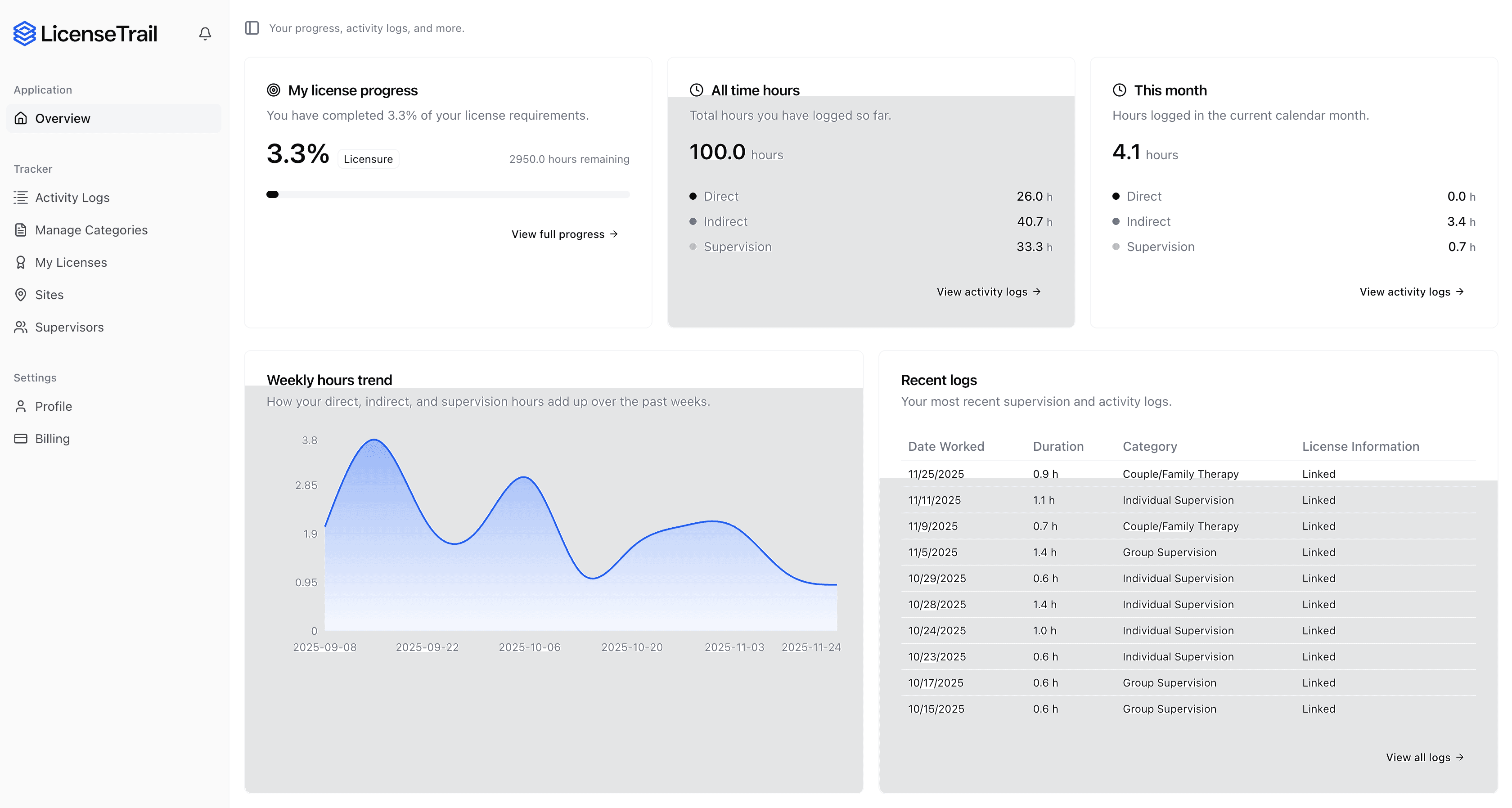
License Trail checks your direct, indirect, and supervision hours against Maine TPE requirements continuously and flags mismatches before you submit.
 Start Tracking for Free
No credit card required · Free plan available
Related Licenses
Is your spreadsheet hiding Maine TPE risks?
Stop guessing if your categories match Maine Board of Examiners of Psychologists requirements. License Trail checks your direct, indirect, and supervision hours continuously and flags mismatches before you submit.
Import or log
Bring your spreadsheet or start fresh
Upload your existing tracking spreadsheet and we'll map every hour into the right Maine Board of Examiners of Psychologists categories automatically.
Verify against Maine
Catch mismatches before the board does
License Trail checks your direct, indirect, and supervision hours against Maine TPE requirements continuously.
Export board-ready
One-click clean reports
Generate professional, board-ready reports for supervision meetings and Maine Board of Examiners of Psychologists submissions in seconds.
No credit card required · Free plan available