
Maine TPSY Requirements: Hours, Exams & Step-by-Step Guide
Stop guessing if your categories match Maine requirements. License Trail checks your direct, indirect, and supervision hours against TPSY requirements continuously and flags mismatches before you submit.
No credit card required · Free plan available
Quick Requirements Overview
- License type/term: Temporary Psychologist (TPSY/TP1421); valid 1 year from issue; non‑renewable
- Purpose/limits: Allows practice in ME only under supervision; issued only with a regular Psychologist license application (cannot stand alone)
- Education: Doctoral degree in psychology from an accredited institution
- Exams: EPPP (≥70%) and Maine Jurisprudence Exam
- Supervised experience standard (same as full license): 3,000 hours total = 1,500 predoc + 1,500 postdoc (each 48–104 weeks, 16–40 hrs/week; “actual work” time; no practicum-for-credit hours)
- Predoc structure: 2 hrs/week face‑to‑face supervision + 2 hrs/week learning activities; ≥50% service‑related, with ≥25% of service time direct client contact; ≤25% research
- Postdoc structure: 1 hr/week individual face‑to‑face supervision + 1 hr/week learning activities; 25–60% of time in direct service
- TPSY supervision paperwork: Signed Letter of Agreement with a ME‑licensed psychologist who assumes responsibility; ≥1 hr/week 1:1 supervision during TPSY practice; supervisor must notify Board of interruptions/termination and ensure transfer if needed
License Details
Procedures
The Maine Board of Examiners of Psychologists regulates a “Temporary Psychologist” license (internally coded as TP1421 on the paper form) that allows doctoral‑level psychologists to practice in Maine under supervision for up to one year. The underlying standards for hours and supervision are the same ones the Board uses for full psychologist licensure.
Below is a structured guide to those requirements, with emphasis on the exact hour counts and how the Board describes them.
1. What the Temporary Psychologist (TPSY) license is
On Maine’s licensing site, “Psychologists, Conditional Psychologists, Temporary Psychologists” are grouped together. A Temporary Psychologist license: (www1.maine.gov)
- Is a one‑year license from the date of issue (it “cannot renew”).
- Is issued only in connection with a regular psychologist license application.
- Requires a formal Letter of Agreement with a Maine‑licensed psychologist who accepts responsibility for supervising your professional work.
- Requires at least one hour per week of one‑to‑one supervision while you practice under the temporary license.
The paper application explicitly states that a Temporary Psychologist application “must accompany the Psychological License application” and identifies the license type as “Temporary Psychological (TP1421).” (maine.gov)
2. Baseline eligibility: education, exams, and general requirements
On the Board’s “Description and how to apply” page for psychologists, conditional psychologists, and temporary psychologists, the general requirements include: (www1.maine.gov)
Education
- You must have received a doctoral degree from an accredited institution.
- You must have at least two years of experience in psychology (this is operationalized in the rules as one year of predoctoral supervised experience and one year of postdoctoral supervised experience; see Section 3 below). (regulations.justia.com)
Examinations
- You must pass the EPPP (Examination for Professional Practice in Psychology) with at least a 70% score, and
- Pass the Maine Jurisprudence Exam. (www1.maine.gov)
Other general requirements
- Completed Board application.
- Documentation of supervised experience on Board forms.
- Official doctoral transcript.
- Copy of a current license (if you already hold a license in another jurisdiction).
- Exam scores sent directly to the Board.
- Official license verifications for all professional licenses you have ever held.
- A Letter of Agreement with a Maine‑licensed psychologist if you are applying for a conditional or temporary license; this document must be signed by you and the supervisor. (www1.maine.gov)
3. Supervised experience: required hours and structure
Maine’s Board rules spell out supervised experience in Chapter 4, Section 2 – Supervised Experience (for psychologists). This is what your hours must look like, whether they were accrued in Maine or another jurisdiction.
The rule requires two distinct years of supervised experience: (regulations.justia.com)
- One year of predoctoral supervised experience, and
- One year of postdoctoral supervised experience,
- OR (for certain re‑specialization candidates) two years of postdoctoral supervision instead of the usual predoctoral + postdoctoral split.
The key hour requirements are:
3.1 Predoctoral supervised experience
The Board’s rule defines the predoctoral requirement as: (regulations.justia.com)
-
Minimum total hours
- At least 1,500 hours of actual work experience.
- “Actual work experience” excludes holidays, sick leave, and vacation; it is time actually spent in the training role.
-
Time frame
- Completed in not less than 48 weeks and not more than 104 weeks.
- Average workload between 16 and 40 hours per week.
-
Weekly supervision and learning activities
- At least 2 hours per week of face‑to‑face supervision by a qualified psychologist.
- Plus 2 hours per week of additional learning activities (for example, group supervision, seminars, or case conferences).
-
Activity mix / direct service requirement
- At least 50% of predoctoral hours must be in “service‑related activities” such as assessment, interviews, report writing, case presentations, treatment, and consultation.
- Of that service‑related time, at least 25% must be direct patient/client contact (face‑to‑face work).
- No more than 25% of total predoctoral time may be devoted to research.
-
What does not count
- The Board specifies that this supervised experience does not include practicum hours for which graduate academic credit was awarded.
These same elements are mirrored in the Board’s “Verification of Pre‑Doctoral Supervised Experience” form, which asks supervisors to confirm: weekly hours (16–40), 2 hours of face‑to‑face supervision, 2 hours of learning activities, at least 50% service‑related work, at least 25% of that service time as direct client contact, and no more than 25% research. (maine.gov)
Net effect: for predoctoral experience, Maine expects 1,500 supervised hours, with heavily service‑focused work and a specified minimum of face‑to‑face and learning‑activity supervision.
3.2 Postdoctoral supervised experience
The same rule sets parallel expectations for postdoctoral supervision: (regulations.justia.com)
-
Minimum total hours
- At least 1,500 hours of actual work experience.
-
Time frame
- Completed in 48–104 weeks, again averaging 16–40 hours per week.
-
Weekly supervision and learning activities
- At least 1 hour per week of individual (face‑to‑face) supervision by a psychologist, and
- At least 1 additional hour per week of learning activities (such as seminars or group supervision).
- The rule allows rare variances (e.g., geographic hardship) where supervision might be scheduled so that at least four hours per month of one‑to‑one supervision is maintained, but the standard expectation is weekly contact.
-
Direct service requirement
- Between 25% and 60% of postdoctoral time must be devoted to direct service each week, with the majority of your work in your intended practice area.
-
What does not count
- As with predoctoral hours, postdoctoral supervised experience cannot include practicum work that carried academic credit.
These conditions are echoed in the Board’s “Verification of Post‑Doctoral Supervised Experience” form, which repeats the 1,500‑hour minimum, the 16–40‑hour/week range, the 1 hour of face‑to‑face supervision plus 1 hour of additional learning activities weekly, and the 25–60% direct‑service requirement. (maine.gov)
Net effect: for postdoctoral experience, Maine expects another 1,500 supervised hours, with 25–60% of work in direct services and structured weekly supervision.
3.3 Total supervised experience Maine expects
Putting the two pieces together, Maine’s rules amount to:
- At least 3,000 hours of supervised experience in total, usually:
- 1,500 predoctoral hours, and
- 1,500 postdoctoral hours,
- Structured according to the weekly workload, supervision, and direct‑service proportions listed above. (regulations.justia.com)
These supervised experience standards apply to anybody seeking psychologist licensure in Maine; your Temporary Psychologist (TPSY) practice is expected to be consistent with them.
4. Supervision while you hold the Temporary Psychologist (TPSY) license
Your temporary license cannot stand alone; the Board requires an active supervisory relationship with a Maine‑licensed psychologist.
The Letter of Agreement accompanying the Temporary Psychologist application states that the Maine supervisor: (maine.gov)
- Agrees to be responsible for the professional work of the temporary licensee.
- Confirms familiarity with Maine’s psychology laws and Board rules, including:
- Chapter 3, Section 2(3), and
- Chapter 6, as they apply to temporary and conditional licensees.
- Acknowledges that a minimum of one hour per week of one‑on‑one supervision is required, with additional supervision as needed.
- Promises to notify the Board of any major interruptions or termination of supervision and to help ensure supervisory responsibilities are transferred to another Maine‑licensed psychologist if needed.
In practice, that means:
- You cannot use a TPSY license to practice independently.
- Your supervisory plan must meet both:
- The weekly hour/minimum supervision standards in Chapter 4, Section 2 for pre‑ and post‑doctoral supervised experience, and
- The ongoing one‑to‑one supervision requirement in the Letter of Agreement for temporary licensees. (regulations.justia.com)
5. Application steps specifically for a Temporary Psychologist
From the Board’s licensing and application materials, the typical sequence for TPSY is: (www1.maine.gov)
-
Complete the main Psychologist application
- Either “Psychologist to take EPPP” or “Psychologist passed EPPP,” depending on your status.
- Attach documentation of your pre‑ and (if applicable) post‑doctoral supervised experience using the Board’s PS Supervised Experience forms.
-
Add the Temporary Psychologist application (TP1421)
- Required fee: $200 (non‑refundable).
- This form must accompany your primary psychologist license application; you check a box if it has already been submitted.
-
Submit a signed Letter of Agreement
- Completed and signed by both you and your Maine‑licensed psychologist supervisor.
- Must explicitly acknowledge adherence to the Board’s supervision rules and the one‑hour‑per‑week minimum individual supervision.
-
Ensure all supporting documents are in place
- Official transcripts (doctorate).
- Verification of supervised experience (pre‑ and post‑doc).
- Exam scores (EPPP and Maine jurisprudence, if already taken) sent directly from the testing agencies.
- License verifications from all jurisdictions where you’ve ever held a license.
-
Criminal background check
- The Board requires a criminal history records check for all applicants; there is a separate fee (currently $21). (www1.maine.gov)
Once approved, your Temporary Psychologist license is issued for one year from the date of issue and cannot be renewed; if you need ongoing supervised practice beyond that, you would need to be in another appropriate licensure status (e.g., conditional or full psychologist, depending on your progress).
6. Renewal and term
For psychologists in general:
- Full psychologist licenses renew annually on April 30 with a renewal fee of $125. (www1.maine.gov)
For Temporary Psychologists in particular:
- The licensing page and fee schedule specify:
- Temporary License fee: $200.00 (cannot renew).
- Term: 1 year from date of issue for conditional and temporary licenses. (www1.maine.gov)
So TPSY is explicitly intended as a short‑term, supervised status while other licensure requirements (for example, final exams, completion/documentation of supervised hours, or endorsement review) are finalized.
In summary, in the Board’s own structure
- Maine expects 1,500 hours of predoctoral supervised experience and 1,500 hours of postdoctoral supervised experience, with specified weekly hours, supervision, and direct‑service proportions, for a total of 3,000 supervised hours that meet Chapter 4, Section 2. (regulations.justia.com)
- A TPSY Temporary Psychologist license lets you practice under supervision while your full psychologist licensure is being completed, but:
- It requires a doctoral degree and supervised experience consistent with those standards.
- It requires a signed supervisory Letter of Agreement with at least one hour per week of individual supervision and adherence to the Board’s supervision rules.
- It is valid for one year only and cannot be renewed. (www1.maine.gov)
Track your TPSY hours with confidence
License Trail checks your direct, indirect, and supervision hours against Maine TPSY requirements continuously and flags mismatches before you submit.
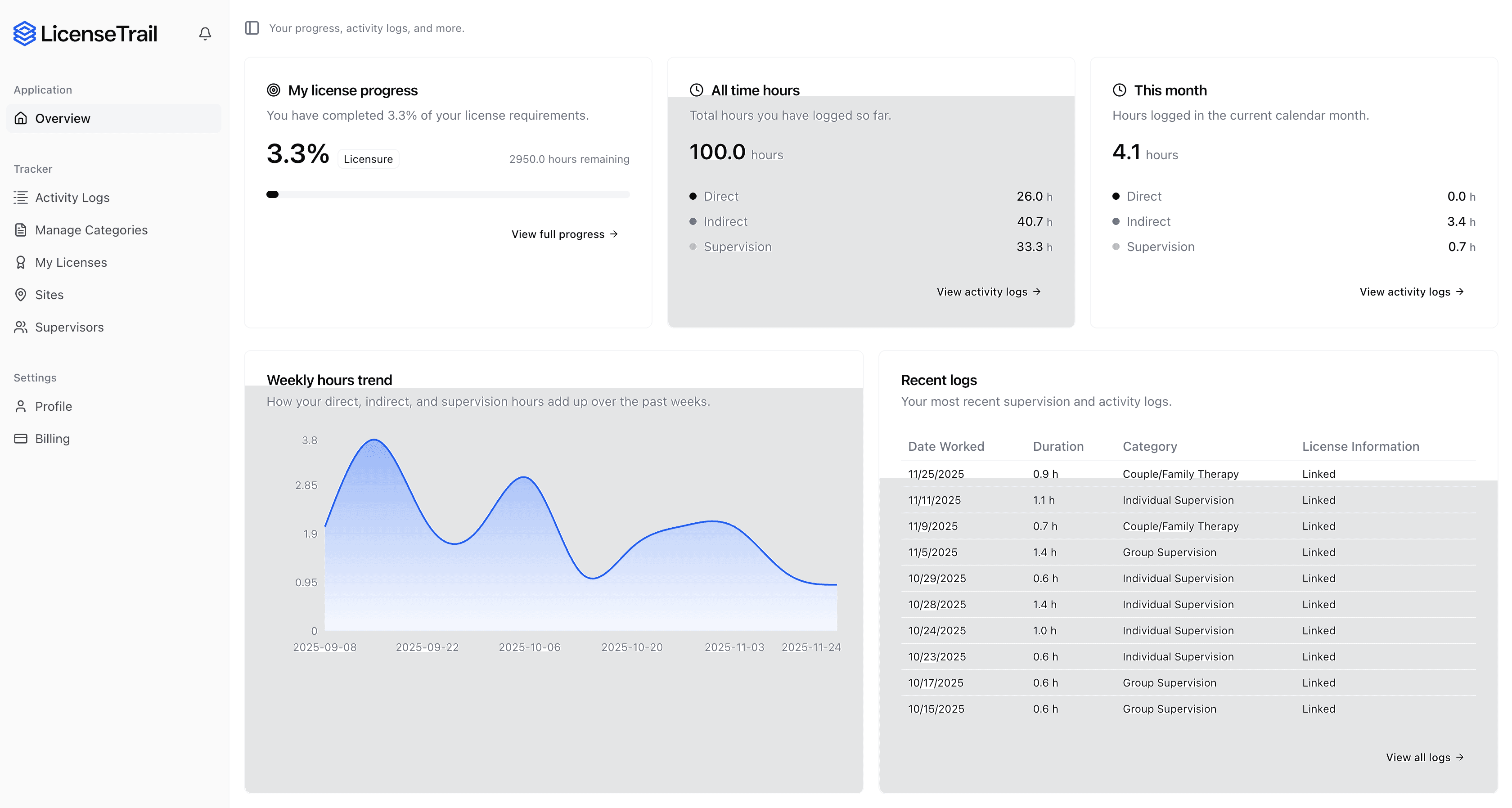 Start Tracking for Free
No credit card required · Free plan available
Related Licenses
Is your spreadsheet hiding Maine TPSY risks?
Stop guessing if your categories match Maine Board of Examiners of Psychologists requirements. License Trail checks your direct, indirect, and supervision hours continuously and flags mismatches before you submit.
Import or log
Bring your spreadsheet or start fresh
Upload your existing tracking spreadsheet and we'll map every hour into the right Maine Board of Examiners of Psychologists categories automatically.
Verify against Maine
Catch mismatches before the board does
License Trail checks your direct, indirect, and supervision hours against Maine TPSY requirements continuously.
Export board-ready
One-click clean reports
Generate professional, board-ready reports for supervision meetings and Maine Board of Examiners of Psychologists submissions in seconds.
No credit card required · Free plan available