
Maryland LBSW Requirements: Hours, Exams & Step-by-Step Guide
Stop guessing if your categories match Maryland requirements. License Trail checks your direct, indirect, and supervision hours against LBSW requirements continuously and flags mismatches before you submit.
No credit card required · Free plan available
Quick Requirements Overview
- Regulator: Maryland State Board of Social Work Examiners (BSWE)
- Education: BSW from a CSWE-accredited or candidate program (or CSWE-approved equivalent/foreign equivalency)
- Age/character: At least 18 years old and of good moral character
- Exam: Pass the ASWB Bachelors exam (authorization after complete application)
- Background check: Criminal history records check required (at applicant’s expense)
- Application/fees: Submit complete Board application, official transcript, and pay applicable fees
- Experience: No post-degree supervised practice hours required for initial LBSW licensure
- Practice limits/maintenance: LBSW may not engage in private practice; renew with 30 CEUs every 2 years (incl. Category I, ethics, and anti-oppressive practice requirements)
License Details
Procedures
Maryland regulates social work through the State Board of Social Work Examiners (BSWE). The LBSW (Licensed Bachelor Social Worker) is the entry-level social work license and, unlike advanced licenses, does not require any post‑degree supervised practice hours to obtain the license itself.
Below is a step‑by‑step guide, using the Board’s and statute’s own terminology.
1. License level and what it means
Maryland law calls this license a “bachelor social worker license”; the Board commonly refers to it as LBSW – Licensed Bachelor Social Worker.(law.justia.com)
The Board’s licensing requirements page states that a Licensed Bachelor Social Worker (LBSW) shall have obtained a baccalaureate degree in social work from a program accredited by the Council on Social Work Education (CSWE).(health.maryland.gov)
LBSWs:
- Practice at the bachelor level under applicable supervision/employer policies.
- May not engage in private practice (solo fee‑for‑service practice) under COMAR 10.42.02.06.(health.maryland.gov)
2. Core statutory requirements to obtain an LBSW license
Maryland Health Occupations §19‑302 sets the baseline requirements to obtain any social work license, then adds specifics for the bachelor level. To obtain any license, an applicant must:(law.justia.com)
- Submit a complete written application on the Board’s form.
- Be at least 18 years old.
- Be of good moral character.
- Pass an examination prescribed by the Board that is pertinent to the license sought (for LBSW, this is the ASWB Bachelors exam).(health.maryland.gov)
- Pay all applicable fees.
- Complete a criminal history records check at the applicant’s expense.
- Submit to any additional examination required under §19‑302.3 (typically used only in special situations).
In addition, to obtain a bachelor social worker license, the statute requires that the applicant:(law.justia.com)
- Meet all items above and
- “Have received a baccalaureate degree in social work from a program that is accredited or is a candidate for accreditation by the Council on Social Work Education or an equivalent organization approved by the Council on Social Work Education.”
This is the only educational/experience requirement specifically listed for LBSW in statute and in the Board’s “Licensing Requirements” page.(health.maryland.gov)
3. Examination requirement (ASWB Bachelors exam)
The Board requires you to pass the ASWB exam “which is required for the licensure level.” For the LBSW, that is the ASWB Bachelors examination.(health.maryland.gov)
Key points:
- Everyone must pass the ASWB exam appropriate to the license level; there are no exceptions.(health.maryland.gov)
- BSW students may apply in their last semester to sit for the Bachelors or Masters exam, per the Board’s guidance.(health.maryland.gov)
- Authorization to test is issued only after the Board has a complete application, including official transcript (or degree‑pending verification) and fees.(health.maryland.gov)
The ASWB Bachelors exam is a 170‑question, four‑hour multiple‑choice exam designed to assess entry‑level competence.(aswb.org)
4. Application materials and documentation
From the BSWE “Licensing Requirements” and “Requirements” pages:(health.maryland.gov)
- Application form.
- Must be completed in full; the Applicant’s Affidavit must be signed and dated.
- Official transcript.
- Must show conferral of a BSW from a CSWE‑accredited (or candidate) program.
- If sent electronically, it must come directly from the school to the Board; mailed transcripts must go directly from the school to the Board’s address.(phoenix.edu)
- Criminal history records check.
- Application and exam fees.
- If foreign‑educated: CSWE Foreign Equivalency Determination must be completed and submitted, with CSWE’s determination letter and a copy of the foreign transcript.(health.maryland.gov)
The Board indicates that once an application is complete, it is mandated to process it within 60 days.(health.maryland.gov)
5. Experience and hour requirements specifically for LBSW
5.1 Initial LBSW licensure – no post‑degree hour requirement
For the initial LBSW license:
- Maryland does not prescribe any specific number of post‑degree supervised hours (e.g., 1,500 or 3,000 hours) as a condition for LBSW licensure.
- The Board’s own “Licensing Requirements” section lists only that an LBSW must have a baccalaureate degree in social work from a CSWE‑accredited program; it does not list a required number of supervised or direct‑service hours.(health.maryland.gov)
The detailed hours you may see in other sources (for example 3,000 hours of supervised experience with 1,500 hours of face‑to‑face client contact) belong to advanced clinical licensure (LCSW‑C), not to LBSW. Those LCSW‑C requirements are set out separately in statute and regulation.(law.justia.com)
In other words, to become an LBSW in Maryland you need:
- No specified post‑BSW experience hours;
- Only the Board‑required field education embedded in your accredited BSW program and successful completion of the ASWB Bachelors exam.
5.2 Hours related to independent practice approval (optional, post‑licensure)
Although not required to become licensed as an LBSW, Maryland does define specific hours if an LBSW later seeks approval to engage in independent practice under Health Occupations §19‑302(f) and COMAR 10.42.02.05.(law.justia.com)
To obtain Board approval for independent practice as an LBSW or LMSW, the law requires documentation of:
- At least 3 years as a licensee, and
- Supervised experience of at least 4,500 hours after receiving the BSW or MSW, and
- A minimum of 150 hours of periodic face‑to‑face supervision during those 4,500 hours.
The statute allows the Board, if it finds a deficiency in those hours or in the nature of the supervision, to require the licensee to work up to 1,500 additional hours of supervised social work experience before re‑applying for independent practice status.(law.justia.com)
Important distinctions in Board terminology:
- “Supervised experience” here means the total 4,500 hours of post‑degree practice as a licensed bachelor or master social worker while working under social work supervision.(mdrules.elaws.us)
- “Periodic face‑to‑face supervision” refers to the dedicated supervisory meetings that must total at least 150 hours across those 4,500 practice hours.
- Independent practice is not the same as private practice. Even with independent status, COMAR 10.42.02.06 specifies that an LBSW may not engage in private practice; only an LCSW‑C may do so.(health.maryland.gov)
5.3 Hours to become a Board‑approved supervisor as an LBSW (optional, post‑licensure)
An LBSW can eventually become a Board‑approved supervisor, but only after meeting additional experience requirements. COMAR 10.42.08.03 and 10.42.08.04 describe these.(law.cornell.edu)
For an LBSW to be approved as a supervisor, the regulations require that the LBSW:
- Obtain independent status under COMAR 10.42.02.05 (so, meet the 4,500‑hour/150‑hour supervision requirements above).(law.cornell.edu)
- Obtain “additional hours of experience as an LBSW” as set out in COMAR 10.42.08.04(C)(4). This provision gives two pathways, both based on bachelor‑level practice experience:
- 24 months of social work experience as an independent licensed bachelor social worker or equivalent before obtaining an LCSW or LCSW‑C license, or
- 60 months of social work experience as an LBSW or equivalent before obtaining an LCSW or LCSW‑C license.(law.cornell.edu)
- Meet supervision‑training and other conditions (coursework or CE in supervision, no recent discipline, filing the supervisory registration form and fee).(law.cornell.edu)
Again, none of these additional hours are required just to obtain the LBSW license. They apply only if you later choose to supervise others or seek independent‑practice status.
6. Continuing education hours after you are licensed
Once you are licensed, the Board requires ongoing continuing education units (CEUs) for renewal. Under COMAR 10.42.06.03 and NASW‑MD’s summary:(dsd.maryland.gov)
- LBSW renewal: 30 CEUs every 2‑year renewal period.
- At least 15 of those CEUs must be in Category I programs approved by the Board.
- At least 3 CEUs (Category I or II) must cover ethics and professional conduct, including boundaries or Maryland practice/law.
- At least 3 Category I CEUs must focus on anti‑oppressive social work practice (race, culture, equity, implicit bias, anti‑racism, etc.).
These are educational hours, not supervised practice hours, but the Board treats them as mandatory “hour” requirements for maintaining licensure.
7. Putting it together
For initial LBSW licensure in Maryland, the Board’s and statute’s requirements, in plain language, are:
- Earn a BSW from a CSWE‑accredited (or candidate) program, or foreign equivalent approved by CSWE.(health.maryland.gov)
- Be 18 or older, of good moral character, and complete a criminal history records check.(law.justia.com)
- Submit a complete LBSW application to the Board with fees and official transcripts.(health.maryland.gov)
- Receive authorization and pass the ASWB Bachelors exam.(health.maryland.gov)
No additional post‑degree supervised practice hours are required to obtain the LBSW license. All hour‑based experience requirements (4,500 supervised hours with 150 hours of face‑to‑face supervision; possible extra 1,500 hours; 24‑ or 60‑month experience for supervision status) apply later, if you choose to pursue independent practice approval or Board‑approved supervisor status, or if you move up to advanced licensure such as LCSW or LCSW‑C.(law.justia.com)
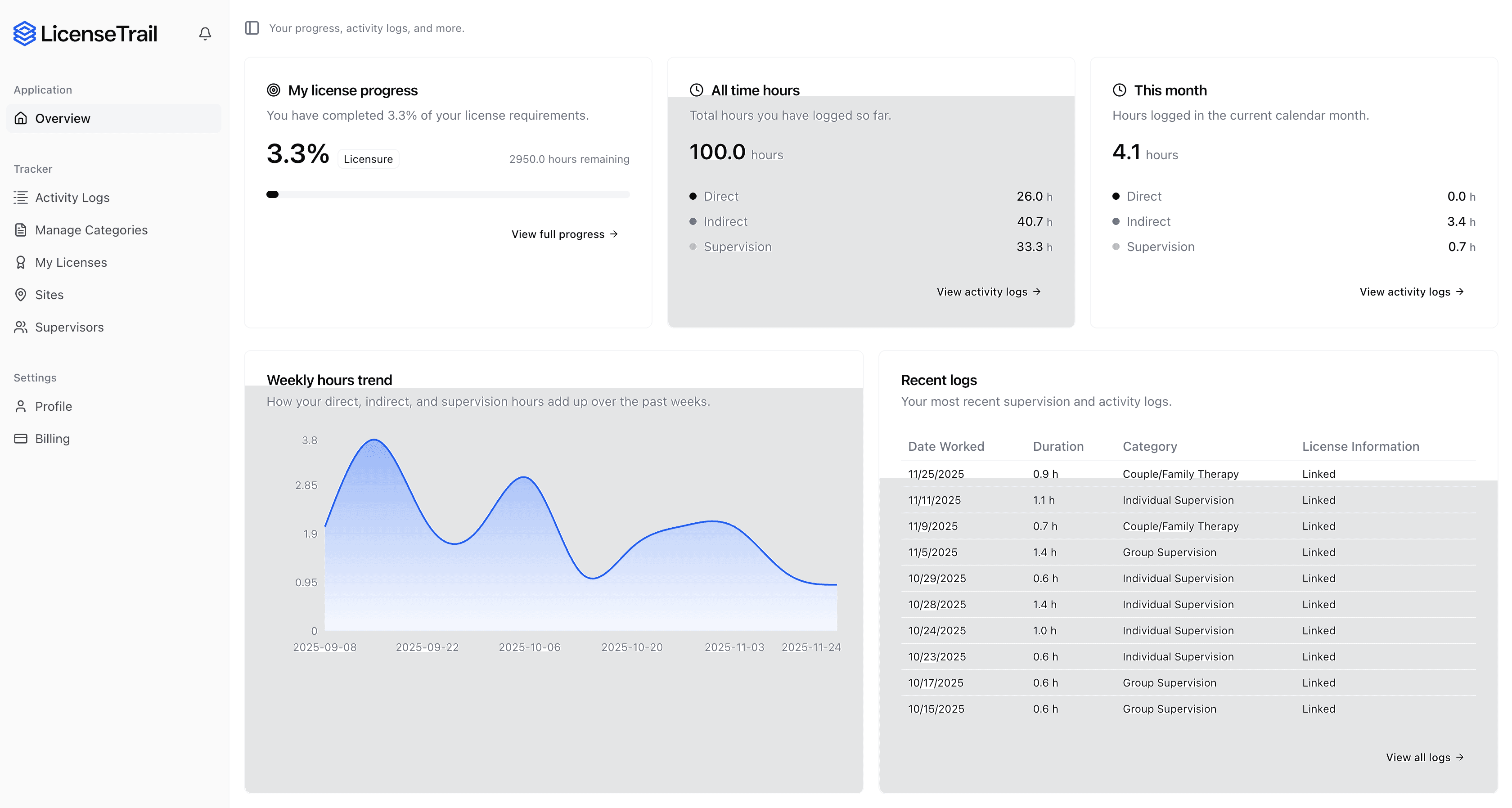
Track your LBSW hours with confidence
License Trail checks your direct, indirect, and supervision hours against Maryland LBSW requirements continuously and flags mismatches before you submit.
 Start Tracking for Free
No credit card required · Free plan available
Is your spreadsheet hiding Maryland LBSW risks?
Stop guessing if your categories match Maryland Board of Social Work Examiners requirements. License Trail checks your direct, indirect, and supervision hours continuously and flags mismatches before you submit.
Import or log
Bring your spreadsheet or start fresh
Upload your existing tracking spreadsheet and we'll map every hour into the right Maryland Board of Social Work Examiners categories automatically.
Verify against Maryland
Catch mismatches before the board does
License Trail checks your direct, indirect, and supervision hours against Maryland LBSW requirements continuously.
Export board-ready
One-click clean reports
Generate professional, board-ready reports for supervision meetings and Maryland Board of Social Work Examiners submissions in seconds.
No credit card required · Free plan available