
Maryland LMSW Requirements: Hours, Exams & Step-by-Step Guide
Stop guessing if your categories match Maryland requirements. License Trail checks your direct, indirect, and supervision hours against LMSW requirements continuously and flags mismatches before you submit.
No credit card required · Free plan available
Quick Requirements Overview
- Degree: MSW from a CSWE-accredited program (or Board-deemed equivalent)
- Exam: Pass the ASWB Master’s exam (typically after Board approval to test)
- Background check: Complete State + FBI CHRC via the Central Repository process
- Application: Submit signed/dated application, nonrefundable fee, and required documents (incl. official transcripts/graduation-pending verification)
- Post‑MSW hours (for LMSW): None required to obtain the LMSW license
- Practice limits (after licensure): Must practice under supervision; cannot diagnose/treat mental disorders or provide psychotherapy without LCSW‑C supervision
- Independent/private practice: Not permitted as an LMSW; separate independent/advanced licensure requirements apply (e.g., 4,500 hrs + 150 supervision hrs for independent status; 3,000 hrs + 100 supervision hrs for LCSW/LCSW‑C)
License Details
Procedures
Maryland’s Licensed Master Social Worker (LMSW) credential is the entry‑level master’s license issued by the Maryland Board of Social Work Examiners (BSWE). It allows you to practice “master social work” under supervision, and it is the license you must hold before accruing hours toward advanced licenses such as LCSW or LCSW‑C.
A key point for Maryland: there is no post‑MSW hour requirement to obtain the LMSW itself. The hour requirements you’ll see in Board materials (e.g., 3,000 hours, 4,500 hours, 150 hours of supervision) apply to advanced licensure or independent practice, not to the initial LMSW license. (health.maryland.gov)
Below is a step‑by‑step guide based directly on the Board’s regulations and licensing page, with emphasis on how and when hours come into play.
1. Basic eligibility for an LMSW in Maryland
To be eligible for a Maryland LMSW, you must:
-
Hold the right degree
The Board’s Licensing Requirements page specifies that a:
Licensed Master Social Worker (LMSW) shall have obtained a master’s of social work degree from a program accredited by the Council on Social Work Education. (health.maryland.gov)
In practice, this means:
- An MSW from a CSWE‑accredited program (or one the Board deems equivalent).
- Your program will have included its own field practicum hours, but those are education requirements, not state‑mandated “licensure hours.”
-
Meet statutory licensure qualifications
The Board’s regulations state that it “shall issue a master social worker license to an applicant who has met the applicable qualifications in Health Occupations Article, §19‑302(a) and (c).” (health.maryland.gov)
Those statutory subsections cover general conditions such as:
- Being of good moral character.
- Submitting a complete application and fees.
- Meeting education and examination requirements.
-
Complete a criminal history records check (CHRC)
Maryland requires a State and national criminal history records check for “an initial license or a license for renewal, reactivation, reinstatement, or reissuance.” (health.maryland.gov)
In other words, you must:
- Use the Central Repository process specified in Maryland law.
- Allow the Board to receive “criminal history records information” (arrests, charges, convictions, pending charges) and, if enrolled, Rap Back notifications. (health.maryland.gov)
-
Pass the required licensing exam
The Board’s regulations require “a passing score from the required examination administered by the Association of Social Work Boards” (ASWB). (health.maryland.gov)
For the LMSW level, that “required examination” is the ASWB Master’s Examination.
2. Pathway: licensure by examination (typical for new MSWs)
If you have not already passed the ASWB exam at the master’s level, you apply for LMSW by examination:
-
Submit an LMSW application to the Maryland Board
On the Board’s Licensing Requirements page, “Licensure By Examination” is defined as the route for applicants who have not yet passed the required exam and must apply to the Board for approval to sit for it. (health.maryland.gov)
Your application packet must be complete. The regulations specify that, for a licensure application to be complete, it must include: (health.maryland.gov)
- A signed and dated application form and the non‑refundable application fee.
- Official transcripts from a program approved or deemed equivalent by CSWE, showing your MSW degree and date conferred.
- A criminal history records check report.
- Ultimately, a passing ASWB exam score (sent directly to the Board).
-
Secure transcripts
The Board accepts either:
- An official transcript showing your MSW has been awarded, or
- For students in their final term, documentation (via Board form) that indicates the expected degree and graduation date. (health.maryland.gov)
-
Undergo the CHRC
Complete the State and FBI background check as directed by the Board so that the Central Repository sends the results to BSWE. (health.maryland.gov)
-
Receive Board approval to sit for the ASWB exam
Once your application and documentation are in order, the Board issues approval for you to register with ASWB for the master’s‑level exam. (health.maryland.gov)
-
Take and pass the ASWB Master’s Examination
- Register for and pass the ASWB Master’s Examination.
- ASWB transmits your passing score directly to the Board.
-
LMSW license issuance
After the Board receives:
- Your complete application,
- Your official transcript,
- Your passing ASWB score, and
- Your criminal history records check,
it can issue your Licensed Master Social Worker license. (health.maryland.gov)
3. Pathway: licensure by endorsement (if already licensed elsewhere)
If you already hold or held a social work license in another state and became licensed by taking the required exam, the Board directs you to apply by endorsement at the level comparable to the license you hold or held and the exam you passed. (health.maryland.gov)
For LMSW‑level endorsement, you must:
- Document your existing license and exam (ASWB or acceptable equivalent).
- Meet Maryland’s education and CHRC requirements.
- Show that your out‑of‑state license is comparable to Maryland’s LMSW in scope and exam level.
4. Practice conditions once you are licensed as an LMSW
Maryland regulations define both your scope of practice and the supervision requirements once you hold the LMSW:
-
Practice under supervision
The regulations state that an “LMSW shall practice social work under a social work supervisor.” (dsd.maryland.gov)
Your LMSW practice may include advanced skills in:
- Assessment, planning, intervention, evaluation,
- Case management, information and referral, counseling,
- Supervision, consultation, education, advocacy, community organization, and
- Policy/program development and administration. (dsd.maryland.gov)
-
Limitations on clinical functions
As an LMSW, you may not, without supervision from an LCSW‑C:
- Diagnose mental disorders,
- Treat emotional disorders,
- Provide psychotherapy. (health.maryland.gov)
-
No private practice as an LMSW
Maryland regulations state that:
- An LMSW “may not engage in the independent practice of social work until the licensee is approved by the Board for independent status,” (dsd.maryland.gov)
- And, separately, that “on or after January 1, 2020, an LMSW may not engage in private practice.” (health.maryland.gov)
Independent practice approval (where relevant) has its own substantial hour requirements, discussed next.
5. How hours actually work in Maryland—and why they don’t apply to initial LMSW licensure
The Board’s materials list specific practice and supervision hour requirements, but they are tied to advanced licensure or independent practice, not to obtaining the LMSW itself.
A. No post‑MSW hour requirement for initial LMSW
Neither the Licensing Requirements page nor the licensure regulations impose a specific number of post‑degree practice or supervision hours to become an LMSW. For LMSW, the Board’s formal requirement is that you:
- Hold an MSW from a CSWE‑accredited program, and
- Meet the exam, CHRC, and application requirements described above. (health.maryland.gov)
There is no Maryland rule that says, for example, “1,500 hours of direct experience and 1,500 hours of supervised experience” to get the LMSW.
The hour counts you see in Board documents are attached to:
- Certified Social Worker (LCSW) – the advanced non‑clinical master’s license.
- Certified Social Worker–Clinical (LCSW‑C) – the clinical license.
- Independent practice status for LBSW/LMSW.
- Board‑approved supervisor status.
These all assume you already hold an LMSW (or higher).
B. Hours for LCSW and LCSW‑C (for context)
The Licensing Requirements page sets out the hours for advanced licensure that you would pursue after becoming an LMSW:
-
Certified Social Worker (LCSW)
To qualify for LCSW, you must have: (health.maryland.gov)
- At least two years, not less than 104 weeks, of at least 3,000 hours of supervised social work experience.
- 100 hours of periodic face‑to‑face supervision in the practice of social work.
- This experience must be obtained under a contractual agreement for supervision with a qualified, registered, Board‑approved supervisor.
-
Certified Social Worker–Clinical (LCSW‑C)
For LCSW‑C, the Board requires: (health.maryland.gov)
- At least two years, not less than 104 weeks, of at least 3,000 hours of supervised clinical social work experience in direct service to clients.
- At least half of those 3,000 hours (1,500 hours) must be face‑to‑face client contact.
- 100 hours of periodic direct face‑to‑face supervision obtained under a contractual supervision agreement.
- Supervision that specifically covers assessment, formulation of a diagnostic impression, treatment of mental disorders and related conditions, and the provision of psychotherapy.
- Twelve (12) academic credit hours in clinical coursework from a CSWE‑accredited social work program.
The Board emphasizes that in Maryland, social work experience for the LCSW or LCSW‑C must be post‑LMSW and under a qualified, registered, Board‑approved supervisor, with the written contract initiated before supervision for advanced licensure begins. (health.maryland.gov)
C. Hours for LMSW (and LBSW) to gain independent practice status
Again, this is not for obtaining the LMSW itself, but for an LMSW or LBSW who later seeks independent practice status.
Under COMAR 10.42.02.05 (Independent Practice): (dsd.maryland.gov)
- An LBSW or LMSW may not engage in independent practice until approved by the Board for independent status.
- For those licensed on or after January 1, 2008, the Board requires:
- Active practice under supervision; and
- At least 3 years as an active licensee with at least 4,500 hours of social work practice and a minimum of 150 hours of periodic face‑to‑face supervision.
- For those licensed on or after January 1, 2021, the 4,500 hours and 150 supervision hours must be completed under Board‑approved social work supervision. (dsd.maryland.gov)
If an applicant for independent practice does not show sufficient supervised experience, the Board:
- May require the licensee to complete up to 1,500 additional hours of supervised social work experience, and
- Allows the licensee to reapply after completing those hours. (dsd.maryland.gov)
6. Summary focused strictly on LMSW requirements
For clarity, if you are asking “What exactly does Maryland require to become an LMSW, and what does that look like in terms of hours?”, the answer is:
-
Hours to obtain the LMSW itself
- Maryland does not specify a minimum number of post‑degree practice or supervision hours for initial LMSW licensure.
- The only hour requirements in Maryland law/regulation attach to advanced licensure (LCSW, LCSW‑C) and independent practice status, not to the basic LMSW.
-
Concrete requirements to obtain the LMSW
- Earn an MSW from a CSWE‑accredited program. (health.maryland.gov)
- Meet the statutory qualifications of Health Occupations Article §19‑302(a), (c) (including good moral character). (health.maryland.gov)
- Submit a complete LMSW application and pay the required fee. (health.maryland.gov)
- Arrange for official transcripts to be sent to the Board (or approved graduation‑pending documentation). (health.maryland.gov)
- Complete the State and national criminal history records check through the Central Repository, with results sent to BSWE. (health.maryland.gov)
- Obtain Board approval to sit for the ASWB Master’s Examination and achieve a passing score. (health.maryland.gov)
- After the Board receives your passing ASWB score, CHRC results, and all other documentation, it issues your Licensed Master Social Worker license. (health.maryland.gov)
Once licensed, you must practice under supervision, cannot provide diagnosis or psychotherapy without LCSW‑C supervision, and cannot engage in private practice or independent practice unless and until you meet the separate hour and supervision requirements for independent status or advanced licensure. (dsd.maryland.gov)
Track your LMSW hours with confidence
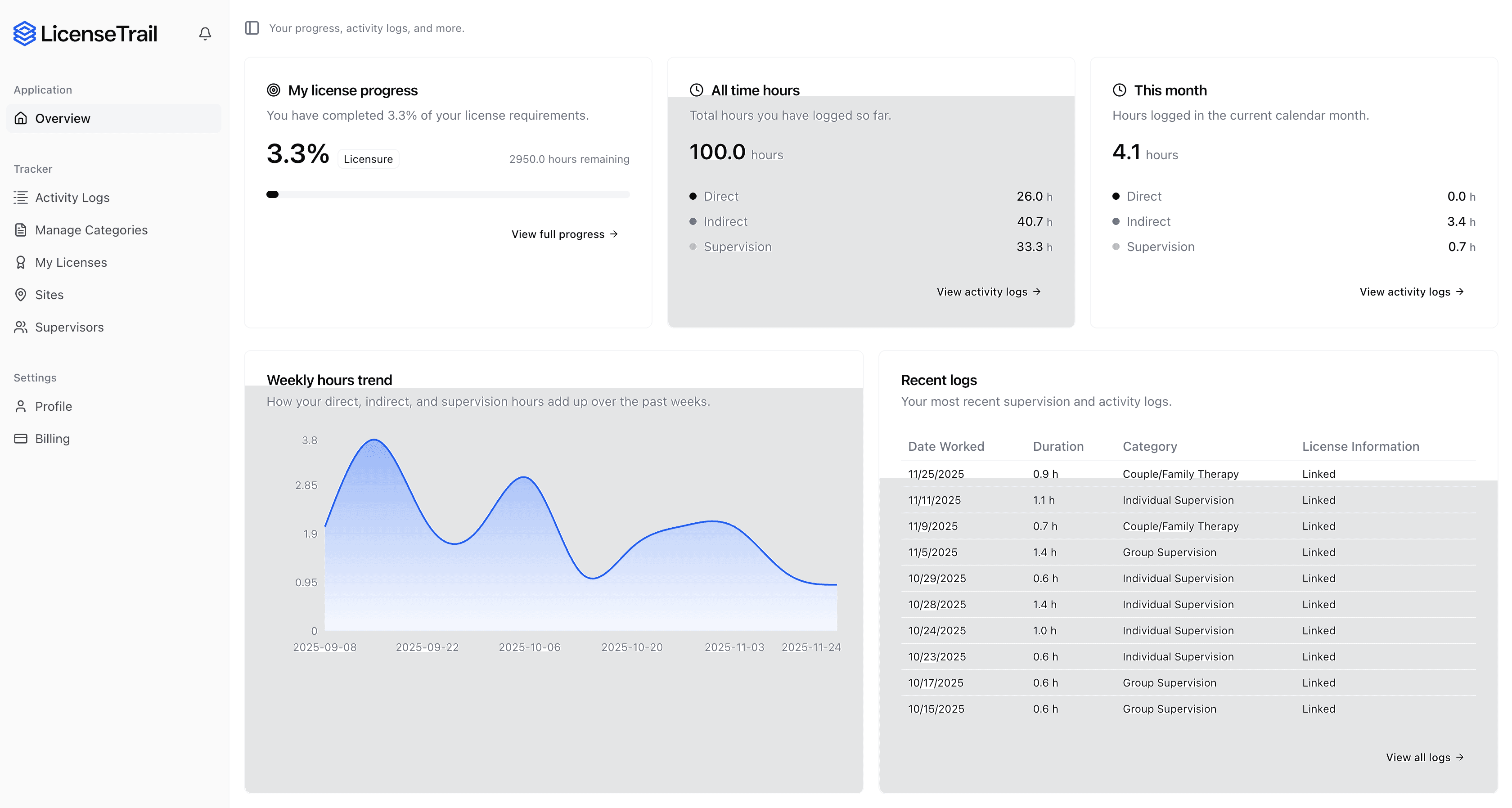
License Trail checks your direct, indirect, and supervision hours against Maryland LMSW requirements continuously and flags mismatches before you submit.
 Start Tracking for Free
No credit card required · Free plan available
Is your spreadsheet hiding Maryland LMSW risks?
Stop guessing if your categories match Maryland Board of Social Work Examiners requirements. License Trail checks your direct, indirect, and supervision hours continuously and flags mismatches before you submit.
Import or log
Bring your spreadsheet or start fresh
Upload your existing tracking spreadsheet and we'll map every hour into the right Maryland Board of Social Work Examiners categories automatically.
Verify against Maryland
Catch mismatches before the board does
License Trail checks your direct, indirect, and supervision hours against Maryland LMSW requirements continuously.
Export board-ready
One-click clean reports
Generate professional, board-ready reports for supervision meetings and Maryland Board of Social Work Examiners submissions in seconds.
No credit card required · Free plan available