
Massachusetts LCSW Requirements: Hours, Exams & Step-by-Step Guide
Stop guessing if your categories match Massachusetts requirements. License Trail checks your direct, indirect, and supervision hours against LCSW requirements continuously and flags mismatches before you submit.
No credit card required · Free plan available
Quick Requirements Overview
- Education: MSW/doctoral degree in Social Work from a CSWE-accredited program (or CSWE-recognized foreign equivalent)
- Exam: Pass ASWB Masters (Intermediate) exam within 2 years of the LCSW application date
- References: 3 professional references on board forms; ≥1 from most recent field placement supervisor or an LCSW/LICSW (or license-eligible equivalent)
- Hours: No post-degree supervised/clinical hour requirement for initial LCSW (hours apply to LICSW, not LCSW)
- Application/Fees: Submit complete application + required fees (application fee + initial license fee; ASWB exam fee separate)
- Practice limitation: LCSW clinical practice must be under appropriate supervision (no independent clinical practice authority)
- Renewal/CE: Renew biennially; 20 CE hours/2 years including 2 anti-racism + 1 anti-discrimination (within the 20)
License Details
Procedures
In Massachusetts, the Licensed Certified Social Worker (LCSW) is the master’s‑level license issued by the Board of Registration of Social Workers to individuals who meet the statutory and regulatory requirements to practice social work under appropriate supervision.(mass.gov) It is also the mandatory stepping‑stone to the independent clinical license (LICSW).
Below is a structured, board‑based overview of what is actually required for LCSW licensure—and where “hours” do and do not come into play.
1. Regulatory Framework and Role of the LCSW
Massachusetts law defines a “licensed certified social worker” as a social worker licensed by the Board who meets the qualifications laid out in statute and regulations.(mass.gov) The detailed licensure standards are in 258 CMR 9.00, “Licensure Requirements and Procedures,” promulgated by the Board of Registration of Social Workers.(law.cornell.edu)
At the master’s level, Massachusetts recognizes two licenses:
- LCSW – Licensed Certified Social Worker: master’s/doctoral level, must work under appropriate supervision for any clinical practice.
- LICSW – Licensed Independent Clinical Social Worker: independent clinical practice license; requires substantial post‑LCSW clinical hours and supervision.
The question of “hours” belongs almost entirely to the LICSW stage; the LCSW itself is primarily an education‑plus‑exam credential.
2. Core Eligibility Requirements for the LCSW
Under 258 CMR 9.04, an applicant “may be granted a license as a Licensed Certified Social Worker (LCSW)” if they submit a complete application including all of the following:(law.cornell.edu)
2.1 Education
- You must hold a master’s or doctoral degree in social work from:
- A graduate school of social work accredited by the Council on Social Work Education (CSWE), or
- A foreign program the CSWE determines to be equivalent to such a degree.(law.cornell.edu)
No other degree (e.g., counseling, psychology, MFT) can substitute for a social work degree for LCSW licensure.
2.2 Examination
- You must pass the ASWB master’s‑level exam.
- The regulation describes this as the “Intermediate licensure examination” administered by the Association of Social Work Boards (or a board‑approved equivalent), and it must be passed no more than two years before your LCSW application date.(law.cornell.edu)
In ASWB’s current nomenclature, the “Intermediate” exam referred to in the regulation is the Masters exam.
2.3 Professional References
-
You must submit at least three professional references on Board‑specified forms. These must:
- Be from people familiar with your professional experience in social work, and
- Attest to your good moral character and that you practice in accordance with accepted professional standards.(law.cornell.edu)
-
At least one of these references must be from one of the following (verbatim categories from the regulation, paraphrased):
- Your most recent field placement supervisor, or
- A person licensed by the Board as an LCSW or LICSW, or
- A person who is license‑eligible for LCSW or LICSW under the Board’s reciprocity provisions.(law.cornell.edu)
2.4 Fees
Current Board‑published fees (as of 2025):
- Application fee (all license types): $173
- ASWB exam registration (Bachelors or Masters level): $230
- LCSW initial licensure fee (paid after you meet requirements and pass the exam): $68(mass.gov)
Fees are set by the Commonwealth and can change; they are not part of 258 CMR itself but are administered through the Board’s application process.
3. Step‑by‑Step Pathway to LCSW Licensure
Step 1 – Complete a Qualifying MSW/DSW/PhD in Social Work
- Enroll in a CSWE‑accredited MSW or doctoral social work program (or a foreign equivalent recognized by CSWE).(law.cornell.edu)
- Complete all degree requirements, including the field education/practicum mandated by your program and CSWE standards.
- Massachusetts does not set a specific practicum hour number in 258 CMR for LCSW; it relies on CSWE accreditation and the school’s curriculum.
Step 2 – Apply to Take the ASWB Masters (Intermediate) Exam
- Contact ASWB and the Board’s application processor (ASWB currently processes Massachusetts social work applications on the Board’s behalf).(mass.gov)
- Submit the required documentation and exam fee.
- Schedule and sit for the Masters‑level / Intermediate exam.
Step 3 – Pass the Exam and Gather Required References
- Pass the ASWB Masters exam.
- Line up your three professional references, making sure:
- At least one is from your most recent field placement supervisor or an appropriately licensed/eligible LCSW or LICSW, as the regulation specifies.(law.cornell.edu)
Step 4 – Submit the LCSW Licensure Application
- Submit a properly completed application to the Board (typically via the Health Professions Licensing Portal, but operational details are handled through ASWB per current Board instructions).(mass.gov)
- Include:
- Official verification of your CSWE‑accredited master’s or doctoral social work degree.(law.cornell.edu)
- Proof of passing the Intermediate/Masters exam within the last two years.(law.cornell.edu)
- Three professional references on Board forms.(law.cornell.edu)
- Payment of the LCSW license fee.(mass.gov)
Once approved, the Board issues your LCSW license.
Step 5 – Practice Under Appropriate Supervision and Within Scope
After licensure, your practice must follow the Board’s scope of practice and supervision regulations (258 CMR 12.00) and policies. In summary:(mass.gov)
- LCSWs may provide a range of social work services but do not have independent clinical practice authority.
- Any clinical consultation or clinical supervision of others must occur under clinical supervision of a social worker who is licensed (or license‑eligible) as an LICSW, with specific minimum supervision standards (notably, at least one hour per week of face‑to‑face individual clinical supervision for LCSWs accruing experience toward LICSW).(mass.gov)
4. Experience and Hour Requirements: What Massachusetts Actually Requires
4.1 Are There Hour Requirements to Obtain the LCSW?
No.
Neither Massachusetts statutes nor 258 CMR 9.04 impose a minimum number of post‑degree practice hours (such as “1,500 hours of direct client contact” or “1,500 hours of supervised experience”) as a prerequisite for the initial LCSW license.(law.cornell.edu)
For LCSW, the regulation is limited to:
- Degree requirement (CSWE‑accredited MSW/DSW/PhD in social work or CSWE‑recognized foreign equivalent)
- Passing the ASWB Intermediate (Masters) exam within two years of application
- Three qualifying professional references
- Payment of required fees(law.cornell.edu)
There is no separate line item in 258 CMR 9.04 for “documented experience hours,” “direct client hours,” or “supervised practice hours” as part of obtaining the LCSW itself. This is consistent with summaries used by NASW‑MA and other educational sources, which explicitly describe the LCSW as having no additional documented experience requirement beyond the qualifying degree and exam.(naswma.org)
The only “experience” implicitly involved at the LCSW stage is your field placement/field education within the MSW program, which is governed by CSWE and your school rather than by a numeric requirement in the Board’s licensure regulation.
4.2 Where the Hour Requirements Do Apply: LICSW (for context)
By contrast, the LICSW license requires extensive post‑LCSW experience, specified clearly and numerically in 258 CMR 9.03:
- At least 3,500 hours of clinical social work services provided after you are licensed as an LCSW, over no less than two years.(law.cornell.edu)
- During those 3,500 hours, you must receive a minimum of 100 hours of individual face‑to‑face clinical supervision from a supervisor who is:
- An LICSW licensed by the Board,
- A license‑exempt LICSW‑eligible social worker in a government position, or
- An independently‑licensed clinical social worker (or equivalent) in another jurisdiction acceptable to the Board.(law.cornell.edu)
These requirements, not any for LCSW, are the Massachusetts analog to other states’ “1,500 hours of direct experience plus 1,500 hours supervised” models.
5. After You’re Licensed: Renewal and Continuing Education for LCSWs
Once you hold an LCSW, you must comply with the Board’s continuing education (CE) and renewal rules.
5.1 CE Credits
The Board’s CE policy specifies the following for LCSWs:(mass.gov)
- 20 CE credits every two‑year license cycle (cycle runs from one birthday to the next renewal birthday).
- Within those 20 credits, all licensees (including LCSWs) must complete:
- 2 CE hours in anti‑racism, focusing on oppression, and
- 1 CE hour in anti‑discrimination (covering specified protected characteristics).(mass.gov)
These 3 hours count inside, not in addition to, the 20‑credit total.
5.2 Renewal and Fees
- LCSWs renew biennially through the state’s Health Professions Licensing Portal.
- The current LCSW renewal fee is $68.(mass.gov)
The Board may audit CE documentation; licensees must keep CE records for at least two full licensing cycles.(mass.gov)
6. Concise Checklist for LCSW Licensure in Massachusetts
To summarize the Board‑based requirements to become an LCSW (not yet an LICSW):
-
Earn the right degree
- Master’s or doctoral degree in social work from a CSWE‑accredited program (or CSWE‑recognized foreign equivalent).(law.cornell.edu)
-
Take and pass the ASWB Masters/Intermediate exam
- Must be passed within two years before submitting your LCSW application.(law.cornell.edu)
-
Secure three qualifying professional references
- At least one from your most recent field placement supervisor or an appropriately licensed/eligible LCSW or LICSW.(law.cornell.edu)
-
Submit a complete application and pay required fees
- Application fee and, upon approval after passing the exam, the LCSW license fee.(mass.gov)
-
Understand that there is no Board‑mandated post‑degree hour requirement to obtain the LCSW
- No specified total of “direct client hours” or “supervised hours” is required for initial LCSW licensure; all hour‑based requirements are attached to LICSW, not LCSW.(law.cornell.edu)
-
Once licensed, practice under appropriate supervision and meet CE/renewal rules
- Follow 258 CMR 12.00 for scope and supervision, and complete 20 CE hours (including the mandated anti‑racism/anti‑discrimination content) every two years to renew.(mass.gov)
As of November 23, 2025, these are the current, regulation‑based requirements released by or through entities of the Commonwealth of Massachusetts for the LCSW license. Always verify directly with the Massachusetts Board of Registration of Social Workers or ASWB for any updates before you apply.
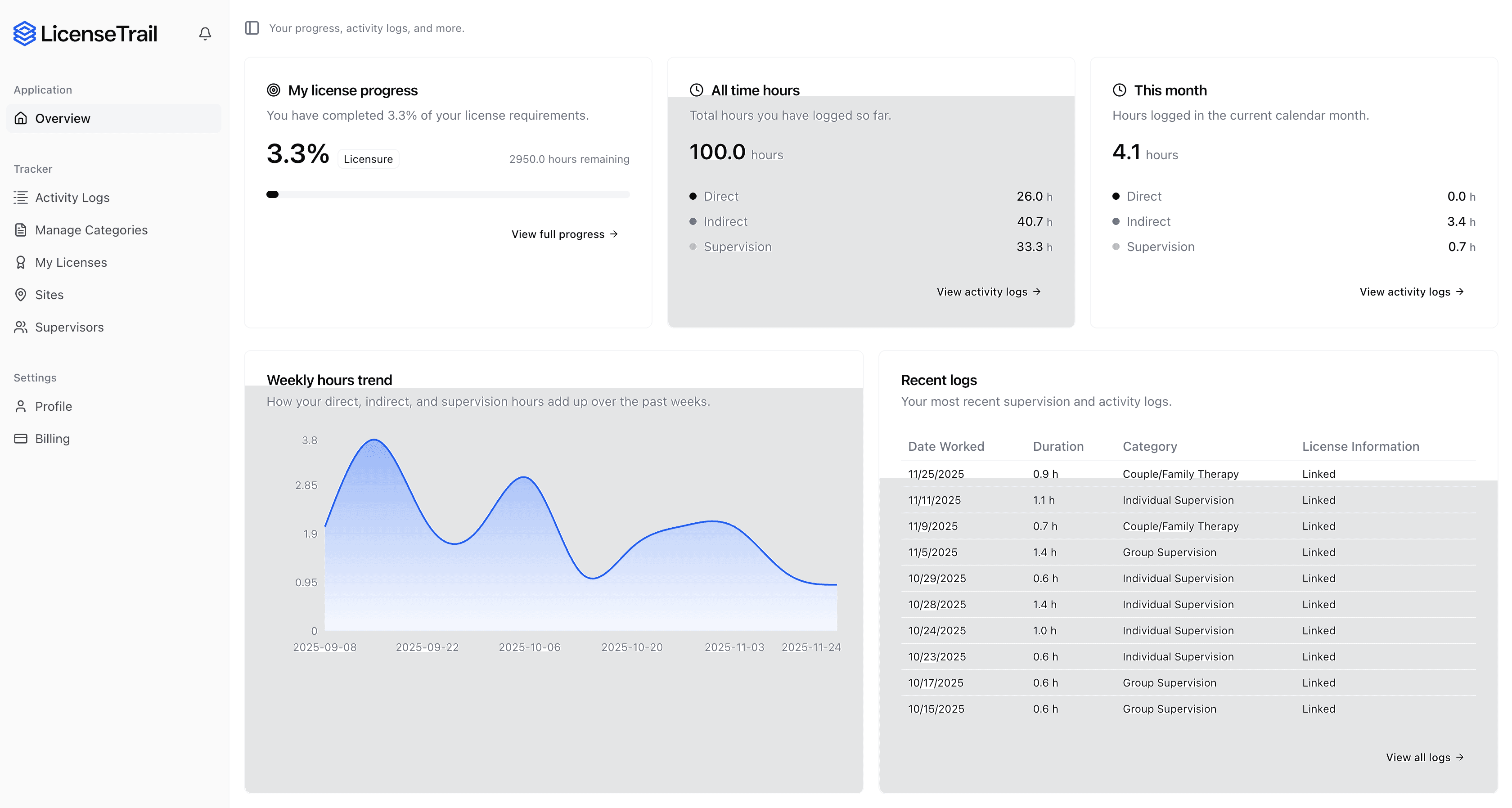
Track your LCSW hours with confidence
License Trail checks your direct, indirect, and supervision hours against Massachusetts LCSW requirements continuously and flags mismatches before you submit.
 Start Tracking for Free
No credit card required · Free plan available
Related Licenses
Is your spreadsheet hiding Massachusetts LCSW risks?
Stop guessing if your categories match Massachusetts Board of Registration of Social Workers requirements. License Trail checks your direct, indirect, and supervision hours continuously and flags mismatches before you submit.
Import or log
Bring your spreadsheet or start fresh
Upload your existing tracking spreadsheet and we'll map every hour into the right Massachusetts Board of Registration of Social Workers categories automatically.
Verify against Massachusetts
Catch mismatches before the board does
License Trail checks your direct, indirect, and supervision hours against Massachusetts LCSW requirements continuously.
Export board-ready
One-click clean reports
Generate professional, board-ready reports for supervision meetings and Massachusetts Board of Registration of Social Workers submissions in seconds.
No credit card required · Free plan available