
Massachusetts LSWA Requirements: Hours, Exams & Step-by-Step Guide
Stop guessing if your categories match Massachusetts requirements. License Trail checks your direct, indirect, and supervision hours against LSWA requirements continuously and flags mismatches before you submit.
No credit card required · Free plan available
Quick Requirements Overview
- Governed by Mass. Gen. Laws c.112 §131 and Board regs 258 CMR 9.00 & 12.00 (MA LSWA).
- Education (choose one): (1) Associate degree or ≥60 credits in SW/psych/counseling/human services; or (2) any bachelor’s degree; or (3) 1,000 hours Board‑approved education in social work theory/methods.
- Experience-for-education equivalency allowed by statute: 2 years full-time (or PT equivalent) social service experience may substitute for each year of undergraduate education (stated in years, not hours).
- Exam: pass ASWB Associate (Basic) exam; score must be within 2 years of application.
- References: 3 professional references on Board forms; ≥1 from (or eligible as) LCSW/LICSW attesting good moral character/standards of practice.
- No fixed pre-licensure practice-hour requirement (e.g., no “1,500 + 1,500 hours”) specified for LSWA.
- Practice restrictions/supervision: must work as an employee and under LSW/LCSW/LICSW (or eligible) supervision; minimum supervision 1 hour per 35 hours worked, with ≥1 hour/week face-to-face; group supervision max 4 supervisees (prorating allowed to ≥1 hr/month).
License Details
Procedures
Licensed Social Work Associate (LSWA) licensure in Massachusetts is governed by statute (Mass. Gen. Laws c.112, §131) and by the Board of Registration of Social Workers’ regulations at 258 CMR 9.00 and 12.00. Those sources are very specific about education, the licensing exam, references, and supervision, but they do not set a pre‑licensure requirement like “1,500 hours of direct experience and 1,500 hours of supervised experience” for LSWA. Where hours are used, they appear in two places:
- as “a minimum of 1000 hours of education in social work theory and methods” as one possible education route; and
- as ongoing supervision hours while you are working as an LSWA (a minimum of one hour of supervision per 35 hours worked).
The guide below walks through the requirements, using the Board’s own wording where it is precise about hours and supervision.
1. Role and scope of an LSWA
An LSWA is defined in regulation as an individual who meets the qualifications in Mass. Gen. Laws c.112, §131 and 258 CMR 9.06, and who is licensed “to perform or provide social work services in accordance with 258 CMR 12.04: Scope of Professional Practice – Licensed Social Work Associate (LSWA).” (law.cornell.edu)
Under the scope‑of‑practice regulation, an LSWA may perform specified social work functions such as:
- gathering information from clients/applicants to determine service needs and available resources,
- assisting individuals or groups in using community resources for day‑to‑day problems (e.g., employment, housing, healthcare, childcare, financial assistance), and
- collecting factual information and data for social services research and identifying unmet community needs. (law.cornell.edu)
All of this work must be done:
- as an employee of an agency, health care facility, or unrelated individual; and
- under the supervision of a social worker licensed or eligible for licensure at the LSW, LCSW, or LICSW level. (law.cornell.edu)
2. Core licensure requirements for LSWA
The LSWA licensure standards are set out at 258 CMR 9.06. An applicant “may be granted a license as a Licensed Social Work Associate (LSWA)” by submitting a completed application plus all of the following: (law.cornell.edu)
2.1 Education and training
You must document one of these three options (Board language summarized):
-
Associate‑degree / 60‑credit option
- An associate degree, or at least 60 college credits, in social work, psychology, counseling, or a similar human services field from an accredited college or university. (law.cornell.edu)
-
Bachelor’s‑degree option
- A baccalaureate degree in any field from an accredited college or university. (law.cornell.edu)
-
1000‑hour education option
- “A minimum of 1000 hours of education in social work theory and methods in courses or programs approved by the Board.” (law.cornell.edu)
Those three routes are the only education/training options spelled out in the LSWA regulation.
How experience can substitute for college (statutory language)
The statute also allows work experience to substitute for college credits when you are trying to meet the Board’s “equivalent education” standard. For a “social work associate,” Mass. Gen. Laws c.112, §131 provides that:
- You must show an associate degree in a human service field or a baccalaureate degree, or satisfy the Board’s requirements for equivalent educational credits; and
- For this equivalency, “two years of full‑time, or the equivalent in part‑time, experience in a social service setting deemed suitable by the board may be substituted for each year of undergraduate college education.” (law.justia.com)
Notice that this part of the law is written in years of full‑time experience, not in a specific number of hours. The statute does not convert these years into a particular hour count.
The Board has also adopted Policy No. 06‑03 stating that, for LSW and LSWA applicants who do not hold a BSW, any required supervised social work experience hours must be gained after you meet the minimum educational qualifications (e.g., after you have the associate degree or equivalent). (mass.gov)
However, for LSWA specifically, neither the statute nor the regulations state a fixed numeric requirement such as “3,500 supervised hours” or “100 supervision hours” for initial licensure. Those kinds of counts appear at the LSW and LICSW levels, not for LSWA. (msweducation.org)
2.2 Licensing examination
You must show that you have:
“attained the Associate level passing score on the Basic licensure examination administered by the Association of State Social Work Boards (ASWB), or its successor agency, or an equivalent examination as determined by the Board, not more than two years prior to the date of the application.” (law.cornell.edu)
This is the ASWB Associate exam. There is no pre‑licensure practice‑hour requirement to sit for this exam at the LSWA level; the regulation focuses on your education and the exam score.
2.3 Professional references
You must provide at least three professional references, on Board‑supplied forms, from people familiar with your “professional experience in the field of social work,” attesting that:
- you are of good moral character, and
- you will conduct your activities “in accordance with generally accepted standards of professional social work practice.”
At least one of these references must come from:
- a Licensed Certified Social Worker (LCSW),
- a Licensed Independent Clinical Social Worker (LICSW), or
- a person eligible for LCSW or LICSW licensure under the Board’s LICSW/LCSW provisions (258 CMR 9.03, 9.04, or 9.07). (law.cornell.edu)
The regulation does not convert this “professional experience” into a defined number of hours for LSWA; it simply requires that referees can speak to your experience and professional conduct.
2.4 Fees and processing
You must also pay “the licensure fees prescribed by the Executive Office of Administration and Finance” for social workers. (law.cornell.edu)
According to the ASWB’s current instructions for Massachusetts, the typical fee structure is:
- Board/ASWB application fee (all levels): $173
- ASWB exam registration (Associate/Bachelors/Masters): $230
- LSWA initial licensure fee (after you pass the exam and meet requirements): $42 (aswb.org)
Fees can change, so the Board and ASWB application materials should always be checked for the latest amounts.
3. Supervision and hours while practicing as an LSWA
Although Massachusetts does not require a set number of pre‑licensure “experience hours” for LSWA, it is very specific about supervision hours once you are licensed and working.
3.1 Required supervision ratio
Under 258 CMR 12.04, an LSWA may perform the functions listed there only:
- as an employee (not an independent practitioner); and
- “under the supervision of a social worker who is licensed or eligible for licensure” at the LICSW, LCSW, or LSW level. (law.cornell.edu)
The regulation then sets out explicit supervision‑hour requirements:
- The supervisor must provide “at least one hour per week of face‑to‑face supervision.”
- If supervision is in a group format, it may include no more than four supervisees.
- The supervision may be prorated so that supervision hours to work hours are at a rate of not less than one hour per month for social workers.
- And, crucially: “A licensee must obtain at least one hour of supervision per 35 hours worked.” (law.cornell.edu)
In other words, for ongoing practice as an LSWA, the Board defines supervision in hour‑per‑work‑hour terms:
- Minimum supervision requirement:
- 1 hour of supervision for every 35 hours of social work performed, with at least some supervision every week.
This is the main place where you see a clear hour‑based requirement in the LSWA rules.
3.2 Type of work that must be supervised
The same provision clarifies that all LSWA functions—information gathering, resource linkage, and research/data collection—must be performed under this supervision arrangement. (law.cornell.edu)
LSWAs are not permitted to independently perform advanced clinical assessment or psychotherapy; those activities and the related 3,500‑hour supervised clinical requirements appear at the LICSW level instead. (msweducation.org)
4. Putting it together: what Massachusetts does and does not require in hours for LSWA
To directly address the kind of example you gave (“1,500 hours of direct experience and 1,500 hours of supervised experience”):
4.1 Explicit hour‑based requirements for LSWA
From statute and regulation, the explicit, quantitative hour requirements for LSWA are:
-
Education hours (one pathway only)
- You may qualify educationally by completing “a minimum of 1000 hours of education in social work theory and methods” in Board‑approved courses or programs. (law.cornell.edu)
-
Supervision hours while practicing
- Once licensed and working as an LSWA, you must receive at least one hour of supervision per 35 hours worked, with at least one hour of face‑to‑face supervision each week (individual or small‑group of up to four supervisees, prorated to not less than one hour per month overall). (law.cornell.edu)
4.2 Requirements written in years, not hours
Where the law allows experience to substitute for education, it is written in years of full‑time experience, not in hours:
- For a social work associate: “Two years of full‑time, or the equivalent in part‑time, experience in a social service setting… may be substituted for each year of undergraduate college education.” (law.justia.com)
The Board’s Policy 06‑03 adds that any such “supervised social work experience hours” for LSW and LSWA applicants who lack a BSW must be gained after the minimum education is completed, but it does not specify a numeric hour total for LSWA beyond what the statute already implies in years of full‑time work. (mass.gov)
4.3 What Massachusetts does not require for LSWA
For LSWA, Massachusetts does not require, in its own regulations:
- a fixed number of pre‑licensure practice hours (such as “1,500 direct + 1,500 supervised hours”) to be documented before you can take the ASWB Associate exam;
- a specified number of pre‑licensure clinical hours; or
- a mandatory multi‑year, hour‑counted supervised practice period comparable to the 3,500‑hour requirement set for LICSW candidates. (law.cornell.edu)
Instead, at the LSWA level:
- The Board focuses on education/training (including the 1,000‑hour education path),
- a passing Associate‑level ASWB exam score,
- three professional references (including one from an LCSW/LICSW‑level practitioner), and
- ongoing supervised practice defined by the 1‑per‑35‑hours supervision rule once you are licensed and working. (law.cornell.edu)
5. Step‑by‑step summary
In practical terms, becoming an LSWA in Massachusetts typically involves:
-
Confirm your education or equivalency path
- Meet one of the three 258 CMR 9.06 education routes (associate degree/60 credits in a human services field; any bachelor’s degree; or 1,000 hours of Board‑approved social work theory/methods coursework).
- If you are relying on work experience to substitute for college, make sure your experience fits the statute’s “two years full‑time per year of college” equivalency and that the hours were obtained after you met the Board’s minimum education standard, consistent with Policy 06‑03. (law.cornell.edu)
-
Pass the ASWB Associate exam
- Arrange to sit for the ASWB Associate‑level Basic examination and obtain the Board‑required passing score within two years of your application. (law.cornell.edu)
-
Gather professional references
- Secure at least three professional references on Board forms, with at least one from an LICSW or LCSW (or someone eligible for those licenses), attesting to your moral character and professional conduct. (law.cornell.edu)
-
Submit your licensure application and fees
- File the LSWA application through the Board/ASWB system, include all required documentation, and pay the applicable application, exam, and license issuance fees. (aswb.org)
-
Practice only with proper supervision and supervision hours
- Once licensed, work as an employee (not independently) and ensure you receive at least one hour of supervision for every 35 hours worked, with weekly, face‑to‑face supervision from a qualified LSW, LCSW, or LICSW supervisor. (law.cornell.edu)
Taken together, these provisions give you a clear picture of what the Massachusetts Board actually requires in terms of hours and supervision for LSWA: a 1,000‑hour education option as one route to eligibility, and a 1‑hour‑per‑35‑hours supervision rule governing your work once you are licensed, but no fixed pre‑licensure practice‑hour total like the example you mentioned.
Track your LSWA hours with confidence
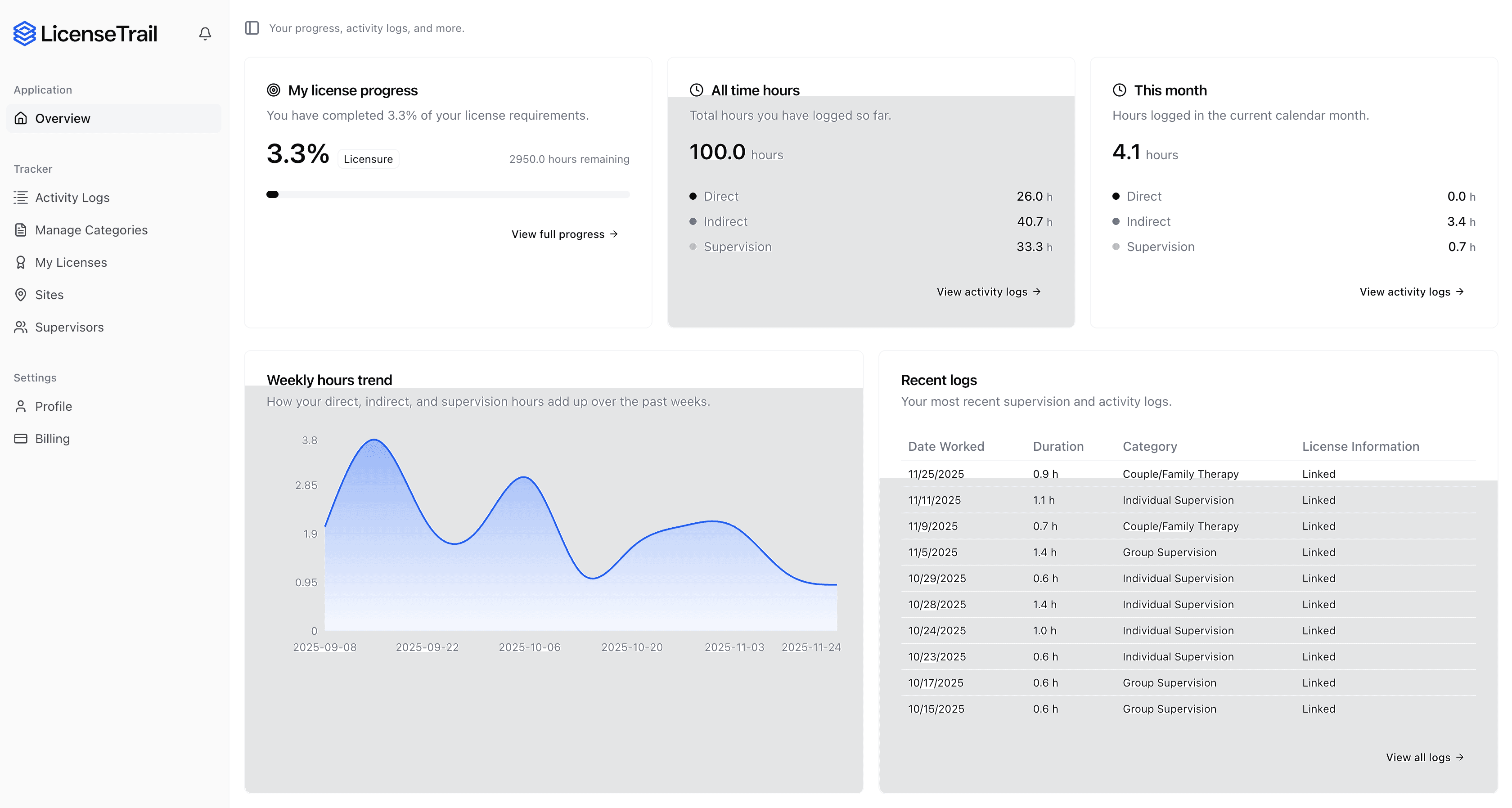
License Trail checks your direct, indirect, and supervision hours against Massachusetts LSWA requirements continuously and flags mismatches before you submit.
 Start Tracking for Free
No credit card required · Free plan available
Related Licenses
Is your spreadsheet hiding Massachusetts LSWA risks?
Stop guessing if your categories match Massachusetts Board of Registration of Social Workers requirements. License Trail checks your direct, indirect, and supervision hours continuously and flags mismatches before you submit.
Import or log
Bring your spreadsheet or start fresh
Upload your existing tracking spreadsheet and we'll map every hour into the right Massachusetts Board of Registration of Social Workers categories automatically.
Verify against Massachusetts
Catch mismatches before the board does
License Trail checks your direct, indirect, and supervision hours against Massachusetts LSWA requirements continuously.
Export board-ready
One-click clean reports
Generate professional, board-ready reports for supervision meetings and Massachusetts Board of Registration of Social Workers submissions in seconds.
No credit card required · Free plan available