
Massachusetts LSW Requirements: Hours, Exams & Step-by-Step Guide
Stop guessing if your categories match Massachusetts requirements. License Trail checks your direct, indirect, and supervision hours against LSW requirements continuously and flags mismatches before you submit.
No credit card required · Free plan available
Quick Requirements Overview
- Education/experience pathway (pick one): CSWE‑accredited BSW (no post‑degree hours required), or Non‑SW BA + 3,500 hrs/≥2 yrs, or ≥75 credits + 8,750 hrs/≥5 yrs, or 60 credits + 10,500 hrs/≥6 yrs, or 30 credits + 14,000 hrs/≥8 yrs, or HS/GED + 17,500 hrs/≥10 yrs
- Experience type: paid work experience in the provision of social work services as an employee of an agency/healthcare facility/unrelated individual (non‑clinical scope)
- Supervision (all non‑BSW pathways): individual, face‑to‑face supervision ≥1 hour per 35 work hours
- Supervisor qualifications: typically MA LICSW/LCSW (or equivalent/exempt categories allowed by Board)
- Timing rule: required supervised experience for non‑BSW routes must be earned after completing the minimum education used for the pathway
- Exam: pass ASWB Bachelors/Basic (or Board‑approved equivalent) within 2 years before applying
- References: 3 professional references, including one from most recent SW employment supervisor (or MA LCSW/LICSW‑level)
- Application/fees: submit application with transcripts, hours/supervision documentation (if applicable), references, exam verification, and pay required fees
License Details
Procedures
Massachusetts LSW (Licensed Social Worker) Requirements: Education, Hours, and Supervision
The Massachusetts Board of Registration of Social Workers licenses at four levels: LICSW, LCSW, LSW, and LSWA. The LSW is a non‑clinical license that allows you to provide non‑clinical social work services under supervision. (mass.gov)
For the LSW, Massachusetts does not use a “1,500 direct hours + 1,500 supervised hours” model. Instead, the Board ties licensure to:
- A specific education level, and
- A specific number of work experience hours in the provision of social work services, many of which must be directly supervised at a defined ratio. (regulations.justia.com)
Below is a step‑by‑step guide to what the Board requires and how the hours are structured.
1. Core requirements for LSW licensure in Massachusetts
Under 258 CMR 9.05, an applicant for the LSW must submit: (regulations.justia.com)
- Education + documented social work experience in one of several combinations (detailed in Section 2 below).
- Supervised experience (for all routes except the BSW route), with:
- Work experience in “the provision of social work services” as an employee of an agency, health care facility, or unrelated individual, and
- Individual, face‑to‑face supervision at not less than one hour of supervision for every 35 hours of work experience from a qualified supervisor. (regulations.justia.com)
- Passing the ASWB “Basic” (Bachelors) licensure exam, or an equivalent exam approved by the Board, taken no more than two years before the application date. (regulations.justia.com)
- Three professional references, including at least one from your most recent social work employment supervisor (or an appropriately licensed LCSW/LICSW‑level person). (regulations.justia.com)
- Payment of required fees (application, exam, and license fee). Current Mass.gov guidance lists a separate application fee, ASWB exam fee, and a license issuance fee for LSW. (mass.gov)
2. Education and experience pathways: how many hours you need
Massachusetts offers six main education/experience combinations that can qualify you for the LSW. The key phrase in the regulation is “work experience… in the provision of social work services”, and, except for the BSW route, that experience must be directly supervised as defined in 258 CMR 9.05(2). (regulations.justia.com)
Pathway A – BSW from a CSWE‑accredited program (no post‑degree hours required)
You qualify if you have:
- A bachelor’s degree in social work (BSW) from an undergraduate program accredited by the Council on Social Work Education (CSWE), or
- A foreign degree determined by CSWE to be equivalent to a BSW. (regulations.justia.com)
For this pathway, the regulation does not require a minimum number of post‑degree work experience hours. The degree itself satisfies the education/experience requirement of 258 CMR 9.05(1)(a). (regulations.justia.com)
Pathway B – Non‑social‑work bachelor’s degree
You qualify with:
- A bachelor’s degree in a field other than social work from an accredited college or university, plus
- At least 3,500 hours of work experience in the provision of social work services,
- Completed over not less than two years,
- As an employee of an agency, health care facility, or unrelated individual,
- Under the direct supervision of a qualified supervisor (see Section 3). (regulations.justia.com)
Pathway C – 2.5 to <4 years of undergraduate education
You qualify with:
- At least 2.5 years of undergraduate education (≥75 semester hours or 100 quarter hours), but less than four years, at an accredited college or university, plus
- At least 8,750 hours of work experience in the provision of social work services,
- Completed over not less than five years,
- Under the same employment and supervision conditions as above. (regulations.justia.com)
Pathway D – 2 years of undergraduate education
You qualify with:
- 2 years of undergraduate education (60 semester hours or 80 quarter hours) at an accredited college or university, plus
- At least 10,500 hours of work experience in the provision of social work services,
- Completed over not less than six years,
- Under qualifying supervision. (regulations.justia.com)
Pathway E – 1 year of undergraduate education
You qualify with:
- 1 year of undergraduate education (30 semester hours or 40 quarter hours) at an accredited college or university, plus
- At least 14,000 hours of work experience in the provision of social work services,
- Completed over not less than eight years,
- Under qualifying supervision. (regulations.justia.com)
Pathway F – High school diploma or GED
You qualify with:
- A high school diploma or equivalent, plus
- At least 17,500 hours of work experience in the provision of social work services,
- Completed over not less than ten years,
- Under qualifying supervision. (regulations.justia.com)
3. How Massachusetts defines supervision and supervised hours
For all pathways other than the BSW route (Pathway A), you must document that your required work experience was completed under specific supervision conditions set out in 258 CMR 9.05(2). (regulations.justia.com)
3.1. Type and intensity of supervision
The regulation requires that you:
- Perform your hours as “work experience in the provision of social work services”; and
- Receive individual, face‑to‑face supervision at a minimum rate of 1 hour of supervision for every 35 hours of work experience. (regulations.justia.com)
Board policy on proration and supervision reinforces that social workers must obtain at least one hour of supervision per 35 hours worked, and that supervision hours can be prorated for part‑time work (for example, one hour per month if hours are low), but may not fall below that 1:35 ratio. (regulations.justia.com)
So, for example:
- If you complete 3,500 hours under Pathway B, at minimum you must have around 100 hours of documented individual, face‑to‑face supervision (3,500 ÷ 35).
- If you complete 8,750 hours under Pathway C, the minimum supervision would be approximately 250 supervision hours at the same 1:35 ratio.
The Board does not split the experience into categories like “direct client hours vs. supervised hours”. Instead, it requires:
- A total number of work experience hours in social work services (3,500; 8,750; 10,500; 14,000; or 17,500, depending on education), and
- A fixed supervision ratio (1 hour per 35 work hours). (regulations.justia.com)
3.2. Who can supervise your hours
Your supervision must come from one of several categories of qualified supervisors listed in 258 CMR 9.05(2), including: (regulations.justia.com)
- A Massachusetts‑licensed LICSW,
- Someone who meets LICSW requirements but is exempt from licensure under 258 CMR 9.02(1),
- A social worker independently licensed for clinical practice in another jurisdiction whose requirements are substantially equivalent to an LICSW in Massachusetts,
- A Massachusetts‑licensed LCSW,
- Someone who meets LCSW requirements but is exempt from licensure,
- An LCSW‑equivalent license holder from another jurisdiction, or
- An individual with at least a BSW from a CSWE‑accredited program (or foreign equivalent).
In practice, many LSW candidates are supervised by LICSWs or LCSWs in their agencies or health‑care settings.
3.3. Timing of supervised hours for non‑BSW applicants
A Board policy bulletin (Policy No. 06‑03) clarifies that for non‑BSW applicants for the LSW or LSWA, the required supervised social work experience hours must be: (mass.gov)
- The appropriate number of supervised hours specified in 258 CMR 9.05 or 9.06, and
- Gained after completion of the minimum educational qualifications you are using for licensure.
In other words, if you are qualifying under, say, Pathway B (non‑social‑work bachelor’s plus 3,500 supervised hours), those 3,500 supervised hours must be accumulated after you complete the bachelor’s degree that you are using as your educational base.
4. What counts as “work experience in the provision of social work services”
While the regulation does not list every task, it is specific about the context: your experience must be as “an employee of an agency, health care facility or unrelated individual” providing social work services. (regulations.justia.com)
In Massachusetts, the LSW scope of practice is non‑clinical and includes functions such as: (regulations.justia.com)
- Providing non‑clinical social work services (e.g., assessment and service planning that do not constitute psychotherapy),
- Non‑clinical case management,
- Administrative (but not clinical) supervision of LSWs and LSWAs, and
- Consultation on non‑clinical issues.
To be safe, your documented hours should clearly involve direct provision or coordination of social work services, not purely administrative or business‑skills work unrelated to service delivery.
5. Exam, references, and application steps
Once your education and hours are in place (if required for your pathway), the remaining steps are:
5.1. Take and pass the ASWB Bachelors (“Basic”) exam
Massachusetts requires you to pass the ASWB Basic/Bachelors exam (or an equivalent approved exam) within two years before the date you apply for licensure. (regulations.justia.com)
Exam registration is done through ASWB, and Mass.gov lists the current exam fee separately from the Board’s application and license fees. (mass.gov)
5.2. Collect professional references
You must have at least three professional references, on Board‑supplied forms, from people familiar with your social work practice. At least one reference must be from your most recent social work employment supervisor or from a Massachusetts LCSW/LICSW (or someone eligible for such licensure). (regulations.justia.com)
5.3. Submit your application and fees
Through the Mass.gov “Apply for a Social Worker License” process, you will: (mass.gov)
- Complete the application (online or as instructed by the Board),
- Attach documentation of education (transcripts),
- Attach documentation of supervised work experience hours (if applicable for your pathway),
- Include professional references,
- Verify your ASWB exam pass, and
- Pay the application fee and, once requirements are met, the LSW license issuance fee (Mass.gov lists these separately).
6. Summary of hour requirements by pathway
Putting it all together for Massachusetts LSW:
-
BSW from CSWE program (Pathway A)
- No minimum post‑degree experience hours specified in the regulation. Education alone satisfies the 9.05(1)(a) requirement. (regulations.justia.com)
-
Non‑social‑work bachelor’s (Pathway B)
- 3,500 hours work experience in social work services over ≥2 years,
- Supervision: ≥1 hour individual, face‑to‑face supervision per 35 work hours by a qualified supervisor. (regulations.justia.com)
-
2.5–<4 years college (Pathway C)
- 8,750 hours over ≥5 years,
- Same supervision ratio and qualifications. (regulations.justia.com)
-
2 years college (Pathway D)
- 10,500 hours over ≥6 years,
- Same supervision ratio and qualifications. (regulations.justia.com)
-
1 year college (Pathway E)
- 14,000 hours over ≥8 years,
- Same supervision ratio and qualifications. (regulations.justia.com)
-
High school diploma/GED (Pathway F)
- 17,500 hours over ≥10 years,
- Same supervision ratio and qualifications. (regulations.justia.com)
Across all non‑BSW pathways, the Board’s policy also emphasizes that these supervised hours must be completed after you have obtained the “minimum educational qualifications” you are using for that pathway. (mass.gov)
This structure is different from states that specify separate totals of “direct client hours” and “supervision hours.” Massachusetts instead defines one pool of work experience hours in social work services, with a mandatory supervision ratio (1:35) tied to those hours.
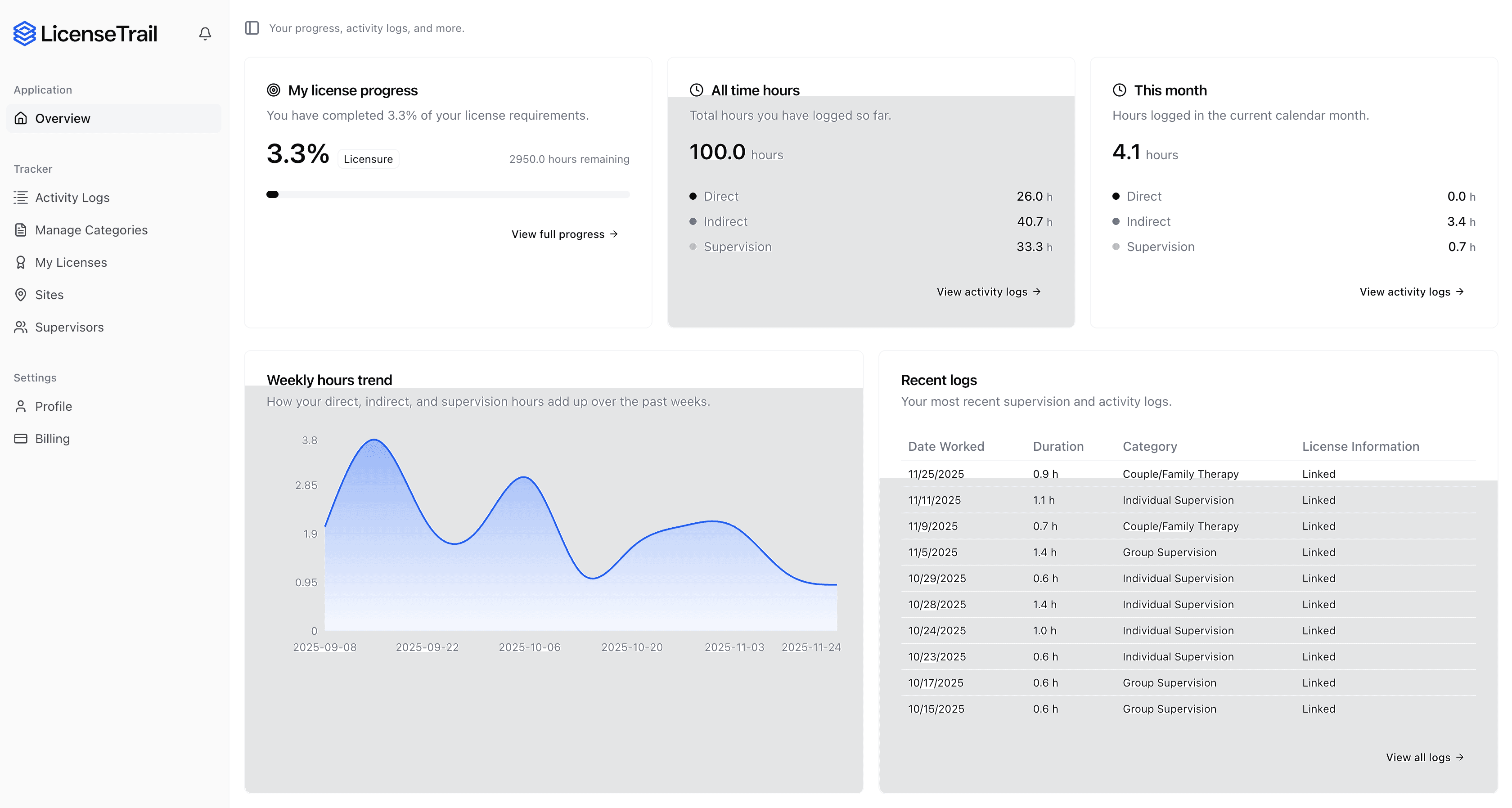
Track your LSW hours with confidence
License Trail checks your direct, indirect, and supervision hours against Massachusetts LSW requirements continuously and flags mismatches before you submit.
 Start Tracking for Free
No credit card required · Free plan available
Related Licenses
Is your spreadsheet hiding Massachusetts LSW risks?
Stop guessing if your categories match Massachusetts Board of Registration of Social Workers requirements. License Trail checks your direct, indirect, and supervision hours continuously and flags mismatches before you submit.
Import or log
Bring your spreadsheet or start fresh
Upload your existing tracking spreadsheet and we'll map every hour into the right Massachusetts Board of Registration of Social Workers categories automatically.
Verify against Massachusetts
Catch mismatches before the board does
License Trail checks your direct, indirect, and supervision hours against Massachusetts LSW requirements continuously.
Export board-ready
One-click clean reports
Generate professional, board-ready reports for supervision meetings and Massachusetts Board of Registration of Social Workers submissions in seconds.
No credit card required · Free plan available