
Michigan LMSW-Clinical & Macro Requirements: Hours, Exams & Step-by-Step Guide
Stop guessing if your categories match Michigan requirements. License Trail checks your direct, indirect, and supervision hours against LMSW-Clinical & Macro requirements continuously and flags mismatches before you submit.
No credit card required · Free plan available
Quick Requirements Overview
- Education: MSW/DSW from a Board-approved (CSWE-accredited) program
- Initial credential to earn hours: Hold an active LLMSW; only post-degree hours earned while LLMSW is active count
- First LMSW designation (Clinical or Macro): 4,000 supervised hours over ≥2 years in the chosen specialty
- Hour limits: 16–40 hrs/week; max 2,080 hrs per 12 months
- Supervision (“supervisory review”): ≥4 hrs/month, including ≥2 hrs/month individual; supervisor must be MI-licensed LMSW with the same designation
- Setting: Board-approved agency/health facility/institution (paid or volunteer allowed if requirements met)
- Exams: ASWB Clinical (Clinical) and ASWB Advanced Generalist (Macro)
- Add second designation (to hold Clinical & Macro): +2,000 hours over ≥1 year in the second specialty +≥50 supervision hours in that specialty, supervised by LMSW with that designation, plus pass the second ASWB exam (minimum 6,000 total post-degree hours)
License Details
Procedures
Licensure requirements for becoming an LMSW – Clinical & Macro in Michigan
Michigan’s Board of Social Work (under the Department of Licensing and Regulatory Affairs, LARA) regulates one master’s-level license — Licensed Master’s Social Worker (LMSW) — which can carry one or both of these specialty designations:
- Clinical designation
- Macro designation
Holding both designations is what is typically referred to as being licensed as “LMSW – Clinical & Macro.” Michigan’s rules spell out:
- The supervised post-degree social work experience you must complete.
- How “supervised work experience” and “supervisory review” must be structured.
- Additional requirements to add the second designation.
The key numbers:
- 4,000 hours of post-degree, supervised social work experience for the first LMSW designation (clinical OR macro), over at least 2 years. (council.legislature.mi.gov)
- 2,000 additional hours of post-degree social work experience in the second specialty area, over at least 1 year, with at least 50 hours of supervisory review, plus the exam for that designation. (council.legislature.mi.gov)
That means a minimum of 6,000 post-degree hours to hold both clinical and macro designations.
The sections below walk through the requirements, using the Board’s own terminology.
1. Licensure structure and key Board terminology
Michigan’s social work rules define several terms that are central to how your hours must be accumulated:
- “Board” – the Michigan Board of Social Work. (council.legislature.mi.gov)
- “Supervised work experience” – the post-degree work you complete while holding a limited license, under an LMSW supervisor, in approved settings, and in accordance with detailed hour and supervision requirements. (council.legislature.mi.gov)
- “Supervisory review” – a limited licensee (such as an LLMSW) meets with a Michigan-licensed bachelor’s or master’s social worker supervisor, individually or in a group setting, “during which active work functions and the work records of the supervisee are reviewed.” (council.legislature.mi.gov)
- “Clinical designation” – a master’s-level social work specialty involving assessment, treatment, and intervention using a formal professional relationship with individuals, couples, families, or groups, including psychotherapy and related clinical activities. (council.legislature.mi.gov)
- “Macro designation” – a master’s-level specialty focused on administration, management, community organizing, policy, program development, research, and other large-system interventions. (council.legislature.mi.gov)
The LMSW license is then issued “with a clinical designation” or “with a macro designation” (or both, after you add the second designation). (council.legislature.mi.gov)
2. Baseline prerequisites and the Limited LMSW (LLMSW)
Before you can start accruing the supervised hours that count toward the LMSW:
-
Education
- You must complete a master’s or doctoral degree in social work from a program accredited according to standards adopted by the Board (Council on Social Work Education – CSWE). (council.legislature.mi.gov)
-
Limited License – Master’s (LLMSW)
- To accumulate LMSW-level supervised work experience in Michigan, you must hold a Limited Licensed Master Social Worker (LLMSW). The rules state that master’s-level supervised work experience may only be earned while holding a Michigan limited master’s license issued under R 338.2947. (council.legislature.mi.gov)
- The LLMSW is issued for one year at a time and may be renewed up to six times while you work toward your hours. (nasw-michigan.org)
Only post-degree hours, and only hours earned while your LLMSW is active, count toward LMSW requirements.
3. Supervised post-degree experience for the first LMSW designation
To become an LMSW (either clinical or macro first), Michigan requires that you complete:
- “At least 4,000 hours of post-degree social work experience accrued over not less than 2 years” at the master’s level. (council.legislature.mi.gov)
The 4,000 hours must meet all of the following Board conditions.
3.1. Timeframe and weekly hour limits
The Board’s rules on master’s-level supervised work experience (R 338.2949 as amended) set these parameters: (council.legislature.mi.gov)
- Experience must be spread over at least 2 years.
- You may not be credited with more than 2,080 hours of supervised work experience in any 12‑month period.
- You must accumulate at least 16 hours, but no more than 40 hours, of supervised work experience per week.
In practical terms, that means:
- You cannot “rush” all 4,000 hours in one year.
- A typical full-time LLMSW (around 40 hours per week) will still take at least 2 full calendar years to meet the requirement.
3.2. Supervision structure – “supervisory review”
For your 4,000 hours to count, supervisory review must be structured according to the rules: (council.legislature.mi.gov)
- Supervision must be conducted by a Michigan-licensed MSW who holds the same designation you are working toward:
- LLMSW (clinical) → supervised by LMSW with clinical designation.
- LLMSW (macro) → supervised by LMSW with macro designation. (council.legislature.mi.gov)
- Supervision can occur:
- Individually, in person.
- Individually, using real-time telecommunications.
- In a group, so long as at least 50% of supervision hours are individual with review of your active work and records. (council.legislature.mi.gov)
- Minimum frequency and duration:
- At least 4 hours of supervisory review per month, and
- At least 2 of those hours must be individual (in person or real-time telecommunication) between you and the supervisor. (council.legislature.mi.gov)
The Board’s definition of “supervisory review” emphasizes reviewing “active work functions and the work records of the supervisee.” In other words, it is not just casual consultation; the supervisor must actively oversee and evaluate your social work practice. (council.legislature.mi.gov)
3.3. Approved practice settings
The rules require that LLMSWs accumulate supervised experience in an agency, health facility, institution, or other entity approved by the Board, meaning a setting where a licensed master’s social worker is engaged in master’s-level social work practice. (council.legislature.mi.gov)
Work may be paid or unpaid (volunteer) as long as:
- It is post-degree.
- You hold an active LLMSW.
- It occurs in an approved setting under qualifying supervision. (nasw-michigan.org)
4. What “clinical” hours must look like vs. “macro” hours
The 4,000 hours for your first LMSW designation must be in activities that match that specialty.
4.1. Clinical designation – qualifying experience
For an LMSW with a clinical designation, the rules specify that your experience must include one or more of a list of clinical practice activities, such as: (council.legislature.mi.gov)
- Assessment, diagnosis, and treatment using a formal professional relationship.
- Psychotherapy with individuals, couples, families, or groups.
- Managing complex or high-risk cases.
- Advocacy and protection of vulnerable clients.
- Clinical supervision or direction of clinical programs, where appropriate.
- Other clinical intervention and treatment methods provided within a social work framework.
All of this must be under the supervision of an LMSW with a clinical designation.
4.2. Macro designation – qualifying experience
For an LMSW with a macro designation, the rules require that experience be in one or both of these broad macro areas: (council.legislature.mi.gov)
- Administration, management, and supervision of human service organizations, including:
- Translating laws and regulations into agency policies.
- Inter‑organizational collaboration and consultation.
- Community organizing and development.
- Program planning, social planning, and policy formulation.
- Legislative advocacy and broader social action.
- Social work education and training, where it is part of macro practice.
- Advanced macro interventions that improve social or health services in communities, groups, or organizations through planned, large‑system change.
These hours must be supervised by an LMSW with a macro designation.
5. Examination requirements for each designation
After completing the 4,000 hours of supervised experience in one specialty area and meeting all other requirements, you must pass the appropriate ASWB examination: (council.legislature.mi.gov)
- For LMSW – Clinical:
- Pass the ASWB Clinical examination (the rule refers to the “clinical examination” approved under R 338.2925).
- For LMSW – Macro:
- Pass the ASWB Advanced Generalist examination (referred to in the rules as the “advanced generalist examination”).
Only after the Board has your verified hours and passing exam result can it issue the LMSW license with the corresponding designation.
6. Adding the second designation to become “LMSW – Clinical & Macro”
Once you are fully licensed as an LMSW with one designation, you may add the second designation (so you hold both clinical and macro) by meeting additional requirements spelled out in R 338.2949(4) and explained by NASW-Michigan: (council.legislature.mi.gov)
To add the second master-level designation, you must:
-
Complete additional supervised experience in the second specialty area
- The rules require “an additional 2,000 hours of post-degree social work experience, accrued over not less than 1 year, in the second specialty designated area with at least 50 hours of supervisory review.” (council.legislature.mi.gov)
- Those hours must:
- Be in clinical activities if you are adding a clinical designation, or macro activities if you are adding a macro designation (as described earlier).
- Be supervised by a Michigan LMSW who holds the designation you are adding.
- Follow the same general supervision structure (monthly reviews, appropriate settings) as other supervised work experience.
-
Complete at least 50 hours of supervisory review
- Within those 2,000 hours, you must have a minimum of 50 hours of supervisory review in the second specialty, as defined by the Board (review of your active work and records, individually or in group, within the permitted formats). (council.legislature.mi.gov)
-
Pass the second examination
- You must pass the ASWB exam appropriate to the second designation (clinical exam if you are adding clinical, advanced generalist exam if you are adding macro), as expressly required by the rules. (council.legislature.mi.gov)
-
Apply to the Board to add the designation
- You submit an application through Michigan’s MiPLUS system to add the second LMSW designation, including forms documenting your:
- 2,000 additional hours in the second specialty.
- 50 hours of supervisory review.
- Passing exam score. (nasw-michigan.org)
- You submit an application through Michigan’s MiPLUS system to add the second LMSW designation, including forms documenting your:
Once approved, your license will show both clinical and macro designations (often written informally as LMSW – Clinical & Macro).
7. How Michigan counts hours (and what it does not require)
The Board’s rules do not divide your 4,000 or 2,000 hours into separate “direct experience” and “supervised experience” blocks like “1,500 direct + 1,500 supervised.” Instead, Michigan uses these concepts:
- Post-degree social work experience – the total hours you work in qualifying roles (clinical or macro) after receiving your degree, while appropriately licensed and supervised.
- Supervised work experience – those same hours, but only as counted when:
- You hold an LLMSW (for initial LMSW hours).
- You are in approved settings.
- You are under qualifying LMSW supervision with required supervisory review each month. (council.legislature.mi.gov)
- Supervisory review – the time spent in supervision sessions, which must total at least 4 hours per month for limited licensees, with at least 2 hours of individual supervision each month, and at least 50 hours in the second specialty when adding that designation. (council.legislature.mi.gov)
So, rather than separate “direct” vs “supervised” hour buckets, Michigan requires that all qualifying experience hours be supervised, and then adds minimum supervision-contact requirements inside that supervised experience.
8. Hour totals and milestones at a glance
To end with the numbers consolidated:
First LMSW designation (clinical OR macro)
- Degree: CSWE-compliant MSW (or doctoral in social work).
- License while accruing hours: LLMSW.
- Experience:
- 4,000 hours of post-degree, supervised social work experience.
- Over at least 2 years.
- At 16–40 hours per week, with no more than 2,080 hours per 12‑month period.
- In clinical or macro activities matching the designation.
- Under an LMSW supervisor with the same designation.
- With at least 4 hours of supervisory review per month, including 2 hours of individual supervision. (council.legislature.mi.gov)
- Exam:
- Clinical designation: ASWB Clinical examination.
- Macro designation: ASWB Advanced Generalist examination. (council.legislature.mi.gov)
Adding the second designation (to become LMSW – Clinical & Macro)
- Already hold an LMSW with one designation.
- Additional experience in second specialty:
- 2,000 hours of post-degree social work experience.
- Over at least 1 year.
- In activities specific to the second specialty (clinical or macro).
- Under LMSW supervision with that second designation.
- With at least 50 hours of supervisory review in that specialty. (council.legislature.mi.gov)
- Exam: Pass the ASWB exam for the second designation (clinical or advanced generalist). (council.legislature.mi.gov)
From start to finish, becoming an LMSW – Clinical & Macro in Michigan entails a minimum of:
- 6,000 post-degree supervised hours of social work practice:
- 4,000 in your first specialty (clinical or macro).
- 2,000 in your second specialty.
- Structured supervision and supervisory review that meet all Board rules.
- Passing both relevant ASWB examinations.
Track your LMSW-Clinical & Macro hours with confidence
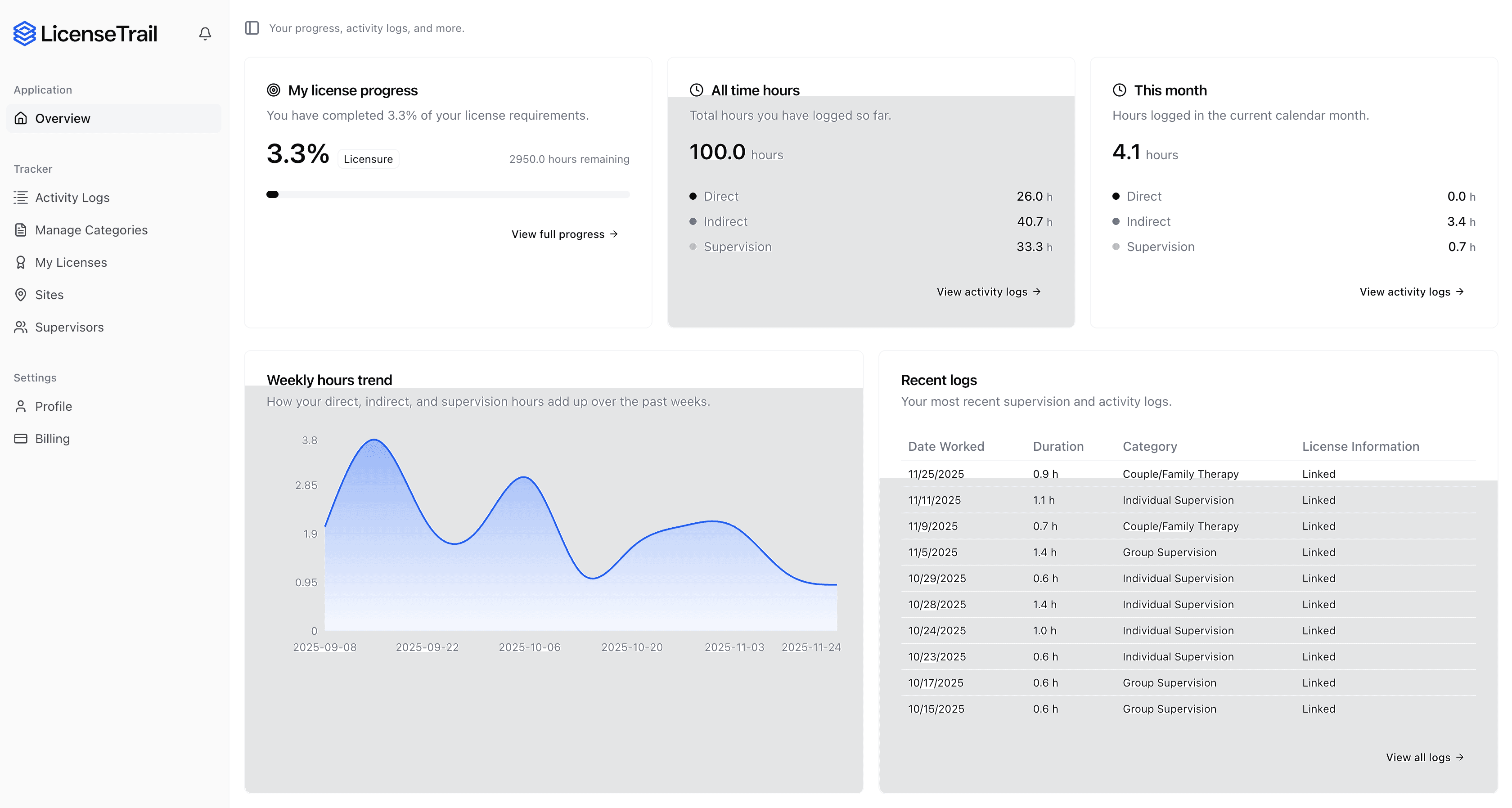
License Trail checks your direct, indirect, and supervision hours against Michigan LMSW-Clinical & Macro requirements continuously and flags mismatches before you submit.
 Start Tracking for Free
No credit card required · Free plan available
Is your spreadsheet hiding Michigan LMSW-Clinical & Macro risks?
Stop guessing if your categories match Michigan Board of Social Work requirements. License Trail checks your direct, indirect, and supervision hours continuously and flags mismatches before you submit.
Import or log
Bring your spreadsheet or start fresh
Upload your existing tracking spreadsheet and we'll map every hour into the right Michigan Board of Social Work categories automatically.
Verify against Michigan
Catch mismatches before the board does
License Trail checks your direct, indirect, and supervision hours against Michigan LMSW-Clinical & Macro requirements continuously.
Export board-ready
One-click clean reports
Generate professional, board-ready reports for supervision meetings and Michigan Board of Social Work submissions in seconds.
No credit card required · Free plan available