
Michigan LLMFT Requirements: Hours, Exams & Step-by-Step Guide
Stop guessing if your categories match Michigan requirements. License Trail checks your direct, indirect, and supervision hours against LLMFT requirements continuously and flags mismatches before you submit.
No credit card required · Free plan available
Quick Requirements Overview
- Education (pre‑LLMFT): Master’s+ from Board‑approved MFT program or related master’s+ with required grad coursework (family studies, MFT methodology, development/psychopathology, ethics/law, research).
- Practicum (pre‑LLMFT): 300 direct client contact hours over ≥8 consecutive months; ≥150 hours with couples/families/subsystems physically present.
- Practicum supervision (pre‑LLMFT): 1:5 supervision-to-contact ratio = ≥60 supervision hours, concurrent with the 300 hours.
- LLMFT application: Submit application/fee + proof of qualifying degree + proof of required supervised clinical (practicum) experience.
- Practice limits as LLMFT: Use LLMFT title only; no independent practice; practice only under LMFT supervision in an organized health care setting/Board‑approved arrangement.
- Post‑degree hours (while LLMFT): 1,000 supervised direct client contact hours; ≥500 with couples/families/subsystems physically present.
- Post‑degree supervision (while LLMFT): 1:5 ratio = ≥200 supervision hours; ≥100 must be individual (remaining may be group per limits).
- Time limit: Limited license not renewable beyond 6 years.
License Details
Procedures
Michigan regulates Marriage and Family Therapists under the Public Health Code and the Board of Marriage and Family Therapy. The state uses one full license (LMFT) and an “Educational Limited” or Limited Licensed Marriage and Family Therapist (LLMFT) status that you hold while you finish your post‑degree hours. (aamft.org)
Becoming an LLMFT in Michigan hinges on two things:
- Completing the degree and practicum requirements in MCL 333.16909(1)(a)–(b). (law.justia.com)
- Applying for a limited license so you can complete the post‑degree supervised experience required in §16909(1)(c). (legislature.mi.gov)
Below is a step‑by‑step breakdown with the specific hour counts and the board’s own terminology.
1. Educational qualification before you can be LLMFT
The Board will only grant a limited license to someone who has already met the education requirement in §16909(1)(a). (legislature.mi.gov)
You must provide “satisfactory evidence” of either:
Option A – MFT training program
- A master’s or higher graduate degree from an accredited training program in marriage and family therapy approved by the Board. (law.justia.com)
Option B – Related degree with specific coursework
-
A master’s or higher graduate degree from an accredited college or university approved by the Board, and the following graduate‑level courses: (law.justia.com)
- Three courses in family studies totaling at least 6 semester or 9 quarter hours.
- Three courses in family therapy methodology totaling at least 6 semester or 9 quarter hours.
- Three courses in human development, personality theory, or psychopathology totaling at least 6 semester or 9 quarter hours.
- At least 2 semester or 3 quarter hours in ethics, law, and standards of professional practice.
- At least 2 semester or 3 quarter hours in research. (law.justia.com)
Programs accredited by COAMFTE generally satisfy these requirements automatically; non‑COAMFTE programs must document equivalence. (mft-license.com)
2. Practicum / clinical experience required before you can hold LLMFT
To be eligible for a limited license, you must also have completed the “supervised clinical marriage and family therapy experience in conjunction with the applicant’s educational program” described in §16909(1)(b). (law.justia.com)
That experience must meet all of the following:
2.1 Setting and timing
- Obtained either:
- In a clinical practicum during graduate education, or
- In a postgraduate marriage and family institute training program acceptable to the Board. (law.justia.com)
- Completed over not less than 8 consecutive months. (law.justia.com)
2.2 Supervisor qualifications
The experience must be verified by a supervisor who has a master’s or higher graduate degree from an approved college or university and who is one of the following: (law.justia.com)
- A marriage and family therapist.
- A certified social worker or social worker registered under Article 16 of the Occupational Code.
- A licensed professional counselor.
- A physician practicing in a mental health setting.
- A fully licensed psychologist.
- An approved supervisor or supervisor‑in‑training through an American Association for Marriage and Family Therapy (AAMFT) program approved by the Board.
2.3 Required practicum hours and supervision
The statute and rules specify very clearly the type and mix of hours: (law.justia.com)
- At least 300 direct client contact hours in supervised clinical marriage and family therapy experience.
- At least one‑half of those 300 hours must be in a setting where “families, couples, or subsystems of families” are physically present in the therapy room.
- Supervision ratio:
- Supervision must be provided at a minimum ratio of 1 hour of supervision for each 5 hours of direct client contact.
- This yields not less than 60 hours of supervision, concurrent with those 300 hours of direct client contact.
In other words, before you can be granted the LLMFT, Michigan expects:
- 300 direct client contact hours,
- ≥150 hours with couples, families, or family subsystems in the room.
- 60 supervision hours,
- Delivered alongside those 300 hours, at a 1:5 supervision‑to‑contact ratio.
These practicum hours are usually completed as part of your graduate program.
3. Applying for the Limited License (LLMFT)
Once you have:
- Met the educational requirement in §16909(1)(a), and
- Completed the supervised clinical MFT experience in §16909(1)(b) (the 300‑hour practicum with 60 hours of supervision),
the Board may grant a limited license so that you can accrue your post‑degree hours. (legislature.mi.gov)
The Public Health Code states that:
“The board may grant a limited license to an individual who has met the requirements of section 16909(a) and (b) in order to permit that individual to obtain the experience required under section 16909(c).” (legislature.mi.gov)
Administrative Rule R 338.7205 further requires that applicants provide, in the form and manner directed by the department: (regulations.justia.com)
- The required fee and completed application;
- Proof of the qualifying degree (meeting §16909(1)(a));
- Proof of the supervised clinical experience that meets §16909(1)(b).
4. What you are allowed (and not allowed) to do as an LLMFT
Section 333.16903(3) governs limited licensees. A person granted a limited license must: (legislature.mi.gov)
- Use only the title “limited licensed marriage and family therapist” or “limited licensed marriage counselor.”
- Not represent that they are engaged in the independent practice of marriage and family therapy.
- Practice only under the supervision of a fully licensed marriage and family therapist.
- Confine practice to an organized health care setting or another arrangement approved by the Board.
Additional structural limits:
- The Board “shall not renew a limited license for more than 6 years.” (legislature.mi.gov)
- According to AAMFT’s summary of state rules, you must hold this Educational Limited License to complete the supervised experience for full licensure. (aamft.org)
5. Post‑degree supervised experience while you hold the LLMFT
Once you are an LLMFT, you begin working toward the post‑degree supervised experience required for a full LMFT license in §16909(1)(c). This is where the bulk of your clinical hours accumulate.
5.1 Total required post‑degree hours
Michigan law requires: (law.justia.com)
- A minimum of 1,000 direct client contact hours in supervised marriage and family therapy experience.
- At least one‑half of those 1,000 hours must involve families, couples, or subsystems of families physically present in the therapy room.
These 1,000 hours:
- Must be verified by the supervising licensed marriage and family therapist.
- Are generally obtained after completing the qualifying degree, or as part of a doctoral MFT program meeting Board standards, and may include certain experience that also counted as part of your doctoral training as specified in the statute. (law.justia.com)
5.2 Supervision requirements for the 1,000 hours
The statute prescribes a specific supervision structure: (law.justia.com)
-
Supervision ratio:
- At least 1 hour of supervision for each 5 hours of experience,
- For a total of not less than 200 hours of supervision concurrent with the 1,000 hours.
-
Type of supervision:
- At least 100 of the 200 supervision hours must be individual supervision (with no more than one other supervisee present).
- The remaining supervision hours may be group supervision with up to six supervisees and one supervisor.
- Supervision must be provided in face‑to‑face contact with the supervisee (the law also now allows some real‑time, secure technology in certain circumstances, but the core requirement remains face‑to‑face contact). (law.justia.com)
In practical terms, during your LLMFT period you must log:
- 1,000 post‑degree direct client contact hours,
- ≥500 hours with couples/families/family subsystems present.
- 200 hours of supervision tied to those 1,000 hours,
- ≥100 hours individual;
- Up to 100 hours group supervision, within the Board’s limits.
These hours must all be “supervised marriage and family therapy experience” and must occur while you are appropriately licensed (LLMFT) and supervised.
6. How the hours add up across the whole pathway
Although your question focuses on the LLMFT, it’s useful to see the entire Board‑mandated training sequence:
-
Before LLMFT (degree + practicum)
- 300 direct client contact practicum hours,
- ≥150 with families/couples/subsystems present.
- 60 supervision hours during practicum. (law.justia.com)
- 300 direct client contact practicum hours,
-
While holding the LLMFT (post‑degree supervised practice)
- 1,000 direct client contact hours of supervised MFT.
- ≥500 with families/couples/subsystems present.
- 200 supervision hours,
- ≥100 individual;
- Remaining group, within Board limits. (law.justia.com)
- 1,000 direct client contact hours of supervised MFT.
Total required by Michigan law for full licensure:
- 1,300 direct client contact hours (300 practicum + 1,000 post‑degree).
- 260 supervision hours (60 practicum + 200 post‑degree). (careersinpsychology.org)
The LLMFT is the legal status that allows you to complete the 1,000 direct client contact hours and 200 hours of supervision required after graduation, under the conditions and titles set by §333.16903.
7. Special note for doctoral graduates
The Board must waive both the practicum and post‑degree experience requirements in §16909(1)(b) and (c) for applicants who can show they obtained a doctoral degree from an accredited doctoral training program in marriage and family therapy approved by the Board. (law.justia.com)
Such applicants may not need to follow the typical LLMFT‑then‑LMFT progression, but should confirm details directly with the Michigan Board of Marriage and Family Therapy, as the Board still controls licensure decisions and application procedures.
Snapshot of hour requirements in Michigan’s own terms
- “Not less than 300 direct client contact hours” in supervised clinical MFT experience during or immediately following graduate study, with at least half involving families/couples/subsystems in the room, and “not less than 60 hours of supervision” at a 1:5 ratio. (law.justia.com)
- A limited license is granted to those who have met §16909(1)(a) and (b) so they can obtain “the experience required under section 16909(c)”, and cannot be renewed for more than six years. (legislature.mi.gov)
- §16909(1)(c) requires “a minimum of 1,000 direct client contact hours in supervised marriage and family therapy experience”, at least half with couples/families/family subsystems present, with supervision of “not less than 200 hours” at a 1:5 ratio, including at least 100 hours of individual supervision. (law.justia.com)
Those are the controlling numbers and phrases the Michigan Board uses for the LLMFT pathway.
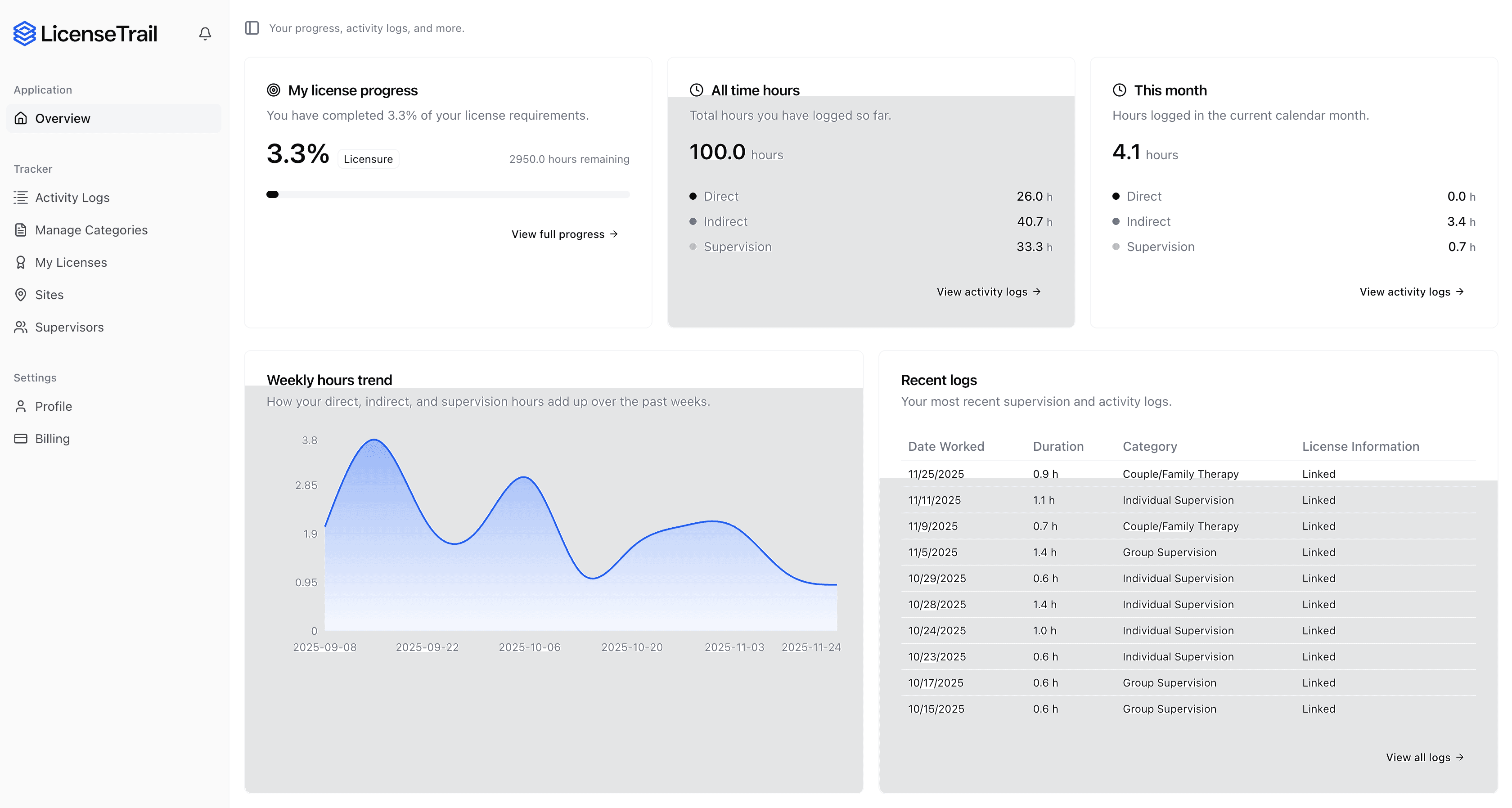
Track your LLMFT hours with confidence
License Trail checks your direct, indirect, and supervision hours against Michigan LLMFT requirements continuously and flags mismatches before you submit.
 Start Tracking for Free
No credit card required · Free plan available
Related Licenses
Is your spreadsheet hiding Michigan LLMFT risks?
Stop guessing if your categories match Michigan Board of Marriage and Family Therapy requirements. License Trail checks your direct, indirect, and supervision hours continuously and flags mismatches before you submit.
Import or log
Bring your spreadsheet or start fresh
Upload your existing tracking spreadsheet and we'll map every hour into the right Michigan Board of Marriage and Family Therapy categories automatically.
Verify against Michigan
Catch mismatches before the board does
License Trail checks your direct, indirect, and supervision hours against Michigan LLMFT requirements continuously.
Export board-ready
One-click clean reports
Generate professional, board-ready reports for supervision meetings and Michigan Board of Marriage and Family Therapy submissions in seconds.
No credit card required · Free plan available